논문 해설
Rate or Fate? RLV$^\varepsilon$R: Reinforcement Learning with Verifiable Noisy Rewards
속도인가 운명인가? RLV$^\varepsilon$R: 검증 가능한 잡음 섞인 보상을 이용한 강화학습
- 연구 문제 검증 잡음이 RLVR 학습을 늦추기만 하는지, 아니면 결과 방향을 뒤집는지를 묻습니다.
- 연구 방법 잘못된 양성과 음성을 가진 이진 보상 아래 GRPO의 나쁜 질량 흐름을 평균장 ODE로 분석하고, 그 부호를 Youden 지수 J=TPR−FPR로 정리합니다.
- 주요 결과 J>0에서는 나쁜 질량이 줄고, J=0에서는 중립이며, J<0에서는 나쁜 질량이 늘어나는 상전이가 Python 코드 생성 실험의 pass@1 결과와 함께 보고됩니다.
검증 노이즈가 RLVR을 늦추는가, 아니면 결과를 뒤집는가
검증 가능한 보상을 쓰는 강화학습(RLVR)은 샘플링한 완성문을 검증하고 정책을 갱신하는 단순한 틀입니다. 그러나 실제 검증기는 단위 테스트가 일부 경우만 확인하거나, 사람과 합성 라벨이 불완전하거나, LLM 판정기가 잡음을 가지기 쉬워 깨끗하지 않습니다. 이 논문은 검증 잡음이 학습 속도(rate)만 늦추는지, 아니면 최종 결과(fate)의 방향까지 바꾸는지를 묻습니다. 이 질문에 답하기 위해 저자들은 잘못된 양성(FP)과 잘못된 음성(FN)을 포함하는 이진 보상 모델을 세우고, 그 순 판별력 J=TPR−FPR이 학습 방향을 결정하는지 분석합니다.
Youden 지수 J가 학습 방향을 가르는 평균장 모델
프롬프트마다 G개의 완성문을 정책에서 샘플링하고, 노이즈가 있는 검증기로 이진 보상을 부여합니다. GRPO는 배치 안의 평균과 표준편차로 보상을 정규화하여 샘플별 이점을 계산합니다. 저자들은 잘못된 추론 모드들이 차지하는 총 확률 질량을 p로 두고, 그 기대 흐름을 평균장 상미분방정식으로 근사합니다. 이 분석에서 정규화된 보상 차이는 J/σ(p)로 정리되고, 나쁜 질량의 변화는 대략 −η·(J/σ(p))·[p(1−p)]^2에 비례하는 항으로 기술됩니다. 여기서 J>0이면 p는 감소하고, J<0이면 p는 증가하며, J=0이면 결정적 드리프트가 사라집니다. 따라서 J의 부호가 학습과 반학습 체제를 나누는 상전이 경계가 됩니다.
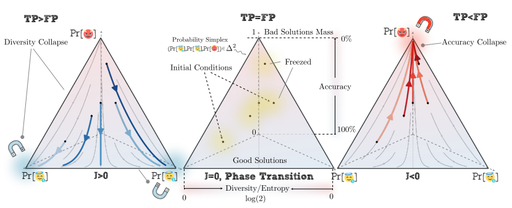
Figure 2 :The Winner Takes It All.The GRPO mean-field dynamics exhibit a striking structural property: in the absence of any symmetry among initial good arm masses, one arm ultimately dominates. When the oracle is in thelearningregime ( J=TPR−FPR> 0), the total bad-arm mass p(t) converges to 0, and among the good arms the algorithm converges to the one with the highest initial probability (see Appendix I for a rigorous theoretical analysis of this phenomenon.). At thecriticalboundary ( J= 0), the probability vector remains fixed throughout training, yielding a continuum of equilibrium points. In theunlearningregime (J< 0), the flow reverses and the bad arm becomes the almost-sure winner. This “winner-take-all” behavior is an inherent feature of the GRPO-style replicator dynamics.
원문 · CC BY 4.0 · Ali Rad, Khashayar Filom, Darioush Keivan, Peyman Mohajerin Esfahani, Ehsan Kamalinejad · Rate or Fate? RLV$^\varepsilon$R: Reinforcement Learning with Verifiable Noisy Rewards · 원문 그림 인용 · 원본 PDF 3쪽에서 그림 영역을 추출했습니다.Python 코드 생성에서의 J 부호 실험
실험은 Qwen2.5-3B를 기반 정책으로 삼아 OpenR1에서 가져온 Python 코드 생성 문제를 학습합니다. 학습 프롬프트는 10,239개, 검증 프롬프트는 594개이며, 각 프롬프트마다 8개 롤아웃을 사용합니다. 합성 노이즈는 참 정답을 TPR과 FPR로 뒤집는 방식으로 주며, J의 여러 값을 격자로 두어 같은 J를 다른 (TPR, FPR) 조합으로 실현합니다. 측정은 검증 세트의 pass@1이고, 결과는 다섯 번의 독립 실행에서 평균과 표준편차로 보고됩니다. 이 실험은 KL 계수를 0으로 두어 순수한 보상 구동 동역학을 분리합니다.
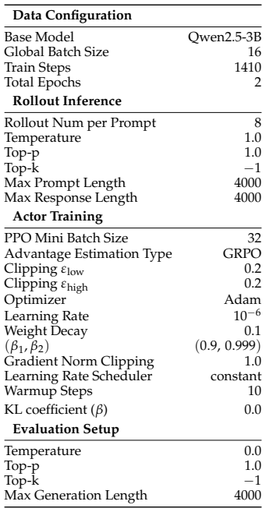
Table 4 : Training configuration.
원문 · CC BY 4.0 · Ali Rad, Khashayar Filom, Darioush Keivan, Peyman Mohajerin Esfahani, Ehsan Kamalinejad · Rate or Fate? RLV$^\varepsilon$R: Reinforcement Learning with Verifiable Noisy Rewards · 원문 그림 인용 · 원본 PDF 60쪽에서 그림 영역을 추출했습니다.J 부호에 따른 결과와 수렴 속도 해석
검증 pass@1 결과는 J 부호에 따른 질적 경계를 보여 줍니다. J=0 조건에서는 13.40%로 기준 대비 +0.6% 개선에 그쳤고, J=−0.1 조건에서는 0.16%로 떨어져 저자들은 이를 반학습의 확인으로 해석합니다. J가 양수인 조건들은 모두 단조로운 개선을 보였으며, J=0.3에서 FPR=0.00, FNR=0.70 구성은 15.98%, FPR=0.70, FNR=0.00 구성은 14.64%로 나타났습니다. 이 차이는 같은 J에서도 잘못된 양성과 잘못된 음성의 구성이 속도에 영향을 줄 수 있음을 시사합니다. 다만 저자들은 J>0 조건들이 같은 최종 기저로 수렴한다는 주장을 1410 단계 안에서 직접 확인했다고 보기보다, 궤적이 그 방향과 일치한다는 수준으로 제시합니다.
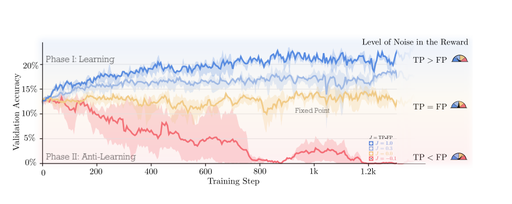
Figure 1 :Phase transition under a sloppy oracle.We vary a single noise knob J, defined as J= 1 −δ FP − δFN =TPR−FPR , which summarizes the net effect of false-positive and false-negative reward corruption induced by a noisy oracle. As J crosses zero, we observe a sharp transition fromPhase I(learning; J> 0, accuracy improves with training and the bad-solution mass p for a prompt converges to 0) toPhase II (unlearning; J< 0, accuracy systematically degrades and p converges to 1), with J= 0 as the critical boundary. Curves reportvalidationperformance during GRPO training on a Python code-generation task (two epochs) starting from Qwen-2.5-3B; solid lines denote the run-averaged E[pass@1] and shaded bands indicate 95% confidence intervals across runs. Although our mean-field ODE characterizes thetraining- timedynamics of p, the same sign-of-J transition is mirrored on held-out validation prompts in this setup, suggesting the drift is not merely a training-set artifact.
원문 · CC BY 4.0 · Ali Rad, Khashayar Filom, Darioush Keivan, Peyman Mohajerin Esfahani, Ehsan Kamalinejad · Rate or Fate? RLV$^\varepsilon$R: Reinforcement Learning with Verifiable Noisy Rewards · 원문 그림 인용 · 원본 PDF 2쪽에서 그림 영역을 추출했습니다.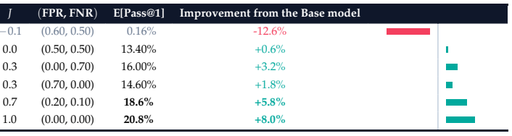
Table 1 :Validation Accuracy & Noise Sensitivity.Validation accuracy after two epochs across noise conditions. Improvement is visualized relative to the Baseline model performance. Bars to the left indicate degradation; bars to the right indicate gain.
원문 · CC BY 4.0 · Ali Rad, Khashayar Filom, Darioush Keivan, Peyman Mohajerin Esfahani, Ehsan Kamalinejad · Rate or Fate? RLV$^\varepsilon$R: Reinforcement Learning with Verifiable Noisy Rewards · 원문 그림 인용 · 원본 PDF 18쪽에서 그림 영역을 추출했습니다.실험 기간과 적용 범위의 한계
저자들은 실험을 1410 단계, 즉 두 에포크로 제한했으므로 점근적 행동에 대해서는 판단을 유보합니다. 실험은 Python 코딩과 Qwen2.5-3B에 한정되며, 수학 추론이나 다른 모델로의 일반화는 이 논문의 결과에서 직접 확인되지 않습니다. 또한 TPR과 FPR이 정책과 검증기가 함께 진화하면서 변할 수 있다는 점은 이론적으로 다루었지만, 공동 진화 동역학의 전체 실험은 향후 과제로 남겨 둡니다. 평균장 분석은 작은 학습률과 고정된 PPO 클리핑 임계값을 가정하므로, 그 밖의 조건에서의 결론은 별도 확인이 필요합니다.
논문 정보
- 저자
- Ali Rad, Khashayar Filom, Darioush Keivan, Peyman Mohajerin Esfahani, Ehsan Kamalinejad
- 학회·저널
- arXiv · 프리프린트
- 최초 공개일
- 2026년 1월 7일
- 등록일
- 2026년 10월 30일
- 수정일
- 2026년 1월 7일
- 버전
- v1
- arXiv
- 2601.04411
- 분류
- cs.LG · cs.AI · cs.CL
- 원문 이용 조건
- CC BY 4.0
- 제공 범위
- 논문 정보, 해설, 허용된 원문 그림
AI 해설은 논문 원문과 별개의 설명이며 오류가 있을 수 있습니다. 원문과 그림은 각 출처의 이용 조건과 따로 표시된 권리를 따릅니다.
초록
Reinforcement learning with verifiable rewards (RLVR) is a simple but powerful paradigm for training LLMs: sample a completion, verify it, and update. In practice, however, the verifier is almost never clean--unit tests probe only limited corner cases; human and synthetic labels are imperfect; and LLM judges (e.g., RLAIF) are noisy and can be exploited--and this problem worsens on harder domains (especially coding) where tests are sparse and increasingly model-generated. We ask a pragmatic question: does the verification noise merely slow down the learning (rate), or can it flip the outcome (fate)? To address this, we develop an analytically tractable multi-armed bandit view of RLVR dynamics, instantiated with GRPO and validated in controlled experiments. Modeling false positives and false negatives and grouping completions into recurring reasoning modes yields a replicator-style (natural-selection) flow on the probability simplex. The dynamics decouples into within-correct-mode competition and a one-dimensional evolution for the mass on incorrect modes, whose drift is determined solely by Youden's index J=TPR-FPR. This yields a sharp phase transition: when J>0, the incorrect mass is driven toward extinction (learning); when J=0, the process is neutral; and when J<0, incorrect modes amplify until they dominate (anti-learning and collapse). In the learning regime J>0, noise primarily rescales convergence time ("rate, not fate"). Experiments on verifiable programming tasks under synthetic noise reproduce the predicted J=0 boundary. Beyond noise, the framework offers a general lens for analyzing RLVR stability, convergence, and algorithmic interventions.
원문 인용
Ali Rad, Khashayar Filom, Darioush Keivan, Peyman Mohajerin Esfahani, Ehsan Kamalinejad (2026). Rate or Fate? RLV$^\varepsilon$R: Reinforcement Learning with Verifiable Noisy Rewards. arXiv:2601.04411v1. https://arxiv.org/abs/2601.04411v1
BibTeX
@misc{rad2026rate,
  title = {{Rate or Fate? RLV$^\varepsilon$R: Reinforcement Learning with Verifiable Noisy Rewards}},
  author = {Ali Rad and Khashayar Filom and Darioush Keivan and Peyman Mohajerin Esfahani and Ehsan Kamalinejad},
  year = {2026},
  eprint = {2601.04411},
  archivePrefix = {arXiv},
  url = {https://arxiv.org/abs/2601.04411v1}
}