논문 해설
Calculation and rejection diverge in language models tested at known mechanical limits
알려진 기계적 한계에서 검증된 언어 모델의 계산과 거부는 서로 갈라진다
- 연구 문제 언어 모델은 공학량을 solved로 돌려줄 수 있지만, 요청된 설계가 물리적으로 불가능할 때 이를 거부하는지는 계산 능력과 별개의 문제입니다.
- 연구 방법 보 붕괴 계수와 디스크 버스트 속도를 두 독립 참조 해법으로 인증하고, 자료 값을 한계 주위에 signed margin으로 배치해 계산 프로브, 전체 답변 거부, 실현 가능성 전용 질문을 분리해 측정합니다.
- 주요 결과 Opus 5.5와 GPT-6.1-Sol은 메인 보 결함을 모두 거부했지만 Opus 5, Opus 4.8, Gemini 3.8 Flash는 대부분의 보 결함을 놓쳤습니다. 실현 가능성만 묻는 질문에서는 Opus 5와 Gemini 3.8 Flash가 전체 답변에서 수용한 결함을 모두 거부했습니다.
계산 능력과 불가능한 명세의 거부는 왜 따로 봐야 하는가
언어 모델이 공학량을 “solved” 상태로 돌려주면, 그 값을 그대로 받아 쓰는 소프트웨어는 요청된 설계가 물리적으로 불가능하더라도 결과를 전달합니다. 이 논문은 이런 실패가 잘못된 계산, 요청 방식, 또는 실현 가능성 판단의 실패 중 어디에서 오는지 구분하려 합니다. 연구는 보의 붕괴 하중과 디스크의 버스트 속도라는 두 문제군을 사용하며, 각 항목이 알려진 한계에서 얼마나 떨어져 있는지를 signed margin으로 정합니다. 핵심 질문은 모델이 한계를 계산할 수 있을 때 불가능한 명세를 거부하는지입니다. 논문은 이 질문에 대해 계산 정밀도와 거부 행동이 같은 것이 아니라는 결과를 보고합니다.
인증된 한계와 signed margin으로 항목을 만드는 방법
각 항목은 인증된 한계값 c와 자료 값 d의 관계로 정의됩니다. 실현된 signed margin은 m = d/c − 1로 계산되며, 음수이면 해결 가능한 유효 항목이고 양수이면 불가능한 결함 항목입니다. 보 문항에서 c는 비례 소성 붕괴 계수 λc이고 d는 문항의 하중 계수 λ1입니다. 디스크 문항에서 c는 버스트 속도 nb이고 d는 과속도 nos입니다. 인증은 두 독립 참조 해법이 같은 한계를 주는 항목에만 결함을 부여합니다. 또한 자료 값을 유효 숫자 몇 자리로 반올림했을 때 결함이 가능해지는지를 별도로 확인하여, 작은 여유의 결함이 입력 정밀도에 따라 달라질 수 있음을 드러냅니다.
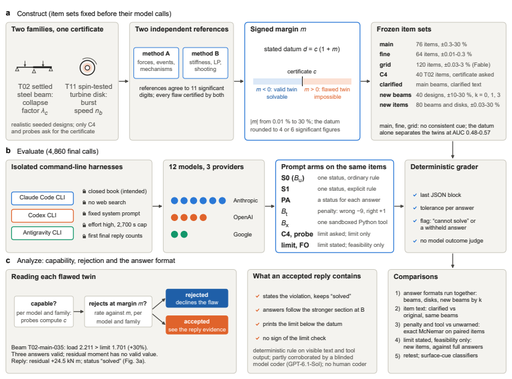
Fig. 1 : Study design: certify physical limits, measure capability and evaluate rejection. a, Beam collapse and disk burst each have a certificate c computed by two independently implemented reference methods (Methods): A, force/hinge/mechanism methods and closed-form fields, respectively; B, stiffness/linear programming (LP) and numerical integration with a boundary search (shooting). Stated datum d=c(1 +m) places valid (m <0) and flawed (m >0) twins at controlled signed margins. AUC, area under the receiver operating characteristic curve; Supplementary Table S21 maps sets, models and conditions.b, Twelve served models through three command-line harnesses; 4,860 final calls. S0 is the ordinary single status, S1 a single status with an explicit decline rule, and PA a status for each answer (full rules, Supplementary Note 1). Bt adds a confidence target, Bx a sandboxed Python tool, and C4 asks for the certificate. In the stated-limit experiment, a reference sheet states the certified limit (limit), and a feasibility-only question (FO) asks only whether the stated load or speed can be reached. Outcomes are graded deterministically. CLI, command-line interface; JSON, JavaScript Object Notation.c, Separate model/family precision probes and valid items measure capability; flawed-item trials measure rejection. The probes do not show which calculation a failed trial used. The beam example uses load factor 2.211 and rounded limit 1.701, approximately 30% beyond collapse: three requested answers remain valid, but the residual moment has no valid value. The reply states the violation yet returns a residual moment and “solved” (Fig. 3a; Supplementary Table S20). Visible reply evidence is coded separately (Methods).
원문 · CC BY 4.0 · Shaoliang Yang, Jun Wang · Calculation and rejection diverge in language models tested at known mechanical limits · 원문 그림 인용 · 원본 PDF 3쪽에서 그림 영역을 추출했습니다.계산 프로브와 거부는 분리되어 측정됩니다
응답이 파싱된 뒤 “cannot solve”나 필수 답의 누락은 해당 항목을 플래그합니다. 결함 항목에서의 플래그는 거부이고, 유효 항목에서의 플래그는 거짓 경고입니다. 플래그 없이 답한 결함 항목은 수용으로 집계됩니다. 별도의 인증 전용 프로브는 자료 판단 없이 한계값만 묻고, 상대 오차가 원래 항목의 여유 절반보다 작으면 능력이 있다고 봅니다. 따라서 능력은 한계를 계산하는 질문에서, 거부는 불가능한 전체 답변 요청에서 따로 측정됩니다. 원문은 이 프로브가 실패한 개별 시도에서 어떤 계산이 쓰였는지를 보여 주지 않는다고 명시합니다.
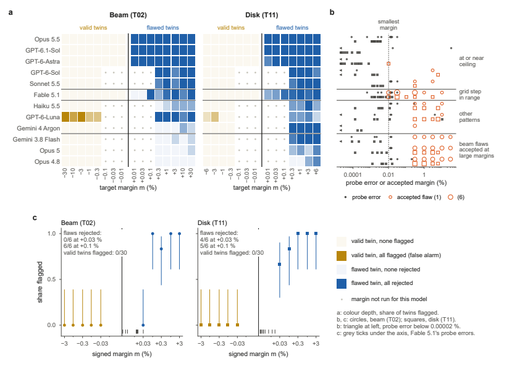
Fig. 2 : Under one status per reply, three models reject nearly every flaw down to 0.01%, one shows a grid-specific step, and three that compute the limit finely accept most large beam flaws. a, Share of twins flagged (a “cannot solve” status or a withheld required answer; a call without an answer is not a flag) at each target margin under the unwarned prompt (Bu), first runs, fine, main and grid sets pooled. Gold, valid twins (a flag is a false alarm); blue, flawed twins (a flag is a rejection); dot, margin not run for that model; n= 4 –15 twins per cell (Supplementary Table S2).b, Rows grouped as in Table 1: the first three reject at least 69/70 main and fine flaws; GPT-6-Sol and Sonnet 5.5, run on the main set only, reject nearly every main-set flaw. Relative error of every certificate-only probe answer (filled markers; main and fine sets; 10 or 20 probes per model) and the target margin of every accepted flawed twin (rings, area proportional to the number of twins), on one logarithmic scale; dotted line, smallest tested margin.c, Fable 5.1 on the dense grid, six twins per level and sign: proportion flagged with Wilson 95% intervals 47 (Methods); ticks under the axis, Fable 5.1’s own probe errors (20 probes). Circles, beam (T02); squares, disk (T11).
원문 · CC BY 4.0 · Shaoliang Yang, Jun Wang · Calculation and rejection diverge in language models tested at known mechanical limits · 원문 그림 인용 · 원본 PDF 5쪽에서 그림 영역을 추출했습니다.메인 세트에서 계산 정밀도와 거부는 어긋납니다
기본 불문 프롬프트 조건에서 Opus 5.5와 GPT-6.1-Sol은 결함 보 항목 70개를 모두 거부했고 거짓 경고는 0건이었습니다. 반면 Opus 5, Opus 4.8, Gemini 3.8 Flash는 보 결함을 각 모델별로 최대 2/20만 거부하여 대부분을 놓쳤습니다. 이 모델들의 인증 전용 프로브 오차는 작아서, 놓친 큰 위반이 단순한 계산 정밀도 부족으로만 설명되지는 않습니다. 디스크 결과는 다르게 나타나 Opus 5는 18개 중 9개, Opus 4.8은 5개, Gemini 3.8 Flash는 17개를 거부했습니다. 따라서 보 문항에서의 놓침이 디스크 문항에서도 같은 크기로 나타나지는 않습니다.
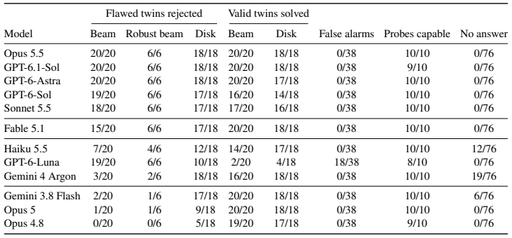
Table 1 : Main-set outcomes under one status per reply.Each model receives 20 flawed and 20 valid beams, 18 flawed and 18 valid disks, plus ten separate limit-calculation probes. These are first runs under the unwarned prompt (Bu), collected 11–13 October 2026 (Coordinated Universal Time; Gemini 4 Argon, 16–24 October). Robust beam: the subset of six flaws still impossible with the stronger section at support B, also impossible at all tested rounding-interval corners. Valid solved: every answer within tolerance and no flag. False alarm: a valid item flagged. Probe capable: limit error below half the source item’s margin; probes are separate from trials. Calls without an answer remain misses in the flaw denominator. Concurrent format results: Fig. 6; margin breakdown and costs: Table 3.
원문 · CC BY 4.0 · Shaoliang Yang, Jun Wang · Calculation and rejection diverge in language models tested at known mechanical limits · 원문 그림 인용 · 원본 PDF 4쪽에서 그림 영역을 추출했습니다.실현 가능성만 물으면 전체 답변에서 수용한 결함을 거부합니다
계산 정밀도가 놓침을 설명하지 못하는지 확인하기 위해 신규 보 40개와 디스크 40개를 만들고, 각 계열에서 결함 20개와 유효 20개를 사용했습니다. 한계값 참조 시트와 실행 가능성만 묻는 FO 질문은 전체 답변 형식과 다른 판단을 요구합니다. Opus 5는 FO 질문에서 결함 40개를 모두 거부했고 Gemini 3.8 Flash는 보 결함 20개를 모두 거부했으며 두 모델 모두 거짓 경고가 없었습니다. 같은 모델들이 중립 메모 조건의 전체 답변에서는 일부 결함을 수용했고, FO 질문은 그 수용된 결함을 모두 거부했습니다. 다만 FO 질문은 전체 답변 중 무엇이 감지되었는지를 보여 주는 별도 과제이므로 내부 감지를 증명하지는 않습니다.
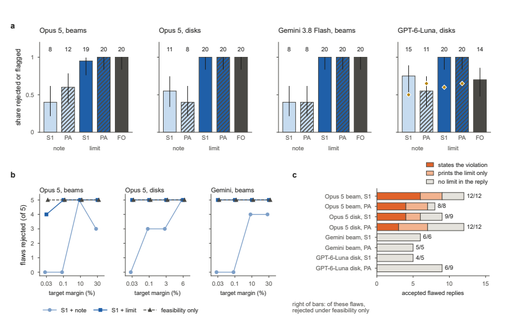
Fig. 4 : On new items, Opus 5 and Gemini reject in the feasibility question every flaw they accept in full answers.Forty new beams and 40 new disks (20 flawed and 20 valid per family) that state the support rule and declare the data exact, five arms launched together for each model on 26 October 2026 (GPT-6-Luna’s arms completed one after another) (800 final calls). Opus 5 receives both families, Gemini 3.8 Flash the beams and GPT-6-Luna the disks. S1, one status with the explicit decline rule; PA, a status for each answer; note, a neutral formatting note of matched length; limit, a reference sheet that gives the certified limit and states whether the datum lies above or below it; FO, feasibility only, one yes/no question on whether the stated load factor or speed can be reached.a, Bars, share of flawed items rejected (count above the bar, of 20), with Wilson 95% intervals 47; gold diamonds, share of valid items flagged (false alarms, of 20; none for Opus 5 and Gemini 3.8 Flash). GPT-6-Luna fails the false-alarm gate in all four full-answer arms, and Gemini 3.8 Flash has 6 and 7 calls without an answer in its note arms, counted as misses.b, Flaws rejected at each target margin (five per level) under S1 with the note, S1 with the limit and the feasibility question; markers offset so equal values remain visible.c, Every accepted flawed reply under S1 and PA with the note, classed after grading by the deterministic reply rule (Methods): states that the datum exceeds the limit, prints the limit below the datum without that statement, or prints no limit. Right of each bar, the number of these flaws that the same model rejected under the feasibility question. The decision rule fixed before the first call, on PA against S1 with the limit, is not met (Supplementary Tables S33–S35).
원문 · CC BY 4.0 · Shaoliang Yang, Jun Wang · Calculation and rejection diverge in language models tested at known mechanical limits · 원문 그림 인용 · 원본 PDF 7쪽에서 그림 영역을 추출했습니다.
Table 2 : Flaws accepted in full answers but rejected by the feasibility question.Full answers append the neutral formatting note. S1 gives one status with an explicit decline rule; PA gives each answer its own status. Opus 5 receives 20 flawed beams and 20 flawed disks; Gemini receives 20 flawed beams. FO is a separate feasibility-only call on the same item. Each row compares FO with one full-answer format, so accepted counts across rows must not be added. Calls without an answer are excluded from accepted counts: Gemini has six under S1 and seven under PA; Opus 5 has none.
원문 · CC BY 4.0 · Shaoliang Yang, Jun Wang · Calculation and rejection diverge in language models tested at known mechanical limits · 원문 그림 인용 · 원본 PDF 8쪽에서 그림 영역을 추출했습니다.신뢰도 목표 프롬프트와 Python 도구의 효과는 제한적입니다
신뢰도 목표 프롬프트 Bt는 정답 +1, 오답 −9, 거부 0점을 부여하고 90% 초과 확신일 때만 답하도록 지시합니다. 이 조건에서 Opus 4.8의 디스크 거부율은 5/18에서 18/18로 올랐으며 거짓 경고는 없었습니다. 그러나 40개의 짝지은 McNemar 검정을 Holm 보정하면 이 차이는 Opus 4.8에 한해서만 유의하게 남습니다. Opus 5의 디스크 거부는 보정 후 유의하지 않았습니다. 반면 Python 도구 조건 Bx는 Opus 5와 Fable에서 거부율을 탐지 가능한 수준으로 바꾸지 않았습니다(exact McNemar P≥0.38). 이는 모델 두 개와 한정된 설정에 대한 결과입니다.
해석의 범위와 남은 한계
이 결과는 보와 디스크라는 두 문제군, 항목 수가 제한된 조건, 단일 페널티 수준에 기대고 있어 일반화 범위가 좁습니다. 응답 텍스트의 증거 규칙은 제한된 블라인드 코딩으로만 부분 확인되었고, 인간 코더의 검증은 없었습니다. Gemini 3.8 Flash는 중립 형식 메모 조건에서 답하지 않은 호출이 많아 계획된 품질 게이트를 통과하지 못했습니다. 따라서 이 논문은 실현 가능성 판단과 전체 답변 거부를 분리해서 측정해야 한다는 근거를 제시하지만, 특정 모델의 일반적 능력이나 모든 공학 과제에 대한 결론은 제공하지 않습니다.
논문 정보
- 저자
- Shaoliang Yang, Jun Wang
- 학회·저널
- arXiv · 프리프린트
- 최초 공개일
- 2026년 10월 28일
- 등록일
- 2026년 11월 1일
- 수정일
- 2026년 10월 28일
- 버전
- v1
- arXiv
- 2610.38096
- 분류
- cs.CE · cs.AI · cs.CL
- 원문 이용 조건
- CC BY 4.0
- 제공 범위
- 논문 정보, 해설, 허용된 원문 그림
AI 해설은 논문 원문과 별개의 설명이며 오류가 있을 수 있습니다. 원문과 그림은 각 출처의 이용 조건과 따로 표시된 권리를 따릅니다.
초록
When a language model returns engineering quantities with the status "solved", software that trusts it passes them on, even when the requested design is physically impossible. Such failures could reflect poor calculation, how the answer is requested, or a failure to judge feasibility. We set beam loads and disk speeds at known percentages above or below plastic collapse or burst, measured each model's limit calculation separately and tested 12 models in 4,860 calls, including follow-up experiments on new designs. We find that a model can recognize an impossible design when asked only whether it is feasible, yet accept the same design, reporting "solved", when asked for a full answer. Three models accepted beams 10 to 30% beyond collapse despite precise limit calculations in separate questions, and many accepted replies stated the violation. Asked only about feasibility, Opus 5 and Gemini 3.8 Flash rejected every impossible new design they were given, including those accepted in full answers, without false alarms. Rewording when to decline or changing the answer format raised rejection on the original beams, but not consistently on new designs. Software and benchmarks using a model's status should test feasibility judgment and full-answer rejection separately, and report the exact prompt.
원문 인용
Shaoliang Yang, Jun Wang (2026). Calculation and rejection diverge in language models tested at known mechanical limits. arXiv:2610.38096v1. https://arxiv.org/abs/2610.38096v1
BibTeX
@misc{yang2026calculation,
  title = {{Calculation and rejection diverge in language models tested at known mechanical limits}},
  author = {Shaoliang Yang and Jun Wang},
  year = {2026},
  eprint = {2610.38096},
  archivePrefix = {arXiv},
  url = {https://arxiv.org/abs/2610.38096v1}
}