논문 해설
Do We Need an LLM to Know Why Sources Conflict? Decision Models for Knowledge-Conflict Typing in RAG
소스가 충돌하는 이유를 알기 위해 LLM이 필요한가? RAG에서 지식 충돌 유형 분류를 위한 결정 모델
- 연구 문제 검색 결과가 엇갈릴 때 충돌의 원인을 빠르고 저렴하게 분류하는 문제를 다룹니다.
- 연구 방법 타입 지정 의사결정 모델에 단일 선택 질문을 주고 확률로 충돌 유형을 예측하며, 신뢰도 기반 cascade와 진단 실험을 함께 검증합니다.
- 주요 결과 의사결정 모델 11개 중 10개가 원 논문 LLM 기준선과 맞먹거나 능가했고, 신뢰도 기반 cascade는 비용을 크게 줄였습니다.
검색 결과의 충돌 유형을 빠르게 분류하는 문제
검색 결과가 서로 엇갈릴 때 적절한 응답은 충돌의 원인에 따라 달라집니다. 질문이 불충분하게 주어져 여러 정답이 가능한 경우, 논쟁적인 주제인 경우, 답이 시간이 지나 바뀌어 오래된 자료가 섞인 경우, 그리고 잘못된 자료가 있는 경우는 각각 다른 대응을 요구합니다. CONFLICTS 벤치마크는 458개의 검색 질의에 전문가가 충돌 유형을 붙인 자료이며, 다섯 범주의 분류 체계를 사용합니다. 원 논문은 충돌 유형을 생성기에 알려 주면 응답이 크게 개선된다고 보고했지만, 유형 예측 자체는 어렵다고 밝혔습니다. 그 원 논문에서 가장 강한 LLM인 Gemini 2.5 Flash의 정확도는 65.3%였습니다. 충돌 유형 분류는 답변을 쓰기 전 질의마다 한 번 실행되므로 빠르고 저렴하며 불확실성이 보정된 분류기가 필요합니다.
이 글은 타입이 지정된 의사결정 모델이 그 역할을 맡을 수 있는지를 다룹니다.
의사결정 모델과 두 가지 질문 형식
타입 지정 의사결정 모델은 질문 유형(선택형, 점수형, 예/아니오형)과 상태를 받아 고정된 답의 확률을 한 번의 순전파로 반환합니다. 텍스트를 생성하지 않으며 보정을 목표로 학습된 모델입니다. 이 연구에서 상태는 질의와 번호가 붙은 검색 결과 집합입니다. 첫 번째 방식인 flat 질문은 다섯 범주를 모두 담은 하나의 선택형 질문입니다. 지시문과 범주 정의, 예시는 원 논문 프롬프트에서 단어 그대로 가져왔습니다. 가장 확률이 높은 범주가 예측 유형이 되고, 그 확률이 신뢰도가 됩니다. 두 번째 방식인 tree는 다섯 개의 예/아니오 질문(차이, 호환, 의견, 오래됨, 잘못된 정보)을 같은 상태에 대해 한 요청으로 묻고, 코드에서 그 확률을 결합합니다.
Tree v1은 taxonomy의 순서를 따라 P(No conflict)=1−d, P(Complementary)=d·c로 두고, 나머지 질량 d(1−c)를 세 원인에 예/아니오 확률 비율대로 나눕니다. 여기서 d는 differ 질문의 확률이고 c는 compatible 질문의 확률입니다. Tree v2는 개발 분할에서 Jev 1.13의 v1 답변을 검토한 뒤 opinion을 compatible보다 먼저 묻도록 순서를 바꾼 결합 방식입니다. 이 순서 수정은 한 모델의 개발 답변에서 얻었으며 모든 모델에 같은 규칙으로 적용되었습니다.
직접 질문의 정확도와 LLM 기준선 비교
CONFLICTS 테스트 분할의 406개 질의에서 11개 의사결정 모델은 flat 질문으로 50.0%에서 67.0% 사이의 정확도를 보였습니다. 같은 질의에서 원 논문 프롬프트로 재실행한 Gemini 2.5 Flash는 61.3%였습니다. 11개 중 10개 모델이 이 값과 맞먹거나 능가했고, Liquid d1 Ultra와 Perplexity Decider v1.2는 유의하게 더 정확했습니다. 반면 ScaleDown Classify-1은 유의하게 낮았습니다. 비용은 의사결정 모델이 1,000개 질의당 $0.04에서 $0.41이었고 두 모델은 무료였으며, Gemini 2.5 Flash는 $1.66이었습니다.
지연은 의사결정 모델이 0.26초에서 0.72초였고 Gemini 2.5 Flash는 1.55초였습니다. 최신 Gemini 3.8 Flash는 낮은 생각 수준에서 70.0%를 기록하여 8개 의사결정 모델보다 유의하게 정확했습니다. 같은 Gemini 2.5 Flash를 458개 전체 질의에 재실행하면 60.7%로, 원 논문이 보고한 65.3%보다 낮았습니다. 따라서 이 글의 비교는 저자들이 같은 입력에서 다시 측정한 결과에 근거하며, 원 논문의 수치는 참고 값으로만 다룹니다.
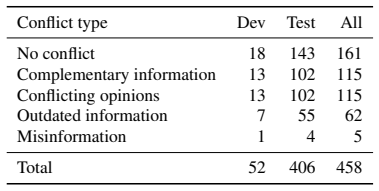
Table 1 : CONFLICTS(Cattan et al., 2025) and our frozen split. The development split (stratified, fixed seed) is used only to choose settings; all reported re- sults are on the test split unless stated.
원문 · CC BY 4.0 · Parv Khatri, Harshul Jain, Mehak Kapoor, Tanya Sah · Do We Need an LLM to Know Why Sources Conflict? Decision Models for Knowledge-Conflict Typing in RAG · 원문 그림 인용 · 원본 PDF 3쪽에서 그림 영역을 추출했습니다.신뢰도 기반 cascade의 효과와 한계
의사결정 모델의 최상위 확률은 자신의 오류를 어느 정도 구분합니다. 이때 AUROC는 0.64에서 0.76 사이였습니다. 이 신뢰도를 이용하면 신뢰도가 가장 낮은 질의 일부만 Gemini 3.8 Flash에 보내는 cascade를 만들 수 있습니다. 임계값은 라벨 없이 신뢰도의 분위수로 정하며, 같은 수의 질의를 무작위로 보내는 기준과 비교합니다. 25%의 질의를 보낸 경우 8개 cascade가 LLM 단독과 통계적으로 동점이었고, 비용은 LLM의 25%에서 37% 수준이었습니다. 대부분 모델에서 신뢰도 기반 선택은 무작위 선택보다 나았지만, GPT-6 Luna Decisions는 AUROC가 0.65로 낮아 25% cascade가 무작위 선택과 같았습니다.
동점은 두 시스템이 동등하다는 증명이 아니며, 406개 질의로는 몇 점의 손실을 배제하기 어렵습니다.
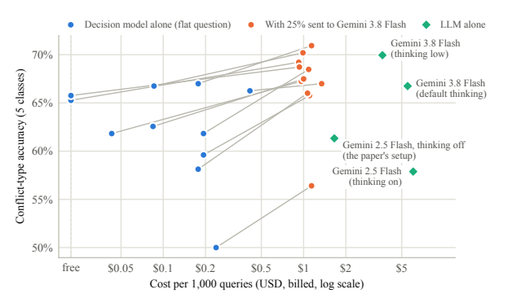
Figure 2 : Accuracy against cost (log scale) on the test split. Each decision model alone with the flat question (blue) is joined to the same model with its least confident 25% of queries sent to Gemini 3.8 Flash (orange). Diamonds: LLMs alone with the paper’s prompt. The two models that were free at the time of the runs are drawn at the “free” tick.
원문 · CC BY 4.0 · Parv Khatri, Harshul Jain, Mehak Kapoor, Tanya Sah · Do We Need an LLM to Know Why Sources Conflict? Decision Models for Knowledge-Conflict Typing in RAG · 원문 그림 인용 · 원본 PDF 7쪽에서 그림 영역을 추출했습니다.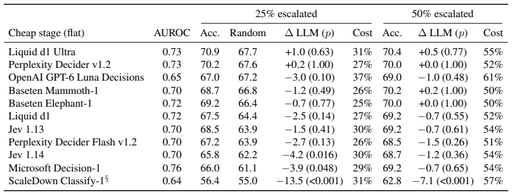
Table 5 : Confidence-gated cascade on the test split: the decision model answers every query and the fraction with the lowest top probability goes to Gemini 3.8 Flash (thinking low; 70.0% alone). AUROC: how well the decision model’s confidence separates its correct from its wrong answers. Random: expected accuracy when the same number of queries is escalated at random.∆LLM: difference from the LLM alone in points (exact McNemarp). Cost: relative to the LLM alone. Thresholds are label-free quantiles, fixed before computing.§Its API accepts only a single text field, so it receives the same content as one text (the LLMs’ numbered results).
원문 · CC BY 4.0 · Parv Khatri, Harshul Jain, Mehak Kapoor, Tanya Sah · Do We Need an LLM to Know Why Sources Conflict? Decision Models for Knowledge-Conflict Typing in RAG · 원문 그림 인용 · 원본 PDF 8쪽에서 그림 영역을 추출했습니다.Tree 분해의 실패와 수정 버전의 제한
예/아니오 질문으로 분해하는 방식은 모든 의사결정 모델에서 flat 질문보다 낮은 정확도를 보였습니다. Tree v1은 11개 모델 모두에서 flat 질문보다 유의하게 낮았습니다. 개발 분할에서 Jev 1.13을 관찰한 결과, compatible 질문이 의견 주제에도 yes에 가까운 확률을 주어 많은 의견 질의가 Complementary로 분류되었습니다. Tree v2는 opinion을 먼저 묻도록 순서를 바꾼 방식입니다. 그러나 이 수정은 Jev 1.13의 개발 답변에서 얻었으므로 다른 모델에 적용했을 때 유의하게 낫지 않았습니다. 7개 모델은 동점이었고 4개 모델은 유의하게 낮았습니다. Jev 1.13 자신에서도 flat 질문과 정확도가 거의 같았습니다.
그래서 이 글의 결론은 질문 형식 분해가 일반적으로 실패한다는 것이 아니라, 이 설정에서 직접 선택형 질문이 가장 안정적이라는 것입니다.
날짜, 검색 결과 순서, 거짓 출처에 대한 진단
저자들은 날짜 정보가 오래된 정보를 찾는 데 쓰이는지 확인했습니다. 날짜를 모두 제거하거나 코드에서 계산한 최신성 순위를 추가해도 정확도는 22개 검정 중 어떤 경우에도 유의하게 변하지 않았습니다. 검색 결과의 순서를 섞으면 예측 유형이 5.4%에서 42.1%의 질의에서 바뀌었으며, 이 변화는 모델마다 달랐습니다. 다만 두 번의 셔플에서 정확도가 유의하게 바뀐 경우는 22번 중 2번이었고, 둘 다 GPT-6 Luna Decisions였습니다. 거짓 출처 진단에서는 No conflict 질의 96개의 검색 결과 하나를 GPT-4.1-mini가 만든 그럴듯한 잘못된 답으로 바꾸었습니다. 의사결정 모델이 이 변형을 Misinformation으로 분류한 비율은 7.3%에서 66.7%였습니다.
하지만 Misinformation 확률은 변형된 복사본과 원래 복사본을 AUROC 0.66에서 0.86으로 구분했습니다. 따라서 거짓 출처는 최상위 답보다 확률 분포에서 더 잘 드러난다고 저자들은 해석합니다.
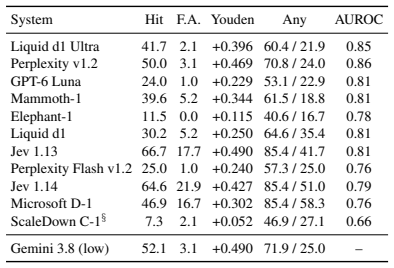
Table 7 : One planted false source in 96No conflict test queries (expected label:Misinformation), flat ques- tion. Hit: planted copy labelled Misinformation (%). F.A.: clean copy of the same query labelled Misin- formation (%). Youden: hit−false alarm. Any: planted / clean copy not labelled No conflict (%). AU- ROC: P(Misinformation) separating planted from clean copies. §Its API accepts only a single text field, so it receives the same content as one text (the LLMs’ num- bered results).
원문 · CC BY 4.0 · Parv Khatri, Harshul Jain, Mehak Kapoor, Tanya Sah · Do We Need an LLM to Know Why Sources Conflict? Decision Models for Knowledge-Conflict Typing in RAG · 원문 그림 인용 · 원본 PDF 9쪽에서 그림 영역을 추출했습니다.예측 유형을 넣은 엔드투엔드 답변 평가
충돌 유형 분류가 실제 답변 품질로 이어지는지를 Gemini 2.5 Flash 생성기로 확인했습니다. 유형 정의와 기대 행동을 생성기에 넣었을 때, 기대 행동을 따른 답변의 비율은 type이 없는 Vanilla 87.9%, Gemini 2.5 Flash가 예측한 Pipeline 91.6%, 정답 유형인 Oracle 95.3%였습니다. 11개 의사결정 모델 중 10개는 Pipeline과 동점이었고 차이는 -3.9점에서 +0.7점이었습니다. 보조 판정자인 Gemini 3.8 Flash를 쓰면 예측 유형의 이득은 사라졌습니다. Pipeline은 89.7%로 Vanilla 91.1%보다 낮았고 유의하지 않았습니다.
따라서 엔드투엔드 이득의 크기는 판정자에 따라 달라집니다. 판정자는 100개 답변으로 검증되었으며 주석자 다수와 92%의 일치를 보였습니다.
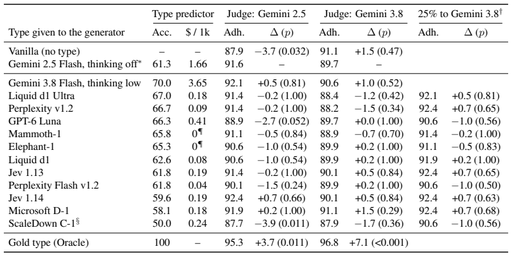
Table 8 : End to end on the test split (n= 406): Gemini 2.5 Flash answers given the type from the first column (the Pipeline of Cattan et al. (2025)). Acc.: type accuracy (%). $ / 1k: classification cost per 1,000 queries. Adh.: answers following the gold type’s expected behaviour (%), per LLM judge.∆: points from the original setup ∗ (exact McNemarp). †Cascade of Table 5, primary judge. §Single text field (Table 2). ¶Billed $0.
원문 · CC BY 4.0 · Parv Khatri, Harshul Jain, Mehak Kapoor, Tanya Sah · Do We Need an LLM to Know Why Sources Conflict? Decision Models for Knowledge-Conflict Typing in RAG · 원문 그림 인용 · 원본 PDF 10쪽에서 그림 영역을 추출했습니다.적용 범위와 한계
이 결과의 근거가 되는 테스트 분할은 406개 질의뿐이므로 약 5점보다 작은 차이는 유의하지 않습니다. Misinformation 테스트 질의는 4개뿐이어서 자연 데이터에서 이 범주를 평가하는 것은 제한적입니다. 그래서 거짓 출처 실험은 구성한 변형 데이터에 근거하며 자연스러운 오정보 전체를 대표하지 않습니다. 또한 측정은 한 게이트웨이가 하나의 날에 제공한 모델에 대해 이루어졌고, 일부 모델은 버전이 고정되지 않았습니다. 같은 입력을 다시 실행해도 의사결정 모델은 최대 9.4%, Gemini 3.8 Flash는 3.4%의 예측이 바뀌었습니다. 모델 크기와 학습 데이터는 공개되지 않아 모델 차이의 원인을 설명할 수 없습니다.
논문 정보
- 저자
- Parv Khatri, Harshul Jain, Mehak Kapoor, Tanya Sah
- 학회·저널
- arXiv · 프리프린트
- 최초 공개일
- 2026년 10월 27일
- 등록일
- 2026년 11월 1일
- 수정일
- 2026년 10월 27일
- 버전
- v1
- arXiv
- 2610.36915
- 분류
- cs.CL · cs.IR
- 원문 이용 조건
- CC BY 4.0
- 제공 범위
- 논문 정보, 해설, 허용된 원문 그림
AI 해설은 논문 원문과 별개의 설명이며 오류가 있을 수 있습니다. 원문과 그림은 각 출처의 이용 조건과 따로 표시된 권리를 따릅니다.
초록
When the sources retrieved for a query disagree, the right response depends on why they disagree: a question with several valid answers, a contested topic, stale information and a false source each call for different behaviour. Cattan et al. (2025) showed that telling a generator the conflict type improves its responses by about 24 points, but that predicting the type is hard even for frontier LLMs. We study whether typed decision models, which return probabilities over fixed options in a single forward pass instead of generating text, can do this classification fast and cheaply. Using the CONFLICTS benchmark and the original paper's prompt verbatim, we evaluate all 11 decision models served by one commercial inference gateway, from 7 providers, against Gemini models on identical inputs. Asked directly, the decision models reach 50.0--67.0% accuracy; 10 of the 11 match or exceed Gemini 2.5 Flash, the paper's model (61.3%), at 4--39x lower billed cost (2 were free) and 2.6--6.0x lower latency. The current Gemini 3.8 Flash (70.0%) is significantly more accurate than 8 of them, but sending each decision model's least confident quarter of queries to it gives a cascade statistically tied with it for 8 of the 11, at 25--37% of its cost. End to end, answers generated with the types of 10 of the 11 follow the expected behaviour as often as with the LLM's types. Decomposing the taxonomy into yes/no questions lowers accuracy for every model, and a repair fitted on one model does not transfer. Pre-specified diagnostics show that dates play no measurable role and that sensitivity to source order varies widely between models. Decision models detect a planted false source less reliably than the LLM as hard labels, but their probabilities still separate planted from clean sources. We release code, prompts and all model outputs at https://github.com/Parv17k/decision-models-conflict-typing.
원문 인용
Parv Khatri, Harshul Jain, Mehak Kapoor, Tanya Sah (2026). Do We Need an LLM to Know Why Sources Conflict? Decision Models for Knowledge-Conflict Typing in RAG. arXiv:2610.36915v1. https://arxiv.org/abs/2610.36915v1
BibTeX
@misc{khatri2026need,
  title = {{Do We Need an LLM to Know Why Sources Conflict? Decision Models for Knowledge-Conflict Typing in RAG}},
  author = {Parv Khatri and Harshul Jain and Mehak Kapoor and Tanya Sah},
  year = {2026},
  eprint = {2610.36915},
  archivePrefix = {arXiv},
  url = {https://arxiv.org/abs/2610.36915v1}
}