논문 해설
What a Weight Update Buys: Leverage Across Training Stages
가중치 업데이트가 가져오는 효과: 학습 단계별 레버리지
- 연구 문제 pre-training과 post-training이 가중치를 움직이는 양은 크게 다르지만, 그 움직임이 출력 분포를 얼마나 바꾸는지를 같은 척도로 비교하는 방법이 필요합니다.
- 연구 방법 업데이트 방향의 Fisher 이차형식을 같은 앵커에서 같은 크기의 무작위 방향 곡률 평균으로 나눈 레버리지를 정확한 forward-mode 계산으로 측정합니다.
- 주요 결과 공개 체크포인트의 레버리지는 pre-training 윈도우에서 약 1, SFT에서 약 5, DPO에서 수백에서 수만 범위로 나타나며, 통제된 학습에서는 상대 변위가 커질수록 레버리지가 줄어듭니다.
연구 문제: 가중치 변화가 행동을 얼마나 바꾸는가
pre-training과 post-training은 모두 모델의 가중치를 움직이지만, 그 움직임이 출력 분포에 주는 영향은 크게 다릅니다. 논문은 Post-training이 가중치 노름의 약 천분의 일만 움직이면서도 행동을 급격히 바꾸는 반면, pre-training은 노름의 약 3분의 1을 움직이며 느리게 표류한다고 보고합니다. 이 차이를 같은 척도로 비교하려면 가중치 변화 한 단위가 출력 분포를 얼마나 움직이는지 측정해야 합니다. 논문은 이 양을 레버리지 ρ로 정의합니다. 레버리지는 업데이트 방향의 Fisher 이차형식을, 같은 앵커에서 같은 크기를 가진 무작위 방향의 값으로 나눈 비율입니다. 따라서 ρ가 1이면 무작위 방향과 같은 수준이고, 값이 클수록 같은 크기의 무작위 변화보다 출력 분포가 더 많이 움직입니다.
레버리지의 정확한 계산과 기준선
앵커 θ0에서 방향 Δ를 따라 움직이면 각 토큰 위치의 다음 토큰 분포 변화는 KL의 이차 전개로 표현됩니다. 이때 이차항의 계수는 Δ의 Fisher 이차형식 Δ⊤FΔ에 비례하며, 로짓의 방향 미분인 Jacobian–vector product로 한 번에 계산됩니다. 논문은 이 값을 float32의 forward-mode 자동미분으로 모든 위치에서 구하고, 곡률 c(Δ)를 토큰 평균 제곱 상대 변위 rel∆W² 단위로 정의합니다. 유한차분 방법은 작은 섭동에서 부동소수점 한계에 부딪히지만, 정확한 형식은 가중치를 섭동하지 않으므로 이 한계가 없습니다.
레버리지는 ρ=c(Δ)/c(null)이며, 분모는 같은 앵커에서 뽑은 null 방향들의 평균 곡률입니다. 기본 기준선은 모든 좌표가 독립 동일분포 가우시안인 isotropic null이며, 논문은 이 경우 곡률이 평균 Fisher 고윳값으로 수렴한다고 설명합니다. profile null은 각 텐서의 노름을 델타와 맞추고, sign-flip null은 델타의 크기는 두고 부호만 무작위화합니다. sign-flip 곡률은 대각 Fisher 부분의 합으로 기대되므로, 이 둘의 비 ρsign은 교차 좌표 구조가 기여하는 몫을 나타냅니다.
공개 체크포인트의 레버리지 스펙트럼
논문은 Olmo-3-7B의 pre-training 윈도우, SFT, RL-Zero, RLVR, DPO 델타와 Tülu-3, Zephyr, OLMo-2-1B의 델타를 앵커에서 정확한 형식으로 측정합니다. mixed corpus에서 isotropic null 기준으로 보고된 값은 다음과 같습니다. pre-training 윈도우는 0.78과 0.95이고, SFT는 5.4–5.7, RL-Zero와 RLVR 방향은 388–1,508입니다. DPO는 Olmo-3에서 3,304–6,165, Tülu-3에서 22,570, Zephyr에서 378로 보고됩니다. 이 값들은 네 자릿수에 걸친 범위를 보여 주며, 단계마다 가중치 변화에 대한 출력 민감도가 다르다는 주장의 근거가 됩니다.
다만 이 수치는 공개 체크포인트의 앵커에서 측정한 결과이며, 여러 단계의 델타를 같은 조건의 통제 실험으로 비교한 것은 아닙니다.
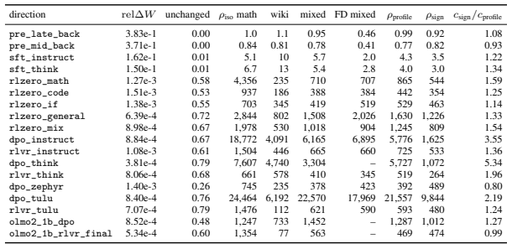
Table 2 :Every released direction, exact form.Columns as in Table 1, one row per direction. Leverage against isotropic nulls on the three corpora, and against profile and sign-flip nulls on the mixed corpus (6 isotropic draws per anchor and 3 profile and 3 sign-flip draws per direction; 24, 12, and 12 at the Think anchors; 8, 2, and 2 for the OLMo-2-1B rows); “unchanged” is the fraction of coordinates bit-identical to the anchor (bf16 storage). “FD mixed” is the earlier finite-difference read at the certified common scale (Appendix B); dpo_think has no common certified scale there and the OLMo-2-1B deltas were not in that campaign.
원문 · CC BY 4.0 · Shikhar Shiromani · What a Weight Update Buys: Leverage Across Training Stages · 원문 그림 인용 · 원본 PDF 13쪽에서 그림 영역을 추출했습니다.학습 궤적에서 레버리지가 줄어드는 현상
통제 실험은 Qwen2.5-0.5B 기반 모델에 UltraFeedback으로 SFT와 DPO를 적용하며, fp32 마스터 가중치와 표준 손실을 사용합니다. 학습률은 5×10⁻⁷, 5×10⁻⁶, 5×10⁻⁵이고 600 step 동안 50 step마다 체크포인트를 측정합니다. 이 설정에서 SFT의 레버리지는 상대 변위 rel∆W가 커질수록 rel∆W의 −1.29, −1.38, −0.99 승으로 떨어지고, DPO는 −0.36, −0.70, −0.83 승으로 떨어집니다. 이는 레버리지가 궤적을 따라 소진된다는 관찰입니다.
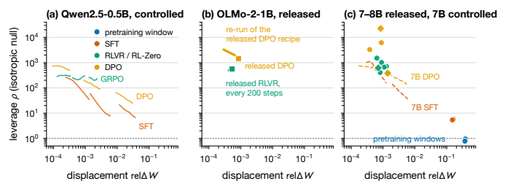
Figure 1 : Leverage against displacement, measured exactly, for three model families. Leverage ρ (isotropic null; mixed corpus) against relative displacement, on the same axes in every panel; colors give the stage. (a) Controlled SFT, DPO, and GRPO runs on Qwen2.5-0.5B with fp32 master weights, three learning rates each, one seed per curve (repeats: Table 5). (b) OLMo-2-1B: the released DPO delta (square), the released RLVR checkpoints every 200 steps (line; its square is the released final), and the released DPO recipe re-run from the released SFT checkpoint (thick line), ending on the released delta. (c) Released Olmo-3-7B (circles), Tülu-3-8B, and Zephyr-7B (diamonds) deltas, and controlled SFT and DPO on Qwen2.5-7B (dashed, two learning rates).
원문 · CC BY 4.0 · Shikhar Shiromani · What a Weight Update Buys: Leverage Across Training Stages · 원문 그림 인용 · 원본 PDF 2쪽에서 그림 영역을 추출했습니다.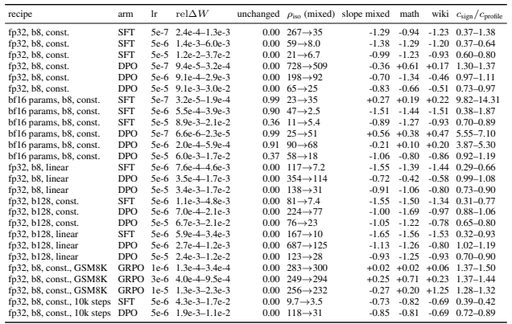
Table 3 : Every controlled run on Qwen2.5-0.5B (UltraFeedback, 600 steps for batch 8 and 300 for batch 128, seed 0; the GRPO rows train on GSM8K for 150 steps and the last two rows for 10,000 steps). “unchanged” is the fraction of coordinates bit-identical to the base at the last checkpoint (seed 0; the other seeds of the 5 × 10⁻⁵ pure-bf16 runs reach 0.46). Slopes are ordinary least squares of log c on log rel∆W over all checkpoints of a run (12; 6 for GRPO, 40 for the 10,000-step runs); the last column ranges over those with nulls (6; 3 and 10).
원문 · CC BY 4.0 · Shikhar Shiromani · What a Weight Update Buys: Leverage Across Training Stages · 원문 그림 인용 · 원본 PDF 14쪽에서 그림 영역을 추출했습니다.같은 실험에서 GRPO는 GSM8K에서 150 step 동안 학습되었고 레버리지가 감소하지 않았습니다. 논문은 released OLMo-2 손실을 단독으로 쓴 실행도 평탄하거나 증가한다고 보고합니다. 이 결과들은 학습 방법과 손실에 따라 궤적의 기울기가 달라짐을 보여 주지만, 짧은 GRPO 실행과 세 시드 설정에 한정됩니다.
bf16 파라미터 학습이 측정을 왜곡하는 방식
fp32 마스터 사본 없이 bf16 파라미터를 직접 갱신하면, Adam의 한 단계 크기가 학습률 정도인 갱신이 반올림에서 사라집니다. 논문은 |θ|가 256η에서 512η 이상인 좌표는 학습률 η에서 움직이지 않으며, Qwen2.5-0.5B에서 η=5×10⁻⁷일 때 좌표의 99%, η=5×10⁻⁶일 때 90–91%, η=5×10⁻⁵일 때 36–46%가 이 조건에 해당한다고 보고합니다. 같은 레시피를 fp32 마스터 가중치로 실행하면 낮은 두 학습률에서 변위가 1.5–14배 큽니다.
같은 변위에서 bf16 델타의 레버리지는 1.8–7.3배 낮게 읽힙니다. 낮은 학습률의 bf16 실행은 레버리지가 감소하지 않고 증가하며, 크기 정렬(magnitude alignment)은 5–14로 올라갑니다. 논문은 이를 소수의 작은 크기 좌표만 움직이기 때문이라고 설명합니다. 따라서 bf16 통제 실험은 released와 통제 실험 사이의 차이를 과장하고 정렬을 왜곡합니다. 이 결과는 Qwen2.5-0.5B의 bf16 파라미터 설정에 관한 것이며, 모든 mixed precision 설정을 대표하지 않습니다.
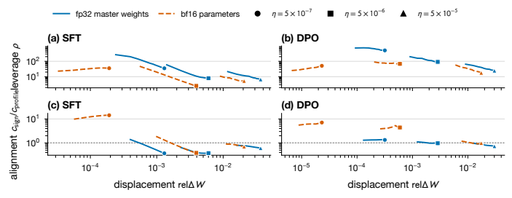
Figure 4 :bf16 parameters without a master copy distort the update.Qwen2.5-0.5B, SFT and DPO at learning rates 5×10 −7, 5×10 −6, and 5×10 −5 (end markers), 600 steps, identical data and seed. Blue solid: fp32 master weights. Red dashed: bf16 parameters.(a, b)Leverage and(c, d) magnitude alignment (dotted at 1) against displacement. One seed per curve; at 5×10 −6 three seeds differ by at most 8% (Table 5).
원문 · CC BY 4.0 · Shikhar Shiromani · What a Weight Update Buys: Leverage Across Training Stages · 원문 그림 인용 · 원본 PDF 6쪽에서 그림 영역을 추출했습니다.released 레시피 재실행과 구성요소 제거
논문은 released OLMo-2-1B DPO 레시피를 OLMo-2-0425-1B-SFT 앵커에서 fp32 마스터 가중치로 두 번 재실행합니다. 두 재실행은 상대 변위 8.594와 8.547×10⁻⁴에서 끝나며, released 델타는 8.520×10⁻⁴입니다. ρiso는 재실행에서 1,447과 1,504, released 델타에서 1,452로 보고됩니다. 따라서 released 델타의 레버리지는 재실행들의 범위 안에 있습니다. 한편 plain 레시피는 같은 앵커에서 released보다 5–6배 낮은 값을 보입니다.
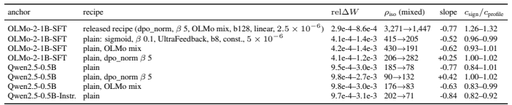
Table 4 :Runs of the reproduction trainer.The released OLMo-2-1B recipe and single-knob variants of a plain DPO recipe at three anchors; leverage at the first and last checkpoint, slope of logc on log rel∆W, and the range of the magnitude alignment over checkpoints with nulls. One seed each; Table 5 gives the repeats.
원문 · CC BY 4.0 · Shikhar Shiromani · What a Weight Update Buys: Leverage Across Training Stages · 원문 그림 인용 · 원본 PDF 15쪽에서 그림 영역을 추출했습니다.이 간격을 설명하기 위해 논문은 released 레시피에서 손실, 데이터, 문맥 길이를 하나씩 뺀 세 가지 변형을 배치 128, 학습률 2.5×10⁻⁶, 2,955 step 스케줄 아래에서 600 step 동안 학습합니다. 길이 정규화 손실을 제거하면 released 레벨의 약 5.5–7.3배 아래로 떨어지고, 데이터를 제거하면 약 1.8배, 문맥 길이를 제거하면 거의 차이가 없습니다. 논문은 길이 정규화 손실과 배치 128이 함께 레벨을 결정하고 데이터는 약 2배의 요인이라고 해석합니다. 이 결론은 OLMo-2-1B 앵커와 세 시드 조건에 기반합니다.

Table 6 :Leave-one-out at the released settings, OLMo-2-1B SFT anchor, three data-order seeds per arm: leverage at two matched displacements (seed mean and range) against the released re-run (mean of two seeds, interpolated), the slope of logc on log rel∆W over the six checkpoints (mean ± s.d.), and the range over seeds of the last checkpoint’s magnitude alignment and ρsign. One seed of the minus-loss arm met a gradient spike at step 558 (gradient norm 727 against a median of 32 and no other step above 163; the recipe does not clip). Its step-600 checkpoint then carries 93% of its form in 1% of positions. We exclude that checkpoint; its median-based read, 228, continues the arm’s decline. The 5×10 −4 cell of that arm therefore averages the two seeds whose clean trajectories reach it. The upper end of itsρ sign range (524) is the spiking seed’s step-400 checkpoint, its last with nulls.
원문 · CC BY 4.0 · Shikhar Shiromani · What a Weight Update Buys: Leverage Across Training Stages · 원문 그림 인용 · 원본 PDF 16쪽에서 그림 영역을 추출했습니다.DARE 손상 예측의 적용 범위
DARE는 델타의 각 좌표를 확률 p로 유지하고 남은 값을 1/p로 재조정하는 병합 방법입니다. 논문은 마스크 m에 대한 기대 이차형식이 ∆⊤F∆ + ((1−p)/p) Σi Fii ∆i²로 주어진다고 보이며, 두 번째 항이 sign-flip null의 형식과 같다고 설명합니다. 따라서 델타의 상대 손상은 대략 (1−p)/(p ρsign)으로 예측됩니다. 이 예측은 DARE가 작동하는 델타에서 측정과 약 2배 이내로 일치합니다.
여섯 개의 released 델타를 p=0.5, 0.1, 0.01에서 평가하면 예측값이 약 0.5 아래인 구간에서 측정 비율이 예측과 2.1배 이내로 맞습니다. 예를 들어 OLMo-2-1B RLVR(ρsign=474)은 세 p에서 델타 자체 KL의 0.2%, 2.0%, 22%를 잃는데 예측은 0.2%, 1.9%, 21%입니다. 예측값이 약 1을 넘으면 손상은 이차 근사를 벗어나 DARE가 실패한다고 논문은 설명합니다. 이 판단은 측정 비율과 이차 예측을 비교한 범위에 한정되며, 모든 병합 상황에 대한 일반 증명은 아닙니다.
pre-training 윈도우의 무작위 수준 수렴과 잡음 모델
stage-1 체크포인트에서 800단계 이상의 폭을 가진 Olmo-3 pre-training 윈도우는 30k 단계 이후 산문 텍스트에서 ρiso=0.6–1.5 범위에 머무릅니다. 즉 pre-training의 긴 윈도우는 같은 크기의 무작위 방향과 비슷한 곡률을 가집니다. 반면 좁은 윈도우는 산문에서도 훨씬 높은 레버리지를 보이며, 폭이 커질수록 감소합니다. 논문은 이 현상을 Fisher 근처에서 SGD의 정상 상태 공분산 FΣ+ΣF=(η/B)F로 설명하는 잡음 있는 이차 모델로 해석합니다. 이 모델에서 Σ=(η/2B)I이므로 정상 상태 요동은 가중치 공간에서 등방적이며, 모든 모드가 평형에 도달하면 ρ=1이 됩니다. 이 설명에는 Fisher와 학습률이 고정되어 있다는 가정이 있으며, 논문은 수천 단계 이상에서 이 가정이 깨진다고 밝힙니다.
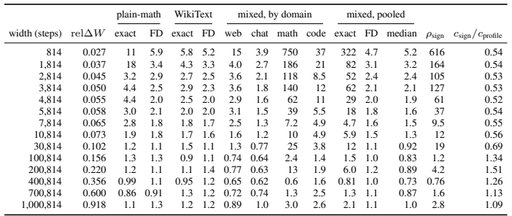
Table 10 :Olmo-3-7B stage-1 windows, exact form against finite differences.Backward windows anchored at stage1-step1413814; isotropic leverage by the exact form and by the earlier finite- difference read (FD) on the two small corpora, per domain and pooled on the mixed corpus (mean and median), and the exact sign-flip read and magnitude alignment on the mixed corpus.
원문 · CC BY 4.0 · Shikhar Shiromani · What a Weight Update Buys: Leverage Across Training Stages · 원문 그림 인용 · 원본 PDF 19쪽에서 그림 영역을 추출했습니다.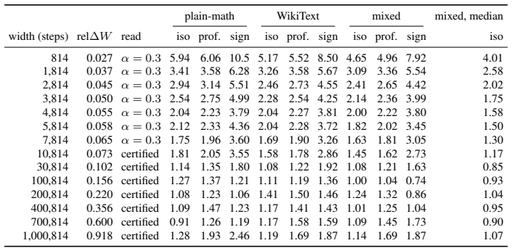
Table 11 :Olmo-3-7B backward windows at the last stage-1 checkpoint, every width from 814 to 1,000,814 steps, leverage by finite differences against the three per-delta nulls on the three corpora. “read”: both sides atα= 0.3(narrow windows) or at the certified common scale.
원문 · CC BY 4.0 · Shikhar Shiromani · What a Weight Update Buys: Leverage Across Training Stages · 원문 그림 인용 · 원본 PDF 20쪽에서 그림 영역을 추출했습니다.
Table 14 :The noisy quadratic modelfor power-law spectra λk =k −a: leverage at one unit of ηw, its w→0 limit (the inverse participation ratio), its value at ηw= 10 5, and the fitted exponents of ρ and∥∆∥in width.
원문 · CC BY 4.0 · Shikhar Shiromani · What a Weight Update Buys: Leverage Across Training Stages · 원문 그림 인용 · 원본 PDF 22쪽에서 그림 영역을 추출했습니다.범위와 한계
논문이 밝힌 제약은 실험 규모와 반복 수에 있습니다. 주요 제어 실험은 0.5B와 1B 모델에서 두세 개 시드로 수행되고, 7B 실험은 각 설정당 하나의 시드로 수행됩니다. GRPO 실험은 150 step으로 짧게 수행되었습니다. released 델타는 bf16으로 저장되어 좌표의 일부가 앵커와 같게 남으며, 따라서 크기 정렬 값은 fp32 학습 값의 상한으로 읽어야 한다고 논문은 명시합니다. 또한 외삽 검증은 유한차분 판독과 소수의 채점 가능한 델타에 기대고 있어 결론의 강도가 제한적입니다. 논문은 시드 간 변동이 주요 효과보다 작다고 보고하지만, 이 판단 역시 같은 실험 설정 안에서의 것입니다.
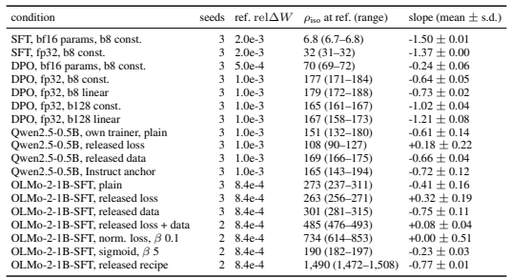
Table 5 :Seed repeats.Leverage at a reference displacement (mixed corpus; mean and range over seeds) and the slope of logc on log rel∆W (mean ± s.d.), for every controlled comparison in the body. Seeds change the data order; the released-recipe re-run uses data-order seeds 111 and 222. The pure-bf16 DPO run at 5×10 −6 stops at rel∆W= 5.9×10 −4, so its reference displacement is 5×10 −4.
원문 · CC BY 4.0 · Shikhar Shiromani · What a Weight Update Buys: Leverage Across Training Stages · 원문 그림 인용 · 원본 PDF 15쪽에서 그림 영역을 추출했습니다.
Table 8 :The 0.5B recipe at 7B.SFT and DPO on Qwen2.5-7B with fp32 master weights, batch 8, constant learning rate, 600 steps, one seed each: displacement range, leverage at three displacements where the run covers them, slope of logc on log rel∆W, the range of the magnitude alignment over checkpoints with nulls, and the fraction of coordinates unchanged at the last checkpoint (unused vocabulary rows).
원문 · CC BY 4.0 · Shikhar Shiromani · What a Weight Update Buys: Leverage Across Training Stages · 원문 그림 인용 · 원본 PDF 16쪽에서 그림 영역을 추출했습니다.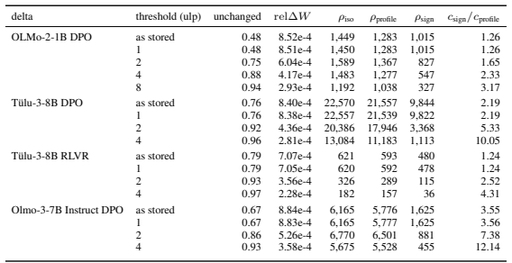
Table 9 :Truncation ladder.Four released deltas as stored and with every coordinate below t bf16 units in the last place of the anchor value zeroed; each row is a full measurement with 6 isotropic, 3 profile, and 3 sign-flip draws on the mixed corpus; Table 2 uses 8, 2, and 2 draws for the OLMo-2-1B delta, so its values differ from the as-stored row here in the third digit.
원문 · CC BY 4.0 · Shikhar Shiromani · What a Weight Update Buys: Leverage Across Training Stages · 원문 그림 인용 · 원본 PDF 17쪽에서 그림 영역을 추출했습니다.논문 정보
- 저자
- Shikhar Shiromani
- 학회·저널
- arXiv · 프리프린트
- 최초 공개일
- 2026년 10월 27일
- 등록일
- 2026년 11월 1일
- 수정일
- 2026년 10월 27일
- 버전
- v1
- arXiv
- 2610.37719
- 분류
- cs.LG · cs.CL
- 원문 이용 조건
- CC BY 4.0
- 제공 범위
- 논문 정보, 해설, 허용된 원문 그림
AI 해설은 논문 원문과 별개의 설명이며 오류가 있을 수 있습니다. 원문과 그림은 각 출처의 이용 조건과 따로 표시된 권리를 따릅니다.
초록
Post-training moves a language model's weights by about a thousandth of their norm and changes its behavior sharply; pretraining moves them by a third and buys a slow drift. We introduce leverage, an exact measure of what a unit of weight change buys: the Fisher quadratic form of an update, computed with one forward-mode pass per direction, divided by the same form for random directions of the same size at the same checkpoint. Leverage orders released Olmo-3, Tülu-3, Zephyr, and OLMo-2 checkpoints over four orders of magnitude: pretraining windows sit at the random level on prose, SFT five times above it, RL-Zero and RLVR at 400-1,500, and DPO at 400-23,000. With this instrument we find that pretraining accumulates into noise: windows of 30k to 1M steps are no more consequential on prose than random directions of their size, as a noisy quadratic model of SGD predicts. We find that training precision changes what an update looks like: training bf16 parameters without an fp32 master copy freezes 36-99% of coordinates, lowers leverage up to sevenfold, and creates an alignment between update magnitudes and the diagonal Fisher that fp32 training does not show. We derive and verify a law for reuse: the sign-flip null predicts the relative damage of random drop-and-rescale (DARE) at keep rate $p$ as $(1-p)/(p\,ρ_{\mathrm{sign}})$, within a factor of two of measurement wherever DARE succeeds. Two controls make these readings reliable: every controlled SFT and DPO trajectory with fp32 master weights loses leverage as it moves, and two re-runs of a released DPO stage from its anchor with its published recipe land within 1% of the released displacement and 4% of its leverage, where a plain recipe reads five to six times lower; leaving one component out traces the level to the length-normalized loss and its batch size of 128 together.
원문 인용
Shikhar Shiromani (2026). What a Weight Update Buys: Leverage Across Training Stages. arXiv:2610.37719v1. https://arxiv.org/abs/2610.37719v1
BibTeX
@misc{shiromani2026what,
  title = {{What a Weight Update Buys: Leverage Across Training Stages}},
  author = {Shikhar Shiromani},
  year = {2026},
  eprint = {2610.37719},
  archivePrefix = {arXiv},
  url = {https://arxiv.org/abs/2610.37719v1}
}