논문 해설
M4Bench: Evaluating Procedural Specification for Clinical EHR Derivation Agents
M4Bench: 임상 EHR 도출 에이전트를 위한 절차적 명세 평가
- 연구 문제 임상 EHR 파생변수는 스키마 밖의 항목 코드, 시간 창, 결측 규칙, 출력 단위에 따라 정의되므로 코딩 에이전트의 재현 능력을 평가할 기준이 필요합니다.
- 연구 방법 28개 과제를 가진 M4Bench에서 과제 지시문과 DB만 준 NO-SKILL 조건과 임상가 검토 스킬을 추가한 WITH-SKILL 조건을 비교하고, 열별 일치율 reward로 채점합니다.
- 주요 결과 Codex에서 스킬은 과제 균형 reward를 0.136 높였고 26/28 과제가 개선되었지만, 엄격 통과와 key F1의 개선은 제한적이었습니다. 8개 과제 통제 실험에서는 명세 완전성이 대부분의 효과를 설명하는 것으로 보고됩니다.
임상 EHR 파생변수 재현 문제
임상 연구에서 쓰이는 SOFA, APS-III, KDIGO, MELD 같은 파생변수는 스키마에 단순한 열로 존재하지 않으며, 항목 식별자, 단위, 시간 창, 결측 규칙, 출력 단위 선택에 따라 정의가 달라집니다. 이 차이는 코호트 구성과 하위 결론을 바꿀 수 있습니다. 이 논문은 코딩 에이전트가 이러한 선언된 파생 절차를 재현할 수 있는지, 그리고 임상가가 검토한 절차형 스킬이 그 결과를 어떻게 바꾸는지를 평가 문제로 다룹니다. 평가 대상은 자유 텍스트 임상 질문에 대한 답이 아니라 선언된 참조 구현과의 열별 일치입니다.
스킬 조건과 열별 평가 방식
M4Bench는 과제마다 참조 대상을 제거한 DuckDB 복제본을 에이전트에 제공합니다. NO-SKILL 조건은 과제 지시문과 데이터베이스 접근만 제공하며, WITH-SKILL 조건은 같은 입력에 과제별 마크다운 절차형 스킬을 추가합니다. 스킬은 임상 규칙, 항목 식별자, 시간 창, 출력 단위를 요약하며 숨겨진 참조 출력이나 완성된 해답 코드는 포함하지 않는다고 기술됩니다. 에이전트가 쓴 output.csv는 참조 출력과 키 기준으로 결합되며, reward는 scored 값 열들의 일치율을 평균한 값입니다. 누락, 추가, 중복 키는 각 열의 분모에 포함됩니다. key F1은 행 단위 일치를, strict pass는 모든 검사를 통과했는지를 나타내므로 reward와 구분해서 읽어야 합니다.
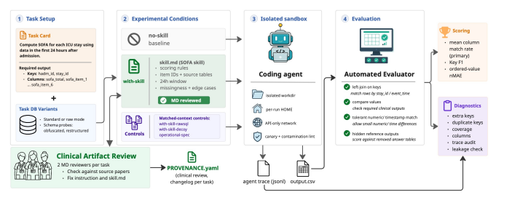
Figure 1 : M4Bench evaluation pipeline. Each task pairs a task card with a DuckDB clone whose reference targets are removed. The primaryNO-SKILL–WITH-SKILLcomparison and matched controls test specification completeness, reference-code structure, and schema familiarity under sandboxed execution and contamination auditing.
원문 · CC BY 4.0 · Hannes Ill, Rafi Al Attrach, Rajna Fani, Ahram Han, Ryohei Yamamoto, Marlene Louisa Moerig, Dukyong Yoon, Leo Anthony Celi · M4Bench: Evaluating Procedural Specification for Clinical EHR Derivation Agents · 원문 그림 인용 · 원본 PDF 2쪽에서 그림 영역을 추출했습니다.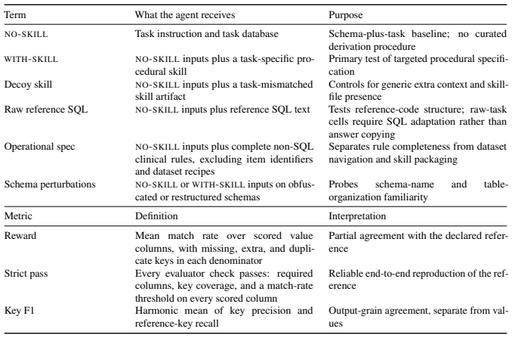
Table 1 : Glossary of benchmark conditions, controls, and metrics.
원문 · CC BY 4.0 · Hannes Ill, Rafi Al Attrach, Rajna Fani, Ahram Han, Ryohei Yamamoto, Marlene Louisa Moerig, Dukyong Yoon, Leo Anthony Celi · M4Bench: Evaluating Procedural Specification for Clinical EHR Derivation Agents · 원문 그림 인용 · 원본 PDF 5쪽에서 그림 영역을 추출했습니다.Codex 실험의 주요 결과와 진단 지표
Codex 캠페인에서 targeted skill은 28개 native 과제 전체에서 과제 균형 reward를 NO-SKILL의 0.703에서 WITH-SKILL의 0.839로 0.136 높였고, 26/28 과제가 개선되었습니다. 모델별로는 GPT 5.4 Mini가 0.162, GPT 5.5가 0.109 높아졌습니다. 같은 비교에서 과제 균형 key F1은 0.962에서 0.965로 0.003만 변했고 5/28 과제에서만 개선되었습니다. 엄격 통과는 전체 760회 중 87회이며, 주요 비교에서는 NO-SKILL 13/280, WITH-SKILL 25/280입니다. 따라서 이 결과는 행 단위 grain의 큰 개선보다는 키가 맞는 행의 숫자 값 일치 개선에 가깝습니다.
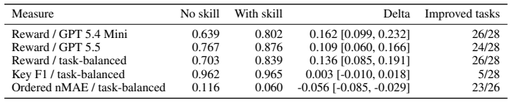
Table 3 : Native-schema Codex skill effect and diagnostics. Reward is mean value-column match rate; key F1 measures row grain; ordered nMAE is lower-is-better. Intervals are 95% task-bootstrap intervals.
원문 · CC BY 4.0 · Hannes Ill, Rafi Al Attrach, Rajna Fani, Ahram Han, Ryohei Yamamoto, Marlene Louisa Moerig, Dukyong Yoon, Leo Anthony Celi · M4Bench: Evaluating Procedural Specification for Clinical EHR Derivation Agents · 원문 그림 인용 · 원본 PDF 8쪽에서 그림 영역을 추출했습니다.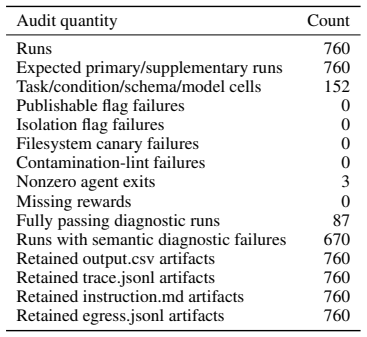
Table 15 : Primary Codex campaign integrity checks after replacing matching May 2 runs with the May 4 clinician-review reruns. Publishability means the run is eligible for analysis. It does not mean the submitted derivation is clinically correct.
원문 · CC BY 4.0 · Hannes Ill, Rafi Al Attrach, Rajna Fani, Ahram Han, Ryohei Yamamoto, Marlene Louisa Moerig, Dukyong Yoon, Leo Anthony Celi · M4Bench: Evaluating Procedural Specification for Clinical EHR Derivation Agents · 원문 그림 인용 · 원본 PDF 21쪽에서 그림 영역을 추출했습니다.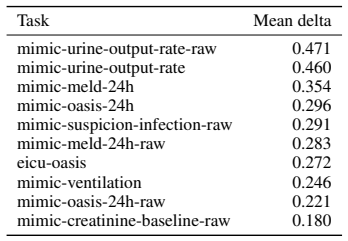
Table 16 : Largest native-schema skill gains after averaging task-level deltas across the Codex models.
원문 · CC BY 4.0 · Hannes Ill, Rafi Al Attrach, Rajna Fani, Ahram Han, Ryohei Yamamoto, Marlene Louisa Moerig, Dukyong Yoon, Leo Anthony Celi · M4Bench: Evaluating Procedural Specification for Clinical EHR Derivation Agents · 원문 그림 인용 · 원본 PDF 21쪽에서 그림 영역을 추출했습니다.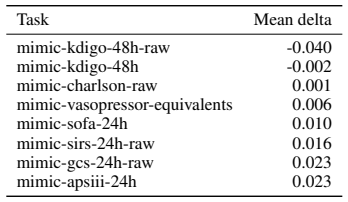
Table 17 : Largest negative or flat native-schema skill effects after averaging task-level deltas across the Codex models.
원문 · CC BY 4.0 · Hannes Ill, Rafi Al Attrach, Rajna Fani, Ahram Han, Ryohei Yamamoto, Marlene Louisa Moerig, Dukyong Yoon, Leo Anthony Celi · M4Bench: Evaluating Procedural Specification for Clinical EHR Derivation Agents · 원문 그림 인용 · 원본 PDF 21쪽에서 그림 영역을 추출했습니다.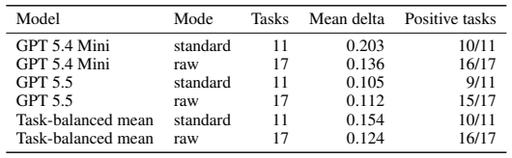
Table 18 : Native-schema Codex skill effect split by task mode. Values are task-paired deltas. Final rows average the two Codex models within task before aggregating.
원문 · CC BY 4.0 · Hannes Ill, Rafi Al Attrach, Rajna Fani, Ahram Han, Ryohei Yamamoto, Marlene Louisa Moerig, Dukyong Yoon, Leo Anthony Celi · M4Bench: Evaluating Procedural Specification for Clinical EHR Derivation Agents · 원문 그림 인용 · 원본 PDF 22쪽에서 그림 영역을 추출했습니다.
Table 19 : Cluster sensitivity for the primary native-schema Codex skill effect. Task rows are the paper headline. Family rows resample or balance the 15 task families to check sensitivity to standard/raw sibling tasks.
원문 · CC BY 4.0 · Hannes Ill, Rafi Al Attrach, Rajna Fani, Ahram Han, Ryohei Yamamoto, Marlene Louisa Moerig, Dukyong Yoon, Leo Anthony Celi · M4Bench: Evaluating Procedural Specification for Clinical EHR Derivation Agents · 원문 그림 인용 · 원본 PDF 23쪽에서 그림 영역을 추출했습니다.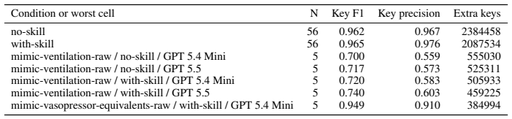
Table 20 : Native-schema key diagnostics for Codex. The first two rows summarize native no-skill and with-skill cells. Subsequent rows show high-extra-key cells. N counts cells in the first two rows and runs in the others. Key F1 and key precision are means.
원문 · CC BY 4.0 · Hannes Ill, Rafi Al Attrach, Rajna Fani, Ahram Han, Ryohei Yamamoto, Marlene Louisa Moerig, Dukyong Yoon, Leo Anthony Celi · M4Bench: Evaluating Procedural Specification for Clinical EHR Derivation Agents · 원문 그림 인용 · 원본 PDF 23쪽에서 그림 영역을 추출했습니다.명세 완전성과 대조 통제 실험
통제 실험은 스킬 효과가 명세 완전성, 일반적 추가 문맥, 참조 구현 구조 중 어디에서 오는지 나눠 봅니다. 8개 과제 부분집합에서 항목 식별자와 데이터셋 레시피를 뺀 operational spec만 제공하면 reward가 0.606에서 0.767로 0.162 올랐고, 여기에 targeted skill을 더하면 0.767에서 0.792로 0.024만 추가로 올랐습니다. 이 0.024의 구간은 0을 포함합니다. 10개 과제 부분집합에서 과제와 맞지 않는 decoy skill은 NO-SKILL과 같은 수준(0.554 대 0.553)이었고, raw reference SQL은 targeted skill에 가까운 0.837을 기록했습니다.
두 통제 부분집합은 목록을 실행 전에 고정했지만 대형 효과 과제를 많이 포함하므로, 이 결과는 전체 28개 과제의 평균과 구분해 읽어야 합니다.
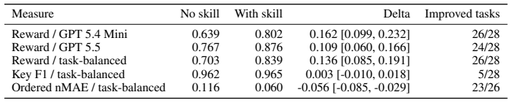
Table 4 : Codex operational-spec follow-up on the eight-task control subset. Values are task-balanced after averaging the two Codex models within each task.
원문 · CC BY 4.0 · Hannes Ill, Rafi Al Attrach, Rajna Fani, Ahram Han, Ryohei Yamamoto, Marlene Louisa Moerig, Dukyong Yoon, Leo Anthony Celi · M4Bench: Evaluating Procedural Specification for Clinical EHR Derivation Agents · 원문 그림 인용 · 원본 PDF 8쪽에서 그림 영역을 추출했습니다.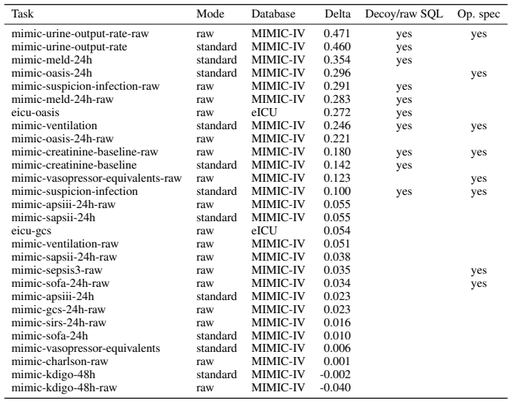
Table 13 : Control-subset membership and final Codex targeted-skill delta (task-balanced over both models) for all 28 tasks. Each task’s family follows from its name, and families are listed in Table 2.
원문 · CC BY 4.0 · Hannes Ill, Rafi Al Attrach, Rajna Fani, Ahram Han, Ryohei Yamamoto, Marlene Louisa Moerig, Dukyong Yoon, Leo Anthony Celi · M4Bench: Evaluating Procedural Specification for Clinical EHR Derivation Agents · 원문 그림 인용 · 원본 PDF 20쪽에서 그림 영역을 추출했습니다.스키마 교란 실험
스키마 교란 실험은 원래 데이터 값을 유지한 채 스키마 이름이나 테이블 구성을 바꿉니다. GPT 5.4 Mini의 26개 MIMIC 과제 후속 실험에서, native 스키마의 스킬 효과 0.157에 대해 난독화 스키마는 0.135, 재구성 스키마는 0.110이었고, 이는 각각 native 효과의 0.862와 0.704 비율입니다. 원문은 이 비율을 기술적 강건성 점검으로 해석하며, 값 수준 기억이나 기억 없는 추론을 증명하지 않는다고 밝힙니다. 이 실험은 스키마 친숙성을 탐색하는 장치로만 읽어야 합니다.

Table 23 : Codex schema-skill generalization follow-up for GPT 5.4 Mini over 26 MIMIC tasks. Transformed rows match May 6WITH-SKILLruns to the earlier transformed-schemaNO-SKILL probe.
원문 · CC BY 4.0 · Hannes Ill, Rafi Al Attrach, Rajna Fani, Ahram Han, Ryohei Yamamoto, Marlene Louisa Moerig, Dukyong Yoon, Leo Anthony Celi · M4Bench: Evaluating Procedural Specification for Clinical EHR Derivation Agents · 원문 그림 인용 · 원본 PDF 24쪽에서 그림 영역을 추출했습니다.Claude Code 설명적 복제
Claude Code 복제는 Opus 4.7과 Sonnet 4.6을 28개 native 과제 전체에서 실행했습니다. 과제 균형 reward는 NO-SKILL 0.747에서 WITH-SKILL 0.867로 0.120 올랐고, 21/28 과제가 양의 차이를 보였습니다. Opus 차이는 +0.083, Sonnet 차이는 +0.156입니다. 다만 CLI 버전과 라우팅 프로필이 조건 사이에서 균일하지 않아, 원문은 이 결과를 교차 제공자 설명적 검증으로 한정합니다. 기록된 CLI 버전과 라우팅 프로필이 맞는 19개 과제에서도 차이는 +0.119였지만, 이것이 harness 차이의 영향이 없었다는 증거는 아닙니다.
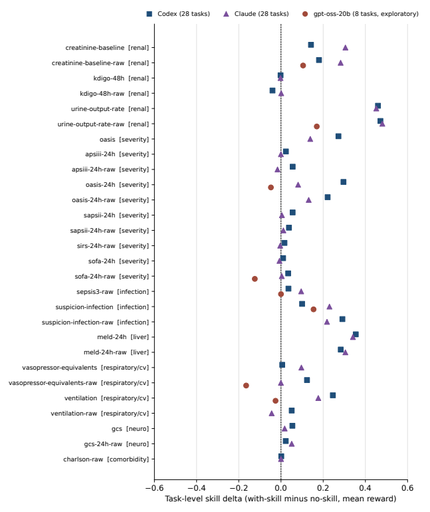
Figure 2 : Per-task native-schema skill delta (with-skill minus no-skill mean reward) for the primary Codex campaign and the full-coverage Claude replication on all 28 tasks, and for the exploratory gpt-oss-20barm on the eight tasks it covers.
원문 · CC BY 4.0 · Hannes Ill, Rafi Al Attrach, Rajna Fani, Ahram Han, Ryohei Yamamoto, Marlene Louisa Moerig, Dukyong Yoon, Leo Anthony Celi · M4Bench: Evaluating Procedural Specification for Clinical EHR Derivation Agents · 원문 그림 인용 · 원본 PDF 22쪽에서 그림 영역을 추출했습니다.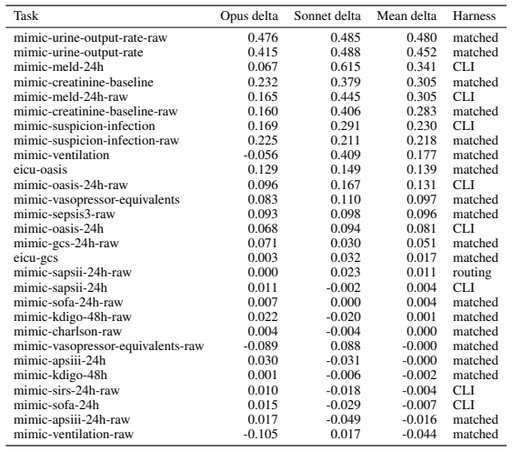
Table 31 : Full-coverage Claude replication per-task skill deltas. “Harness” marks tasks whose NO-SKILLandWITH-SKILLcells match in recorded CLI version and routing profile, or the indicator that differs.
원문 · CC BY 4.0 · Hannes Ill, Rafi Al Attrach, Rajna Fani, Ahram Han, Ryohei Yamamoto, Marlene Louisa Moerig, Dukyong Yoon, Leo Anthony Celi · M4Bench: Evaluating Procedural Specification for Clinical EHR Derivation Agents · 원문 그림 인용 · 원본 PDF 26쪽에서 그림 영역을 추출했습니다.해석 범위와 한계
M4Bench의 참조 출력은 공개 MIT-LCP 및 eICU 관례에서 나온 참조 구현이며, 임상적으로 검증된 금표준이 아닙니다. 임상가 검토는 저자 팀 내부의 검토이며 외부 검증이 아닙니다. 평가 데이터는 MIMIC-IV 중심(26개 과제)이고 eICU 과제는 2개이므로 데이터셋 또는 병원 일반성을 입증하지 않습니다. 또한 대부분의 실패는 키가 맞는 행의 값 오류이며, reward는 엔드투엔드 정답성과 같지 않습니다. 따라서 이 벤치마크는 선언된 참조와의 일치 정도를 측정하며, 임상적 정확성이나 실제 배치 적합성을 보장하지 않습니다.
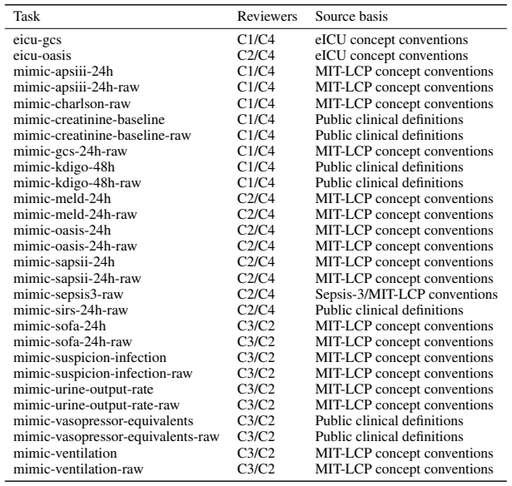
Table 7 : Task-level clinical review provenance. Each task is reviewed by two clinicians, identified as C1–C4, and every review covered the task definition, schema, and output. Reviewer identifiers are described in Table 8.
원문 · CC BY 4.0 · Hannes Ill, Rafi Al Attrach, Rajna Fani, Ahram Han, Ryohei Yamamoto, Marlene Louisa Moerig, Dukyong Yoon, Leo Anthony Celi · M4Bench: Evaluating Procedural Specification for Clinical EHR Derivation Agents · 원문 그림 인용 · 원본 PDF 16쪽에서 그림 영역을 추출했습니다.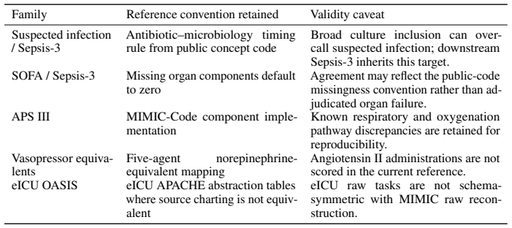
Table 9 : Reference-validity audit for selected task families. These caveats describe the declared benchmark target, not new exclusions from scoring.
원문 · CC BY 4.0 · Hannes Ill, Rafi Al Attrach, Rajna Fani, Ahram Han, Ryohei Yamamoto, Marlene Louisa Moerig, Dukyong Yoon, Leo Anthony Celi · M4Bench: Evaluating Procedural Specification for Clinical EHR Derivation Agents · 원문 그림 인용 · 원본 PDF 17쪽에서 그림 영역을 추출했습니다.논문 정보
- 저자
- Hannes Ill, Rafi Al Attrach, Rajna Fani, Ahram Han, Ryohei Yamamoto, Marlene Louisa Moerig, Dukyong Yoon, Leo Anthony Celi
- 학회·저널
- arXiv · 프리프린트
- 최초 공개일
- 2026년 10월 27일
- 등록일
- 2026년 11월 1일
- 수정일
- 2026년 10월 27일
- 버전
- v1
- arXiv
- 2610.37459
- 분류
- cs.AI
- 원문 이용 조건
- CC BY 4.0
- 제공 범위
- 논문 정보, 해설, 허용된 원문 그림
AI 해설은 논문 원문과 별개의 설명이며 오류가 있을 수 있습니다. 원문과 그림은 각 출처의 이용 조건과 따로 표시된 권리를 따릅니다.
초록
Clinical research over electronic health records depends on derived variables whose definitions sit outside the schema, in item codes, time windows, missingness rules, and output-grain choices that change cohorts and downstream conclusions. We introduce M4Bench, 28 clinical derivation tasks across 15 task families on MIMIC-IV and eICU, to test whether AI coding agents can reproduce such derivations and how clinician-reviewed agent skills change their results. Its controls decompose the value of skills into specification completeness, delivery format, and schema familiarity. In a Docker-isolated Codex campaign (GPT 5.4 Mini and GPT 5.5), skills raise reward by 0.136 over the no-skill baseline, with 26 of 28 tasks improving. Specification completeness accounts for most of this gain: on an eight-task control subset, an operational spec alone raises reward by 0.162, and skills add only 0.024 on top, indistinguishable from zero. On a ten-task subset, decoy skills score like no skill and raw reference SQL nearly matches targeted skills, arguing against generic context or the skill format as the explanation. Schema obfuscation and restructuring preserve 86% and 70% of the skill gain (GPT 5.4 Mini, 26 MIMIC-IV tasks), a descriptive robustness check rather than a bound on memorization. A descriptive Claude Code replication on all 28 tasks (Opus 4.7 and Sonnet 4.6, 560 runs) is directionally consistent (+0.120, 21 of 28 tasks improving). These gains are partial agreement with the reference, not completed tasks: only 25 of 280 with-skill and 13 of 280 no-skill Codex runs pass every strict check, and skills barely change which rows agents return (key F1 +0.003). Skills are released as a versioned, clinician-reviewable markdown delivery format, with a family-level reference-validity audit. M4Bench releases tasks, skills, evaluation code, and sanitized per-run evidence as an open-source benchmark.
원문 인용
Hannes Ill, Rafi Al Attrach, Rajna Fani, Ahram Han, Ryohei Yamamoto, Marlene Louisa Moerig, Dukyong Yoon, Leo Anthony Celi (2026). M4Bench: Evaluating Procedural Specification for Clinical EHR Derivation Agents. arXiv:2610.37459v1. https://arxiv.org/abs/2610.37459v1
BibTeX
@misc{ill2026m4bench,
  title = {{M4Bench: Evaluating Procedural Specification for Clinical EHR Derivation Agents}},
  author = {Hannes Ill and Rafi Al Attrach and Rajna Fani and Ahram Han and Ryohei Yamamoto and Marlene Louisa Moerig and Dukyong Yoon and Leo Anthony Celi},
  year = {2026},
  eprint = {2610.37459},
  archivePrefix = {arXiv},
  url = {https://arxiv.org/abs/2610.37459v1}
}