논문 해설
LLM knowledge for improved Out-of-Distribution Tabular Prediction - A Cross-Validated Regularisation Approach
분포 외 표형 데이터 예측 성능 향상을 위한 LLM 지식: 교차 검증 기반 정규화 접근법
- 연구 문제 예측 모델은 배포 집단이 학습 집단과 다를 때 성능이 떨어질 수 있으며, 이 논문은 LLM이 제시한 계수 사전분포를 축소 목표로 쓰면 OOD 예측이 나아지는지 검증합니다.
- 연구 방법 LLM에서 얻은 계수 샘플로 사전분포의 평균과 정밀도를 만들고, 능형 회귀의 0 방향 축소를 그 평균 방향 축소로 바꿉니다. λ와 변형 선택은 소스 교차검증으로만 정합니다.
- 주요 결과 다섯 데이터셋 중 네 데이터셋에서 OOD 개선이 나타나며, Boston Housing에서 Correlated-Prior는 평균 OOD MSE를 7.85% 줄입니다. 다만 단일 배포 구간은 넓고 대부분 0을 포함합니다.
배포 집단이 바뀔 때 예측이 무너지는 문제
예측 모델은 학습 데이터와 배포 대상이 같은 분포에서 왔다는 가정 위에서 성능을 보장받습니다. 그러나 병원, 지역, 인구 집단이 바뀌면 같은 모델의 성능이 떨어질 수 있습니다. 이 논문은 이 문제를 도메인 이동(domain shift)으로 다루며, 특히 학습 표본만으로는 어떤 특징-반응 관계가 새 집단에서도 유지되는지 알 수 없다는 점을 출발점으로 삼습니다. 앙상블은 예측 불확실성을 보여 주지만 예측을 개선하지는 않습니다. 따라서 학습 데이터 밖의 지식을 넣는 방법이 필요하며, 전문가 유도(expert elicitation)는 느리고 확장하기 어렵습니다. 이 연구는 LLM이 제시한 계수 사전분포를 능형 회귀의 축소 목표로 쓸 수 있는지 묻습니다.
계수 평균을 축소 목표로 바꾸는 사전분포 회귀
기존 능형 회귀는 모든 계수를 0 방향으로 끌어당기는 0 평균 등방 가우시안 사전분포의 MAP 추정으로 읽을 수 있습니다. 이 논문은 목표를 µ, 정밀도 구조를 P, 전체 규모를 λ로 나눈 일반 형태를 씁니다. 목적함수는 음의 로그우도 L(β; Dn)에 (1/2)λ(β−µ)ᵀP(β−µ)를 더한 값을 최소화하는 형태이며, µ는 축소 목표이고 P는 축소 구조입니다. P를 항등행렬로 두면 점 믿음만 쓰고, 대각 정밀도를 두면 계수별 신뢰도를 쓰고, 완전 공분산 역행렬을 두면 계수 간 의존성까지 씁니다. LLM에서는 M=50개의 계수 샘플을 얻어 평균, 분산, 공분산을 계산하며, 분산이 0이면 역행렬이 발산하므로 작은 ε와 jitter를 더합니다.
λ는 소스 데이터의 5-fold 교차검증으로 고르고, 사전분포의 형태만 LLM에서 가져옵니다.
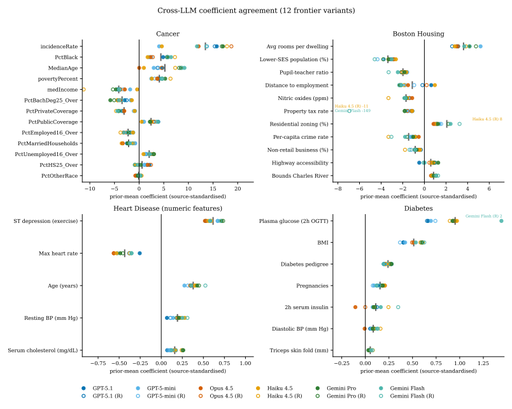
Figure 4 : Cross-variant coefficient agreement on the four datasets where priors help. Each panel shows the prior-mean coefficient for all twelve variants per feature in source-standardised space. Filled circles: non-reasoning. Open circles: reasoning. Grey tick: across-variant mean. Heart Disease shows numeric features only. Off-panel points are annotated at the boundary.
원문 · CC BY 4.0 · Sølve Langseth, Kristoffer Herland Hellton, Hugo L. Hammer · LLM knowledge for improved Out-of-Distribution Tabular Prediction - A Cross-Validated Regularisation Approach · 원문 그림 인용 · 원본 PDF 21쪽에서 그림 영역을 추출했습니다.소스 전용 선택과 OOD 평가 구조
이 연구의 핵심 설계는 OOD 분할에서 나온 어떤 양도 적합, 튜닝, 선택 단계에 들어가지 않는다는 점입니다. 데이터는 도메인을 정의하는 실제 공변량으로 나누고, 결측 대체와 표준화 통계는 소스 학습 풀에서만 계산합니다. 소스 학습 풀에서 5-fold 교차검증으로 λ를 고르고, 각 가족에서 평균 CV 점수가 가장 좋은 LLM 변형을 배포합니다. 선택된 모델은 전체 학습 풀에서 다시 적합되고 ID 테스트 집합과 OOD 집합에서 평가됩니다. 리프트는 능형 회귀 기준선 대비 OOD MSE 감소율이며, 분류에서는 AUC, log loss, Brier score를 임계값 무관 지표로 씁니다. 신뢰구간과 예측구간은 소스 분할, λ 재선택, 타깃 표본 부트스트랩을 함께 반영하며, 두 구간의 의미는 다릅니다.
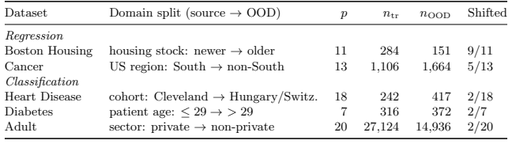
Table 2 : Datasets, domain splits and resulting partitions. “Shifted” counts features with |Cohen’sd|>0.5 between source and OOD.
원문 · CC BY 4.0 · Sølve Langseth, Kristoffer Herland Hellton, Hugo L. Hammer · LLM knowledge for improved Out-of-Distribution Tabular Prediction - A Cross-Validated Regularisation Approach · 원문 그림 인용 · 원본 PDF 10쪽에서 그림 영역을 추출했습니다.회귀 데이터셋의 OOD 개선과 구간의 의미
Boston Housing에서 Independent-Prior는 평균 OOD MSE를 7.40% 줄이고 Correlated-Prior는 7.85% 줄입니다. 같은 평균 목표를 쓰는 Prior-Mean은 거의 이득이 없습니다. 따라서 이 데이터에서 효과는 위치 µ 자체보다 계수별 상대 신뢰도 정보에서 나온다고 저자들은 해석합니다. Cancer에서는 Prior-Mean이 +2.4%, Independent-Prior와 Correlated-Prior가 약 +1%를 보입니다. 다만 이 신뢰도 정보는 Cancer에서 도움이 되지 않았습니다. 단일 배포의 예측구간은 대부분 0을 포함하므로, 평균 이득은 측정되지만 한 번의 배포가 개선을 보장하지는 않습니다.
분류 결과, 플라시보 대조와 임계값 주의
분류에서 사전분포는 AUC보다 log loss와 Brier score 같은 확률 품질 지표를 개선합니다. Heart Disease에서는 log loss가 약 10% 넘게 줄고, Adult에서는 소스 교차검증이 λ를 격자 하한으로 몰아 사전분포가 기준선으로 붕괴합니다. 플라시보 실험은 값의 순열이나 부호 반전으로 사전분포의 내용을 손상시키면서 규모와 상관 구조는 유지합니다. 실제 사전분포는 24개 조합 중 20개에서 p<0.05로 플라시보 분포를 이겨, 이득이 단순한 임의 축소 효과가 아니라 특징별 내용에서 나온다고 해석됩니다. 고정 0.5 임계값의 F1은 레이블 이동에서 임계값 차이를 만들 수 있으므로, 부록 B처럼 기준선에도 소스에서 고른 임계값을 준 비교가 필요합니다.
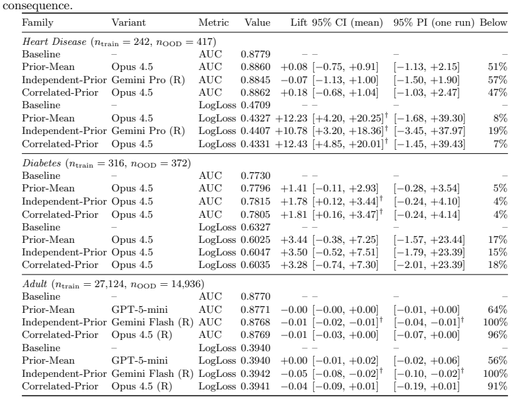
Table 5 : Classification datasets. “Value” is the deployed model’s metric on the reference split; “lift” is the percentage improvement over theL 2-logistic baseline. “CI” is a 95% confidence interval for the mean lift and “PI” a 95% prediction interval for a single deployment; both propagate source-split,λ-selection and target-sample variability and differ only in whether the source component is averaged over theSsplits. “Below” is the fraction of prediction draws in which the prior-informed model is worse than baseline. The Mixed family is omitted and tracks Prior-Mean closely (γ= 1.00 and 0.97). A dagger ( †) marks a confidence interval excluding zero; on Adult the two such entries point in the direction of harm, at magnitudes of no practical
원문 · CC BY 4.0 · Sølve Langseth, Kristoffer Herland Hellton, Hugo L. Hammer · LLM knowledge for improved Out-of-Distribution Tabular Prediction - A Cross-Validated Regularisation Approach · 원문 그림 인용 · 원본 PDF 17쪽에서 그림 영역을 추출했습니다.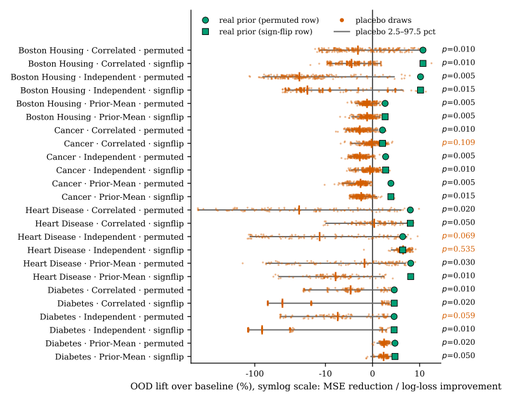
Figure 2 : Placebo priors. Each row is one (dataset, prior family, placebo type) combination. Vermillion points are individual placebo draws (200 for regression, 100 for classification) with the grey bar marking their 2.5–97.5 percentile range and the tick their median; the bluish-green marker is the real elicited prior.pis the empirical fraction of placebo draws reaching at least the real prior’s lift. Lift is OOD MSE reduction for Boston Housing and Cancer, and OOD log-loss improvement for Heart Disease and Diabetes, the metrics the priors actually move, as established in Tables 4 and 5. The horizontal axis is symmetric-log beyond±10%, because corrupted priors on the classification datasets can be worse than baseline by several hundred per cent.
원문 · CC BY 4.0 · Sølve Langseth, Kristoffer Herland Hellton, Hugo L. Hammer · LLM knowledge for improved Out-of-Distribution Tabular Prediction - A Cross-Validated Regularisation Approach · 원문 그림 인용 · 원본 PDF 18쪽에서 그림 영역을 추출했습니다.후보 선택의 보호 효과와 적용 범위
각 데이터셋에는 12개 LLM 변형과 4개 사전 가족의 48개 후보가 있으며, 최악 후보는 모든 데이터셋에서 기준선보다 나쁩니다. 소스 교차검증은 이 후보 분포를 완전히 구분하지 못합니다. 선택된 후보는 대체로 분포의 중간에 있고, 최적 후보 식별이라기보다 최악 후보를 피하는 보호 효과가 확인됩니다. 한계로는 LLM 학습 데이터와 공개 벤치마크의 중복 가능성, 단일 소스-타깃 분할, 힌트 블록이 방향성 정보에 기여했을 가능성, 그리고 OOD 분할 수가 적다는 점이 있습니다. 이 결과는 Boston Housing, Cancer, Diabetes 같은 특정 데이터셋과 표에 포함된 변형의 범위 안에서 읽어야 합니다.
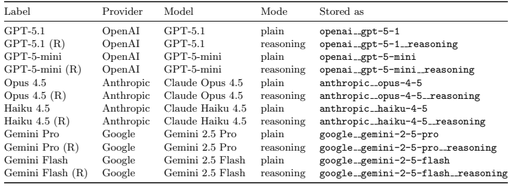
Table 3 : The twelve elicitation variants. “Mode” distinguishes a plain completion from one in which the model was asked to reason before emitting the coefficient block; the two modes use different JSON schemas, described in Appendix D. “Stored as” is the directory under priors/<dataset>/in the repository. Dated API snapshot identifiers were not recorded at elicitation time; see the note below.
원문 · CC BY 4.0 · Sølve Langseth, Kristoffer Herland Hellton, Hugo L. Hammer · LLM knowledge for improved Out-of-Distribution Tabular Prediction - A Cross-Validated Regularisation Approach · 원문 그림 인용 · 원본 PDF 11쪽에서 그림 영역을 추출했습니다.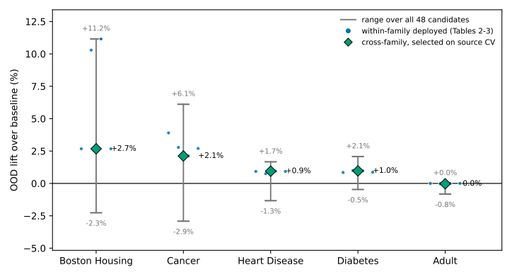
Figure 3 : Per-dataset OOD lift over baseline across all 48 (12 elicitation variants×4 prior model families) candidates at their CV-tunedλ. Grey bar: the range from worst to best candidate. Blue circles: the four models deployed by the within-family rule, which are the models reported in Tables 4 and 5. Green diamond: the single model selected by a cross-family rule, the best of all 48 candidates by source-domain cross-validation. Every quantity is computed from source data alone; the distance from each marker to the top of its bar is the benefit that source-domain selection does not reach.
원문 · CC BY 4.0 · Sølve Langseth, Kristoffer Herland Hellton, Hugo L. Hammer · LLM knowledge for improved Out-of-Distribution Tabular Prediction - A Cross-Validated Regularisation Approach · 원문 그림 인용 · 원본 PDF 20쪽에서 그림 영역을 추출했습니다.논문 정보
- 저자
- Sølve Langseth, Kristoffer Herland Hellton, Hugo L. Hammer
- 학회·저널
- arXiv · 프리프린트
- 최초 공개일
- 2026년 10월 27일
- 등록일
- 2026년 11월 1일
- 수정일
- 2026년 10월 27일
- 버전
- v1
- arXiv
- 2610.36806
- 분류
- cs.LG · stat.ME · stat.ML
- 원문 이용 조건
- CC BY 4.0
- 제공 범위
- 논문 정보, 해설, 허용된 원문 그림
AI 해설은 논문 원문과 별개의 설명이며 오류가 있을 수 있습니다. 원문과 그림은 각 출처의 이용 조건과 따로 표시된 권리를 따릅니다.
초록
Prediction models degrade when the deployment population differs from the one used to train them, and training data cannot say which feature-response relationships will transfer. Expert elicitation is slow and unscalable. We ask whether coefficient priors elicited from large language models (LLMs) improve out-of-distribution (OOD) prediction as the shrinkage target of a regularised regression instead of zero, across five tabular datasets split on real covariates, selecting providers and prior structures by source-domain cross-validation alone. The priors help on four of five datasets, by up to 7.9% OOD mean squared error, and ten of twenty-four prior-informed results resolve the mean improvement at conventional confidence; single-deployment intervals are much wider. On classification the gain is in probabilistic accuracy, not ranking, and control tests with corrupted priors attribute the benefit to feature-specific content rather than scale. Two findings temper this. Variation across candidate priors exceeds the average benefit, yet cross-validation margins fall below their own noise, so selection avoids the worst prior rather than finding the best. On three datasets the prior improves in-domain accuracy as much as out-of-domain, making it better regularisation than shift correction. Only where the training data are large enough that the in-domain gain disappears does elicited knowledge demonstrably improve transfer. Code, priors and results: https://github.com/hugohammer/llm-priors-ood.
원문 인용
Sølve Langseth, Kristoffer Herland Hellton, Hugo L. Hammer (2026). LLM knowledge for improved Out-of-Distribution Tabular Prediction - A Cross-Validated Regularisation Approach. arXiv:2610.36806v1. https://arxiv.org/abs/2610.36806v1
BibTeX
@misc{langseth2026knowledge,
  title = {{LLM knowledge for improved Out-of-Distribution Tabular Prediction - A Cross-Validated Regularisation Approach}},
  author = {Sølve Langseth and Kristoffer Herland Hellton and Hugo L. Hammer},
  year = {2026},
  eprint = {2610.36806},
  archivePrefix = {arXiv},
  url = {https://arxiv.org/abs/2610.36806v1}
}