논문 해설
Beauty Is Human: When People Love AI-Generated Art, They Think a Human Made It
아름다움은 인간의 것: 사람들은 AI가 만든 예술을 좋아할 때 인간이 만들었다고 생각한다
- 연구 문제 사람들이 AI 생성 그림과 시를 보며 스스로 제작자를 판단할 때, 좋아하는 작품이 인간 제작으로 판단되는 경향이 있는지 검증합니다.
- 연구 방법 AI Art Turing Test의 11,123명 응답과 Porter and Machery의 시 실험을 사용하여 응답자와 그림의 고정효과를 포함한 선형확률모형으로 좋아하는 작품과 인간 판단의 연관을 추정합니다.
- 주요 결과 응답자와 그림을 고정한 뒤에도 좋아하는 그림은 인간 제작으로 판단될 확률이 22.1 pp 높았으며, 이 연관은 50개 그림 모두와 AI 제작·인간 제작 그림 모두에서 나타났습니다.
출처를 모를 때 좋아하는 작품은 어떻게 판단되는가
생성형 AI가 만든 그림과 시는 많은 사람이 사람의 작품과 구별하기 어려워졌습니다. 그래서 사람들은 작품을 보며 누가 만들었는지 스스로 판단하는 경우가 많습니다. 기존 연구는 작품에 AI라는 라벨을 붙였을 때 평가가 낮아지는 현상을 보여 주었고, 이를 human premium이라고 부릅니다. 그러나 라벨이 없는 실제 환경에서는 사람이 작품의 출처를 스스로 형성하며, 이 믿음이 호감과 어떻게 연결되는지는 충분히 검증되지 않았습니다.
이 논문은 두 가지 설명을 비교합니다. 하나는 사람이 스스로 인간 제작이라고 믿은 작품을 더 즐긴다는 설명입니다. 다른 하나는 beauty-is-human inference로, 사람들이 작품에서 느끼는 미적 반응을 그것을 만든 사람이 인간이라는 증거로 사용한다는 가설입니다. 저자들은 이 추론이 AI 예술에 대한 거부감과 무관하게도 나타날 수 있다고 봅니다. 따라서 두 설명은 같은 관찰에서 다른 예측을 낳으며, 논문은 그 예측을 데이터로 검토합니다.
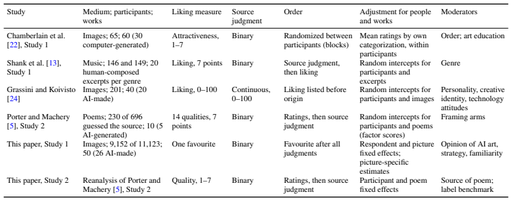
Table 1 : The closest prior studies of liking and believed authorship, and this study.
원문 · CC BY 4.0 · Zihan Chen, Di Zhu, Lei Nico Zheng · Beauty Is Human: When People Love AI-Generated Art, They Think a Human Made It · 원문 그림 인용 · 원본 PDF 4쪽에서 그림 영역을 추출했습니다.두 공개 데이터와 좋아하는 작품 추정 방식
주요 증거는 AI Art Turing Test의 공개 응답 파일에서 나옵니다. 11,123명이 50개 그림 각각을 인간 제작 또는 AI 제작으로 판단했고, 그중 9,152명이 좋아하는 그림을 하나 골랐으며 이들의 판단 453,865건이 분석 표본입니다. 좋아하는 그림은 모든 판단이 끝난 뒤에 선택되었습니다.
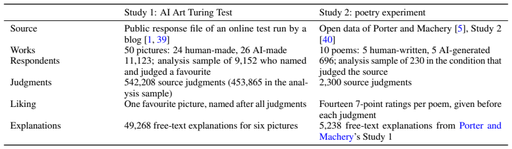
Table 2 : Data sources.
원문 · CC BY 4.0 · Zihan Chen, Di Zhu, Lei Nico Zheng · Beauty Is Human: When People Love AI-Generated Art, They Think a Human Made It · 원문 그림 인용 · 원본 PDF 5쪽에서 그림 영역을 추출했습니다.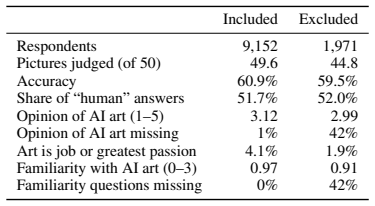
Table 8 : Respondents included in and excluded from the favourite analysis (Study 1). Included respondents named a favourite and judged it. Shares are of all respondents in each group.
원문 · CC BY 4.0 · Zihan Chen, Di Zhu, Lei Nico Zheng · Beauty Is Human: When People Love AI-Generated Art, They Think a Human Made It · 원문 그림 인용 · 원본 PDF 19쪽에서 그림 영역을 추출했습니다.주 모형은 선형확률모형입니다. 종속변수는 그림을 인간 제작으로 판단했는지 여부이고, 주 예측변수는 그 그림이 응답자의 좋아하는 그림인지 여부입니다. 응답자 고정효과는 응답자가 전반적으로 인간 판단을 얼마나 자주 내리는지를, 그림 고정효과는 그림이 모두에게 얼마나 인간처럼 보이는지를 흡수합니다. 따라서 계수는 두 일반적 경향을 제외한 뒤 좋아하는 그림에서 나타나는 차이로 읽어야 합니다. 표준오차는 응답자 기준으로 군집화하며, 그림까지 포함한 이중 군집 표준오차도 함께 보고됩니다.
두 번째 데이터는 Porter and Machery의 시 실험입니다. 이 실험은 참가자가 시를 먼저 14개 품질로 평가한 뒤 작성자를 판단하게 했으므로, 평가가 판단보다 먼저 기록되었다는 점에서 Study 1과 순서가 다릅니다.
응답자와 그림을 고정한 연관의 크기
응답자와 그림을 고정한 주 모형에서 좋아하는 그림은 인간 제작으로 판단될 확률이 22.1 pp 높았습니다. 표준오차는 0.4 pp이고 95% 신뢰구간은 21.3에서 22.9 pp입니다. 그림까지 군집화하면 구간은 19.6에서 24.6 pp로 넓어집니다. 같은 자료를 로지스틱 모형으로 추정하면 오즈비는 3.87이며 평균 변화량은 23.6 pp입니다.
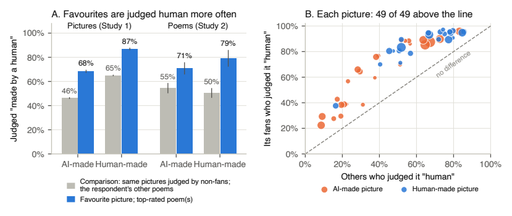
Figure 1 : Favourites are judged human more often. (A) Share of judgments “made by a human” for each respondent’s favourite picture and for the same pictures judged by respondents who did not choose them (Study 1, pictures weighted by their number of fans), and for each respondent’s top-rated poem or poems and their other poems (Study 2), by true source. Bars show 95% intervals from 1,000 bootstrap resamples of respondents (participants for poems). These are raw shares; Table 3 and Table 6 give the fixed-effects estimates. (B) Each dot is one of the 49 pictures with at least 30 fans: the share of its fans (vertical) and of all other respondents (horizontal) who judged it human. Dot size is proportional to the number of fans; the dashed line marks equal shares.
원문 · CC BY 4.0 · Zihan Chen, Di Zhu, Lei Nico Zheng · Beauty Is Human: When People Love AI-Generated Art, They Think a Human Made It · 원문 그림 인용 · 원본 PDF 8쪽에서 그림 영역을 추출했습니다.이 수치는 응답자가 좋아하는 그림을 인간 제작으로 판단한 비율 76.6%와, 같은 그림을 좋아하지 않은 다른 응답자가 인간으로 판단한 비율 54.6%를 단순 비교한 값과는 다릅니다. 단순 비율 차이는 응답자와 그림의 일반 경향을 포함하지만, 고정효과 추정은 그 경향들을 제외하고 남는 차이를 봅니다. 이 결과는 연관이며, 좋아함이 판단을 일으켰다는 인과 효과로 읽을 수 없습니다.
그림별 일관성, 출처별 차이, 대체 설명 검토
연관은 평균만이 아니라 그림마다 나타났습니다. 팬이 30명 이상인 49개 그림에서 모두 팬의 인간 판단 비율이 다른 응답자보다 높았고, 그림별 고정효과 추정치는 50개 그림 모두에서 양의 값이었으며 5.3에서 38.1 pp 범위였습니다. 이 추정치를 랜덤효과 모형으로 요약하면 평균은 22.4 pp입니다. 여러 검정을 보정하는 Holm correction을 적용하면 50개 중 45개가 유의하게 남았습니다.
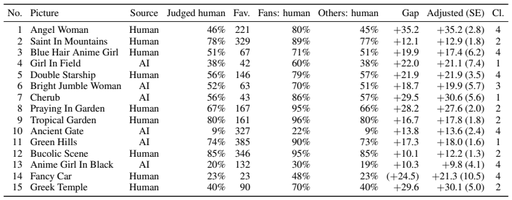
Table 9 : The 50 pictures of Study 1. Source is the true origin; “Judged hu- man” is the share of all respondents calling it human; fans are respondents who named it their favourite and also judged it (Fav.: number of respondents naming it). Gap is the raw difference between fans and other respondents; Adjusted is the picture-specific favourite association with respondent and picture fixed ef- fects (SE clustered by respondent). Cl. is the four-cluster co-judgment solution (Appendix B).
원문 · CC BY 4.0 · Zihan Chen, Di Zhu, Lei Nico Zheng · Beauty Is Human: When People Love AI-Generated Art, They Think a Human Made It · 원문 그림 인용 · 원본 PDF 19쪽에서 그림 영역을 추출했습니다.좋아하는 그림을 AI 제작과 인간 제작으로 나누면 연관은 각각 21.8 pp와 22.4 pp로 비슷했습니다. 차이는 0.5 pp이며 신뢰구간은 응답자 기준과 응답자 및 그림 기준에서 다르게 계산됩니다. 따라서 연관은 올바르게 인식된 인간 작품에만 나타나는 현상이 아닙니다.
세 가지 대체 설명도 검토되었습니다. 공유된 외양은 응답자-군집 고정효과를 넣었을 때 20.0 pp로 줄었고, 군집을 나눈 반분 교차검증에서도 19.9 pp였습니다. 인식의 영향은 본 적 없는 응답자만 보았을 때 22.6 pp로 남았습니다. 가장 확신하는 인간 작품과 좋아하는 그림이 같은 경우를 제외해도 20.7 pp였습니다. 이들은 연관이 대체 원인만으로 설명되지 않는다는 근거입니다.
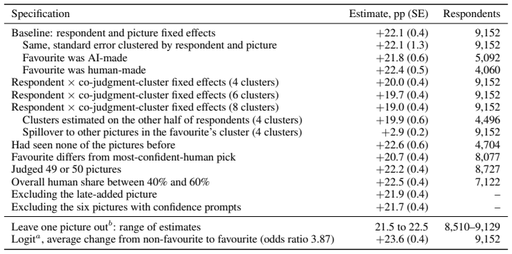
Table 3 : The favourite association in Study 1 across specifications. Linear probability models of judging a picture human-made, with respondent and picture fixed effects unless stated otherwise; standard errors clustered by respondent unless stated otherwise. Co-judgment clusters group pictures that the same people tend to call human. aThe logit model uses picture indicators and the respondent’s leave-one-out share of “human” judgments in place of respondent fixed effects. bEach estimate drops one picture and the respondents whose favourite it was, so the number of respondents varies.
원문 · CC BY 4.0 · Zihan Chen, Di Zhu, Lei Nico Zheng · Beauty Is Human: When People Love AI-Generated Art, They Think a Human Made It · 원문 그림 인용 · 원본 PDF 9쪽에서 그림 영역을 추출했습니다.AI 예술 의견과 선택, 믿음의 관계
응답자의 AI 예술 의견은 1에서 5까지의 척도로 판단 이후에 보고되었습니다. 가장 부정적인 집단의 47%가 AI 제작 그림을 좋아하는 그림으로 골랐고, 가장 긍정적인 집단은 60%였습니다. 같은 척도에서 AI 제작 좋아하는 그림을 인간 제작으로 믿은 비율은 가장 부정적인 집단 80%, 가장 긍정적인 집단 56%였습니다.
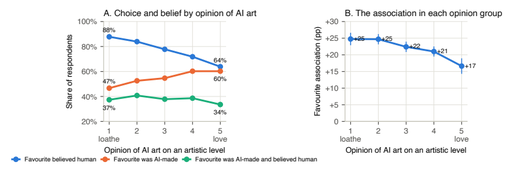
Figure 2 : Choice and belief by opinion of AI art (Study 1). (A) By opinion of AI art, the share of respondents whose favourite was AI-made, whose favourite they believed human-made, and whose favourite was AI-made and believed human-made. (B) The favourite association within each opinion group, with 95% confidence intervals.
원문 · CC BY 4.0 · Zihan Chen, Di Zhu, Lei Nico Zheng · Beauty Is Human: When People Love AI-Generated Art, They Think a Human Made It · 원문 그림 인용 · 원본 PDF 10쪽에서 그림 영역을 추출했습니다.이 차이에는 두 원인이 함께 있습니다. 첫째, 집단마다 고른 AI 제작 그림이 달랐습니다. 가장 부정적인 집단이 고른 AI 제작 그림은 다른 응답자의 54%가 인간으로 판단한 그림이었고, 가장 긍정적인 집단이 고른 그림은 38%였습니다. 둘째, 같은 그림에 대해서도 부정적인 집단이 더 자주 인간으로 판단했습니다. 같은 그림으로 제한하면 차이는 8.9 pp였습니다.
좋아하는 그림이 AI 제작이면서 인간으로 믿은 응답의 비율은 집단마다 33.5%에서 40.8% 사이로 유지되었습니다. 선택 비율은 올라가고 믿음 비율은 내려가기 때문에 두 비율의 곱이 대체로 일정하게 나타났습니다. 연관 크기는 가장 부정적인 집단에서 24.8 pp, 가장 긍정적인 집단에서 16.6 pp였습니다. 이 결과는 방향을 확정하지 않으며 의견이 선택을 바꾼 것인지, 작품 경험이 의견을 바꾼 것인지는 구분되지 않습니다.
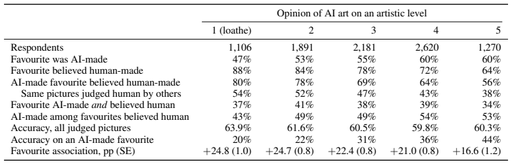
Table 4 : Opinion of AI art, choice of favourite, and belief about the favourite (Study 1). Respondents who named and judged a favourite. The row on other respondents gives the share of all other respondents who judged the chosen AI-made favourites human. Accuracy is computed for the same respondents. The favourite association is estimated within each opinion group as in Equation (1).
원문 · CC BY 4.0 · Zihan Chen, Di Zhu, Lei Nico Zheng · Beauty Is Human: When People Love AI-Generated Art, They Think a Human Made It · 원문 그림 인용 · 원본 PDF 10쪽에서 그림 영역을 추출했습니다.탐지 전략과 친숙도별 연관
자기보고 주요 전략별 연관은 17.1 pp에서 25.1 pp 사이였습니다. 가장 많은 응답자가 쓴 전략인 작은 오류 찾기의 연관은 23.4 pp였으며, 좋은 작품이나 창의적 작품을 인간으로 판단했다고 답한 집단과 차이가 거의 없었습니다. 기술적 인상이 AI의 증거라고 답한 집단은 17.1 pp로 가장 작았지만 모든 전략 집단에서 연관은 나타났습니다.
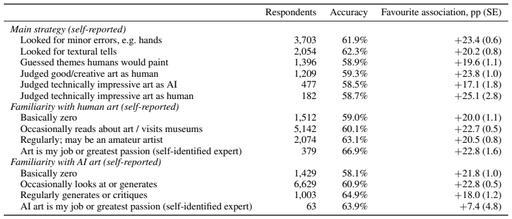
Table 5 : The favourite association by reported strategy and familiarity (Study 1). Accuracy is the mean share of judged pictures answered correctly. The favourite association is estimated within each group as in Equation (1); differences between groups reported in the text come from a pooled model with group-specific picture effects.
원문 · CC BY 4.0 · Zihan Chen, Di Zhu, Lei Nico Zheng · Beauty Is Human: When People Love AI-Generated Art, They Think a Human Made It · 원문 그림 인용 · 원본 PDF 11쪽에서 그림 영역을 추출했습니다.친숙도에서도 연관은 대부분 유지되었습니다. 예술을 직업이나 가장 큰 열정으로 여기는 집단은 판단 정확도가 66.9%로 가장 높았지만 연관은 22.8 pp로 다른 응답자와 뚜렷이 다르지 않았습니다. 반면 AI 예술을 직업이나 열정으로 여기는 63명은 7.4 pp로 작았습니다. 이 집단은 규모가 작으므로 더 큰 표본에서 확인할 필요가 있습니다.
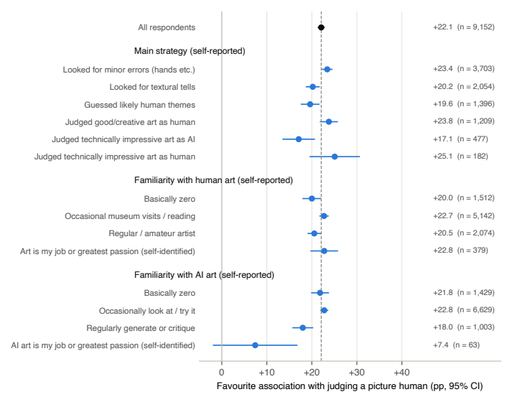
Figure 3 : The favourite association by reported strategy and familiarity (Study 1), with 95% confidence intervals. The dashed line marks the association among all respondents.
원문 · CC BY 4.0 · Zihan Chen, Di Zhu, Lei Nico Zheng · Beauty Is Human: When People Love AI-Generated Art, They Think a Human Made It · 원문 그림 인용 · 원본 PDF 12쪽에서 그림 영역을 추출했습니다.평가를 먼저 기록한 시 실험의 결과
Study 2에서는 참가자가 시를 먼저 평가하고 작성자를 판단했습니다. 아무 정보도 받지 않은 조건의 230명은 AI 작성 시를 인간 작성 시보다 더 자주 인간으로 판단했고, 그 결과 작성자 판단 정확도는 47.3%로 우연 수준보다 낮았습니다. AI 작성 시는 좋은 정도 평가에서도 5.30점으로 인간 작성 시 4.18점보다 높았습니다.
시의 평가가 한 점 높을수록 인간 작성 판단 확률은 11.5 pp 높았습니다. 이 기울기는 AI 작성 시에서 11.7 pp, 인간 작성 시에서 11.4 pp로 거의 같았고 차이는 -0.3 pp였습니다. 최고 평가 시의 집단은 나머지 시보다 23.6 pp 더 자주 인간으로 판단되었습니다. 이 대비는 AI 작성 시에서 18.5 pp, 인간 작성 시에서 32.7 pp였으므로 출처에 따라 차이가 있었습니다.
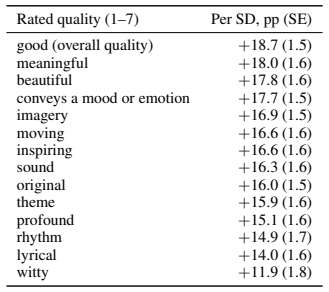
Table 10 : Judging a poem human-written by each rated quality (Study 2, told-nothing condition). Each row is a separate linear model of the “human” judgment on the standardized rating, with participant and poem fixed effects; standard errors clustered by participant. The qualities are correlated measures of one evaluation.
원문 · CC BY 4.0 · Zihan Chen, Di Zhu, Lei Nico Zheng · Beauty Is Human: When People Love AI-Generated Art, They Think a Human Made It · 원문 그림 인용 · 원본 PDF 20쪽에서 그림 영역을 추출했습니다.참가자에게 작성자를 명시한 라벨 효과와 비교하면, 인간 작성자 표시와 AI 프로그램 표시 사이의 평점 차이는 0.81점이었습니다. 응답자 자신의 판단에 따라 생긴 평점 차이는 0.89점이었고, 두 차이는 0.08점 차이만 보였습니다. 이는 자신의 판단과 관련된 평점 차이가 명시적 라벨 효과와 같은 규모임을 보여 줍니다. 다만 두 값은 다른 추정량이므로 같은 원인으로 합쳐 해석하지 않아야 합니다.
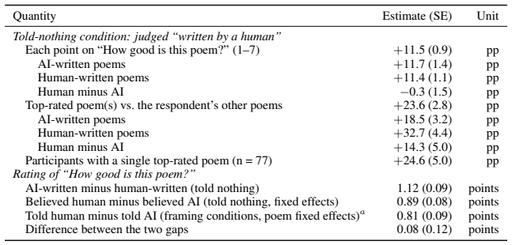
Table 6 : Liking and judged authorship of poems (Study 2). Linear models with participant and poem fixed effects in the told-nothing condition (230 participants, 2,300 judgments); standard errors clustered by participant. aThe label effect compares the two framing conditions (466 participants) with poem fixed effects; the human label named a poet, the AI label “an AI program”.
원문 · CC BY 4.0 · Zihan Chen, Di Zhu, Lei Nico Zheng · Beauty Is Human: When People Love AI-Generated Art, They Think a Human Made It · 원문 그림 인용 · 원본 PDF 13쪽에서 그림 영역을 추출했습니다.자유 텍스트 설명과 해석의 한계
설명 분석은 탐색적 분석입니다. Study 1의 6개 그림 설명 49,268건과 Porter and Machery 연구의 시 설명 5,238건에 키워드 목록을 적용했습니다. 장점과 인간 제작 관련 키워드는 인간 판단과 함께 나타나는 경향을 보였고, 기술적 단서와 결함 관련 키워드는 AI 판단과 함께 나타났습니다. 이 키워드 범주는 상호 배타적이지 않으며 RQ1에서 RQ4의 검정에는 사용되지 않습니다.
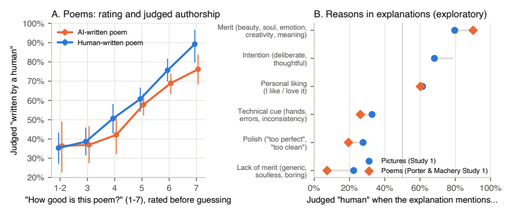
Figure 4 : (A) Share of poems judged “written by a human” by the rating given just before the judgment (Study 2, told- nothing condition), by true source, with 95% intervals from 1,000 bootstrap resamples of participants. (B) Exploratory: share of judgments “human” among explanations matched by each keyword category, for pictures (Study 1) and poems (Study 1 of Porter and Machery). Intention is shown for pictures only; fewer than 30 poem explanations matched it.
원문 · CC BY 4.0 · Zihan Chen, Di Zhu, Lei Nico Zheng · Beauty Is Human: When People Love AI-Generated Art, They Think a Human Made It · 원문 그림 인용 · 원본 PDF 13쪽에서 그림 영역을 추출했습니다.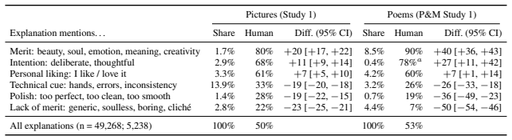
Table 7 : Reasons in free-text explanations (exploratory). Share of explanations matched by each keyword category (categories are not exclusive), share of the corresponding judgments that were “human”, and the difference in that share between matched and unmatched explanations, within the same picture or poem (pp, 95% CI clustered by respondent). Pictures: six pictures of Study 1. Poems: optional explanations in Study 1 of Porter and Machery [5]. aFewer than 30 explanations.
원문 · CC BY 4.0 · Zihan Chen, Di Zhu, Lei Nico Zheng · Beauty Is Human: When People Love AI-Generated Art, They Think a Human Made It · 원문 그림 인용 · 원본 PDF 14쪽에서 그림 영역을 추출했습니다.주요 한계는 인과 방향과 자료 범위입니다. 주 분석은 좋아하는 그림과 인간 판단의 연관을 추정하지만 좋아함이 판단을 만들었다고 확정하지 않습니다. 의견은 판단 이후에 보고되었으므로 관찰된 행동의 일부로 읽어야 하며, 좋아하는 그림을 조작하는 실험은 수행되지 않았습니다. 응답자는 한 블로그의 독자이고 50개 그림은 어렵게 선택되었으므로 대표 집단이나 임의의 작품에 대한 예측으로 확대할 수 없습니다.
논문 정보
- 저자
- Zihan Chen, Di Zhu, Lei Nico Zheng
- 학회·저널
- arXiv · 프리프린트
- 최초 공개일
- 2026년 10월 28일
- 등록일
- 2026년 11월 1일
- 수정일
- 2026년 10월 28일
- 버전
- v1
- arXiv
- 2610.38113
- 분류
- cs.HC · cs.AI · cs.CY
- 원문 이용 조건
- CC BY 4.0
- 제공 범위
- 논문 정보, 해설, 허용된 원문 그림
AI 해설은 논문 원문과 별개의 설명이며 오류가 있을 수 있습니다. 원문과 그림은 각 출처의 이용 조건과 따로 표시된 권리를 따릅니다.
초록
Generative AI now produces images and poems that people cannot reliably distinguish from human-made work, so people often judge for themselves who made a work. We examine how these perceived-authorship judgments relate to aesthetic preference. In a public online AI Art Turing Test, 11,123 people judged whether each of 50 pictures (26 AI-generated) was made by a human and were asked for their favourite. Among the 9,152 respondents who judged their favourite, a picture was 22.1 percentage points more likely to be judged human-made when it was the respondent's favourite, holding respondent and picture fixed. The association was similar for AI-generated and human-made favourites, was positive for all 50 pictures, and appeared under every reported detection strategy. Respondents most negative about AI art chose fewer AI-generated favourites (47% against 60% among the most positive) but more often believed them human-made, partly because others also judged those pictures human. As a result, in every opinion group a third to two fifths of respondents named an AI-generated favourite they believed human-made. A reanalysis of a published experiment on AI-generated poetry, in which 230 people rated each poem before judging its authorship, found the same pattern, although the AI poems were rated higher. When provenance is hidden, liking and perceived human authorship travel together, consistent with aesthetic response serving as evidence of a human maker and with beliefs about the maker shaping enjoyment. The findings qualify research on bias against AI art, which typically uses explicit labels, and inform AI disclosure policy.
원문 인용
Zihan Chen, Di Zhu, Lei Nico Zheng (2026). Beauty Is Human: When People Love AI-Generated Art, They Think a Human Made It. arXiv:2610.38113v1. https://arxiv.org/abs/2610.38113v1
BibTeX
@misc{chen2026beauty,
  title = {{Beauty Is Human: When People Love AI-Generated Art, They Think a Human Made It}},
  author = {Zihan Chen and Di Zhu and Lei Nico Zheng},
  year = {2026},
  eprint = {2610.38113},
  archivePrefix = {arXiv},
  url = {https://arxiv.org/abs/2610.38113v1}
}