Paper commentary
FRUGAL: Memory-Efficient Optimization by Reducing State Overhead for Scalable Training
State-free updates cut optimizer memory
- Problem Low-rank methods like GaLore and BAdam update weights only within a small subspace at each step. The gradient information in the frozen complement goes unused, which can lose important information during pre-training.
- Method FRUGAL splits each gradient into two parts. Adam updates the low-dimensional part that keeps optimizer state, while signSGD updates the remaining part without storing any state.
- Results On LLaMA-130M at density 0.25, FRUGAL reached 18.60 validation perplexity, compared to 21.11 for GaLore.
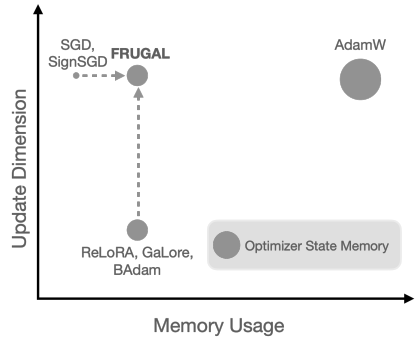
Figure 1 . FRUGAL reduces memory usage by splitting gradient updates into low-dimensional updates with advanced optimizers (e.g., AdamW) and using state-free methods (e.g., SignSGD and SGD) for the rest.
Original paper · CC BY 4.0 · Philip Zmushko, Aleksandr Beznosikov, Martin Takáč, Samuel Horváth · FRUGAL: Memory-Efficient Optimization by Reducing State Overhead for Scalable Training · Original paper figure · Extracted the figure area from page 2 of the original PDF.Why low-rank updates leave gradient information unused
Training a large language model keeps weights, gradients and optimizer statistics in memory at the same time. PEFT methods such as LoRA cut this cost by training a small number of parameters while the rest of the model stays frozen.
GaLore, ReLoRA and BAdam get around this limit by periodically changing the optimizable low-rank subspace L. Over a whole run, the total parameter change becomes high-dimensional. Each individual step, however, still updates the weights only within a low-dimensional subspace. The frozen complement M, with dimension dim L⊥, significantly exceeds dim L in size.
The gradient information that lies in M goes unused in the parameter update at that step.
The authors ask whether this leftover information can train the model without paying for optimizer state. Adam is ruled out for M because its state would bring back the memory overhead the authors want to avoid. State-free methods such as SGD or signSGD don't need that state, so they can update M directly. The authors test a hybrid in which Adam handles a selected subset and signSGD handles the other parameters, using LLaMA-130M with Random projection.
Splitting each gradient between two update rules
FRUGAL splits each gradient into two parts, so one optimizer keeps state and the other keeps none. Adam, or AdamW in the experiments, updates the state-full part, which lives in the subspace the authors call L. SignSGD or SGD updates the remaining state-free part, which lives in the complementary subspace M. The state-free rule keeps no memory beyond the parameters, so FRUGAL updates the complement at every step.
Because the complement gets updated too, each step is high-dimensional, which lets the method explore more of the parameter space. The authors also argue this may improve convergence, though the paper frames it as a motivation rather than a proven gain.
Two earlier observations shaped this design, one about projections and one about the stateless rule. In the projection study, random projections that change over time did better in long training than SVD projections. SVD projections keep the updates in a narrow subspace, because the principal angles between projections stay large across steps.
For the stateless rule, signSGD beat SGD in a preliminary test, so the authors chose signSGD. They link this result to the similarities between signSGD and Adam. They also expect signSGD to suit the complement because its update size is close to Adam's, which keeps the learning rate for the stateless part easier to set.
One FRUGAL step, line by line
Each iteration starts with a forward pass on a data batch, which yields the loss. Each parameter set has its own projector, which maps that set's gradient into the state-full subspace. The residual is the part of the gradient that the projection leaves out, found by subtracting the back-projected state-full gradient. The state-full optimizer, such as AdamW in the experiments, updates its statistics from the projected gradient.
signSGD turns the residual into its own update without storing any state, and the state-full update is mapped back to the full space.
Because the state-full subspace changes over time, the stored optimizer states have to move with it. Line 7 projects each state from the previous projector onto the current one. If the projector stays the same, the projected state equals the old state. When the projector changes, the authors can either project the states or reset them. Their RandK experiments showed that resetting performs comparably to projecting the states.
GaLore skips this step, which degrades performance when projections update frequently.
Blockwise selection is the default, because it needs only the indices of the active block. SVD slightly outperforms RandK and block projections but demands more compute and memory. The authors switch to column-wise projection when the parameters of one block exceed the memory budget. In a preliminary test, signSGD outperformed SGD as the state-free rule, as Table 10 shows.
The convergence analysis uses SGDM as the state-full optimizer and SGD as the state-free one. Algorithm 2 applies coordinate-wise projection and keeps momentum only on the coordinates in the momentum set Jk. Coordinates outside Jk take the raw stochastic gradient, and the iterate moves by the step size times that update.
SVD versus random projections
The authors compared projection types on LLaMA-130M, with AdamW as the state-full optimizer, at 4k, 40k and 200k steps. Without a state-free part, SVD reached 21.11 validation perplexity at 200k steps. A random projection reached 20.01 at the same point, so it led in long training. Adding signSGD on the residual lowered the random projection to 18.64, against 18.13 for AdamW.
With signSGD on the rest, SVD reached 18.35, which beats the random projection's 18.64. The authors kept blockwise selection because SVD only slightly outperformed RandK and blockwise projections. SVD needs extra compute and memory, while blockwise selection stores only the active block indices.
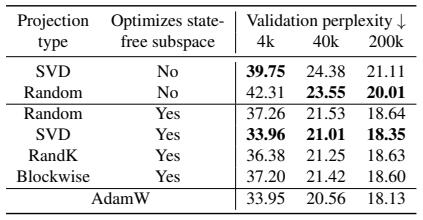
Table 1 . Comparison of different projection and state-free subspace optimization strategies on pre-training LLaMA-130M on C4 with AdamW as the state-full algorithm.
Original paper · CC BY 4.0To see why, the authors computed principal angles between projection matrices from different iterations of LLaMA-60M. They took the key projection from the 5th layer and compared SVD projections with random ones. The top 57 SVD cosines surpass 0.9, even for gradients 1000 steps apart. Random projections show no cosines above 0.9. The authors read this as GaLore updating the weights only in a small subspace.
They hypothesized that random projections win because they explore the optimizable space more thoroughly during training.
SVD captures the information in the gradient better, so its early advantage makes sense. The authors conclude that reaching better convergence requires optimizers that explore the entire space during training.
Pre-training LLaMA at a fixed memory budget
Table 3 shows how weight precision changes both memory and perplexity when pre-training LLaMA models. A 350M model trained in pure bf16 reached a perplexity of 17.75 with 2.1GB of memory. The same model in mixed precision reached 15.16 with 4.2GB. The authors chose mixed precision for their main comparisons, so the optimizers are compared without extra stability tricks.
The main comparison fixes density at ρ = 0.25, so a quarter of the Linear layer parameters sit in the state-full subspace. GaLore, BAdam and FRUGAL share that budget, while Embeddings, RMSNorms and the Output layer always use AdamW. At 130M, FRUGAL reached 18.60 validation perplexity, versus 21.11 for GaLore and 20.34 for BAdam. Its memory overhead was 0.52G, compared to 1.00G for AdamW, which reached 18.13 without any memory saving.
The same ordering held at 60M, 350M and 1B, where FRUGAL reached 23.59, 14.79 and 12.32. The authors ran a grid search for the AdamW learning rate and reused it for FRUGAL and BAdam.
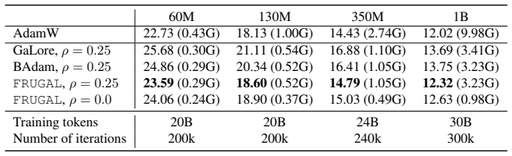
Table 2 . Comparison of validation perplexity and memory estimation for various optimization methods across LLaMA model scales trained on C4. We also indicate the additional memory overhead introduced by the optimization algorithm. The values are calculated assuming that each float value occupies 4 bytes (float32). ρ denotes the proportion of the Linear layer parameters in the state-full subspace. Note that Embeddings, RMSNorms, and Output layer are always trained with AdamW.
Original paper · CC BY 4.0With density 0.0, FRUGAL reached 18.90 at 130M, still ahead of GaLore and BAdam at density 0.25. In this setting every Linear layer is state-free and updated with signSGD, while the other modules keep AdamW. Its overhead at 130M was 0.37G, below the 0.52G at density 0.25. At 1B, the zero-density run reached 12.63, versus 12.32 at density 0.25.
Across all four model sizes, FRUGAL stayed closer to AdamW than the memory-efficient baselines did. The gap to AdamW didn't close fully, since AdamW reached 12.02 at 1B.
Which modules tolerate signSGD
Table 4 moves different module sets from AdamW to signSGD in LLaMA-130M to find which modules really need state. The leftmost column lists the modules moved to the state-free set, and every row keeps the Linear layers state-free. Moving only the Linear layers gives 20.02 perplexity, which is the FRUGAL ρ = 0.0 setting from Table 2. Adding RMSNorms gives 20.07, and adding Embeddings gives 20.48.
Adding Embeddings and RMSNorms together gives 20.55. Adding the Output layer instead raises perplexity to 34.66.
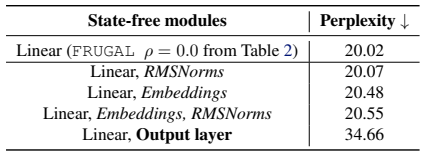
Table 4 . Perplexity of LLaMA-130M models pre-trained on C4 for 100k iterations (10B tokens). The leftmost column indicates the modules moved to the state-free set and trained using signSGD. The results show that Output layer, unlike Embeddings and RM- SNorms, are exceptionally responsive to the choice of optimization algorithm from AdamW to signSGD.
Original paper · CC BY 4.0The authors ran these combinations by moving subsets of Embeddings, RMSNorms, and Output layer from the state-full set to the state-free set. Embeddings and RMSNorms tolerate signSGD with little change, while the Output layer shows a dramatically higher sensitivity. Changing the Output layer's optimizer causes severe performance degradation, so it stays on AdamW in FRUGAL.
This finding aligns with Zhao et al. (2024b), who showed that most parameters can be trained with SGDM while the Output layer requires AdamW.
The 130M experiments use 200k steps, which the authors chose to be far beyond the roughly 20 tokens-per-parameter rule. Training for longer periods gives the Output layer comparisons more room to separate the optimizers. The authors didn't test other Output layer optimizers beyond signSGD and AdamW in this table.
Scaling the comparison to LLaMA 3B
They evaluated FRUGAL against AdamW on pre-training of the LLaMA 3B model. Because of computational constraints, they ran a single training run of 300k steps. The learning rate was 5e-4, weight decay was 0.1, and gradient clipping was 1.0.
Other hyperparameters followed the settings in Appendix A.1. Table 5 reports validation perplexity on C4 at 100k, 200k and 300k steps. AdamW reached 10.93 at 300k steps. FRUGAL with density 0.25 reached 11.07 at 300k steps, against 10.93 for AdamW. FRUGAL with density 0.0 reached 11.35 at 300k steps. At 100k steps, the gap was 14.2 for AdamW, 14.33 for density 0.25, and 14.78 for density 0.0.
The gap to AdamW stays small at density 0.25 and grows slightly at density 0.0. The authors call FRUGAL a viable option for industrial-scale applications. They ran only one seed, so the spread across runs is not shown.
Fine-tuning RoBERTa and LLaMA
On GLUE, the authors fine-tuned RoBERTa-base and compared FRUGAL with LoRA and GaLore under LoRA's setup of rank 8 on the Q and V matrices. FRUGAL used columnwise selection because LoRA with rank 8 has roughly 2.5 times fewer trainable parameters than any RoBERTa matrix. FRUGAL with rank 8 on QV averaged 86.7, compared to 86.1 for LoRA and 84.1 for GaLore on QV.
Because the GaLore code projects all modules, the authors also ran GaLore on All modules, which averaged 85.8. In the rank 0 setting, only the classification head trains with AdamW, the embeddings stay frozen, and the other parameters use signSGD, averaging 86.6. The table reports means and standard deviations over three independent runs, and the rank 0 variant still beats GaLore.
The authors also found that the classification head is sensitive to its optimizer, so signSGD on that head hurts the model. Each method adapts the Q, K, V, Up, and Down projection matrices, following the protocol from Hu et al. (2023). On eight commonsense reasoning tasks, FRUGAL with rank 0 averaged 84.94, FRUGAL with rank 32 averaged 84.89, GaLore averaged 84.65, and LoRA averaged 84.18.
The rank 0 variant needs no optimizer state, and the authors present its better accuracy as a result of that zero state memory. The table gives only averages, so the small gaps between the four rows cannot be read as settled.
A convergence bound for the SGDM and SGD case
The authors prove a convergence bound for a simplified FRUGAL, where SGDM handles the state-full coordinates and SGD handles the state-free ones. They use coordinate-wise projection and minimize the expectation of a stochastic objective f(x) through a stochastic oracle. The analysis relies on the vector l2-norm and a notion of L-smoothness, where the gradient is Lipschitz continuous with constant L.
Each coordinate's selection probability is defined from the prior iteration, with p_max and p_min giving the largest and smallest such probabilities.
Theorem 5.2 bounds the average squared gradient norm over k steps when the step size alpha is at most (1 - beta) divided by L(4 - beta + beta squared). The bound has an optimization term, f(x1) minus f* divided by k alpha, and a variance term scaled by L alpha sigma squared. The variance term also includes a momentum factor involving p-hat max, one minus p-bar min, and beta divided by one minus beta.
When every coordinate is in the momentum set, the method reduces to SGDM, and p-bar min equals 1 for SGDM. When the momentum set is empty, the method reduces to SGD, and p-hat max equals 0 for SGD. In both cases the resulting rate is O(1/(k alpha) + L alpha sigma squared), which recovers the best-known rate for SGD and SGDM under these assumptions.
If each coordinate is sampled independently with probability p, the authors get p-bar min and p-hat max both equal to p. The rate is recovered when p equals O(1 - beta) or O(beta), so the momentum set size controls this regime. In the worst case, such as a deterministic set with 0 < |Jk| < d, p-bar min is 0 and p-hat max is 1. The rate then becomes worse by a factor of 1/(1 - beta), because momentum bias isn't outweighed by variance reduction.
Only the coordinates with momentum enjoy reduced variance, which is why the bias from momentum isn't cancelled in that case.
Limits of the evidence
The 3B comparison rests on a single training run of 300k steps, so no spread across runs appears. The authors trained it with a cosine scheduler, 10% warmup steps, and a learning rate of 5e-4. At 300k steps, AdamW reached a perplexity of 10.93, while FRUGAL with ρ = 0.25 reached 11.07. They didn't run GaLore or BAdam at 3B, so that scale compares FRUGAL only against AdamW.
The GLUE table reports the mean and standard deviation over 3 independent runs for each method. The commonsense table gives only average accuracy over 8 tasks, with no deviation across runs. On that table, FRUGAL with rank 32 reached 84.89, against 84.65 for GaLore and 84.18 for LoRA. The authors varied the learning rate over [5e-6, 1e-5, 2e-5, 5e-5, 1e-4, 2e-4] for each algorithm.
For GaLore, the authors kept the AdamW learning rate, which worked better than GaLore's suggested rate.
The convergence theory covers only SGDM as the state-full optimizer and SGD as the state-free one. It also assumes coordinate-wise projection, so the proof doesn't reach the blockwise setup that the experiments use. The bound concerns the average squared gradient norm, not accuracy or perplexity. In the worst case, where the momentum set is deterministic, the rate becomes worse by a factor of 1/(1-β).
The authors didn't compare Fira, LDAdam and Adamem, because these concurrent works appeared late in their work. They left out MicroAdam, since its implementation supports only bfloat16 master weights.
Paper info
- Authors
- Philip Zmushko, Aleksandr Beznosikov, Martin Takáč, Samuel Horváth
- Venue
- arXiv · Preprint
- First published
- 2024-11-12
- Added
- 2026-10-30
- Updated
- 2025-8-14
- Version
- v3
- arXiv
- 2411.07837
- Category
- cs.LG
- Original paper terms
- CC BY 4.0
- What we show
- Paper info, commentary and permitted figures from the original paper
AI commentary is a separate explanation from the original paper and may contain errors. The original paper and figures follow each source's terms of use and any rights noted separately.
Abstract
With the increase in the number of parameters in large language models, the process of pre-training and fine-tuning increasingly demands larger volumes of GPU memory. A significant portion of this memory is typically consumed by the optimizer state. To overcome this challenge, recent approaches such as low-rank adaptation (LoRA (Hu et al., 2021)), low-rank gradient projection (GaLore (Zhao et al., 2024)), and blockwise optimization (BAdam (Luo et al., 2024)) have been proposed. However, in all these algorithms, the $\textit{effective rank of the weight updates remains low-rank}$, which can lead to a substantial loss of information from the gradient. This loss can be critically important, especially during the pre-training stage. In this paper, we introduce $\texttt{FRUGAL}$ ($\textbf{F}$ull-$\textbf{R}$ank $\textbf{U}$pdates with $\textbf{G}$r$\textbf{A}$dient sp$\textbf{L}$itting), a new memory-efficient optimization framework. $\texttt{FRUGAL}$ leverages gradient splitting to perform low-dimensional updates using advanced algorithms (such as Adam), while updates along the remaining directions are executed via state-free methods like SGD or signSGD (Bernstein et al., 2018). Our framework can be integrated with various low-rank update selection techniques, including GaLore and BAdam. We provide theoretical convergence guarantees for our framework when using SGDM for low-dimensional updates and SGD for state-free updates. Additionally, our method consistently outperforms concurrent approaches across various fixed memory budgets, achieving state-of-the-art results in pre-training and fine-tuning tasks while balancing memory efficiency and performance metrics.
Quote from the paper
Philip Zmushko, Aleksandr Beznosikov, Martin Takáč, Samuel Horváth (2024). FRUGAL: Memory-Efficient Optimization by Reducing State Overhead for Scalable Training. arXiv:2411.07837v3. https://arxiv.org/abs/2411.07837v3
BibTeX
@misc{zmushko2024frugal,
  title = {{FRUGAL: Memory-Efficient Optimization by Reducing State Overhead for Scalable Training}},
  author = {Philip Zmushko and Aleksandr Beznosikov and Martin Takáč and Samuel Horváth},
  year = {2024},
  eprint = {2411.07837},
  archivePrefix = {arXiv},
  url = {https://arxiv.org/abs/2411.07837v3}
}