Paper commentary
EvoPress: Accurate Dynamic Model Compression via Evolutionary Search
EvoPress searches for per-layer compression levels instead of scoring each layer alone
- Problem Non-uniform compression methods score each layer's error alone and add the scores, which fails for LLMs because layers do not contribute independently to the error.
- Method EvoPress runs an evolutionary search over compression profiles. Each candidate's fitness is its KL-divergence from the base model, and mutations move compression between two units so the total size holds.
- Results On Llama-3-8B at 70% sparsity, EvoPress cut Wiki2 perplexity to 28.76, compared with 85.84 for uniform sparsity.
Why per-layer scores fall short
Dynamic compression gives each layer its own compression level, so a global size target can be met with as much accuracy as possible. Most existing methods assign each layer and compression level an error or sensitivity score, then pick the assignment with the smallest total. That shortcut rests on error monotonicity, which assumes a lower sum of per-layer errors implies a lower error for the whole model.
In their Llama-3-8B layer dropping example, pruning strictly more blocks gives significantly better perplexity than pruning fewer. Table 1 shows the perplexity on Wiki2, C4 and FW for this case, where the orange blocks mark the extra removals.

Table 1 . Depth pruning is not monotone. In this example (Llama-3-8B), removing strictly more blocks (depicted in orange) can improve perplexity across sources. The left half of a block corresponds to the attention layer, the right half to the MLP.
Original paper · CC BY 4.0Once monotonicity breaks, a method can settle on a profile that is worse than one it had rejected. The authors say this refutation means most prior approaches can lead to sub-optimal solutions. Most block-scoring methods assume error linearity, so each block adds its compression error independently to the total. Shortened Llama scores each block by the perplexity change after removing it, while ShortGPT uses cosine similarity between input and output embeddings.
Weight Subcloning scores each block by the ratio of ℓ2 norms of its output embeddings with and without the residual connection. Gromov et al. restrict removals to consecutive blocks, and they score each configuration by cosine similarity instead of isolated scores.
SPDY is the closest non-uniform framework for quantization, and it reduces the problem to knapsack-type instances. SPDY explicitly relies on monotonicity and linearity between per-layer errors and model output error. The authors find these assumptions don't hold on large models, especially in the high-compression regime below 3 bits per parameter.
Each candidate in such a search costs a full model evaluation, which the authors call exceedingly high for LLMs. So a method has to find good profiles with few evaluations, which is the goal that motivates EvoPress.
Searching whole profiles instead of scoring layers
EvoPress treats the choice of compression levels as a search, improving one candidate profile step by step. Each candidate is a model stitched together from a level database, with one compression level per unit. Its fitness is the KL-divergence from the base model, measured on calibration samples, so lower KL means a better candidate. Because the base model is the gold standard, the search doesn't need benchmark tasks, which have limited scope and need lengthy evaluation.
Each generation starts from one parent and creates λ offspring by copying it and applying a mutation to each copy. Level-switch mutation picks one unit and raises its level, then finds a second unit with a matching step size and lowers its level. This keeps the compression constraint intact and keeps each offspring close to its parent. Selection runs in stages, where the first stage evaluates all λ offspring on only a fraction of a full sample.
Each later stage keeps fewer survivors and uses more tokens, and the last stage adds the parent back so it can compete.
The authors argue that the fitness landscape behaves like a linear function, which suits highly local hill climbing. They prove that a linear fitness function is optimized in expected O(k(n − k)/λ) generations under the constraint ∥x∥1 = k. The search space grows exponentially with the number of units, but the maximum Hamming distance grows only linearly.
In the Llama-3-8B example, the search covered 8008 block removal configurations with six pairs of blocks removed. EvoPress reached the optimum by the 6th generation, using 16 initial candidates and 8 candidates per generation. Figure 1 reports 56 model evaluations in total to reach that optimum. Each unit must be compressed independently, or stitching the units together can lose performance.
One generation of the search
The search is a (1 + λ) evolutionary algorithm: one parent produces λ offspring, and the fittest offspring replaces the parent only if it is better. Level-switch mutation first raises the level of one randomly chosen unit, then lowers a second unit by a matching step, so the total size stays the same. Because an offspring differs from its parent in only two units, it stays close to the parent, which the authors treat as important for fast convergence.
Selection then runs in stages, and the first stage gives every offspring only a fraction of one calibration sample. Each stage keeps the fittest few offspring for a larger minibatch, and the final stage compares the survivors with the parent on approximately 20-50 times the first stage's tokens. With λ = 64 offspring, the authors' scheme avoids evaluating every offspring on a full batch.
Most offspring never reach the expensive stages, which the authors say cuts total evaluations sharply.
The search starts from a candidate chosen from random samples. When the target falls between two levels, some layers go to the lower level and others to the higher one. For block dropping, the authors start from around 32 random configurations and keep the fittest one. Each generation makes between one and three random switches, with the count taken as the smaller of two random draws from 1 to 3, and the current parent is added back in the last selection stage.
Why a local search should converge
The search space grows exponentially with the number of units, yet the largest Hamming distance between two points grows only linearly. That gap is why a search that moves in small steps can still reach a high-quality solution quickly, once it gets any signal of improvement. The authors build this on the observation that prior work assumes error linearity, which suggests the fitness landscape behaves like a linear function.
Linear functions suit hill climbing, where the search improves through highly local exploration, much like gradient descent in a continuous space.
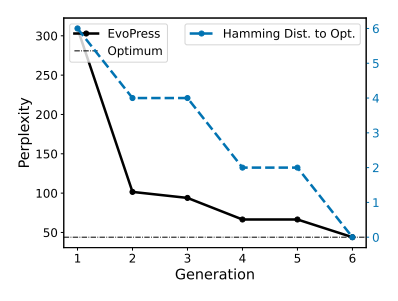
Figure 1 . Removing twelve transformer blocks from Llama-3-8B under the constraint that only pairs of consecutive blocks can be removed. EvoPress finds the optimal configuration from the 8008 possible removal combinations in generation 6.
Original paper · CC BY 4.0To test the idea, the authors took removal of consecutive block pairs from Llama-3-8B, which gives 8008 possible configurations. EvoPress reached the optimum in generation 6, starting from 16 initial candidates and evaluating 8 candidates per generation. Figure 1 shows the perplexity and the Hamming distance to the optimum across generations.
The introduction reports 56 model evaluations in total for its correlated block-dropping example.
The theory covers linear fitness functions, and Theorem 3.1 bounds the generations for the (1 + λ)-EA with level-switch mutation. Here the constraint is \(\|x\|_1 = n - k\), and the expected number of generations is \(O\big(k(n-k)/\lambda\big)\), for \(\lambda \in O(n/\log(n))\). In this setting one bit corresponds to two compression levels, and each weight of the linear function stands for a unit's saliency.
Adding offspring per generation reduces the generations needed, roughly in proportion to λ up to a reasonably large value. The authors argue that the compression landscape behaves like a linear one, based on prior work, but this is not proven for LLM compression.
Depth pruning results on Mistral-7B-v0.3
For depth pruning, the authors compare EvoPress against four baselines that each score blocks with a different rule. Shortened Llama ranks blocks by the perplexity change after each block is removed. Weight Subcloning uses a norm ratio that leaves the residual stream out of the block output. Sliding Window Cosine Similarity scores sets of consecutive blocks, while Gromov et al.
score entire removal configurations directly. EvoPress treats attention and MLP modules separately, and each module either stays or is removed. Mutation only moves compression between modules of the same type, and the initial target removes equal numbers of each.
Figure 2 plots perplexity against sparsity from 0 to 50 percent on Mistral-7B-v0.3 for every method. The authors also add a variant that removes only entire transformer blocks, labelled Attn.+MLP, for a fairer comparison. The baselines fail entirely beyond 31.25% sparsity, whereas EvoPress still finds functional submodels when half of the model is removed.
The authors saw similar collapses on Llama-2-7B, Llama-3-8B and Llama-3.1-8B. Across all tested models and sparsities, EvoPress beats every baseline, and the full results sit in Appendix D.1.
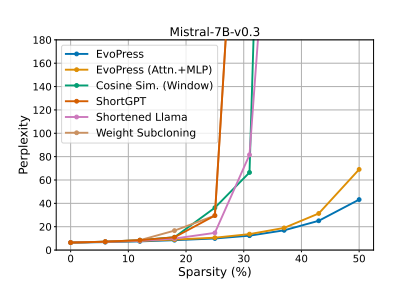
Figure 2 . Depth pruning results, on Mistral-7B-v0.3. Relative to all prior methods, EvoPress shows significantly lower PPL gap relative to the uncompressed model, with remarkably large gaps at medium compression rates.
Original paper · CC BY 4.0 · Sieberling, Oliver, Kuznedelev, Denis, Kurtic, Eldar, Alistarh, Dan · EvoPress: Accurate Dynamic Model Compression via Evolutionary Search · Original paper figure · Extracted the figure area from page 6 of the original PDF.Most scoring methods favor deeper blocks, so their removal sets end up highly similar, as Appendix Table 13 shows. The authors argue that this bias can reflect the scoring method more than the model's true behavior. EvoPress avoids such hand-made scores and offers, in the authors' view, a more accurate picture of the model. EvoPress finishes these runs in minutes, and Appendix G compares it with SLEB and BlockPruner.
Unstructured sparsity against OWL
Unstructured sparsity gives finer control than block removal, but the usual recipe spreads the same sparsity over every layer. The authors argue that some layers are more sensitive to sparsity, so a uniform budget can strongly affect the model's output. OWL scores each layer with the Layer Outlier Distribution metric, a saliency measure, and weights the sparsity profile by that score.
EvoPress is compared against both uniform sparsity and OWL, and for OWL the authors reused the original hyperparameter grid. Each EvoPress layer gets levels around the targeted average, and neighbouring levels differ by a fixed count of 1M weights.
All methods are evaluated at 70% average sparsity, with SparseGPT as the layer pruner. The authors use the same calibration data for all competitive methods, which keeps the comparison fair. On Llama-3-8B, Wiki2 perplexity was 28.76 for EvoPress, compared to 48.07 for OWL and 85.84 for uniform sparsity. On Mistral-7B-v0.3, EvoPress reached 14.42 Wiki2 perplexity, against 17.22 for OWL and 23.08 for uniform sparsity.
On Phi-3-Medium-14B, Wiki2 perplexity was 13.83 for EvoPress, versus 15.66 for OWL and 16.66 for uniform. C4 perplexity follows the same order, with EvoPress at 33.72 on Llama-3-8B and OWL at 52.32. On Llama-3-8B, the zero-shot average was 50.8 for EvoPress, compared to 48.4 for OWL and 44.1 for uniform. The authors say EvoPress beats competing methods on perplexity and zero-shot accuracy by large margins on all models.
The sparsity profile EvoPress found prunes the first blocks less aggressively than the rest of the model. It prunes blocks at the start of the second half more heavily, while the deepest blocks stay relatively dense. EvoPress gives high importance to the v proj matrices, cutting their sparsity below 45% against a 70% average. The 50% and 60% sparsity results are reported in the appendix Tables 14 and 15.
Dynamic bitwidths for quantization
Here the baseline is uniform GPTQ, and the authors add a DP allocation as a second comparison. The DP search is similar to SPDY, minimizing the Normalized Mean Squared Error between the original and compressed layer outputs. Each linear layer gets different configurations from GPTQ with a standard group size of 128. Levels are 2, 3, 4, 5 and 6 bits, and each step changes the bitwidth by one bit.
The authors target 3 bits and below, where uniform GPTQ quantization faces significant performance drops. At 3 bits on Llama-3-8B, EvoPress reaches Wiki2 perplexity 7.49, versus 12.19 for uniform and 29.00 for DP. Zero-shot averages on the same model are 64.3 for EvoPress, 60.2 for uniform and 61.3 for DP. Mistral-7B-v0.3 and Phi-3-Medium-14B show the same ordering in the same table, with smaller gaps than Llama-3-8B.
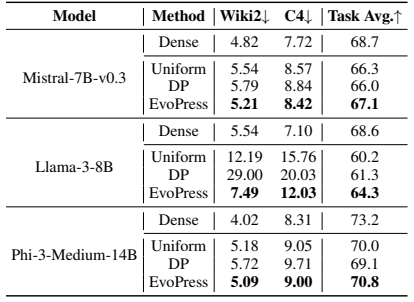
Table 3 . Performance of various profiles at 3 bit quantization, for PPL and avg. zero-shot accuracy.
Original paper · CC BY 4.0The authors also tested a restricted search limited to vLLM options, which allow only 4-bit and 8-bit quantization. vLLM also requires a uniform bitwidth within a block's query, key, value and up/gate projections. Under these constraints, Figure 4 shows mixed precision quantization still works for Llama-3-8B. For Llama-3.1-8B, the first block is compressed most, while the second and last blocks are compressed less.
Overall, EvoPress yields a 4.1 point gain on the zero-shot averages for Llama-3-8B over the uniform profile.
Search cost and the lightweight variant
The full EvoPress search converges in a few hours on a single RTX 3090 GPU at high compression granularity. The authors also present a lightweight version that uses fewer samples and converges in about 1 hour on an 8B-parameter model. Figure 3 shows Llama-2-7B reaching convergence close to the optimum in 5-6h on a single RTX 3090 with 24GB RAM.
The convergence plot tracks perplexity on the test set against generations and GPU hours, which makes the cost visible per generation.
The super-fast variant cuts the number of tokens by 4 times in the first selection step and 8 times in the last one. It also uses fewer offspring per generation, which lowers the per-generation cost further. This variant reaches similar test perplexity in a little over one GPU hour, on the same setting as Figure 3. The authors read this as evidence that the search stays robust when the evaluation budget shrinks.
The main runs use a fixed number of generations, chosen conservatively to study convergence rather than to save time. Stopping the search early can noticeably reduce runtime, and the authors say so directly. They describe a simple stopping criterion and runtime comparisons in Appendix G, so the reported times don't reflect early stopping.
Depth-pruning runs finish in a matter of minutes, according to the authors, and they compare runtime with SLEB and BlockPruner in Appendix G.
Limitations and open questions
The convergence guarantee in Theorem 3.1 covers only linear fitness functions over the hypercube. The authors argue that the compression fitness landscape behaves like a linear function, but they don't prove this for LLM compression.
Quantization options span 2, 3, 4, 5, and 6 bits, built on GPTQ with a group size of 128. The vLLM test is restricted to 4-bit and 8-bit quantization, and it requires uniform bitwidths for query, key, and value matrices and for up and gate projections. The paper does not extend the vLLM test beyond those supported options.
In depth pruning, attention and MLP modules start with equal removal counts. The authors leave open future research on removing this constraint, so the number of removed attention and MLP modules can differ. Combining different compression approaches in one search space, and finer-grained structured pruning, are left for future work.
The main runs use a fixed number of generations, chosen conservatively to study convergence behavior. Stopping the search early can reduce runtime requirements, so the reported runtimes don't show that saving. Figure 3 shows the lightweight version converging in a little over one GPU hour.
Paper info
- Authors
- Sieberling, Oliver, Kuznedelev, Denis, Kurtic, Eldar, Alistarh, Dan
- Venue
- arXiv · Preprint
- First published
- 2024-10-18
- Added
- 2026-10-29
- Updated
- 2025-7-1
- Version
- v2
- arXiv
- 2410.14649
- Original paper terms
- CC BY 4.0
- What we show
- Paper info, commentary and permitted figures from the original paper
AI commentary is a separate explanation from the original paper and may contain errors. The original paper and figures follow each source's terms of use and any rights noted separately.
Abstract
The high computational costs of large language models (LLMs) have led to a flurry of research on LLM compression, via methods such as quantization, sparsification, or structured pruning. A new frontier in this area is given by dynamic, non-uniform compression methods, which adjust the compression levels (e.g., sparsity) per-block or even per-layer in order to minimize accuracy loss, while guaranteeing a global compression threshold. Yet, current methods rely on estimating the importance of a given layer, implicitly assuming that layers contribute independently to the overall compression error. We begin from the motivating observation that this independence assumption does not generally hold for LLM compression: pruning a model further may even significantly recover performance. To address this, we propose EvoPress, a novel evolutionary framework for dynamic LLM compression. By formulating dynamic compression as a general optimization problem, EvoPress identifies optimal compression profiles in a highly efficient manner, and generalizes across diverse models and compression techniques. Via EvoPress, we achieve state-of-the-art performance for dynamic compression of Llama, Mistral, and Phi models, setting new benchmarks for structural pruning (block/layer dropping), unstructured sparsity, and quantization with dynamic bitwidths. Our code is available at https://github.com/IST-DASLab/EvoPress}.
Quote from the paper
Sieberling, Oliver, Kuznedelev, Denis, Kurtic, Eldar, Alistarh, Dan (2024). EvoPress: Accurate Dynamic Model Compression via Evolutionary Search. arXiv:2410.14649v2. https://arxiv.org/abs/2410.14649v2
BibTeX
@misc{oliver2024evopress,
  title = {{EvoPress: Accurate Dynamic Model Compression via Evolutionary Search}},
  author = {Sieberling, Oliver and Kuznedelev, Denis and Kurtic, Eldar and Alistarh, Dan},
  year = {2024},
  eprint = {2410.14649},
  archivePrefix = {arXiv},
  url = {https://arxiv.org/abs/2410.14649v2}
}