Paper commentary
EmbodiedLab: Benchmarking Embodied Agents That Act to Know
EmbodiedLab tests whether robots can act to learn physical facts
- Problem Manipulation benchmarks give the target state, and science benchmarks swap experiments for symbolic queries, so agents never have to act to find out.
- Method EmbodiedLab hides a physical parameter in each instance, unlike fixed targets, and has the robot measure it on a simulated bench.
- Results Claude Opus 5.5 scored 43.3% at T0, the best of six models, compared with 40.0% for GPT-6 Astra.
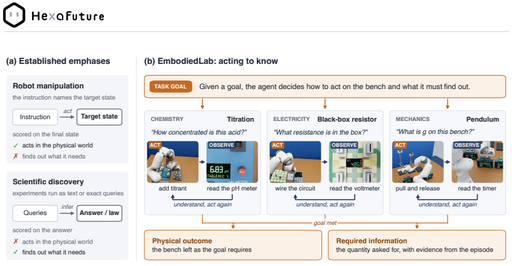
Figure 2 .Acting to know.(a) Manipulation benchmarks stop at acting to change the scene into a named target state; science benchmarks find things out without physical action. (b) Given a goal, a EmbodiedLab agent changes the state of the apparatus through interaction, observes the feedback and acts again on what it learned, in the same loop across disciplines; at submission, what it found out, the evidence it recorded and the bench state are scored.
Original paper · CC BY 4.0 · Hongcheng Gao, Zelin Zheng, Alex Zhou, Jay Zhu, Shijia Ge, Yazhe Wang, Xiping Li, Jianshu Zeng, Di Wu, Xuan Shangguan, Yexing Wan, Lingyu He, Yongli Wang, Xiaohan Yu, Zhiqi Jia, Yue Liu, Bryan Hooi, Yinpeng Dong, Wentao Zhang, Sihang Wu, Xiao He · EmbodiedLab: Benchmarking Embodied Agents That Act to Know · Original paper figure · Extracted the figure area from page 2 of the original PDF.Why benchmarks split acting from finding out
Manipulation benchmarks specify the state a scene should reach and check whether the robot gets there. Laboratory robotics benchmarks extend this form to instruments and protocol steps, so they still stop at acting to change.
Their experiments are text commands or choices of inputs, so the result comes back as text or as an exact value. Embodied question answering and interactive perception do act for information, but they only gather views or estimate a single object property.
Many real goals depend on a loop that runs from acting to observing and back to acting. Checking whether a wire is live is one example, because the agent must interact with the circuit before it knows the answer. The agent must change the system first, and what it learns decides how it proceeds next. Neither benchmark family tests this coupled cycle as one loop.
Quantitative science experiments give a controlled way to test this loop. The answer stays checkable even though the agent must find it through interaction.
One episode with a hidden parameter
An episode starts with a hidden parameter that the agent must find out by acting on the apparatus. The key idea is to hide a physical parameter, draw it anew for each instance, and make the agent measure it. So the agent must choose its own procedure, decide what to measure and read the answer from the bench.
Each instance draws a hidden θ from a distribution conditioned on public parameters ϕ, and only the scorer reads θ. The objective is a measurement, a prediction or a configuration, and its target is y* = q(θ, sτ). For a prediction or a configuration, the target therefore depends on the physical state the agent leaves behind.
It writes code that moves the arm and gripper, changes the apparatus and reads the instruments from three camera images. The agent submits once, with an answer and citations to the records it rests on, while the environment keeps logs throughout. Figure 3 traces one such episode on the lens experiment, from the hidden parameter to the scoring.
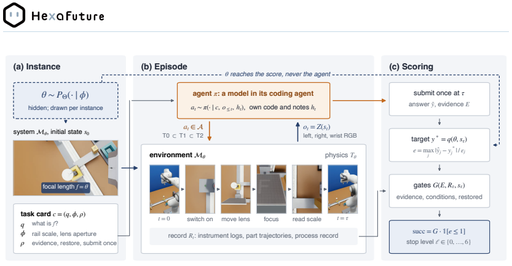
Figure 3 .One episode on the lens experiment.(a) A hidden θ fixes the system; the task card gives the objective, public parameters and rules, but no method. (b) The agent acts and observes through three cameras while the environment keeps a record. (c) Success requires every gate and an error within tolerance of the hidden target.
Original paper · CC BY 4.0Scoring runs and the three interface levels
A run's score starts from the error, the largest ratio of deviation to tolerance across the scored quantities. A run counts as a success only when that error is at most 1 and every gate holds, so success is G times the indicator of e at most 1. The gates check that every cited reading came from an instrument in this episode.
Because a failed run can still earn credit, the authors score it by milestone rather than by success alone. The six milestones run from acting on the apparatus (L1) to restoring the bench (L6). L1 to L4 earn 10 points each, while knowing the result and restoring the bench earn 30 each. So an accurate run that leaves the bench untidy scores 70, and a run that never knows the result scores at most 40.
The weights reflect the goal of the task, since the readings are a means while the result and the restored bench are the goal. L1 to L4 are minimal checks that any valid method passes, so they don't prescribe a method.
The robot moves only through seven-joint position targets and gripper commands, so the agent writes trajectories, collision avoidance and perception itself.
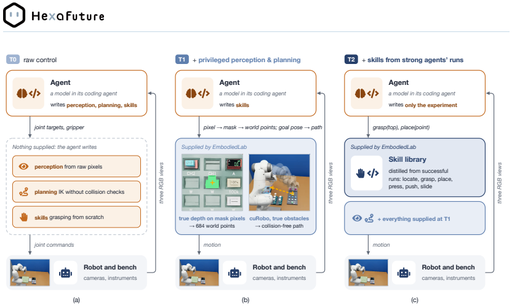
Figure 4 .Interface levels.Robot, bench and camera views are the same at every level; each level supplies more between the agent and the robot. (a) T0 supplies only the camera images, the robot state, joint position targets and gripper commands. (b) T1 supplies ground-truth depth on segmentation masks and cuRobo [41] planning against the true obstacles, shown with real outputs of T1 runs. (c) T2 adds a skill library, distilled from the successful runs of the strongest agents, in the agent’s workspace.
Original paper · CC BY 4.0The authors treat T2 as a diagnostic level, because its skills reuse known solutions to the same experiments. At every level the agent still reads, records and analyzes the experiment for itself.
Headline success rates at T0
Claude Opus 5.5 leads at T0 with a success rate of 43.3%, which is the best score among the six models. GPT-6 Astra follows at 40.0%, so the two strongest agents sit well above the rest. GPT-6.1 Sol reaches 28.3%, which is the highest score among the remaining agents. Every other agent scores at most 28.3%, so the gap between the top two and the rest is large.
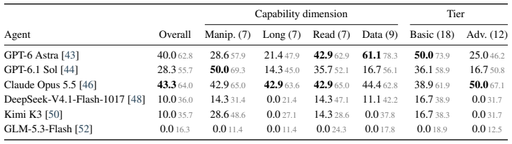
Table 2 .Main results at T0.Success rate (%) with the process score (0–100) in grey, overall and per capability dimension and tier; numbers of experiments in parentheses; best success rate in bold.
Original paper · CC BY 4.0DeepSeek-V4.1-Flash-1017 and Kimi K3 each reach 10.0% at T0. GLM-5.3-Flash scores 0% at T0, so it solves none of the experiments in that run set. None of these three agents solves an advanced experiment. The process scores rank the agents in the same order, from 64.0 down to 16.3.
Claude Opus 5.5 scores between 42.9% and 44.4% in every capability dimension, which makes it the most even agent. It succeeds more often on advanced experiments, at 50.0%, than on basic ones, at 38.9%. The per-dimension figures for every agent appear in Table 2.
The authors conclude that acting to know is far from solved, since the three weakest agents reach at most 10%.
What perception, planning and skills change
Perception and motion planning help little, changing the success rate by at most 10 points. From T0 to T1, the success rate rose by 1.7 to 10.0 points, so the gain stayed small. Where success rose, the gain came through observing, such as 42.9% to 71.4% for GPT-6 Astra in fine reading.
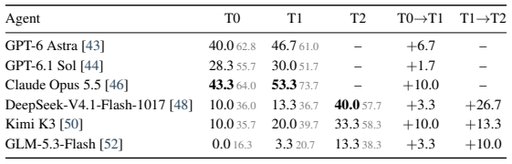
Table 3 .Success across levels: success rate (%) with the process score (0–100) in grey, and the change in success rate in percentage points. T2 skills are distilled from the successful runs of the GPT and Claude agents and are not given back to them.
Original paper · CC BY 4.0The DeepSeek, Kimi and GLM agents receive these skills, and the skills are not given back to the agents that produced them. Manipulation skills raise success by 10.0 to 26.7 points from T1 to T2 for those three agents. For DeepSeek, the T2 gain brings its success to the T0 level of GPT-6 Astra.
Skills supply the manipulation, but they don't supply the experiment itself. The three agents still complete their readings in 47% to 77% of runs, against 90% for Claude Opus 5.5 at T1. Claude Opus 5.5 solves at T1 the three experiments that no agent solved at T0. No agent that receives skills reaches the strongest agent at T1.
Where runs stop and why
Success factorizes over the six milestones, so each stage pass rate is a conditional probability. The product of the stage pass rates gives the success rate, \( \Pr[\mathrm{succ}] = \prod_{l=1}^{6} \pi_l \), with \( \pi_l = \Pr[\ell \ge l \mid \ell \ge l-1] \). The stage with the pass rate furthest from one is where the agent loses the most runs.
The three strongest agents pass L1 to L4 at rates from 0.81 to 1.00. Their lowest rates fall at L5, knowing the result within tolerance (0.73 to 0.82), and at L6, restoring the bench (0.55 to 0.79). They know the result at similar rates, from 51.7% to 55.0%, so restoring the bench separates them.
The other three agents lose most runs earlier. 60% of DeepSeek runs, 67% of Kimi runs and 90% of GLM runs stop while the apparatus is being changed or observed. For those weaker agents, acting accounts for 64% to 69% of failed runs, and contact alone for 45% to 62%. The authors base these causes on each run's first decisive error.
Limits of the evidence
The T2 comparison rests on a narrow base, because only the DeepSeek, Kimi and GLM agents ran at that level. Their skills came from successful runs of the GPT and Claude agents, so the T2 gains show transfer from other agents' solutions. The authors call T2 a diagnostic level, and they don't include it in the released protocol.
The evaluation covers six models from five developers, each run in its developer's coding agent. Every agent ran at its middle reasoning setting, so the paper doesn't show how other reasoning settings would change the ranking. The headline ranking uses a single submission per run at T0, with the strongest agent at 43.3%.
The tolerances range from 0.2% to 5%, and the reference solution sets them from the instruments. The reference solution is scripted and doesn't use a language model, so it shows solvability rather than a strong baseline. The process score weights are a design choice, since the authors set them to follow the goal of the task.
The failure causes depend on how the authors attribute each failed run to its first decisive error. The stage analysis of the three strongest agents rests on the same attribution, and the paper gives the GPT-6 Astra stopping share as 19%.
The experiments run in a physics-based simulated laboratory, so the paper doesn't test the same tasks on a real bench. Three experiments remain unsolved by any agent at T0, and the paper states that Claude Opus 5.5 solves them at T1. The gap between the best agent and the rest is 10 to 27 points for manipulation skills, which the authors measured on only four apparatus carrying both tiers.
Paper info
- Authors
- Hongcheng Gao, Zelin Zheng, Alex Zhou, Jay Zhu, Shijia Ge, Yazhe Wang, Xiping Li, Jianshu Zeng, Di Wu, Xuan Shangguan, Yexing Wan, Lingyu He, Yongli Wang, Xiaohan Yu, Zhiqi Jia, Yue Liu, Bryan Hooi, Yinpeng Dong, Wentao Zhang, Sihang Wu, Xiao He
- Venue
- arXiv · Preprint
- First published
- 2026-10-26
- Added
- 2026-10-29
- Updated
- 2026-10-26
- Version
- v1
- arXiv
- 2610.35385
- Category
- cs.RO
- Original paper terms
- CC BY 4.0
- What we show
- Paper info, commentary and permitted figures from the original paper
AI commentary is a separate explanation from the original paper and may contain errors. The original paper and figures follow each source's terms of use and any rights noted separately.
Abstract
Embodied agents are expected to accomplish real-world goals by deciding for themselves how and when to interact with their surroundings. For many such goals, changing the physical state of the world is the means rather than the end: the agent changes the state of a system through interaction, observes the feedback, and explores until it either achieves the goal itself (e.g., discovering physical laws) or learns what the goal requires; it acts to know. Manipulation benchmarks stop at acting to change, with the target state given; scientific discovery benchmarks evaluate knowing but replace physical experimentation with symbolic actions or numerical queries. We introduce EmbodiedLab, a benchmark in which a robot must act to know. Quantitative science experiments make this setting controllable: the parameters of the system are resampled for every instance, so the result cannot be known in advance, yet it can be scored exactly. Across 30 experiments in five disciplines on 14 apparatus platforms, the agent receives an objective and the apparatus, chooses its own procedure, and operates a physics-based simulated laboratory, reading the instruments through its cameras. Evaluation checks what the agent came to know, grounded in readings recorded during the episode, as well as the physical state the task requires; every experiment is verified to be solvable. We evaluate six frontier models in their developers' coding agents with native observation and control, with added perception and motion planning, and with manipulation skills distilled from the strongest agents. With native control, even the strongest agent succeeds less than half the time; for every agent, most failures arise in interacting with the apparatus, and manipulation skills help weaker agents more than perception and planning. The benchmark and its evaluation code are available at https://github.com/HexaFuture/EmbodiedLab.
Quote from the paper
Hongcheng Gao, Zelin Zheng, Alex Zhou, Jay Zhu, Shijia Ge, Yazhe Wang, Xiping Li, Jianshu Zeng, Di Wu, Xuan Shangguan, Yexing Wan, Lingyu He, Yongli Wang, Xiaohan Yu, Zhiqi Jia, Yue Liu, Bryan Hooi, Yinpeng Dong, Wentao Zhang, Sihang Wu et al. (2026). EmbodiedLab: Benchmarking Embodied Agents That Act to Know. arXiv:2610.35385v1. https://arxiv.org/abs/2610.35385v1
BibTeX
@misc{gao2026embodiedlab,
  title = {{EmbodiedLab: Benchmarking Embodied Agents That Act to Know}},
  author = {Hongcheng Gao and Zelin Zheng and Alex Zhou and Jay Zhu and Shijia Ge and Yazhe Wang and Xiping Li and Jianshu Zeng and Di Wu and Xuan Shangguan and Yexing Wan and Lingyu He and Yongli Wang and Xiaohan Yu and Zhiqi Jia and Yue Liu and Bryan Hooi and Yinpeng Dong and Wentao Zhang and Sihang Wu and Xiao He},
  year = {2026},
  eprint = {2610.35385},
  archivePrefix = {arXiv},
  url = {https://arxiv.org/abs/2610.35385v1}
}