Paper commentary
SmolWAM: A Latent World-Action Model for Robotic Manipulation on Edge Devices
SmolWAM keeps most of a video world-action model's LIBERO success at lower cost
- Problem Video-based world-action models predict robot actions and future observations, but their inference stack was built for video generation. It takes 624 ms and 42.6 TFLOP per 16-action chunk, too costly for edge devices.
- Method SmolWAM keeps the pretrained trunk of Cosmos Policy and rebuilds its inference interface. It feeds single-frame latents, uses cached BERT text features, prunes to 12 of 28 blocks, and reads actions and future latents in one pass.
- Results SmolWAM succeeds in 95.5% of 400 LIBERO episodes, against 98.2% for the teacher. It runs at 57 ms per chunk, 11 times faster than its teacher.
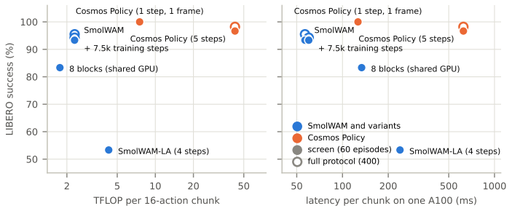
Figure 3 :LIBERO success against costfor every row of Table 1 with an A100 cost. Filled markers are the 60-episode screen and hollow markers the 400-episode protocol (the teacher’s as in Table 1); the 8-block latency was measured on a shared GPU.
Original paper · CC BY 4.0 · Timi Owolabi, Hikmah Olawore, Frances Adelakun, Ayotomiwa Oyewumi · SmolWAM: A Latent World-Action Model for Robotic Manipulation on Edge Devices · Original paper figure · Extracted the figure area from page 8 of the original PDF.Where the teacher's inference cost comes from
World-action models (WAMs) output a robot's next actions and also the observations those actions should bring about. Cosmos Policy is built on the Cosmos-Predict2 video model and handles actions, future observations and values as latent frames. It reaches 98.5% success on LIBERO, yet its inference stack was built for video generation rather than for control.
The stack includes a 4.8B-parameter T5-XXL text encoder, and a VAE that encodes a 33-frame clip for every query. Five denoising steps then run a 2B-parameter transformer over 1,764 tokens. Each 16-action chunk costs 624 ms, 42.6 TFLOP and 7.55 GiB on an A100, even with cached text features. The denoiser has 28 blocks and 1.96B parameters, and it denoises nine latent frames of 196 tokens each.
Those frames hold a blank frame, the robot states, two camera latents, a 16-action chunk, and future states, camera latents and a value. The authors argue that much of this cost comes from an interface built for video generation, not from what control needs.
Efficient policies usually drop either the world model or the video prior to save compute. SmolVLA and TurboVLA predict only actions, and Fast-WAM skips future prediction at test time. The authors ask whether a strong pretrained WAM can be made small while it still predicts the future. SmolWAM answers by keeping the teacher's trunk and rebuilding its inference interface instead.
What SmolWAM keeps and what it changes
SmolWAM keeps the teacher's trunk weights, token positions, and rectified-flow readout. The teacher's video diffusion transformer has 28 blocks and 1.96B parameters, and SmolWAM starts from that trunk. The rectified-flow readout predicts a velocity, which gives a closed-form clean estimate from the noisy input.
A 0.5M-parameter adapter maps these single-frame latents to clip-mode latents. The T5-XXL text encoder is replaced by cached BERT-base features of the instruction. The BERT features are zero-padded to 512 positions, because the trunk's zero-padded positions act as an attention sink.
Blocks 3 to 22 are individually close to the identity, which is why the authors pruned them. Applied zero-shot, most of these changes break the trunk, so the authors apply them through distillation. The student trains in the teacher's 1,764-token layout for the first 1,000 of 5,000 steps before switching to the compact layout.
SmolWAM evaluates its trunk once at τmax and reads actions and future latents from that single pass. The teacher runs five denoising steps per chunk, so the single pass removes most of its inference cost. SmolWAM succeeds in 95.5% of 400 LIBERO episodes, against 98.2% for the teacher.
Single-frame latents and attention-sink padding
The Wan2.1 encoder used here has 54M parameters. Zero-shot, these single-frame latents raise the teacher's normalized one-step action L1 from 0.0089 to 0.038. A 0.5M-parameter adapter maps the latents toward clip-mode latents, which restores the error to 0.0092.
The text path is harder, because the teacher's T5-XXL context already holds padding that the trunk relies on. The trunk's cross-attention uses bias-free key and value projections, so zero-padded positions give zero logits and zero values. Those roughly 500 padded positions act as an attention sink [38]. Restoring the removed softmax mass analytically returns the teacher to 5/5, matching the padded attention to 6×10⁻⁸.
SmolWAM therefore zero-pads the BERT features to 512 positions.
The authors keep the attention-sink padding in place before they cut any blocks. The next step, block pruning, starts from a trunk whose text path already behaves like the teacher's.
Choosing blocks to cut and reading out the chunk
SmolWAM ranks the teacher's blocks by block influence, which is one minus the cosine similarity between a block's input and output. Blocks 0, 1, and 25 to 27 score highest, while blocks 3 to 22 are individually close to the identity. Removing block 1, 26, or 27 fails every zero-shot episode, so the authors don't treat the blocks as independent.
Skipping block 7, 14, or 20 alone fails none, but skipping the four near-identity blocks 12 to 15 together fails all. The kept set is blocks 0 to 2 and 19 to 27, which gives SmolWAM 0.85B parameters.
The authors read the state-conditioned action queries as a learned layout rather than a fixed one. Dropping the blank frame raises the error to 0.30, and dropping the state frame raises it to 0.058. Compacting the vector frames to 28 tokens raises the error to 0.21, so that layout change matters too.
It computes the clean estimate from the velocity, so the readout doesn't need a denoised future. Actions and future latents are both read from this single clean estimate. The future latents form the world head, which is supervised in training and never decoded.
The student then trains on 68,830 observations sampled every fourth step from 1,700 successful LIBERO demonstrations. It then moves to the compact layout, with 2×10⁻⁵ for inherited weights and 10−4 for new weights.
Distilling the student in two layouts
SmolWAM's student trains on 68,830 observations, sampled every fourth step from 1,700 successful LIBERO demonstrations. The targets are the teacher's one-step predictions of the action chunk and the future latents, cached at fixed noise in 66 min on one A100. The authors borrow this setup from pruning and distillation work on language models, so the student learns from data and teacher together.
The loss adds four L1 terms, pairing the student's action and latent estimates with both the demonstrations and the teacher. Terms for the state and value frames join the loss with weight 0.1 while those frames exist.
Pruning and compaction shift the input distribution in different ways, so the authors train in two layouts. The student starts from the kept teacher blocks and trains in the 1,764-token layout for the first 1,000 of 5,000 steps. It then moves to the compact layout for the remaining steps, which the paper calls a layout curriculum. Zero-shot, dropping the blank frame raises the action error to 0.30, so the authors read the layout as learned rather than fixed.
AdamW uses a learning rate of 2×10⁻⁵ for inherited weights and 10−4 for new weights. Training uses batch 32 in bf16 and takes 3.6 h on one A100. The split learning rate lets the kept teacher weights change slowly while the new weights adapt faster. Single-frame latents raise the teacher's action error from 0.0089 to 0.038, so the student must recover that gap during training.
Does the compact model keep the teacher's success
SmolWAM succeeds in 382 of 400 LIBERO episodes, or 95.5%, against the teacher's 393 of 400, or 98.2%. The 95% Wilson intervals run from 93.0 to 97.1 for SmolWAM and from 96.4 to 99.1 for the teacher. The teacher's suite and full numbers come from an earlier evaluation pipeline on an L4, so the rows aren't one controlled run. Table 1 lists the screen, the four suites and the full protocol, with cost columns for each row.
The authors say both rows start from the same initial states, shown in App. A.6.
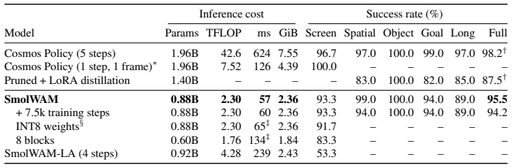
Table 1 :LIBERO success and inference cost.Screen: 60 episodes; suites and Full: 400. Cost per 16-action chunk on one A100 (batch 1, bf16); Params excludes the V AE and text encoder; TFLOP counts network and V AE encoder; GiB: peak memory.∗Unmodified weights, single-frame latents via the 0.5M-parameter adapter.†Suites and Full from an earlier evaluation pipeline, on an L4 (Cosmos Policy reports 98.5% [16]).‡Shared GPU.§Simulated: INT8 weights, bf16 kernels.
Original paper · CC BY 4.0The paper detects no difference on Spatial and Object. The deficit sits in the multi-step Goal suite, 94 vs. 99, and the Long suite, 89 vs. 97. Longer training doesn't help, and the 8-block variant falls to 83.3% on the screen. An earlier student with 8 blocks and LoRA distillation reached 87.5% on the full protocol.
SmolWAM produces a 16-action chunk in 57 ms with 2.30 TFLOP, versus 624 ms and 42.6 TFLOP for Cosmos Policy. That makes SmolWAM 11 times faster than its teacher on one A100. Of the 57 ms, the transformer takes 37, the VAE encode takes 13, and preprocessing takes 7.
Does the world head still forecast motion?
The world head is the set of future latents that SmolWAM reads out in its single action pass. Those future latents are supervised during distillation against the teacher's one-step predictions. The authors never decode these latents into images during inference, so the forecast is judged through the latents themselves. They test the forecast on 96 held-out contexts, comparing the view 16 steps ahead with what the model predicts.
Measured as latent L1, the forecast reaches 0.101, while copying the current frame reaches 0.133. That is a 24% reduction relative to copying the current frame.
Motion gets a second check from RAFT optical flow, computed on the predicted future and on the real future. The end-point error between the two flows falls from 1.63 pixels to 1.43 pixels. Those decoded images blur the arm's appearance, which the authors show only for display in Figure 2.
LPIPS stays at the copy-frame level, at 0.128 for the forecast against 0.115 for copying. The forecast is therefore no better than copying in appearance. The authors read this as the world head capturing motion rather than texture. They didn't evaluate forecasts on other robotics benchmarks, because the paper evaluates SmolWAM only on LIBERO.
Richer world-action components at this scale
The authors ported components of ABot-M0.5 onto SmolWAM to build a latent-action variant called SmolWAM-LA. The latent-action variant is the paper's test of whether richer world-action components help a compact model.
The comparison shows the richer variant is both slower and less successful than the plain SmolWAM.
Reward fine-tuning of the world head collapses SmolWAM-LA's success to 5.0–16.7%. The same fine-tuning worsens every image metric. Earlier, the paper names latent-action cascades as a path that degrades control.
So at this scale, the extra components hurt rather than help the compact model. SmolWAM instead reads future latents from its own action pass, avoiding a separate latent-action stage. The authors tie this result to the small size of the model, which keeps the trunk's pretrained behavior intact.
The authors evaluate SmolWAM only on LIBERO. They leave RoboCasa and real-robot settings for future work.
Paper info
- Authors
- Timi Owolabi, Hikmah Olawore, Frances Adelakun, Ayotomiwa Oyewumi
- Venue
- arXiv · Preprint
- First published
- 2026-10-9
- Added
- 2026-10-20
- Updated
- 2026-10-9
- Version
- v1
- arXiv
- 2610.13740
- Category
- cs.RO · cs.LG
- Original paper terms
- CC BY 4.0
- What we show
- Paper info, commentary and permitted figures from the original paper
AI commentary is a separate explanation from the original paper and may contain errors. The original paper and figures follow each source's terms of use and any rights noted separately.
Abstract
World-action models (WAMs) predict a robot's actions together with the observations those actions will produce. However, the strongest models rely on video diffusion transformers that are far too computationally expensive for resource-constrained edge devices. We present SmolWAM, a latent WAM that we derive from the 2B-parameter Cosmos Policy by keeping its pretrained trunk and rebuilding its inference interface: single-frame visual latents, cached text features that preserve the trunk's attention sinks, 12 of 28 transformer blocks, and 1,008 tokens from which actions and future visual latents are read out in one rectified-flow step. Trained in 3.6 GPU-hours, SmolWAM succeeds in 95.5% of 400 LIBERO episodes at 57 ms and 2.3 TFLOP per 16-action chunk with 2.4 GiB of GPU memory, 11x faster than its teacher with 18.5x fewer FLOPs and 3.2x less memory, and its world head still forecasts scene motion.
Quote from the paper
Timi Owolabi, Hikmah Olawore, Frances Adelakun, Ayotomiwa Oyewumi (2026). SmolWAM: A Latent World-Action Model for Robotic Manipulation on Edge Devices. arXiv:2610.13740v1. https://arxiv.org/abs/2610.13740v1
BibTeX
@misc{owolabi2026smolwam,
  title = {{SmolWAM: A Latent World-Action Model for Robotic Manipulation on Edge Devices}},
  author = {Timi Owolabi and Hikmah Olawore and Frances Adelakun and Ayotomiwa Oyewumi},
  year = {2026},
  eprint = {2610.13740},
  archivePrefix = {arXiv},
  url = {https://arxiv.org/abs/2610.13740v1}
}