Paper commentary
HyperCLOVA X THINK Technical Report
HyperCLOVA X THINK trains a Korean reasoning model with less compute
- Problem High-quality Korean text is far scarcer than English text, and Korean-specific filtering has been largely underexplored. Building a competitive Korean reasoning model has therefore required heavy training compute.
- Method HyperCLOVA X THINK trades depth for width in a Peri-LN Transformer.
- Results THINK with Vision scored 46.4% on KCSAT STEM, compared to 40.3% for GPT-4.1. The model reaches competitive accuracy on Korea-focused benchmarks at substantially lower training compute.
Why Korean reasoning models are costly to build
Reasoning models such as GPT-o1, R1 and QwQ show that multi-step inference can widen what LLMs are used for. The authors add a second demand, sovereign AI, which asks for linguistic fluency and cultural sensitivity tailored to one region. Korea is their immediate focus, so the model has to serve Korean users well from the start. The data side is the first obstacle, because high-quality Korean text is far scarcer than English or Chinese text.
Korean-specific filtering schemes have been largely underexplored in the literature, so the authors had to design their own. The second stage is more selective and retains just 1 – 20 % of the documents it sees.
Their pipeline rewrites existing documents and generates new text from curated seed prompts. Filtering and verification sit at the core of this process, so only high-fidelity Korean data is kept.
So the question is whether a regionally focused model can reach competitive reasoning scores with substantially less training compute. They pair this corpus with a compute-memory-balanced Peri-LN Transformer scaled with the µP framework. A three-stage curriculum then grows the context window to 128k tokens, so the model can handle long documents in one pass.
Post-training then combines supervised fine-tuning with Reinforcement Learning from Verifiable Rewards. On Korea-focused benchmarks, the model reaches competitive accuracy among similarly sized models while needing substantially lower training compute.
Trading depth for width, and keeping training stable
The central idea is to spend a fixed parameter budget on width rather than on depth. The feed-forward cost grows only linearly with \(L\), so widening that layer keeps representational capacity without the same penalty.
The authors began with a 3B-parameter baseline of 26 Transformer blocks and a feed-forward hidden size of 7,168. They cut it to 18 layers, which is 30% shallower, and raised the hidden size to 11,264, which is 57% wider, keeping the total parameter budget. For an 8K-token sequence, this lowers theoretical compute by 13.7% TFLOPs. The authors read this as width preserving modeling quality while saving hardware, based on one pair of configurations.
They then port the chosen settings zero-shot to each production scale, following the µTransfer procedure. Maximal Update Parametrization keeps update magnitudes consistent across configurations, so large models inherit stable gradient norms without retuning.
Peri-LN normalizes both the input and the output of every Transformer sub-layer. This bounds hidden-state variance so that it grows at most linearly with depth, and it suppresses the massive activations seen in Pre-LN models. The authors pair it with µP, because µP keeps optimization statistics steady across width and depth, so small-scale tuning transfers.
To test Peri-LN at scale, the authors trained two Llama-style 8B models, one with Pre-LN and one with Peri-LN, on the same open corpus. Its training loss was 15% lower on average within the same wall-clock budget, so the authors made Peri-LN the default normalization. They report no added computational cost for this gain.
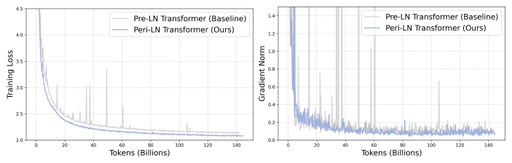
Figure 2 : Performance comparison between 8 B-parameter Pre-LN and Peri-LN Transformers dur- ing pre-training. Each model size excludes the embedding parameters.
Original paper · CC BY 4.0Two-tier filtering and synthetic Korean data
The data pipeline first standardizes raw documents into one schema, then annotates them with quality signals and masks personal information. Filtering then runs in two tiers, one based on heuristics and one based on learned scores.
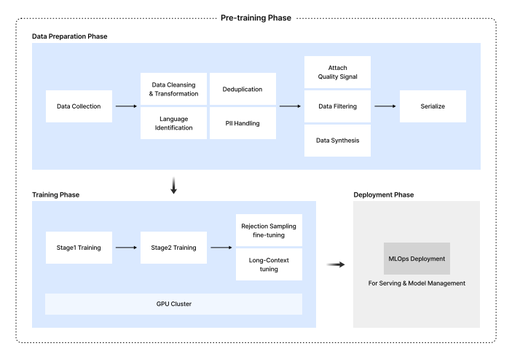
Figure 1 : Pre-training pipeline of HyperCLOV A X THINK. (1) Data-Preparation Phase: A scal- able pipeline collects raw corpora, carries out cleansing, language identification, deduplication, and masking; attaches quantitative quality signals, applies filtering, synthesizes targeted data, and seri- alizes the resulting shards (2) Training Phase: A dedicated three-stage curriculum, with each stage optimized for its specific objective, progressively builds and refines the model’s capabilities.
Original paper · CC BY 4.0 · NAVER Cloud HyperCLOVA X Team · HyperCLOVA X THINK Technical Report · Original paper figure · Extracted the figure area from page 3 of the original PDF.The first tier redesigns the heuristic rules for Korean morphology and computes five signals per document, including symbol-to-word ratio and masked-PII ratio. Thresholds come from manual inspection and are adjusted per source domain, such as blogs or wikis, to cut noise without giving up too much recall. The second tier trains FastText and transformer encoders under two regimes.
In the binary regime, wiki-like text is positive and noisy web pages are negative, which yields a continuous quality score. The ordinal regime asks a language model for ratings from 0 to 5 on educational utility, informativeness and narrative coherence.
A document must pass a stage-specific mix of heuristic thresholds and model scores, and near-duplicates are removed with a MinHash index. On the sub-sampled slice, the total yield is 9.59% at Stage 1 and 1.36% at Stage 2. Blog pages keep 57.74% at Stage 1, while web pages keep only 4.49%. The authors describe this as aggressive compression, with the crawl shrinking by roughly one to two orders of magnitude.
Synthetic data targets domains where Korean content is sparse, such as education, law and historical facts. Each output passes the same filters, plus checks for repetitive templates, logical inconsistencies and machine-like phrasing. Only data that pass every check are merged, and they enter both Stage 1 and Stage 2.
Three stages from 8K to 128K tokens
THINK's pre-training runs in three stages, each with its own capability target and its own data mix. Stage 1 builds a general knowledge base from a multilingual corpus, principally Korean and English. The authors allocate computational FLOPs to the phases with the highest marginal utility. Stage 1 trains on sequences up to 8K tokens for 6 trillion tokens in total.
The learning rate rises linearly over the initial 5,000 steps to a peak of 1.59e-3, set by µP scaling. A cosine schedule then anneals it to 1.59e-4, which is 10 % of the maximum.
Stage 2 refines domain expertise by adding 1 trillion tokens at the same 8K context length. A 2,000-step warm-up smooths the move to the revised data distribution. The authors down-weight generic web text and raise the weight of domain corpora, including the synthetic data from Section 2.1. The learning rate stays at 1.59e-4 for 80 % of training, which the authors follow from Bi et al.
(2024). The data mix is rebalanced during the final 10 % of steps, following Blakeney et al. (2024).
Standard corpora skew toward short documents, so naively over-sampling long texts can disrupt training stability. The authors use length-based, proportion-preserving resampling, which keeps each length bucket's share of total tokens. At each expansion, θ rises from 500 K to 5 M, then to 20 M, and finally to 100 M.
This synthetic dataset spans up to 128 K tokens.
Post-training: one template, SFT, RLVR, length control and RLHF
One chat template covers both modes, so users don't have to switch between a reasoning model and a chatbot. The reasoning mode writes a think segment before the answer, while the non-reasoning mode gives the response directly. The SFT data mixes mathematics, coding, STEM and general samples, and the reasoning share is 39.8%. THINK keeps the reasoning data's think and response parts apart, with the think part free-form and the response concise.
Format checks, language filters and verifiability checks clean the data, and an LLM-as-a-Judge scores non-reasoning samples for helpfulness and safety. Training runs for 4 epochs with early stopping on validation accuracy. The authors observe that a checkpoint from later epochs explores less in the next phase.
RLVR uses GRPO, which computes a baseline advantage from multiple generations per prompt instead of a separate value estimate. The authors drop the KL penalty, because it restricts exploration and requires inference from a reference model. Constant normalization reduces the bias that arises when harder prompts produce longer responses. Offline filtering runs once on SFT checkpoint samples and removes prompts whose average accuracy is exactly 0.0 or 1.0.
Because offline filtering is static, it can't follow the model as its performance improves during training. Online filtering drops, within each batch, prompts whose responses are all correct or all incorrect. The authors observe that online filtering still adds substantial benefit after offline filtering.
The format reward is the fraction of format rules that a response satisfies. The language reward is the ratio of characters written in the same language as the prompt. The verifiable reward is binary: a fully correct response gets 1.0 and an incorrect one gets 0.0. For overlong responses, the authors combine a soft overlong penalty with overlong loss masking.
Harsh penalties on truncated samples would penalize valid reasoning only because of length, so the authors avoid them.
Length controllability appends 'Think for maximum N tokens' to the instruction, with N drawn from the budget set 1024, 2048, 4096, 8192 and 16384. This budget set is narrower than the U[100,4000] range that the original L1 paper samples from. Training runs about 300 steps on L1-Exact to acquire length control, then about 100 steps on L1-Max to shorten reasoning where possible.
A reward model trained on human preference data scores only the response part, not the think part. GRPO then maximizes that reward, with a KL penalty of 0.1 toward the SFT checkpoint. Running RLHF after RLVR slightly degraded the reasoning gained in RLVR, so the authors interleave RLVR and RLHF batches. Each batch mixes RLVR and RLHF samples, which keeps the gains of both stages.
Korea-centric benchmark results
THINK is measured against Qwen3-14B, Qwen3-32B, QwQ-32B and EXAONE-Deep-32B, all reasoning models of comparable size. Where a model's original paper reports a score, the authors reuse that number; otherwise they run the model themselves. All runs use zero-shot chain-of-thought prompting, with the maximum generation length set to 4096 tokens.
THINK samples at temperature 0.5 and top-p 0.95, while the other models use their authors' recommended settings. The authors also generate the reasoning chain first and then request the answer through an answer prefix, because models often skip the final answer in a single pass.
On KMMLU, THINK scores 69.7, compared to 63.5 for Qwen3 32B. On KoBALT-700, THINK reaches 48.9, against 41.4 for Qwen3 32B. On HAERAE-1.0, THINK scores 87.8, where Qwen3 32B reaches 75.1. CSAT is the exception, where THINK's 83.2 sits below 84.7 for QwQ-32B. The authors conclude that THINK surpasses the other baselines, but the CSAT row shows that this doesn't hold on every benchmark.
Averaged by category in Figure 5, THINK leads General Aptitude at 69.4, versus 65.4 for Qwen3 32B.
The authors link the result to cost, since THINK's base model needed fewer GPU hours than similar sized models. The bar in Figure 6 covers the base model, so it describes pre-training cost rather than the post-trained model. The authors attribute the lower cost to a high-efficiency architecture and training grounded in high-quality data, not to model scale.
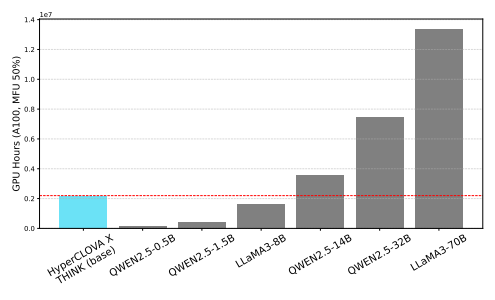
Figure 6 : Training Efficiency (GPU Hours / A100 / MFU 50%)
Original paper · CC BY 4.0Cross-lingual consistency and translation
The consistency test pairs parallel English and Korean multiple-choice questions drawn from Global-MMLU-Lite. THINK keeps only culturally agnostic items, so no gold answer depends on the source language. Each item lands in one of four cases: correct in both languages, correct only in English, correct only in Korean, or wrong in both. The Caliper framework produces these predictions, and the four-way split separates bilingual robustness from overall accuracy.
THINK's both-correct ratio is 74.5%, compared to 81.0 for Qwen3 32B and 62.5 for EXAONE Deep 32B. Its asymmetric errors total 16.5%, made up of 12.0 for English-correct cases and 4.5 for Korean-correct cases. THINK trails Qwen3 32B, which the authors describe as extensively trained. The authors note that THINK was tuned mainly on the Korean and English pair, with a fraction of the compute.
THINK's overall consistency is higher than EXAONE Deep 32B's, which suggests that data curation can sometimes outweigh parameter count.
The Flores sub-samples are translated in both directions, with the same one-shot example in each model's prompt. Each translation is scored with xCOMET-XL, which the authors say correlates more strongly with professional human judgment than BLEU and ChrF. On Ko→En, THINK scores 90.3, behind Qwen3 32B at 92.8. On En→Ko, THINK reaches 85.8, above Qwen3 32B at 85.3 and EXAONE Deep 32B at 77.5.
The authors read the En→Ko result as evidence that the pipeline keeps English knowledge and renders it into Korean. They didn't test language pairs beyond English and Korean, so the translation claim rests on these two directions.
Vision-language reasoning on KCSAT STEM
The vision branch starts from the text SFT pipeline and adds visual modules to build a vision-language model. Each KCSAT STEM item is shown to the model as an image holding equations, tables, diagrams, and scientific text. The model must first recognize the visual content and then run multi-step logical reasoning over it. The vision encoder is SigLIP-2, operating at 512×512 pixels per grid.
The LLM backbone connects to the encoder through an LLaVA-1.5-HD-based framework with a C-Abstractor connector. That framework supports up to 1.57M total pixels distributed over 6 grids.
The training pipeline inserts a dedicated vision SFT stage between text SFT and multimodal RLHF. They first apply SFT on instruction-oriented text, then multimodal SFT on paired image-text data. Multimodal RLHF then covers both text-only and multimodal instructions, which sets this ablation apart from text-only pipelines. Reasoning Mode is toggled by explicit prompting during both training and inference, and ablations compare reasoning-enabled and baseline prompt formats.
The evaluation uses the multimodal Korean Educational Test benchmark, focused on its hardest subset, the KCSAT STEM subjects. The set has 206 items across mathematics, physics, chemistry, earth science, and biology, at basic and advanced levels. Each subject and level has only 20 to 24 items, so individual cell scores are coarse. THINK with Vision reaches an overall accuracy of 46.4%, against 40.3% for GPT-4.1 under the same protocol.
Only OpenAI-o1 scores higher, so the vision variant ranks second in this single evaluation.
Disabling Reasoning Mode drops the vision model to 21.7% overall. The authors read this drop as evidence that reasoning learned from text carries over to vision-centred STEM items. Adding multimodal SFT slightly lowers text-only reasoning performance, which the authors attribute to the difficulty of optimizing both modalities. They didn't test a fully balanced model, and they leave that balance for future tuning.
Where the HyperCLOVA X THINK claims stop
The authors state that the harmlessness of generated text can't be fully guaranteed, so the model's answers are a real risk. They say they took safety measures under NAVER AI Ethics guidelines, but those measures don't remove the risk.
Offline difficulty filtering runs once, before training begins, so it stays static as the model improves. A prompt that was once challenging can become solvable, yet the fixed filter keeps it in the training set. Online filtering is the authors' answer, removing prompts whose sampled responses are all correct or all incorrect within each batch.
This dynamic approach keeps the training set matched to the model's evolving capabilities.
The pruned and distilled version of THINK is still under preparation, so the smaller model isn't available yet. The authors plan to open-source it under a business-friendly license, but they haven't released it.
Where no published score existed, the authors ran the baselines themselves with a 4096-token CoT limit. Their in-house toolkit isn't public yet, so outsiders can't yet reproduce those numbers. The vision results come from one 206-item benchmark, with 20 to 24 items per subject and level. The cross-lingual consistency test covers only the Korean and English pair.
They didn't test other language pairs, so their bilingual claims stay within these two languages.
Paper info
- Authors
- NAVER Cloud HyperCLOVA X Team
- Venue
- arXiv · Preprint
- First published
- 2025-6-27
- Added
- 2026-10-18
- Updated
- 2025-7-1
- Version
- v2
- arXiv
- 2506.22403
- Category
- cs.CL · cs.AI
- Original paper terms
- CC BY 4.0
- What we show
- Paper info, commentary and permitted figures from the original paper
AI commentary is a separate explanation from the original paper and may contain errors. The original paper and figures follow each source's terms of use and any rights noted separately.
Abstract
We introduce HyperCLOVA X THINK, the first reasoning-focused large language model in the HyperCLOVA X family, pre-trained on roughly $6$ trillion high-quality Korean, and English tokens, augmented with targeted synthetic Korean data. It was implemented as a compute-memory-balanced Peri-LN Transformer scaled with $μ$P, pre-trained through a three-stage curriculum that expands the context window to $128$K tokens, and post-trained via supervised fine-tuning with Reinforcement Learning from Verifiable Rewards supports both detailed rationale and concise-answer modes. It delivers competitive performance against similarly sized models on Korea-focused benchmarks such as KMMLU, CSAT, KoBALT-700, HAERAE-1.0, and KoBigBench, while preserving robust bilingual consistency and translation quality. In addition, a vision-augmented variant matches or exceeds GPT-4.1 on the KCSAT STEM benchmark, all of which are achieved with substantially lower training compute than existing models of similar sizes. We also present a pruning and distillation technique that will soon be applied to HyperCLOVA X THINK for an open-source and business-friendly foundation model. Altogether, these capabilities position HyperCLOVA X THINK as a robust foundation for Korean AI innovation and a valuable resource for the global research community.
Quote from the paper
NAVER Cloud HyperCLOVA X Team (2025). HyperCLOVA X THINK Technical Report. arXiv:2506.22403v2. https://arxiv.org/abs/2506.22403v2
BibTeX
@misc{team2025hyperclova,
  title = {{HyperCLOVA X THINK Technical Report}},
  author = {NAVER Cloud HyperCLOVA X Team},
  year = {2025},
  eprint = {2506.22403},
  archivePrefix = {arXiv},
  url = {https://arxiv.org/abs/2506.22403v2}
}