Paper commentary
The Linguistic Knowledge Benchmark: Do Language Models Know the Foundations of Early-Grade Literacy?
Language models show large gaps in Kiswahili literacy knowledge
- Problem Many LMIC languages are poorly represented in training data, so it is unclear whether language models hold the linguistic knowledge early-grade literacy teaching relies on. Nobody had measured this for these languages.
- Method The Linguistic Knowledge Benchmark turns curriculum documents, teacher guides and pupil books into vetted questions. An automated pipeline generates candidate items, filters them, and selects a balanced set before expert review.
- Results Qwen3.5 9B scored 91.7% in English but only 51.9% in Kiswahili. Small models that run on mobile and tablet hardware averaged 47% in English and 24% in Kiswahili.
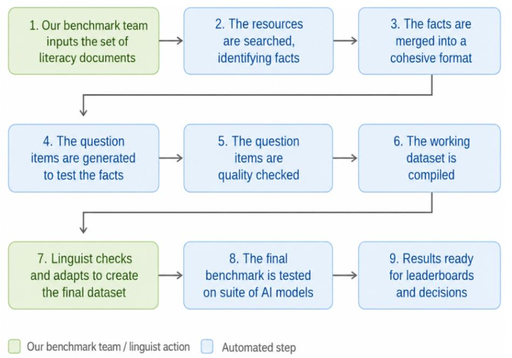
Figure 1 :End-to-end pipeline for producing a Linguistic Knowledge Benchmark in a target language. Green indicates steps performed by the benchmark team or a linguist; blue indicates automated steps.
Original paper · CC BY 4.0 · Lelièvre, Maxime, Mackintosh, Alasdair, Andrews, Dominic, Murray, Tobias, Boos, Moritz, Garrod, Oliver G. B. · The Linguistic Knowledge Benchmark: Do Language Models Know the Foundations of Early-Grade Literacy? · Original paper figure · Converted the paper's own image file from its arXiv HTML version to PNG.Why LMIC literacy tools need a language check
Teachers need decodable text, meaning practice readers limited to the letter-sounds already taught, and such material is rare in Kiswahili. AI could help fill that gap, but only if developers know whether a model handles these languages at all. Language models see little text in many LMIC languages, so their grasp of those languages is an open question.
The authors start from that question: do models hold the linguistic knowledge that literacy teaching relies on?
Splitting the goal into three rungs
One end-to-end score tells us whether a model succeeds at decodable-text generation, but not what breaks. The authors therefore split the goal into three rungs, each testing one capability the final task depends on. The first rung, Linguistic Knowledge, probes which facts about a language's structure a model holds. Decodability Assessment and Decodable Text Generation test functional competence and are still under development.
This paper concerns only the first rung, and it targets formal linguistic competence, meaning correct form rather than goal-directed use. The authors separate the two because they are distinct skills, citing earlier work on this distinction. The grade records where content is first introduced in the curriculum, not how hard the item is. Each item also carries a Simple View of Reading strand and a GEEAP component, which tag the knowledge it serves and what an error would corrupt.
From curriculum files to vetted items
The pipeline is a sequence of stages, and the authors keep each stage separate so experts can see where quality degrades. The team supplies typically 6 to 11 resources per language, such as curricula, teacher guides and pupil books. Each resource is then classed as curriculum, teacher material, student material or other, such as a grammar book.
The survey runs one document at a time and records a verbatim example, a location, a domain and a first-introduction grade for each fact. Working per document lets sources be processed in parallel or added later. Merging then groups duplicates into one feature that lists all its sources, ordered by grade.
Generation drafts multiple-choice items for contrasts and judgements, and short-answer items for facts about producing a form. Both formats let the benchmark test unaided recall and the ability to tell correct forms from plausible, diagnostic errors. Generation oversamples, producing several candidates per feature and making no decisions about counts or balance yet.
Quality control then checks every pooled candidate against anti-gaming and shape rules, such as no answer given away in the stem.
The authors use the responses of a panel of ten models to keep a trimmed set. The trimmed set drops items every model gets right, favours high-discrimination items, and keeps a balanced domain-by-grade spread. Items that no model answers correctly are kept and flagged, so a human expert can look at them.
The authors argue this separates formal knowledge from reading comprehension in the target language, which would otherwise confound a wrong answer. The English medium is a favourable setting, so the scores are read as an upper bound.
Does trimming keep the same ranking?
For Kiswahili, selection cut the pool from 307 to 150 items, meeting its target. The English pool fell from 377 to 140, marginally below target, because 217 items were answered correctly by every model.
Coverage was checked per domain and grade before and after selection. The reduction is broadly uniform, with most strata losing 40% to 60% of their items. D7 lost 80% of its items and Grade 0 was dropped entirely, because both were sparsely populated in the full bank.
Each selected item's selection frequency averaged 0.90 in English and 0.89 in Kiswahili. The authors read this as the selected items staying largely stable when the panel changes.
What expert reviewers changed
Every candidate that passed selection went to a human expert, who judged the item and its metadata as two separate decisions. Kiswahili had two sequential reviews, the first by a pedagogy expert on all 150 candidates, dropping 12 and correcting 9. The second review, by an early-literacy expert and native speaker, dropped 3 and edited 10, leaving 135.
English had one review by a pedagogy expert and native speaker over 140 candidates, dropping 3 and rewriting 7 for a final 137.
The rejections traced back to generation problems, and the same problems appeared in both languages. In Kiswahili, redundancy dominated, since most first-pass drops repeated a feature covered elsewhere. Answer leakage, where the target answer is recoverable from the stem, made up a smaller share.
Scoring with parsing and judges
Multiple-choice responses go through regular-expression parsing, using six patterns that cover the common answer formats. Rows that match no pattern go to a fallback pass, where one LLM judge asks whether the response indicates the correct letter. An unparseable answer is either rescued by that judge or left out of the denominator, never counted as wrong.
Each scored row records its method, so strict-format scores stay separate from rescued ones.
Short answers go to LLM-as-a-judge, with three judges from three providers and the majority verdict counting. The judges' written justifications exposed that many models gave valid synonyms missing from expected_answers.
Pairwise agreement among the judges was 97.5–98.7% in Kiswahili and 92.8–96.4% in English. Full three-way consensus covered 97.0% of Kiswahili and 92.1% of English judged responses, with the rest resolved by majority vote. No meaningful self-preference effect was found in either language.
Fallback was never invoked for 90% of English models and 91% of Kiswahili models. For Claude Sonnet 4.5, fallback rescoring lifted accuracy from 92.2% to 94.2% in English. The smallest model moved the other way: Qwen3-1.7B fell from 53.6% to 48.9% in English, and its recovered answers were mostly wrong.
Where accuracy falls
Accuracy spans nearly the full range, from 99% for the top model to 10% for the lowest. Frontier models cluster above 90%, while mid-sized and smaller models decline steeply. Figure 4 shows the Kiswahili picture for the 49 pre-selected leaderboard models out of 121 evaluated, with bootstrap intervals.
The languages are not equivalent: English keeps a long plateau above 90%, while Kiswahili falls away earlier. So fewer models clear any given accuracy threshold in Kiswahili than in English.
Qwen3.7 Flash, the best model under that limit at the time of writing, reaches 96.4% in English but 69.6% in Kiswahili. Strong performance is therefore available at low cost in English, while Kiswahili gets much less from the same price.
Among models under 10 billion parameters, Qwen3.5 9B and Gemma-4 E2B are the two best. Qwen3.5 9B scores 91.7% in English and 51.9% in Kiswahili, and Gemma-4 E2B scores 73.0% and 40.7%. Figure 5 plots accuracy against cost and size, and the gap for small models is larger in Kiswahili.
Accuracy by hardware tier
The authors grouped models by the smallest hardware tier on which they could run as the primary foreground workload. Closed-weight models sit in the cloud tier, and the rest are assigned by total parameter count against a memory budget.
Mean accuracy declines monotonically as the memory budget shrinks, in both languages. The cloud tier averages 91% in English and 79% in Kiswahili, falling to 47% and 24% on mobile and tablet hardware. Figure 6 shows the tier means with 95% bootstrap intervals over models.
Accuracy was measured at each model's best available precision, mostly 16-bit, while the tiers assume quantisation. On-device accuracy would therefore fall below the plotted values.
Limitations
The items are written in English, which likely makes them easier than the same content in the target language. The near-ceiling frontier scores may partly reflect the English medium.
The benchmark is a retrieval test, so it shows that a model holds a linguistic fact, not that it can apply that fact. Retrieval is necessary but not sufficient for decodable-text generation, and the two upper rungs are not yet tested. A model can pass this benchmark while failing either upper rung.
All models ran under one fixed configuration, with decoding settings left at their defaults. Reasoning effort and extended-thinking budgets were not varied for the larger models, so each reports one operating point. The authors checked that low scores were not parsing artefacts, but they can't rule out that other decoding settings raise small-model accuracy.
Paper info
- Authors
- Lelièvre, Maxime, Mackintosh, Alasdair, Andrews, Dominic, Murray, Tobias, Boos, Moritz, Garrod, Oliver G. B.
- Venue
- arXiv · Preprint
- First published
- 2026-11-25
- Added
- 2026-11-27
- Updated
- 2026-11-25
- Version
- v1
- arXiv
- 2611.34823
- Category
- cs.CL
- Original paper terms
- CC BY 4.0
- What we show
- Paper info, commentary and permitted figures from the original paper
AI commentary is a separate explanation from the original paper and may contain errors. The original paper and figures follow each source's terms of use and any rights noted separately.
Abstract
Many languages of instruction in low- and middle-income countries (LMICs) are poorly represented in the data used to train language models. Before these models can support early-grade literacy in such languages, we need to know whether they hold the linguistic knowledge of each language that literacy teaching relies on. To test this, we present the Linguistic Knowledge Benchmark and the reproducible, largely automated pipeline that turns curriculum documents, teacher guides and pupil books into a vetted question set organised on a fixed grid of nine linguistic domains and seven grade levels. The pipeline combines LLM-driven source survey, feature consolidation, item generation and quality control with an item-selection step inspired by item response theory and a final expert review. We instantiate it for Kiswahili (Kenya; 135 items) and English (United Kingdom; 137 items) and evaluate 121 and 119 models respectively. Frontier models exceed 90% accuracy in both languages, but accuracy falls steeply for smaller and cheaper models, and more so in Kiswahili. The two best models under 10 billion parameters reach 91.7% and 73.0% in English but only 51.9% and 40.7% in Kiswahili, and the mean accuracy of models deployable on mobile and tablet hardware is 47% in English against 24% in Kiswahili. The models most practical for low-resource classrooms are therefore the least capable in the languages they would serve. We release a 20-item sample per language, all pipeline prompts, open-source code, and a public leaderboard. This is the first rung of a three-level evaluation ladder for measuring and generating decodable text to support foundational literacy.
Quote from the paper
Lelièvre, Maxime, Mackintosh, Alasdair, Andrews, Dominic, Murray, Tobias, Boos, Moritz, Garrod, Oliver G. B. (2026). The Linguistic Knowledge Benchmark: Do Language Models Know the Foundations of Early-Grade Literacy?. arXiv:2611.34823v1. https://arxiv.org/abs/2611.34823v1
BibTeX
@misc{maxime2026linguistic,
  title = {{The Linguistic Knowledge Benchmark: Do Language Models Know the Foundations of Early-Grade Literacy?}},
  author = {Lelièvre, Maxime and Mackintosh, Alasdair and Andrews, Dominic and Murray, Tobias and Boos, Moritz and Garrod, Oliver G. B.},
  year = {2026},
  eprint = {2611.34823},
  archivePrefix = {arXiv},
  url = {https://arxiv.org/abs/2611.34823v1}
}