Paper commentary
Solve Vision with Code: Coding Agents Are Stronger Visual Reasoners Than Video Models
Coding agents that write rendering programs beat video models on VBVR-Pro
- Problem Video models are tested as visual reasoners, but they must recover the answer implicitly while denoising pixels. No controlled test had compared them with code on the same tasks.
- Method The authors give a coding agent the same first frame and prompt as a video model. The agent writes a program that renders the answer video, and a rule-based evaluator scores it.
- Results Three closed coding agents scored 0.923, 0.894 and 0.893 on 500 VBVR-Pro-Bench instances. The strongest video model trails each by more than 0.22.
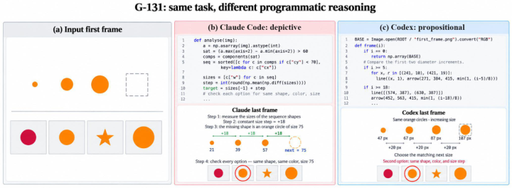
Figures from the paper Figure 4Depictive and propositional programs on the same instance of G-131. (a) The input frame shared by both agents. (b) Claude Code (depictive): the program measures the circle widths, computes the constant difference and evaluates the candidates at run time. (c) Codex (propositional): the correct candidate is identified in the session, and the program only renders and highlights it. Both agents select the same candidate and obtain the same score.
Original paper · CC BY 4.0 · Dezhi Luo, Fengyuan Yu, Haotian Zhang, Zehong Zhao, Ran Ji, Siyuan An, Huayi Qin, Qingying Gao, Zhongang Cai, Lei Yang, Ziqi Huang, Ruisi Wang, Maijunxian Wang, Hokin Deng · Solve Vision with Code: Coding Agents Are Stronger Visual Reasoners Than Video Models · Original paper figure · Converted the paper's own image file from its arXiv HTML version to PNG.Why video models are hard to judge as visual reasoners
Video generators are now tested on whether a first frame and a prompt yield a video that carries out the task. This framing treats the video itself as the place where the reasoning happens, not as a description of it.
VBVR-Pro turns this question into a verifiable test, with procedurally generated tasks scored against symbolic ground truth. Its 100 task families, with five instances each, are spread over five cognitive categories. Even so, the strongest entry is a model trained with reinforcement learning on those same families, using the evaluator as reward.
A pixel denoiser has to recover that function implicitly, whereas a code writer can state it and let an interpreter render it. No controlled test had put code and video on the same tasks, with identical inputs and evaluator.
Swapping the answer medium for code
The authors keep the inputs and the scorer fixed and change only the medium of the answer. The agent receives the first frame, the prompt and the container specification, then writes a program that renders the answer video.
The agent works in a CPU sandbox with standard Python imaging libraries and a 30-minute wall-clock budget. It has no access to ground truth, the task generator or metadata, and it may not call an image or video generation model. A missing video at exit scores zero, which mirrors a video model that fails to generate.
Table 1 lists Codex with gpt-6-astra, Claude Code with Claude Fable 5.1 on Amazon Bedrock and Gemini CLI with gemini-3.1-pro-preview. For open-weight models, OpenCode drives 24 models, and DeepSeek R1 is dropped because it can't call tools on Bedrock, leaving 23 scored models.
A system's score is the mean over all 500 instances, and a family with k labels counts 1/k toward each of its categories.
Coding agents against the best video model overall
Codex scored 0.923, Claude Code 0.894 and Gemini CLI 0.893 on all 500 instances. Each of the three sits more than 0.22 above the strongest video model, so the gap doesn't depend on which closed agent is chosen.
That is a gap of 0.253 below Codex, and the next video model, VBVR-Pro-Wan2.1-I2V-14B, is a further 0.108 behind.
Among the 23 open-weight models, GLM-5 scored 0.572 and ranked fifth among all 37 systems. It scores above every video model except the RL-trained one, and those video scores were taken from the published leaderboard rather than rerun.
Where the advantage sits across categories
The closed agents score above 0.8 in every category. Codex leads on Abstraction, Knowledge and Spatiality, Gemini CLI leads on Perception and Claude Code leads on Transformation.
To compare with the best video model, the authors combined its per-half category scores using the kit's task weights. All three agents beat it in every category, with the smallest margin on Transformation and the largest on Perception. The Perception margin needs caution, because those tasks mostly involve locating and measuring objects, which rule-based code can do exactly.
The authors suggest the small Transformation margin may reflect that video models pick up moving objects more naturally from video data.
For open-weight models, Perception is the strongest category, and rule inference on Abstraction is where they fall furthest behind.
Why some open-weight agents score low
An instance without a video scores zero, so delivery failure drives most of the lowest open-weight scores. Across the 23 models, scores fall with the number of delivered videos, with Spearman's ρ = 0.93.
Some models never call a tool, including Gemma 3 27B, Gemma 3 12B, Llama 3.3 70B and Magistral Small. Qwen3-32B and Llama 4 Maverick stop early and deliver 25 and 7 videos. Qwen3-Coder-Next hits the 1,800 s limit on 93 instances but still delivers 498 videos, so its 0.264 reflects content quality.
Among open-weight agents that delivered a video, more tool calls go with higher scores, with Spearman's ρ = 0.88. The closed agents reach their scores with 3 to 25 calls per instance.
The three closed agents sit within 0.030 of each other, but Gemini CLI makes roughly eight times Codex's tool calls. Claude Code makes roughly three times as many calls, and its score is lower by 0.029 than Codex.
Depictive and propositional programs
The authors classified 1,385 programs that the closed agents wrote to solve their own instance. A depictive program reads the first frame at run time and transfers to other instances of the family, whereas a propositional program renders values fixed in advance.
The authors test each program by re-running it on a different instance of the same family. A program counts as depictive if its answer follows the new input, and as propositional if it draws the same, now incorrect, answer. Programs that transfer only partly fall into a grey band between the two.
Depictive programs make up 67% of Perception programs and 45% of Transformation programs. The propositional share is highest for Abstraction (26%) and Knowledge (28%), compared to 6% for Transformation. The authors read this as tasks that need rule inference or stored knowledge leading the agent to settle the answer in the session.
Claude Code keeps measurement inside its program more often, at 61% depictive, than Codex at 35%. Gemini CLI opens the frame on only 10 of 500 instances, yet 17% of its programs are propositional. Its constants came from exploratory scripts run during the session.
Score doesn't reveal the mode, because Codex scored highest of the three while only 24% of its Abstraction programs are depictive. On one G-131 instance, Claude Code measures the circle widths at run time and tests candidates against them, while Codex only draws a candidate it chose in the session.
What the strategy split suggests
The authors tie the two modes to the mental imagery debate, where depictive representations keep spatial structure and propositional ones store discrete assertions. They suggest coding agents may have properties that resemble how humans navigate array-based imagery, without claiming that reasoning is embodied in an analogue representation.
They also note that these results describe the present state of video reasoning and don't set a limit on what generative video models can learn.
Limitations
Textured, occluded and variably lit real-world scenes were not tested, and no symbolic ground truth exists for them. The comparison is also asymmetric, since the agents get tools, a sandbox and up to 30 minutes, while video models produce a single sample.
The Perception margin over the video model may be inflated, because rule-based code executes those operations exactly. The authors propose training the code-writing policy with GRPO, since the evaluator is deterministic.
Paper info
- Authors
- Dezhi Luo, Fengyuan Yu, Haotian Zhang, Zehong Zhao, Ran Ji, Siyuan An, Huayi Qin, Qingying Gao, Zhongang Cai, Lei Yang, Ziqi Huang, Ruisi Wang, Maijunxian Wang, Hokin Deng
- Venue
- arXiv · Preprint
- First published
- 2026-11-25
- Added
- 2026-11-27
- Updated
- 2026-11-25
- Version
- v1
- arXiv
- 2611.34813
- Category
- cs.CV · cs.AI · cs.LG · cs.MM
- Original paper terms
- CC BY 4.0
- What we show
- Paper info, commentary and permitted figures from the original paper
AI commentary is a separate explanation from the original paper and may contain errors. The original paper and figures follow each source's terms of use and any rights noted separately.
Abstract
Video generation models are increasingly evaluated as visual reasoners: given a first frame and a natural-language prompt, can the model produce the video in which the specified task is carried out? The paradigm is considered advantageous because the reasoning is native to the visual medium, unfolding directly in the frames rather than through language or code. Whether this native route is in fact the more reliable path to visual reasoning has not been tested against a symbolic alternative under the same conditions. We therefore pose the same tasks, with identical inputs, output specification and evaluator, to both media: rather than denoising pixels, a coding agent writes a program that renders the answer video, which an unmodified rule-based evaluator scores. On VBVR-Pro-Bench (Xu et al., 2026), a 500-instance suite spanning five cognitive categories with symbolic ground truth, the agent receives the same first frame and prompt as the video model, with no access to ground truth, metadata or generation models, and one attempt per instance. Three closed-model agents (Codex with gpt-6-astra, Claude Code with Fable 5.1 and Gemini CLI with Gemini 3.1 Pro) score 0.923, 0.894 and 0.893, each more than 0.22 above the strongest video model. Among 23 runnable open-weight models, the best, GLM-5, reaches 0.572, above all video models except the RL-trained one. Together, we show that for tasks whose solutions can be computed from a first frame and a prompt, program synthesis is currently a substantially more reliable route to visual reasoning than video generation. We further distinguish depictive programs, which navigate the image to recover a transferable scheme, from propositional programs, which operate on hard-coded values, revealing how visual reasoning unfolds in agent-written programs and what it implies for its nature of reasoning in general.
Quote from the paper
Dezhi Luo, Fengyuan Yu, Haotian Zhang, Zehong Zhao, Ran Ji, Siyuan An, Huayi Qin, Qingying Gao, Zhongang Cai, Lei Yang, Ziqi Huang, Ruisi Wang, Maijunxian Wang, Hokin Deng (2026). Solve Vision with Code: Coding Agents Are Stronger Visual Reasoners Than Video Models. arXiv:2611.34813v1. https://arxiv.org/abs/2611.34813v1
BibTeX
@misc{luo2026solve,
  title = {{Solve Vision with Code: Coding Agents Are Stronger Visual Reasoners Than Video Models}},
  author = {Dezhi Luo and Fengyuan Yu and Haotian Zhang and Zehong Zhao and Ran Ji and Siyuan An and Huayi Qin and Qingying Gao and Zhongang Cai and Lei Yang and Ziqi Huang and Ruisi Wang and Maijunxian Wang and Hokin Deng},
  year = {2026},
  eprint = {2611.34813},
  archivePrefix = {arXiv},
  url = {https://arxiv.org/abs/2611.34813v1}
}