Paper commentary
Can image generation help visual reasoning? An empirical study
Generated helper images lower visual reasoning accuracy in most tests
- Problem Vision-language models reason mostly in text, so looking at an image again adds no new content. Earlier work found image generation helpful only with curated data and in narrow settings.
- Method Reasoning with Imagination has a VLM write a hint, a generator draws one helper image from it, and the VLM answers using both images.
- Results Generated helper images lowered accuracy in 106 of 130 pipeline-task results, compared with no-generation baselines.
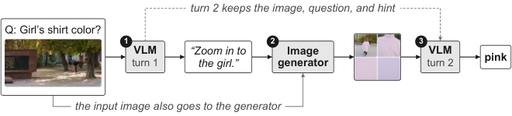
Figure 2 :The Reasoning with Imagination pipeline.The VLM writes a hint, the generator draws a helper, and the VLM answers using evidence from the original images and the helper together.
Original paper · CC BY 4.0 · Xueyang Yu, Yifan Jing, Taiming Lu, Linrong Cai, Zhipeng Cai, Yunyang Xiong, Gabriel Sarch, Zhuang Liu · Can image generation help visual reasoning? An empirical study · Original paper figure · Converted the paper's own image file from its arXiv HTML version to PNG.Why text-only reasoning stalls
Vision-language models mostly reason about an image in text. They look at the picture once and then build long chains of words. Chain-of-thought and long-context reinforcement learning make those chains longer, but they don't make them more visual. Recent methods let a model crop, zoom, or annotate the input partway through reasoning, which is looking again rather than adding content.
A student who draws an extra line adds something that was never on the page.
Image generators can produce exactly that kind of added content. Earlier work found generated images helpful only with curated training data and in narrow settings. So the open question is whether a model can reliably use a helper it draws itself across a broad set of visual tasks.
A helper image drawn mid-reasoning
The key idea is to let the model draw one helper image and then answer with it. In the first turn, a VLM writes a hint, one or two sentences that describe a helper image which would make the question easier. A hint might say to zoom into one panel or to rotate the first image.
A generator then draws the helper from the hint and the input images. A generator that accepts one image edits only the first input, while one that accepts several sees all of them. Each question gets one helper unless the authors state otherwise. In the second turn the VLM gets the question, the original images, its own hint and the helper, and it must use evidence from every image.
For Janus-Pro-7B the generation head is conditioned on the original image embeddings and the hint, and the same backbone then answers. Each model is compared with its own direct-answer baseline, so every result is a change from text-only.
Models and benchmarks in the comparison
The authors paired three VLMs, Qwen3-VL 4B, Qwen3-VL 8B and GLM-4.6V Flash, with four image generators. The four generators are Stable Diffusion 3.5 Large, FLUX.1-Kontext Dev, Qwen-Image-Edit-2511 and Nano-Banana. Gemini 3.0 Flash was paired only with its own Nano-Banana, which gives 13 modular pipelines in total. BAGEL and Janus-Pro-7B are evaluated as unified models.
The nine benchmarks cover six kinds of visual reasoning and span ten tasks once RoboSpatial is split into compatibility and configuration questions. Rule-based scoring is used where possible, and semantic answers are judged by Gemini-2.5-Flash. Most runs use non-thinking mode.
Generation mostly lowers accuracy
Across the 13 modular pipelines, generation lowered accuracy in 106 of the 130 results, which is 82%. A stronger model doesn't escape it: Gemini 3.0 Flash, paired with Nano-Banana, dropped on nine tasks and by 6.9 points on average. Going from Qwen3-VL 4B to 8B barely changed the average loss, from 3.4 to 3.2 points.
The largest drop is on VSTAR, where every pipeline lost accuracy by between 3.8 and 31.3 points. Generators often lose fine detail on ChartQAPro and VSTAR, which the hint had identified correctly. On MathVista and ERQA the hint more often asks for the wrong content.
RoboSpatial-Compatibility is the exception. Generation raised accuracy in 12 of 13 pipelines, by up to 23.8 points, and never lowered it. The authors suggest the questions are hypothetical, so drawing the object in place shows the scene the question asks about. Configuration questions, which describe the scene as it is, fell in 12 of 13 pipelines.
Unified models lose on most tasks
BAGEL and Janus-Pro-7B each lose accuracy on eight of the ten tasks. BAGEL gained 25.7 points on RoboSpatial-Compatibility and 8.1 points on MathVista, compared to its own direct-answer baseline. Its largest loss, 19.4 points, came on VSTAR.
Across 5,906 paired questions, Janus-Pro-7B lost 9.52 points on RoboSpatial-Compatibility and 9.40 points on MathVista. Its largest drop was on ERQA, from 34.50% to 20.25%. Its two gains were on VisualPuzzles, 1.28 points, and Rover-TG, 2.03 points.
Where the pipeline breaks
The split differs by task: bad hints dominate spatial and embodied tasks, and bad generations dominate ChartQAPro and VSTAR.
The examples show three patterns. A model can answer correctly next to a visibly flawed helper. When the answer is wrong, the helper often misses the region the question asks about. In other wrong cases the helper destroys evidence that was in the input.
In the default setting the model always generates, but when Qwen3-VL may choose, it calls the generator on 2 to 12% of questions. The gap between forced and selective generation therefore points at the generated image itself.
Holding the hint fixed on VSTAR
The authors kept the Qwen3-VL 8B planning turn identical and changed only the image in the answer turn. Accuracy on VSTAR was 60.21%, 58.64% and 49.74% in those three conditions. Compared with the hint alone, the generated helper introduced 28 errors and corrected eight, a loss of 10.47 points. The paired 95% interval runs from −16.75 to −4.71.
For hints that ask for a crop or zoom, the authors crop the original pixels rather than generating an edit. They resize the crop bicubically to 1,024 pixels on the long side. On the same 43 VSTAR questions, cropping scored 72.09% and generation 51.16%, a 20.93-point advantage for cropping. The authors read the gap as a rendering failure rather than a planning one.
On RoboSpatial-Compatibility and ChartQAPro the paired intervals span zero, so those comparisons don't separate from no effect.
Repeated edits and thinking mode
The authors reran zero, one and two calls on Qwen3-VL 8B with FLUX.1-Kontext Dev, then extended to ten edits with a fixed hint. ERQA rose from 42.50% at baseline to 45.50% after ten edits. Accuracy moved up and down across rounds on all three tasks.
Adding text reasoning alone raised ChartQAPro by 15.8 points and MathVista by 2.5, and lowered ERQA by 7.6. With thinking mode on, generation still lowered accuracy on all three benchmarks. The loss on ChartQAPro grew from 2.1 to 5.4 points, and on ERQA from 1.5 to 7.9 points. On MathVista it shrank from 3.9 to 2.9 points. So better text reasoning alone doesn't make the generated images useful.
Limitations
Two helper-ablation comparisons have paired intervals that include zero: RoboSpatial-Compatibility at +1.90 points and ChartQAPro at −0.07. The authors' own intervals therefore don't separate those gaps from no effect. The failure breakdown rests on 10 to 20 labeled failures per sampled benchmark.
The thinking check covers only FLUX.1-Kontext Dev with Qwen3-VL 8B. Most runs use non-thinking mode, and video reasoning and planning were not tested. Each question received one helper by default, and the repeated-edit runs used a fixed hint.
Where this sits among related work
Many visual reasoning methods treat images as tools, pulling out boxes, depth or masks through tool use or code. Only a few works explore image generation as an alternative, and only in narrow domains. Unified models that think in text before generating in vision have shown gains in recent work. This study instead holds each reasoner fixed and compares its answers with and without its own helper.
Paper info
- Authors
- Xueyang Yu, Yifan Jing, Taiming Lu, Linrong Cai, Zhipeng Cai, Yunyang Xiong, Gabriel Sarch, Zhuang Liu
- Venue
- arXiv · Preprint
- First published
- 2026-11-25
- Added
- 2026-11-27
- Updated
- 2026-11-25
- Version
- v1
- arXiv
- 2611.34935
- Category
- cs.LG · cs.CL · cs.CV
- Original paper terms
- CC BY 4.0
- What we show
- Paper info, commentary and permitted figures from the original paper
AI commentary is a separate explanation from the original paper and may contain errors. The original paper and figures follow each source's terms of use and any rights noted separately.
Abstract
Language models think in words; then multimodal models might think in images. We test whether a generated helper improves the answer to a visual question. A model describes the helper it needs and then answers using the original and generated images together. Across 13 vision-language model and generator pairs, generation lowers mean accuracy by 3.7 percentage points, with declines on nine of ten tasks. Two unified models, BAGEL and Janus-Pro-7B, each lose accuracy on eight tasks. On VSTAR, adding a generated image to the same planning hint lowers accuracy by 10.47 points. Repeated image edits yield different outcomes across tasks. ChartQAPro and MathVista stay below their no-generation baselines, while ERQA gains three points after ten edits.
Quote from the paper
Xueyang Yu, Yifan Jing, Taiming Lu, Linrong Cai, Zhipeng Cai, Yunyang Xiong, Gabriel Sarch, Zhuang Liu (2026). Can image generation help visual reasoning? An empirical study. arXiv:2611.34935v1. https://arxiv.org/abs/2611.34935v1
BibTeX
@misc{yu2026image,
  title = {{Can image generation help visual reasoning? An empirical study}},
  author = {Xueyang Yu and Yifan Jing and Taiming Lu and Linrong Cai and Zhipeng Cai and Yunyang Xiong and Gabriel Sarch and Zhuang Liu},
  year = {2026},
  eprint = {2611.34935},
  archivePrefix = {arXiv},
  url = {https://arxiv.org/abs/2611.34935v1}
}