Paper commentary
Retrieving from Your Own Mistakes: On-Policy Training of Embedding Models for Multi-Hop Retrieval-Augmented Generation
On-policy state training teaches a chain embedding retriever from its own mistakes
- Problem Chain retrievers train only on gold histories, but at test time they condition on their own wrong passages. Those mistakes lower their chance of finding missing evidence, and the training never shows them.
- Method On-policy state training trains the query encoder on the histories it visits itself. Each visited state is labeled with the earliest missing gold passage, and the labels are mixed with teacher-forced states.
- Results On MuSiQue the retriever completes 49.3 percent of chains within five passages (C@5). Search-R1 completes 36.5 percent.
Where chain retrievers get stuck
Chain retrievers face a mismatch between the histories they train on and the histories they meet at test time. Training gives the retriever gold passages in its history and asks it for the next gold passage. At test time, the history holds whatever the retriever fetched itself, so one wrong passage stays in every later query. The encoder thus sees no training history with a wrong passage, though that is where recovery matters most.
On four-hop MuSiQue questions, 70% of feasible states at step three already hold a non-gold passage. By step four, that share climbs to 89%. In contaminated states the retriever finds a missing gold passage 28% of the time, versus 67% for clean histories.
Harder states explain part of that gap, so the authors tested the wrong passages directly. That recovery is about a third of its remaining chance to continue the chain, which the authors attribute to its own mistakes. The analysis covers 1,358 contaminated states, and deleting the wrong passages costs the retriever 11.3 points.
The authors call this gap the state mismatch. Teacher forcing trains only on clean states, while many states after the second step are contaminated. The paper's next move is to train the encoder on the states it visits itself.
Training on the retriever's own states
On-policy state training changes which histories the query encoder learns from, and little else in the recipe. The encoder trains on the histories it produces itself, rather than only on gold histories. The method keeps visited states with a non-empty R(s), drops duplicate (q, E) pairs, and samples M of the rest uniformly.
A passage d scores as the inner product of a normalized query embedding and a normalized passage embedding. The target a*(s) is the earliest gold passage still missing, and it depends only on the gold set. A wrong passage in the history doesn't remove the target, so every visited state gets a dense, per-step label. The other missing gold passages drop out of the denominator, so retrieving any of them is never penalized.
No reward model, language model or outcome reward is needed, which separates this method from reinforcement-learning retrievers.
The visited half is replaced at every epoch, so the training distribution follows the encoder as it learns. The teacher-forced half stays in the mix, keeping supervision on long correct prefixes that the encoder seldom reaches. The two sources form a half-and-half mixture, and both regimes use the same number of states.
The architecture, loss, negatives and document index match teacher forcing, so only the state distribution differs. Negatives come from the frozen encoder's top 100 passages for each state text, so only the query side changes. Teacher forcing never exposes the encoder to the histories where recovery matters most.
What one training epoch does
One epoch starts with the current encoder running its greedy policy for T steps on every training question. Each visited state with a non-empty missing set is recorded, and duplicate question-history pairs are dropped. From the remaining states, M are sampled uniformly to form the visited set for that epoch. Figure 1b presents this roll-in as the first step, followed by labeling and a contrastive update on a mixed batch.
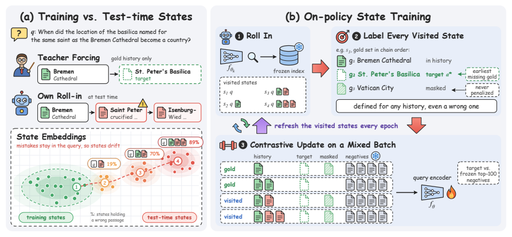
Figure 1 : Overview. (a) Teacher forcing trains on gold histories, while at test time the retriever’s own mistakes stay in the query and its states drift. (b) On-policy state training rolls in the current encoder, labels every visited state with the earliest missing gold passage, and trains on a mix of gold and visited states, refreshed every epoch.
Original paper · CC BY 4.0 · Chenjie Qiu, Zixuan Zeng, Shaobin Shi, Bingfeng Chen, Dongsheng Luo, Boyan Xu · Retrieving from Your Own Mistakes: On-Policy Training of Embedding Models for Multi-Hop Retrieval-Augmented Generation · Original paper figure · Extracted the figure area from page 2 of the original PDF.The epoch then minimizes the contrastive loss of Eq. (4) over the union of the teacher-forced set and the visited set. The teacher-forced set holds M states drawn as random gold subsets, and M is half of the about 4,700 training states of teacher forcing. The teacher-forced half stays in because it keeps long correct prefixes on questions that the current encoder usually gets wrong.
Both regimes use the same number of states, so the comparison isolates the distribution of training states. The visited half is replaced at every epoch rather than accumulated as in DAgger, so it follows the encoder as it changes.
Only the query encoder is updated, through low-rank adapters, while the document embeddings stay fixed. The LoRA parameters start from scratch, as they do for teacher forcing. That teacher-forced encoder doesn't initialize the model, so the trained retriever starts fresh. Negatives for each state come from the top 100 passages the frozen encoder retrieves for that state text, excluding every gold passage.
Complete evidence on MuSiQue and beyond
On MuSiQue, on-policy state training reaches 73.5 recall at 5 and 49.3 complete coverage at 5, averaged over five seeds. Search-R1 completes 36.5% of questions within five passages, and it calls a 7B language model between searches. Teacher forcing with the same encoder and recipe already reaches 44.6 C@5, so training a chain retriever accounts for most of the lead.
Training on visited states lifts that figure from 44.6 to 50.5, but this comparison uses one shared seed rather than five.
The MuSiQue-trained encoder raises C@10 from 1.0 to 29.6 on HotpotQA-Long and from 2.0 to 32.8 on 2Wiki-Long. Search-R1 is the strongest competitor here, with C@5 of 3.3 and 6.0 against 20.8 and 27.7 for the on-policy encoder. Search-R1 reaches a similar recall by the tenth passage, and it leads on 2Wiki-Long in C@10. The MDR checkpoint, trained on HotpotQA, completes 14.7 chains within ten on HotpotQA-Long, against 29.6 for the on-policy encoder.
With the top five passages, a fixed reader reaches 44.1 exact match on the on-policy passages. The same reader scores 35.5 on the passages that Search-R1 retrieves. The on-policy passages put the reader 11.7 points ahead of the passages from Q-RAG.
Four-hop MuSiQue questions stay hard, since every retriever completes fewer than 7% of them within five passages. On 2Wiki-Long, the four- and five-hop chains have 45 and 12 questions, and no retriever completes more than one chain in ten. Complete coverage is the stricter test here, because a question counts only when every step succeeds.
Recovery after the retriever's own mistakes
The probe starts from the 3,403 states that the teacher-forced retriever visited and still missed a gold passage. Every encoder then chooses the next passage on those same states, so differences come from the encoders rather than the states. Scoring each retriever on its own visits would mix the training effect with the states each one happens to reach.
After one wrong passage, success rises from 25.0% under teacher forcing to 35.8% under on-policy state training. After two or more wrong passages, the rate goes from 14.5% to 29.2%, roughly twice as high. Because the encoders see identical states, the difference has to sit in the encoders themselves.
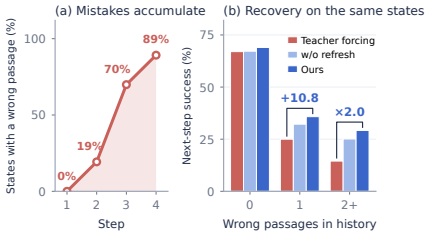
Figure 3 : (a) Share of the teacher-forced retriever’s states whose history contains a wrong passage, at each step of four- hop MuSiQue questions (gold passage still missing). (b) Rate at which each encoder retrieves a missing gold passage next on the same states, by the number of wrong passages in the history. All encoders are trained with the same seed.
Original paper · CC BY 4.0A counterfactual deletes the non-gold passages from the contaminated states and keeps the gold ones in order. On the same 1,358 states, the on-policy encoder moves only from 33.1% to 35.3%, a cost of 2.2 points. Part of the low success reflects harder states, since cleaned states still stay below the 67% of clean starts.
The first two steps change by only one to two points, where most histories are still clean.
Which visited states carry the gain
Visited states collected once and never refreshed keep most of the gain on MuSiQue, but they don't keep much on the long-chain sets. On 2Wiki-Long they keep less than half of the gain, which suggests that following the current encoder matters most when it runs far from its training distribution. Fine-tuning on the question alone, with no chain, gives 54.6 R@5 against 55.1 for the frozen encoder.
Table 4 asks whether any contaminated history would do, or whether the visited states themselves carry the gain. Synthetic contamination inserts passages from the frozen encoder's top 100 into gold histories, matched in the number of wrong and gold passages. Visited states collected once score 48.4 C@5, which is little more than the synthetic contamination reaches.
So roll-in states have no special value on their own, and the remaining gain must come from elsewhere. Refreshing the visited states with the current encoder every epoch raises C@5 to 50.5. Resampling the synthetic contamination every epoch gives 47.1, so fresh samples alone don't reproduce the gain. On the fixed states, the resampled condition recovers no better than the visited states collected once.
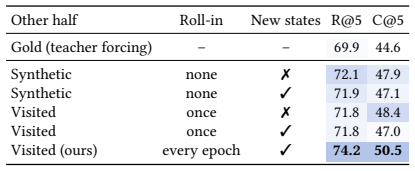
Table 4 : What in the visited states matters on MuSiQue; “new states” marks a half that changes at every epoch. All rows are trained with the same seed and recipe.
Original paper · CC BY 4.0The negative pools are the last factor the authors checked, because a visited state also brings other negatives than a gold state. The conclusion repeats that the gain follows the states the encoder visits, labeled with the earliest missing gold passage.
Where the claims stop
The ablations and the fixed-state probes each train every retriever once, with one shared seed. Table 1 is the only table that averages five seeds, so its spread is not shared by the other comparisons. A single training run per row means small differences in the ablations can't be separated from seed variation.
The long-chain benchmarks are the authors' own constructions, not established public test sets. Each HotpotQA-Long group has 100 test questions, while 2Wiki-Long has 300 test questions in total. Some 2Wiki-Long groups are small, with 45 four-hop questions and 12 five-hop questions. With so few questions in a group, a handful of chains can move its score sharply.
HippoRAG 2 and G-Retriever ran on reduced corpora on the long-chain benchmarks, which is an easier setting than the full corpora. Those reduced corpora hold all gold passages plus the frozen encoder's top 100 per question. Q-RAG and Search-R1 come from released checkpoints, and they keep their own default settings. Search-R1 runs with three passages per search and at most four searches, so its numbers reflect that configuration.
The long-chain results come from MuSiQue-trained encoders that were evaluated without further training. They measure transfer to longer chains and larger corpora, not retraining on those benchmarks. The authors frame their three implications as holding within the setting they study.
Paper info
- Authors
- Chenjie Qiu, Zixuan Zeng, Shaobin Shi, Bingfeng Chen, Dongsheng Luo, Boyan Xu
- Venue
- arXiv · Preprint
- First published
- 2026-10-29
- Added
- 2026-11-1
- Updated
- 2026-10-29
- Version
- v1
- arXiv
- 2610.40409
- Category
- cs.AI
- Original paper terms
- CC BY 4.0
- What we show
- Paper info, commentary and permitted figures from the original paper
AI commentary is a separate explanation from the original paper and may contain errors. The original paper and figures follow each source's terms of use and any rights noted separately.
Abstract
Complex questions in retrieval-augmented generation require evidence spread over several documents, and an answer is reliable only when the retriever finds all of it. Chain embedding retrievers collect such evidence step by step, re-encoding the question together with the passages retrieved so far, and we find that they are already strong: trained only on gold histories, a small chain embedding retriever that calls no language model outperforms graph-based systems and is competitive with a search agent. This training, however, leaves a gap. At test time the retriever conditions on its own retrievals, which soon contain mistakes: by the third step, about half or more of the states it visits hold a wrong passage, and these passages lower its chance of retrieving a missing gold passage well beyond what the difficulty of the states explains. We propose on-policy state training, which trains the encoder on the states it reaches itself. At every epoch the current encoder retrieves chains for the training questions; each state it visits, including those built on its own mistakes, is labeled with the earliest gold passage still missing while the other missing gold passages are masked, so that no correct continuation is penalized; and the encoder is updated contrastively on these states mixed with teacher-forced ones, so that its training distribution follows it as it learns. The resulting retriever retrieves complete evidence more often than teacher-forced training and the systems we compare, and it transfers without further training to harder long-chain variants of HotpotQA and 2WikiMultiHopQA that we construct. On the same states, it recovers from its own mistakes far more often, and controlled comparisons attribute the gain to training on the states the encoder currently reaches.
Quote from the paper
Chenjie Qiu, Zixuan Zeng, Shaobin Shi, Bingfeng Chen, Dongsheng Luo, Boyan Xu (2026). Retrieving from Your Own Mistakes: On-Policy Training of Embedding Models for Multi-Hop Retrieval-Augmented Generation. arXiv:2610.40409v1. https://arxiv.org/abs/2610.40409v1
BibTeX
@misc{qiu2026retrieving,
  title = {{Retrieving from Your Own Mistakes: On-Policy Training of Embedding Models for Multi-Hop Retrieval-Augmented Generation}},
  author = {Chenjie Qiu and Zixuan Zeng and Shaobin Shi and Bingfeng Chen and Dongsheng Luo and Boyan Xu},
  year = {2026},
  eprint = {2610.40409},
  archivePrefix = {arXiv},
  url = {https://arxiv.org/abs/2610.40409v1}
}