Paper commentary
From Small to Large: Assessing Medical Reasoning, Benchmark Contamination, and Model Size in Language Models
Withholding answer choices lowers medical LLM accuracy sharply on the same questions
- Problem Multiple-choice scores cannot show whether models reason or merely recall answers.
- Method The authors test each model under three settings that change only visible information.
- Results Mean accuracy falls from 82.3% to 50.9% when the answer choices are withheld, and the drop holds for every model. The strongest models rebuild about one question in four from the choices alone.
Why multiple-choice scores can't settle the question
A multiple-choice score only records whether the chosen letter matches the answer key. The standard question-answering setup doesn't reveal how a model arrived at the letter it picked. A model may reason through the case, recognize the answer from the printed choices, or recall a question seen during training. All three paths yield the same score, yet they imply very different clinical ability.
Understanding what the score measures therefore means testing models under conditions that separate reasoning from memorization.
The benchmarks involved are MedQA-USMLE, drawn from the United States Medical Licensing Examination, MedMCQA, from Indian medical entrance exams, and PubMedQA, which asks for a yes, no, or maybe judgment about a biomedical abstract. MedBullets adds clinical cases written for USMLE board preparation, so the set covers more than one style of question.
A high score on these benchmarks, however, doesn't tell the whole story.
Hospitals often can't send patient data to outside services, so a model must run on-premises inside a HIPAA-compliant boundary. The open question is whether a 9B model is really far from a frontier model, or whether the distance only looks small because of how current benchmarks measure it.
One question set, three ways of asking
The key idea is to hold the questions fixed and change only what the model can see. The authors run every model on the same questions under three settings, so a drop can be traced to the information that was withheld. Setting one is the standard multiple-choice format, following prior work with 1,273 MedQA-USMLE questions and a 1,000-question MedMCQA validation sample.
Setting two hides the answer choices, so the model produces a free-text answer that a judge then grades. Setting three hides the question stem, and the model sees only the four answer choices and must regenerate the question. Across 3,076 questions and fourteen models, this design lets the authors compare the same items under each condition.
The authors read a large drop from the multiple-choice score as a sign that the score leaned on the choices themselves. Reconstruction is a second probe: if a model can rebuild a specific question from its choices, it has likely encountered that question before. This is only a proxy, because a model may infer a question from distinctive options without recalling it.
The judge checks each generative answer and each reconstruction, so the scoring stays the same across conditions. Reconstruction applies only to MedQA-USMLE, MedMCQA and MedBullets, since PubMedQA's yes, no and maybe choices are identical across questions. The authors also check the judge against text-similarity measures and a clinician, which they report as a validation of the grading instrument.
Reconstructable and un-reconstructable question pools are then defined per model, so each model serves as its own control.
How each setting is run and graded
Each question reaches the pipeline in one of three forms, and the form decides what gets graded. In multiple choice, the model gets the stem with lettered options and must finish with an answer line that the parser reads. In the generative setting, the options are removed, so the model writes a short free-text answer instead of picking a letter.
In reconstruction, the stem is removed, and the model writes a question that its options could belong to. The authors ran MedQA-USMLE, MedMCQA and MedBullets through all three forms, while PubMedQA skipped generative answering and reconstruction.
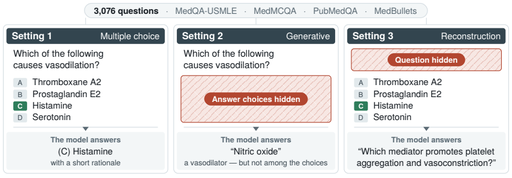
Figure 1 : The three evaluation settings, illustrated on one question from MedMCQA. Hatched panels mark the information withheld from the model in each setting.
Original paper · CC BY 4.0 · Navapat Nananukul, Mayank Kejriwal · From Small to Large: Assessing Medical Reasoning, Benchmark Contamination, and Model Size in Language Models · Original paper figure · Extracted the figure area from page 4 of the original PDF.Every model received an identical prompt, so the authors could attribute a difference to model behaviour rather than prompt engineering. Decoding temperature was fixed at 0 for every model, which removes sampling noise from the comparison. The prompt for each setting is printed in the supplementary material, so a reader can check exactly what the model saw.
That hint names the exam type but not the topic, so it doesn't reveal the answer.
Free-text answers and reconstructed questions can't be matched by string comparison, so Claude Sonnet 5 grades both at temperature 0. The judge is a model outside the fourteen evaluated, and it uses one frozen rubric for every model and both conditions.
For each model, the reconstruction verdict is joined to its multiple-choice correctness on the same questions. That join splits each model's questions into reconstructable and un-reconstructable pools. Because the pools are defined per model, each model serves as its own control. Model size and ensembling are computed from the same predictions, so no extra runs were needed for them.
Whether the best models clear the expert bar
Qwen 3.7 Plus reaches the highest multiple-choice accuracy on MedQA-USMLE in the study, at 94.7%. GPT -5.6 Luna matches that MedQA-USMLE score and reaches 83.8% on MedMCQA, so the two models tie on both benchmarks. On MedBullets, GPT -5.6 Luna scores highest at 89.1%, against 87.8% for Qwen 3.7 Plus. Qwen 3.7 Plus and GPT -5.6 Luna are compared with the human-expert baselines from prior work, which the authors report in the lower block of Table 3.
The best MedQA-USMLE result sits 7.7 percentage points above the 87.0% expert score. The authors note that this gap sits comfortably outside the confidence interval for that result. The authors say the MedMCQA result stays below expert level, so the expert claim holds only for MedQA-USMLE.
MedBullets has no published human baseline, so the authors leave it out of this comparison. Against the 2023 GPT -4 reference of 86.1%, ten of the fourteen models exceed the MedQA-USMLE score. PubMedQA barely moves: the best 2026 score of 81.6% only exceeds GPT -4's 81.2% from 2023 by a small margin. The authors conclude that saturation applies to the licensing-exam benchmark alone.
What moving to the larger model buys
The larger sibling leads its smaller partner in nearly every provider pair, and the pairing keeps the training recipe roughly constant while size changes. Across six pairs the larger model is ahead by 8.7 percentage points on average over all 3,076 questions. A paired t-test over the six pairs gives t(5) = 3.37 and p = .020, so the average gap is unlikely to be noise across providers.
The gain is not uniform, because the benchmark matters as much as the size step.
On MedQA-USMLE the advantage is 8.8 points, and on MedMCQA it is 10.8 points. On PubMedQA the gap shrinks to 1.3 points, and DeepSeek's smaller model scored 77.8% against 76.0% for its larger sibling. DeepSeek is the exception on MedBullets too, since its smaller model is 1.0 point ahead.
Only two of the six smaller models clear that same bar, so the threshold separates the tiers within each provider. Among smaller models the spread is wider than among larger ones, with MedQA-USMLE ranging from 67.5% to 94.0%. The larger models fall within 5.9 points of one another on MedQA-USMLE. Qwen 3.5 9B reaches 91.9%, while Llama 3.1 8B scores 67.5%.
That 24.4-point gap is larger than any smaller model's gap to its own larger sibling, so host selection matters more than the frontier gap for a team hosting its own model.
What the score loses without the choices
Withholding the answer choices cuts mean accuracy on MedQA-USMLE, MedMCQA and MedBullets from 82.3% to 50.9%, and the drop holds for every model. The setting changes only the presence of the printed choices, since the questions, the models and the decoding stay identical. That is why the authors read the drop as evidence that the choices themselves carry much of the multiple-choice score.
Under this view, a multiple-choice score can reflect eliminating implausible options or recognising the answer once it appears, rather than producing it unaided.
The drop is not limited to general-purpose systems, because the two MedGemma models fall more than any other model, by 40.0 and 37.6 points. Because the generative answers are graded by an LLM judge, the authors also check that judge against a clinician and against text similarity.
The setting also feeds the next probe, which asks whether the models can rebuild each question from its choices alone. The strongest models recover about 25% of the questions, and reconstruction rates track multiple-choice accuracy closely. With the answer choices withheld, the same gap widens to 14.5 points, from 62.9% against 48.4%.
Rebuilding questions as a familiarity probe
The reconstruction setting shows only the four answer choices and asks the model to rebuild the question they belong to. The strongest models recover about 25% of the questions this way, and their rebuild rates track multiple-choice accuracy closely. The authors read a successful rebuild as a bounded proxy for memorization, because a model can also infer a question from distinctive choices.
A failed rebuild doesn't prove the question was unseen, so the authors hedge their conclusions. Reconstruction applies only to MedQA-USMLE, MedMCQA and MedBullets, since PubMedQA's yes, no and maybe choices are identical across questions.
Each model's questions are split into a reconstructable pool and an un-reconstructable pool, using the same join of multiple-choice correctness and rebuild outcome. The comparison stays within benchmarks, so one dataset being easier than another doesn't explain the gap. Question difficulty is still a plausible confound, since an easy question is easy both to answer and to rebuild.
The un-reconstructable pool holds between 73.2% and 90.7% of the questions, and accuracy there stays close to each model's overall score.
The authors conclude that prior familiarity adds at the margin rather than carrying the score. They don't claim a single behavioural probe settles the question, and they call for more work on it. For a team hosting its own models, the smaller models trail their larger counterparts by 10.1 points with choices and 13.4 points without them.
Whether the LLM judge can be trusted on free-text answers
The authors check the LLM judge against two text-similarity measures and one clinician, since a frontier judge's verdicts need outside support. Settings 2 and 3 are scored by a frontier model, so the judge's verdicts are the only grading signal for free-text outputs. Agreement is summarised by the AUC, which gives the probability that an accepted output scores higher than a rejected one, with 0.5 meaning no relation.
Mean embedding similarity is 0.695 for accepted generative answers and drops to 0.284 for rejected ones. Embedding similarity separates accepted from rejected generative answers with an AUC of 0.871, the stronger of the two separators. For reconstructions, embedding similarity separates the two groups with an AUC of 0.734, while word overlap gives only 0.631.
Reconstructions run longer than generative answers, with an average word length of 82.0 against 3.4, which the authors say lowers both overlap and similarity.
The 50 answers were drawn at random from MedQA-USMLE, MedMCQA and MedBullets, with 25 judged correct and 25 judged incorrect. The expert also rated the judge's reason sound in 48 of the 50 items, and flagged two answer keys. Fifty verdicts is a small sample, so this check supports the judge without proving it across all outputs.
Ensembling and cost: does combining models close the gap
Majority voting gains at most 1.1 percentage points, and that gain appears only for committees drawn from the six larger models. Voting never helped among the smaller models, so the committees add cost without a measurable benefit there. Ensembling therefore does not close the gap that separates the smaller models from the frontier.
On cost, the authors find that accuracy per dollar strongly favors the smaller models. Each committee multiplies inference cost, so a small accuracy gain has to be weighed against that expense. The prices are for hosted inference rather than self-hosting, which the authors note is the mode a HIPAA boundary actually requires. The authors argue that the cost ratios carry over better than the absolute values.
The authors conclude that the evaluation, rather than the models, is the current limiting factor. The authors suggest that medical benchmarks need a refresh cycle.
Limitations and remaining uncertainty
The leaderboard ordering among the top models is less certain than the tier structure, since the four leading models have overlapping intervals on every benchmark. The authors report that the leaderboard resolves model tiers, not the individual positions inside the leading tier. MedMCQA was scored on a 1,000-question validation sample, because the official test labels are not public.
Its results therefore describe a sample of the benchmark rather than its full test set.
Two MedGemma models were served through a third-party endpoint, since OpenRouter did not offer them during the runs. Hosted endpoints change without notice, so the results describe the checkpoints served on the recorded dates. Two closed larger models have undisclosed size, so the size comparison for OpenAI and Qwen rests on the added open-weight models.
Reconstruction is a proxy for memorization, and a failed reconstruction doesn't show that a question was unseen. A model can infer a question from distinctive choices without recalling it, so a high reconstruction rate isn't direct proof of memorization.
Of the 107 questions that all twelve models missed, the authors flag patterns for review rather than confirm them as key errors. No independent clinician adjudicated the flagged questions, so those flags remain unconfirmed. For several of these questions, the models agree on a non-key answer while the recorded key selects a different choice.
The ensemble committees are picked with hindsight on the same questions they are scored on, which bounds what selection could achieve.
Paper info
- Authors
- Navapat Nananukul, Mayank Kejriwal
- Venue
- arXiv · Preprint
- First published
- 2026-10-30
- Added
- 2026-11-3
- Updated
- 2026-10-30
- Version
- v1
- arXiv
- 2611.00460
- Category
- cs.AI · cs.CL
- Original paper terms
- CC BY 4.0
- What we show
- Paper info, commentary and permitted figures from the original paper
AI commentary is a separate explanation from the original paper and may contain errors. The original paper and figures follow each source's terms of use and any rights noted separately.
Abstract
Large language models (LLMs) now answer medical exam questions at or above expert level, but it is unclear whether such scores reflect clinical competence, or are instead affected by the format of the questions being asked (e.g., multiple-choice versus open-ended), prior exposure to the benchmarks, and the difficulty of the questions. These benchmarks are also public and widely used online, which may be resulting in LLM memorization. Models may perform better on questions that they have seen before. It is also not evident whether smaller models, which are more locally deployable in HIPAA-compliant hospital settings, have achieved human performance. In this study, we evaluate fourteen current models from six leading providers, one smaller and one larger model from each provider with two additional open-weight models, on 3,076 questions from four medical benchmarks (MedQA-USMLE, MedMCQA, PubMedQA, and MedBullets) under standard multiple choice, the same questions with the answer choices withheld, and reconstruction of a hidden question from its choices alone. In the standard multiple-choice setting, the strongest models exceed the human-expert baseline on MedQA-USMLE and PubMedQA, but the smaller models trail their larger models by 8.7 percentage points and only two of the six pass the human-expert bar on the licensing examination. Withholding the answer choices, however, makes every model struggle: mean accuracy falls from 82.3% to 50.9%, and the two largest drops belong to the medically specialised models. On memorization, the strongest models reconstruct one question in four from the answer choices alone, yet accuracy holds on the questions they cannot reconstruct. We further weigh accuracy against inference cost and test whether ensembling several models improves medical question answering.
Quote from the paper
Navapat Nananukul, Mayank Kejriwal (2026). From Small to Large: Assessing Medical Reasoning, Benchmark Contamination, and Model Size in Language Models. arXiv:2611.00460v1. https://arxiv.org/abs/2611.00460v1
BibTeX
@misc{nananukul2026from,
  title = {{From Small to Large: Assessing Medical Reasoning, Benchmark Contamination, and Model Size in Language Models}},
  author = {Navapat Nananukul and Mayank Kejriwal},
  year = {2026},
  eprint = {2611.00460},
  archivePrefix = {arXiv},
  url = {https://arxiv.org/abs/2611.00460v1}
}