Paper commentary
Differentially Private Synthetic Data from Sliced Chebyshev Moments
SPLICE builds private synthetic data from sliced Chebyshev moments
- Problem Accurate private synthetic data methods pay a cost that grows exponentially with the data dimension. Methods that preserve marginals only hope that global structure survives as a side effect.
- Method SPLICE measures noisy Chebyshev moments along random directions instead of across all variables. It then fits a mixture of product distributions to match those noisy moments.
- Results The authors prove a sliced Wasserstein-1 error of order 1/sqrt(n) for constant privacy parameters. This bound does not depend on the data dimension d.
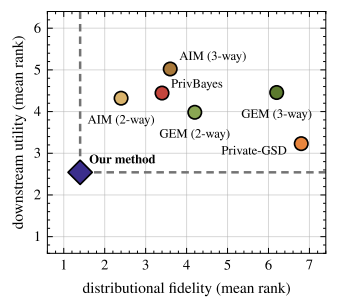
Figure 1 : This plot summarizes a comparison of state-of-the-art DP synthetic data algorithms. Each method is evaluated on the 48 downstream train-on-synthetic, test-on-real tasks and ranked according to accuracy. The distribution returned by each method was also ranked using five fidelity metrics (1-way, 2-way, and 3-way marginal TVD, kernel MMD, and slicedW 1). The average rank determines thexandycoordinates. Lower is better on both axes.
Original paper · CC BY 4.0 · Lucas Rosenblatt, R. Teal Witter, Christopher Musco · Differentially Private Synthetic Data from Sliced Chebyshev Moments · Original paper figure · Extracted the figure area from page 2 of the original PDF.Why guaranteed methods stall in high dimensions
Practical differentially private synthetic data methods usually preserve low-dimensional marginals and hope that global structure survives as a side effect. Methods that target global accuracy guarantees instead pay a cost that grows exponentially with the data dimension d. Because both families fall short, the field has few practically competitive methods that also carry strong guarantees.
Chebyshev moment matching gives near-optimal Wasserstein-1 bounds in one dimension, and it fits the select-measure-estimate pattern. Musco et al. (2025) show that, for n one-dimensional points, moment matching yields an (ϵ, δ)-DP distribution with W1 bounded by a term of order log(1/δ) over ϵn, up to logarithmic factors. In d dimensions, the bound degrades to order 1/n^(1/d) for constant ϵ and δ, which is vacuous once d is at least log n.
The root cause is that small Wasserstein-1 error requires matching multivariate products of Chebyshev polynomials. The authors' fix, discussed next, keeps the Chebyshev measurements but applies them along random slices instead of across all variables.
Slicing the moments
SPLICE swaps the multivariate product moments of prior work for moments taken along random directions. Each measurement averages the degree-j Chebyshev polynomial applied to the inner product of a unit vector theta and a data point. The method uses L such directions, and L scales polynomially in d, so the pattern stays Select-Measure-Estimate.
Noise is added to these sliced moments to ensure differential privacy, and then a distribution q is fitted to the noisy moments.
The reason the slices should work starts in one dimension, where matching the first k moments already controls W1 to order 1/k. Corollary 1 carries this to d dimensions by averaging the one-dimensional error over all directions, giving SW1(p,q) at most 36/k plus the average of Gamma_k over theta. Controlling that average over the whole sphere is hard, so the paper replaces it with an average over L sampled directions.
Theorem 2 bounds the gap between the sphere average and the sample average by a term of order sqrt(d log(6Lk^2)/L), times a constant and beta. The bound holds with probability at least 1 minus beta over the directions, simultaneously for every candidate distribution q. Taking L of order d k^2, up to logarithmic factors, gives SW1 of order 1/k.
The slicing also matters for noisy data, because SPLICE only ever sees noised moments. Theorem 2 allows q to match the sliced moments only approximately, so the noise can be absorbed into the bound. Matching the first 1/alpha moments along about d/alpha^2 slices gives SW1 of order alpha for a distribution on the ball.
What the bound says
The headline guarantee is a sliced Wasserstein-1 error that shrinks with the sample size and with the privacy budget, and it does not grow with the dimension. For points in the unit ball with p uniform over the n data points, the (epsilon, delta)-private output has SW1 of order 1/(sqrt(n) epsilon), written in soft-O notation. The bound is independent of d, although the number of sampled directions still depends on d.
Gaussian noise added to the measured moments is what makes the release differentially private. Fitting the distribution and sampling from it are post-processing of the noisy moments, so they don't change the privacy guarantee. The noise enters only once, at the measurement step, and the fitting step can then search freely over candidate distributions.
The sample-size requirement is the sharpest contrast with the Wasserstein case. For sliced Wasserstein error alpha, SPLICE needs only n of order 1/(epsilon alpha^2) data examples. Obtaining even constant Wasserstein-1 error needs n of order 2^Omega(d) examples, as Boedihardjo et al. (2024) show. This gap is why the authors argue that sliced guarantees escape the dimension penalty that Wasserstein bounds pay.
The sliced bound rests on a moment matching result that the authors consider of independent interest. If two high-dimensional distributions match their first 1/alpha moments along L of order d/alpha^2 random slices, their SW1 distance is O(alpha). The uniform guarantee over all candidate distributions comes from a bound that holds for every q at once with probability at least 1 minus beta.
Lemma 3 controls how well the average over sampled directions approximates the average over the whole sphere.
How the release is built
The theory fixes a distribution to fit, but it doesn't say how to represent that distribution compactly. SPLICE represents the target as a mixture of K product distributions, so each component stays cheap to store and sample. Inside each component, the discrete random variables follow independent distributions. The continuous random variables share one joint Gaussian with a low-rank-plus-diagonal covariance.
Dependencies between discrete variables come from mixing several such components, and each component has O(d) parameters, so O(Kd) in total.
Fitting the mixture to the noisy moments uses gradient descent, because the sliced Chebyshev moments have an exact, differentiable closed form. Simplex constraints on the weights and on each categorical probability vector are enforced with a softmax reparameterization. A logarithmic reparameterization keeps the covariance diagonal positive.
The authors report that K=5 and R=2 are enough, since the mixture is rich enough to match many practical datasets from noisy sliced moments.
Sampling a record starts by picking a component h with probability given by the mixture weights. Each categorical column is then drawn independently from its component's categorical distribution. The continuous block is drawn from a Gaussian with that component's mean and covariance, and then clipped to the encoded range. Fitting and sampling are both post-processing of the noisy moments, so privacy is unaffected by either.
SPLICE keeps the Select-Measure-Estimate pattern, replacing marginal measurements with sliced Chebyshev moments along random directions. The Gaussian noise is added to these moments, and the fitted mixture is the only distribution released. Because the mixture is parameterized with few parameters, the fit touches only the released noisy moments rather than the raw data.
The authors also add stabilizers to the non-convex fit, such as random restarts and an exponential moving average of the parameters.
Does SPLICE win on downstream tasks against marginal-based baselines
The authors evaluate 209 TALENT datasets against AIM, PrivBayes, GEM and Private-GSD at four privacy budgets. Downstream utility is scored with the train-on-synthetic, test-on-real (TSTR) protocol, using the best of four learners on each generated dataset. Those four learners are logistic regression or ridge, random forest, XGBoost and TabPFN, and the ranks are aggregated across datasets.
That filter keeps 184 of 209 datasets, so unlearnable datasets don't contribute noisy wins.
On regression, SPLICE has the best mean TSTR rank at every budget, with 2.58, 2.19, 1.72 and 1.73 at epsilon 0.5, 1, 3 and 10. Those regression ranks cover 67 datasets, so the regression lead rests on a fixed set of tasks. Figure 2 plots the same mean TSTR rank by privacy budget.
On classification, SPLICE stays in the top three at each budget, which is a weaker result than its regression lead. Classification is harder for SPLICE because the target is discrete and the datasets carry more categorical features. The projection into continuous space doesn't represent categorical values without order faithfully.
On the fidelity side, SPLICE is ranked first on four of the five fidelity metrics. At epsilon 1, SPLICE has a 1-way TVD of 0.187, compared to 0.143 for AIM (2-way). SPLICE never targets marginals, so these fidelity gains come from matching sliced moments instead.
Marginals and causal structure
SPLICE never targets marginals, yet it is the best method on 3-way marginal total variation distance at every budget. It is also the best on 2-way marginal distance from epsilon 1, while AIM stays ahead on 1-way distance. AIM matches noisy 1-way marginals directly, so its margin on that metric shrinks as epsilon increases. Across the five fidelity metrics at epsilon 1, SPLICE is ranked first on four of them.
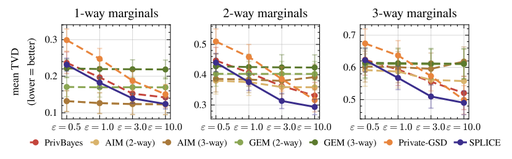
Figure 3 : Meank-way marginal total variation distance (lower is better) on a fixed set ofn= 43datasets where every method has a value at every budget. Left to right: 1-way, 2-way, 3-way marginals.SPLICE never targets marginals yet leads 2-way and 3-way fidelity fromϵ≥1.
Original paper · CC BY 4.0The authors read this as evidence that higher-order interactions survive the random-projection moment matching. Their advantage grows with the interaction order, which the authors call the main benefit of the method. Matching higher-order Chebyshev moments along random projections leads to distributional recovery that contains higher-order interactions.
SPLICE is theoretically motivated by sliced Wasserstein-1, a distributional metric that is sensitive to higher-order relationships. On SW1, SPLICE is best at every budget, and the mixed-block model matches the theoretical rate almost exactly. The theoretical curve is scaled by a large constant factor to match the practical SW1 error scale, so only its decreasing rate across epsilon is meaningful.
Kernel MMD gives the same ordering, as shown in Figure 7 in the appendix.
At tight and moderate budgets, SPLICE reaches measured edge F1 of 0.42 to 0.49 at epsilon up to 3. The best marginal baseline reaches only 0.00 to 0.37 on the same measure, so SPLICE roughly doubles edge recovery.
Cost and reliability at scale
On the controlled grid from 12,500 to 400,000 rows at d = 12, and from 6 to 24 columns at n = 50,000, the SPLICE variants finish in 30 to 120 seconds everywhere. The fitted row exponent is at most 0.09 and the per-column multiplier at most 1.05, so both sweeps stay close to flat. Fit time is modeled as t proportional to n^alpha times c^d, with alpha the row exponent and c the per-column multiplier.
On the benchmark datasets, from 760 to 63,000 training rows, SPLICE takes 20 to 60 seconds with about 2 GB of resident memory. Its GPU memory stays under 1 GB on that range, while only PrivBayes and GEM run faster. The baselines scale much worse: Private-GSD times out beyond 25,000 rows, and PrivBayes scales as n^2.2 on wide tables. Private-GSD takes 659 to 1,470 seconds at only 12,500 rows, and 3-way AIM rises from 61 seconds at 6 columns to 960 seconds at 24.
PrivBayes fails on 34 tasks because its runtime scales roughly with n squared, and its estimated runtime on the largest datasets was multiple days. AIM with 2-way workloads fails on 34 tasks, mostly at ε = 10, and its 3-way variant drops 153 tasks.
Those sketches scale linearly with n and avoid the combinatorial growth tied to width, cardinality, or privacy budget. Every compute run used one GPU per task, and the full SPLICE sweep of 16,800 cells totals roughly 200 GPU-hours.
Limitations: where the claims stop
Classification is where SPLICE is weakest, even though it stays in the top three at each privacy budget. The target is discrete, and the datasets carry more categorical features on average than the regression tasks do. Sliced Chebyshev projections handle continuous or ordinal values well, but unordered categories don't map faithfully into continuous space.
So the benefit is strongest for numerical and ordinal features, and the paper doesn't claim it extends evenly to categorical targets.
The guarantee covers the sliced Wasserstein-1 distance, not the full Wasserstein-1 distance that the one-dimensional bound controls. Theorem 5 assumes data on the unit ball, and the Gaussian block in the fitted model has unbounded support. The implementation handles this by clipping sampled records rather than the fitted distribution itself.
The wall-clock advantage is measured with one task per GPU at epsilon 1, so the timing claims carry that condition.
Metadata is treated as public, which the authors call a small idealization that matches the standard convention in the literature. The baselines don't receive the same side information, so the comparison is not perfectly matched. SPLICE has the smallest metadata footprint, using only per-column bounds and category levels.
Paper info
- Authors
- Lucas Rosenblatt, R. Teal Witter, Christopher Musco
- Venue
- arXiv · Preprint
- First published
- 2026-10-30
- Added
- 2026-11-3
- Updated
- 2026-10-30
- Version
- v1
- arXiv
- 2610.42081
- Category
- cs.LG · cs.CY · cs.DS
- Original paper terms
- CC BY 4.0
- What we show
- Paper info, commentary and permitted figures from the original paper
AI commentary is a separate explanation from the original paper and may contain errors. The original paper and figures follow each source's terms of use and any rights noted separately.
Abstract
Research on practical differentially private (DP) synthetic data has largely focused on methods that approximately preserve low-dimensional marginals of a target distribution, and can thus only hope to preserve higher-dimensional, global structure as a lucky by-product. At the same time, existing methods that target global accuracy guarantees pay a price exponential in the data dimension, $d$. In this work, we address this ``curse of dimensionality'' by presenting a new DP synthetic data algorithm, SPLICE, that comes with a compelling global distributional guarantee, even in high-dimensions, and moreover, is practically state-of-the-art. Our algorithm is based on measuring noisy sliced Chebyshev polynomial moments of the target distribution and fitting a distribution to match, a twist on recent polynomial methods for 1-D synthetic data. We prove that, given a dataset of $n$ examples, SPLICE returns a private distribution with Sliced Wasserstein-1 distance $\tilde{O}(1/\sqrt{n})$ from the target, for constant privacy parameters. Notably, this bound is independent of the data dimension, $d$. Along the way, we prove a moment matching result of independent interest: for a distribution on the unit ball, matching the first $O(1/α)$ Chebyshev moments along $\tilde{O}(d/α^2)$ random directions guarantees $α$ Sliced Wasserstein error. Finally, we provide a practical implementation of the algorithm that borrows tools from the tensor decomposition literature and achieves state-of-the-art performance compared to prior DP synthetic data methods on an extensive benchmark.
Quote from the paper
Lucas Rosenblatt, R. Teal Witter, Christopher Musco (2026). Differentially Private Synthetic Data from Sliced Chebyshev Moments. arXiv:2610.42081v1. https://arxiv.org/abs/2610.42081v1
BibTeX
@misc{rosenblatt2026differentially,
  title = {{Differentially Private Synthetic Data from Sliced Chebyshev Moments}},
  author = {Lucas Rosenblatt and R. Teal Witter and Christopher Musco},
  year = {2026},
  eprint = {2610.42081},
  archivePrefix = {arXiv},
  url = {https://arxiv.org/abs/2610.42081v1}
}