Paper commentary
BlindToChange: AI Agents Can Find Changes When Asked But Do They Look When Needed?
Search agents often miss recent changes they never think to check
- Problem Benchmarks name the fact to look up, so they cannot show whether agents notice their own assumptions need checking. Agents often recommend a candidate that a recent change has made invalid.
- Method BlindToChange pairs a direct probe naming an update with an indirect probe hiding it.
- Results Indirect accuracy trailed direct accuracy by as much as 27.5 points at high reasoning effort. Most failures came from agents never searching to verify whether a fact had changed.
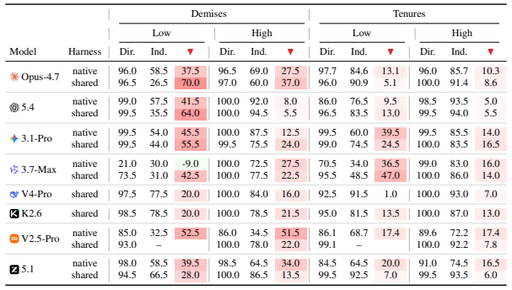
Table 2 : Direct (Dir.) and indirect (Ind.) probing accuracy (%) for each model, harness and reason- ing effort. The▼columns show the drop from direct to indirect accuracy. – marks MiMo-V2.5-Pro (shared, low), which kept calling tools without giving a final answer.
Original paper · CC BY 4.0 · Anirudh Phukan, Tanya Goyal, Danish Pruthi · BlindToChange: AI Agents Can Find Changes When Asked But Do They Look When Needed? · Original paper figure · Extracted the figure area from page 7 of the original PDF.Why a changed fact slips through
Search-enabled agents read news and web pages in real time, so their answers look like they track the current state of the world. The authors argue that this assumption fails in practice. Users, the authors note, often rely on these responses without checking the cited sources. The gap is widest when a request states only the end goal, such as an itinerary for a trip.
The agent then has to notice on its own that a usual candidate no longer qualifies.
In the Bayeux Tapestry Museum example, the agent puts the museum into a Normandy itinerary even though it is closed for renovations. The agent never checks whether the museum is open, so it lists the museum as an afternoon stop. When asked directly whether the museum will be open, the same agent finds the closure and suggests alternatives.
The authors read this inconsistency as a burden shifted onto end users, who must do the verification themselves. Figure 1 shows both probes for the same underlying update, run with Gemini-3.1-pro and search enabled.
Agentic search benchmarks such as BrowseComp and DeepSearchQA are hard, but they spell out every constraint the agent must satisfy. Temporal freshness benchmarks hint at change through markers like current, yet they still name what to look up. So a benchmark built this way can't show whether an agent recognizes its own assumptions as worth checking.
The authors introduce BLINDTOCHANGE to measure this gap directly, using a direct probe and an indirect probe of the same event.
Pairing a direct and an indirect probe
BlindToChange asks about each real update in two ways, and the gap between the two scores measures discovery. The direct probe names the changed fact, so it shows whether an agent can find that fact when asked. The indirect probe is a recommendation request that never mentions the change, and its entity x is eligible before the update. Probes for an update are the questions whose valid answers differ between the old and new knowledge states, written as Q(u) = {q : A(q;K_old) ≠ A(q;K_new)}.
Direct probes act as a control, because answering them needs only the new fact and no further inference. Indirect probes raise a second problem, since an agent might drop x by chance instead of by finding the update. The authors handle this by sampling responses with search disabled, because the events postdate the agent's knowledge cutoff.
They keep a probe only when the agent recommends x in every sampled response. If x then disappears with search enabled, its omission can be attributed to discovery rather than sampling variation.
Table 1 shows the Tony Hoare case, where the update is that he passed away on 5 March 2026. The direct probe asks whether Tony Hoare, the British computer scientist, is alive. The indirect probe asks for veteran British computer scientists to invite for a foreword and never names him. Figure 1 applies the same idea to the Bayeux Tapestry Museum, which is closed until October 2027.
How BlindToChange builds probe pairs from Wikidata events
BlindToChange starts from real updates about people that Wikidata records as demises and ends of official tenures. The authors chose these two types because both have enough support in Wikidata after the frontier models' knowledge cutoffs. An LLM receives each update along with its associated Wikipedia articles and proposes five candidate indirect probes.
Each probe asks for a shortlist of several plausible candidates without uniquely identifying the entity x that the update concerns. Across the five probes, the generator varies the requester, the scenario, and the consequence that makes x ineligible.
Filtering runs before direct-probe generation, so the LLM writes direct probes only for the indirect probes that survive. For each agent, three responses are sampled with search disabled, and a probe is kept only if all three recommend x. The judge penalizes a response only when it recommends the disqualified entity, not when it merely mentions it.
The surviving subset is shared across both effort settings, so the comparison uses the same questions.
Gemini-3.7-Flash then writes a paired direct probe for each retained indirect probe, and Gemini-3.5-Flash-Lite judges all responses. A direct response counts as correct only if it explicitly states the new fact, that the person has died or no longer holds the position. On a stratified sample of 200 responses per category, the judge agreed with a human author on 199 (99.5%) indirect demise responses.
The benchmark covers 2,078 demises and 751 tenures dated from February to June 2026. The window starts in February because the latest cutoff among the evaluated models is January 2026.
Models and two search harnesses
The authors evaluate eight frontier LLMs from different providers, covering both open-weights and closed-source models. The list includes Claude-Opus-4.7, GPT-5.4, Gemini-3.1-Pro and Qwen3.7-Max, along with DeepSeek-V4-Pro-0423, Kimi-K2.6, MiMo-V2.5-Pro and GLM-5.1. They call these two settings low and high, and Table 8 lists the provider-specific values.
A configuration is a model, harness and reasoning effort taken together, and each one gets its own accuracy row.
Each model's probes come from its own filtered set, and the authors sample 200 per category with exactly one probe per event. When fewer than 200 events survive the filter, they use all of them, which affects Claude-Opus-4.7 on tenures with 175 events and MiMo-V2.5-Pro with 115. All Table 2 results use these model-specific samples, so the comparisons rest on each model's own probes.
The judge matched that human label on 199 (99.5%) indirect demise responses and 197 (98.5%) indirect tenure responses.
Most providers ship a native harness with a first-party search tool, default system instructions and other specifications. The native harness shows how users actually meet these systems, but it gives only a limited view of search trajectories. Those differences across providers also make apples-to-apples comparison hard, so the authors run every model under a common scaffold.
Models without a native harness are evaluated only under this shared harness.
The shared harness is built with Inspect AI, and it fixes the search backend and interaction protocol for every model. Each model receives the question plus a common system prompt that states the evaluation date, its knowledge cutoff, and an instruction to search before answering time-sensitive questions. Models write their own queries and can search repeatedly before answering.
How large the direct-indirect gap is
Direct accuracy on demises reaches at least 96.5% at high effort in nearly all configurations, so agents usually find a change when asked. Indirect scores sit under direct scores in all configurations bar one, Qwen3.7-Max on the native harness. These drops mean agents routinely recommend people who have passed away, even though they can confirm the death when asked directly.
The authors read this as agents failing to discover the update on their own, not as failing to retrieve it.
The gap is larger on demises than on tenures in 23 of 27 configurations. Under the shared harness, the median gap is 42.5 points on demises versus 13.0 on tenures at low effort.
GPT-5.4 rises from 35.5% to 94.5% under the shared harness, while Kimi-K2.6 stays at 78.5%. On tenures, indirect accuracy improves in all 13 pairs, by a median of 9.0 points. Claude-Opus-4.7 shows the largest shared-harness gap on demises at low effort, at 70.0 points. Across models, failures with no or unrelated search make up over 75% of demise failures in 13 of 15 configurations.
Why Claude-Opus-4.7 shows the largest demise gap
Claude-Opus-4.7 has the largest demise gap under the shared harness at low effort, at 70.0 points, and 37.0 points at high effort. The authors trace the demise gap to search behavior rather than search quality.
Claude-Opus-4.7 issued no search on 68% of its demise probes at low effort. At high effort it issued no search on 23% of demise probes, while no other model exceeded 8% at high effort. Figure 2 groups its demise probes, alongside three other models, by how many searches each probe triggered.
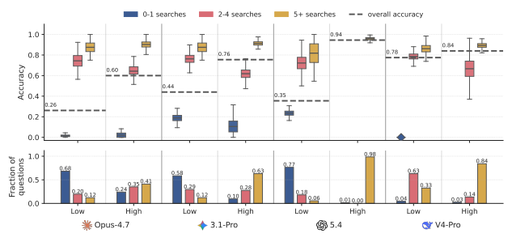
Figure 2 : Across models, we observe comparable performance on indirect probes for demises using the shared harness, when grouped by the number of search queries issued. Top, accuracy per group (with at least 9 probes) and its overall accuracy (dashed). Bottom, the share of probes in each group.
Original paper · CC BY 4.0GPT-5.4 and Gemini-3.1-Pro issued no search on 58.5% and 56.5% of demise probes at low effort. The open-weights models issued no search on at most 30.0% of demise probes at low effort. Tenure probes show a smaller spread, because models search more readily on positions than on whether a person is alive.
Where indirect failures come from
The error analysis sorts each failed indirect probe into one of four mutually exclusive modes, using the first mode it satisfies. Ineffective but explicit search means a query directly asks whether the old fact still holds, but the context has no conclusive evidence.
Gemini-3.7-Flash assigns these failure categories to trajectories at low reasoning effort. These disagreements mainly move failures between indirect and unrelated search, so the tenure conclusions rest on those two modes together.
On tenures, failures spread more evenly across the four modes. Indirect and no or unrelated search together account for a median of 50% of failures. In 14 of the 15 configurations, no or unrelated search explains all the extra demise failures compared with tenures.
Moving from low to high effort cut no or unrelated search failures on demises by 28.9 points on average. That reduction nearly matches the average gain of 28.1 points in indirect accuracy. On tenures, the reduction was 9.1 points, against a gain of 9.4 points. No other failure mode changed by more than 5.0 points for any model. Kimi-K2.6 is the exception, because it already had few no or unrelated search failures at low effort.
Limitations and open questions
The judge was checked against labels from one author, who labeled a stratified sample without seeing the judge's output. On indirect demise responses, the judge matched that author on 99.5% of cases, a strong result that rests on one person's reading. The failure-mode labels agree less often, since Gemini-3.7-Flash matched the authors on only 81.2% of tenure failures.
Most of those tenure disagreements hinge on whether a search is relevant, which depends on background knowledge of the position.
The study covers only two event types, demises and tenure endings for public figures, so other event types weren't tested. The shared harness relies on one web-search tool backed by Exa, so its results reflect that single backend. At low effort, the shared harness trails the native harness on demises by up to 32.0 points for three models.
Claude-Opus-4.7 and MiMo-V2.5-Pro have smaller tenure samples, with 175 events and 115 events respectively. Those smaller samples follow from the filter, which keeps all surviving events when fewer than 200 remain.
The authors speculate that telling agents to verify their facts would help, since higher effort raises indirect accuracy by prompting checks. They didn't test that verification instruction, so its effect on indirect accuracy stays open. Selective verification also needs a rule for which assumptions to check, because how often a fact changes isn't enough on its own.
The authors expect continual learning to complement verification, but they don't test it in this work.
Paper info
- Authors
- Anirudh Phukan, Tanya Goyal, Danish Pruthi
- Venue
- arXiv · Preprint
- First published
- 2026-10-30
- Added
- 2026-11-3
- Updated
- 2026-10-30
- Version
- v1
- arXiv
- 2610.41435
- Category
- cs.CL · cs.AI
- Original paper terms
- CC BY 4.0
- What we show
- Paper info, commentary and permitted figures from the original paper
AI commentary is a separate explanation from the original paper and may contain errors. The original paper and figures follow each source's terms of use and any rights noted separately.
Abstract
Given that AI agents can search the web broadly and deeply in real time, it is tempting to conclude that their outputs account for recent world events. We show that this conclusion does not hold in practice. While agents can search and easily find recent changes, the correctness of their responses depends on whether they search and what they search for. Popular agentic search benchmarks like BrowseComp cannot expose failures wherein agents do not recognize their own assumptions that should be verified, since these benchmarks explicitly state what needs to be found. In contrast, many user requests state only the final information need (e.g., an itinerary for a trip), leaving the agent to discover relevant changes (e.g., the temporary closure of a museum) and account for their consequences. To highlight such gaps, we introduce BlindToChange, a benchmark that measures whether agents proactively discover recent events that affect their responses. Our benchmark comprises requests for recommendations where an obvious candidate is no longer applicable due to a recent real-world event. These events are drawn automatically from Wikidata, allowing BlindToChange to be periodically refreshed. Strikingly, we find a big gap -- as high as 27.5 points, even at high reasoning effort -- in systems' performance, when the recent event is not explicitly mentioned compared to when we ask about it directly. Analyzing search trajectories, we learn that more than half of the failures can be attributed to the fact that agents do not directly search to verify whether a relevant fact has changed. Our benchmark highlights, and tracks, a new axis of progress, wherein systems account for recent information that is not explicitly mentioned in the user request.
Quote from the paper
Anirudh Phukan, Tanya Goyal, Danish Pruthi (2026). BlindToChange: AI Agents Can Find Changes When Asked But Do They Look When Needed?. arXiv:2610.41435v1. https://arxiv.org/abs/2610.41435v1
BibTeX
@misc{phukan2026blindtochange,
  title = {{BlindToChange: AI Agents Can Find Changes When Asked But Do They Look When Needed?}},
  author = {Anirudh Phukan and Tanya Goyal and Danish Pruthi},
  year = {2026},
  eprint = {2610.41435},
  archivePrefix = {arXiv},
  url = {https://arxiv.org/abs/2610.41435v1}
}