Paper commentary
Does Validation Loss Predict Real-Robot Success? Evidence from Four Imitation-Learning Policies on a Low-Cost Arm
Validation loss tracks real-robot success poorly for imitation-learning policies
- Problem Validation loss is the standard offline check for picking imitation-learning checkpoints, but it is rarely tested against success on a real robot. Held-out demonstrations always show the task under way, so they cannot reveal a policy that never starts moving.
- Method The authors score the actions each checkpoint actually outputs on held-out demonstrations, rather than its training loss. They compare these scores with 930 bench rollouts across four policies on a low-cost arm.
- Results Within each policy, lower hold-out action error goes with higher bench success, but across policies the ranking is inverted at +0.90 at 200 episodes. The lowest-error policy succeeded in 3 of 110 rollouts.
Why offline loss may not stand in for the robot
Validation loss is cheap, because the same code that trains the model computes it, and in supervised learning it is the usual way to pick a checkpoint. Imitation learning breaks two assumptions that make validation work in supervised learning. Small errors therefore compound over the run, so a low single-step error doesn't guarantee a good rollout.
The second break comes from the demonstrations: they always show the task already under way. Some ways of failing never appear in such demonstrations, so a held-out set built from them can't reveal those failures.
The four policies, ACT, Diffusion Policy, SmolVLA and π0.5, are trained on different objectives. Their losses don't share a scale, so the losses can't be compared between models. Only ACT's loss is itself an error in the actions. That repair score, averaged over every level of corruption, isn't the quality of the action the policy finally outputs.
To get one scale for all four policies, the paper scores the action each policy actually produces. The policy runs as it does on the robot, through its inference path and saved postprocessor. That comparison is the mean absolute error over N frames, H horizon steps and J joints. Horizons differ by policy, with ACT at 100 steps, SmolVLA and π0.5 at 50, and Diffusion Policy at 24.
Scoring the action a policy actually outputs
Action error scores the action each policy actually produces, not the number its training loss reports. The policy runs on the robot through its inference path and saved postprocessor, so the scored action is the one the arm executes. The training losses differ by objective, so action error is the measure that puts ACT, Diffusion Policy, SmolVLA and π0.5 on one scale.
For ACT the loss is already an action error, while the other three learn to repair a corrupted demonstration.
The measure is a mean absolute error over scored frames, execution steps and joints, in the recorded joint units.
Each checkpoint is scored on the hold-out, 25 demonstrations drawn stratified across nine batches and never used for training. Final ACT, Diffusion Policy and SmolVLA checkpoints are scored on every frame, giving 13,372 hold-out frames and 6,139 probe frames. The π0.5 checkpoints and the 700 intermediate checkpoints are scored on every fifth frame instead.
On 106 checkpoints scored both ways, the stride left the ranking of checkpoints nearly unchanged, with rank correlation of 0.988 or higher.
Each offline score is rank-correlated with bench success across a model line's checkpoints, using Spearman's ρ. The p-values come from 20,000 permutations, and a negative ρ means lower error goes with higher success. To find what episode count alone would produce, the authors simulate success 5,000 times at each budget's pooled rate. A within-budget correlation centres both variables on their budget means and uses 10,000 permutations within budgets.
Within-model and across-model agreement between hold-out error and bench success
Within each model line, lower hold-out action error goes with higher bench success, with Spearman ρ from −0.23 to −0.88.
Across the five model lines at 200 episodes, the error and success rankings correlate at +0.90. Horizon confounds part of this, since ACT is scored over 100 steps and Diffusion Policy over 24.
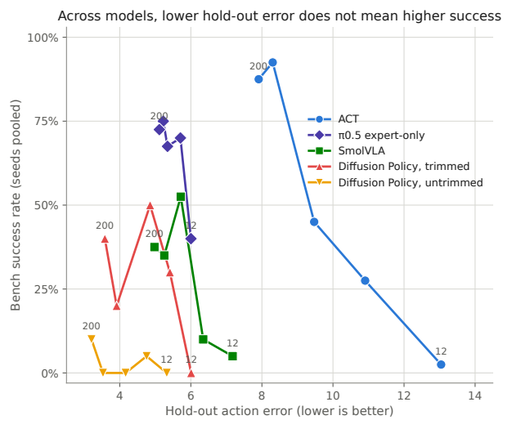
Figure 3 :Hold-out action error against bench success for each model line from 12 to 200 episodes. If validation predicted success across models, the lines would run from top left to bottom right.
Original paper · CC BY 4.0 · Simon Cowling · Does Validation Loss Predict Real-Robot Success? Evidence from Four Imitation-Learning Policies on a Low-Cost Arm · Original paper figure · Extracted the figure area from page 7 of the original PDF.Figure 3 plots each model line across budgets, so a validation signal tracking success would run from upper left to lower right. The lines don't run that way, which is the visual form of the inverted ranking. Figure 4 adds the outcome split behind these points, showing that the untrimmed Diffusion Policy rollouts are dominated by failures to start.
Why the arm that never starts escapes validation
The most common failure in the study is an arm that never leaves its rest pose, and it is concentrated in two policy lines. It ended 96% of untrimmed Diffusion Policy rollouts and 47% of SmolVLA rollouts. Trimmed Diffusion Policy had 9% of its rollouts end this way, while ACT and π0.5 had none. Held-out metrics cannot see this failure because a hold-out made of demonstrations always shows the demonstrator moving.
So a policy that never starts gets no penalty from the hold-out frames it is scored on.
Once the arm moves, validation becomes informative for SmolVLA, whose hold-out action error correlates with success among started rollouts at ρ = −0.81. Its correlation with how often the arm starts is only −0.18, so the signal lives in execution rather than in initiation. At 200 episodes SmolVLA and π0.5 have nearly equal hold-out action errors, 4.98 and 5.11.
Their success rates among started rollouts are similar, 71% and 73%. Their overall success differs, 38% against 73%, and the authors attribute almost all of that gap to initiation.
Trimming the idle lead-in tests this explanation by removing the frames that rewarded an idle policy from training and validation. Trimmed Diffusion Policy cells went from 2 successes in 40 rollouts to 34 in 70 across four paired cells. The trimmed models' validation numbers looked slightly worse, while their bench success rose from 5% to 49%.
The authors argue the idle frames near the start of an untrimmed demonstration reward a policy that holds still, so an idle-prone policy is rewarded there and penalised nowhere.
Lighting adds a second blind spot, since the bench ran dimmer than the recordings. In the brighter-light probe, untrimmed Diffusion Policy started in 16 of 50 rollouts, against 2 of 50 in dim light. SmolVLA started in 36 of 50 in brighter light, against 32 of 50 in dim light. A hold-out recorded under the training conditions cannot reveal this change in deployment conditions either.
EMA, trimming and seeds on the bench
EMA weights change the bench but leave validation nearly untouched across 11 paired models. Each pair shares the same data, budget and seed, and the two members were trained separately. Hold-out action error differs by at most 1.5% between members of a pair, and hold-out loss by at most 3.0%. That contrast gives Fisher p = 0.002, and Figure 6 shows the pairs.
Plain π0.5 and trimmed Diffusion Policy did not change on the bench with EMA.
Trimming the idle lead-in is the second intervention, and it moves the bench far more than validation. Four paired Diffusion Policy cells went from 2 successes in 40 rollouts to 34 in 70. Still, neither validation result predicted success rising from 5% to 49%. The idle lead-in carries the behaviour that validation misses, because removing it removes the frames that rewarded staying at rest.
Seeds separate on the bench while their validation numbers stay close. The brighter-light probe gives a further hint that initiation depends on conditions the hold-out never records. Untrimmed Diffusion Policy started in 16 of 50 rollouts there, against 2 of 50 in dim light.
Why loss rises while action error falls
The authors scored 700 saved checkpoints from 70 runs, ten per run, on the hold-out and the training probe. Training-probe loss falls to the last checkpoint everywhere, which reflects fitting the training set rather than whether training was long enough. Probe loss even correlates positively with success, at +0.86 for ACT, +0.67 for SmolVLA and +0.51 for π0.5, because a 12-episode model fits its few demonstrations almost perfectly.
For ACT, hold-out loss and hold-out action error both drift down a few percent and then flatten. For Diffusion Policy and SmolVLA they diverge: hold-out loss is lowest at the first saved checkpoint in all 15 model and budget combinations.
The authors explain this by what the loss measures: these models learn to repair a corrupted demonstration at every noise level. On unseen frames the repair becomes confidently wrong at many noise levels, so the averaged loss rises.
Only Diffusion Policy at 100 and 200 episodes was still improving on unseen demonstrations when training stopped. Untrimmed Diffusion Policy's action error fell 4.6% and 5.7% over the second half of training at those budgets, in all four seeds. ACT reached within 2% of its final hold-out action error by 20,000 to 40,000 steps. Bench results come from final checkpoints, and for all 20 model and budget combinations that checkpoint is within 5.3% of the best hold-out action error reached in training.
Limitations and open questions for validation-based evaluation
Most checkpoints have ten bench rollouts, with about ±15 percentage points of uncertainty each.
The authors checked the effect of the stride, but the effect of reduced precision wasn't checked.
The authors propose an offline initiation probe as the most direct next step. The probe would present each policy with the opening hold-out frames while the arm is still at rest. It would measure whether predicted actions move the arm within the first second. If this quantity tracks each checkpoint's bench rate of starting, it would give an offline test for the failure mode validation can't observe.
Paper info
- Authors
- Simon Cowling
- Venue
- arXiv · Preprint
- First published
- 2026-10-30
- Added
- 2026-11-3
- Updated
- 2026-10-30
- Version
- v1
- arXiv
- 2611.00283
- Category
- cs.RO
- Original paper terms
- CC BY 4.0
- What we show
- Paper info, commentary and permitted figures from the original paper
AI commentary is a separate explanation from the original paper and may contain errors. The original paper and figures follow each source's terms of use and any rights noted separately.
Abstract
Held-out validation loss is the standard offline signal for choosing checkpoints and comparing models, but its relation to closed-loop success on a real robot is rarely measured. We measure it for ACT, Diffusion Policy, SmolVLA and $π_{0.5}$ (action expert only), trained on nested subsets of 12 to 200 demonstrations of a pick-and-place task on an SO-101 arm. We score 82 checkpoints on 25 held-out demonstrations, with each policy's training loss and with the error of the actions it outputs, and compare the scores with 930 bench rollouts. We also score all 700 intermediate checkpoints of 70 training runs, and recover the ball positions of every training, held-out and bench episode from the front camera. Within each policy, hold-out action error correlates with bench success (Spearman $ρ$ from -0.23 to -0.88), but no more strongly than the number of training episodes alone, and not at all among seeds trained on the same data. Across policies the ranking is inverted ($ρ$ = +0.90 at 200 episodes): the policy with the lowest hold-out error succeeded in 3 of 110 rollouts. The most common failure, the arm never leaving its rest pose, ended 96% of rollouts for Diffusion Policy trained on untrimmed demonstrations and 47% for SmolVLA, and cannot occur in a hold-out set made of demonstrations. Among rollouts in which the arm moved, SmolVLA's hold-out action error predicts success well ($ρ$ = -0.81). For the diffusion and flow-matching policies, hold-out loss rises two- to five-fold during training while hold-out action error falls by up to 29%. Held-out metrics are a sound diagnostic of learning but no substitute for evaluation on the robot, and we recommend reporting initiation failure and success among started rollouts as separate bench outcomes.
Quote from the paper
Simon Cowling (2026). Does Validation Loss Predict Real-Robot Success? Evidence from Four Imitation-Learning Policies on a Low-Cost Arm. arXiv:2611.00283v1. https://arxiv.org/abs/2611.00283v1
BibTeX
@misc{cowling2026does,
  title = {{Does Validation Loss Predict Real-Robot Success? Evidence from Four Imitation-Learning Policies on a Low-Cost Arm}},
  author = {Simon Cowling},
  year = {2026},
  eprint = {2611.00283},
  archivePrefix = {arXiv},
  url = {https://arxiv.org/abs/2611.00283v1}
}