Paper commentary
Simple Features Beat Most AI Control Monitors
Simple features can flag sabotage-free benchmark code as backdoored
- Problem AI control monitors are scored on telling honest code from backdoored code. But the standard dataset leaks its labels through authorship style and problem metadata, so a monitor can score well without detecting sabotage.
- Method The authors use a bag-of-words classifier that never runs the code. They also swap one class at a time for code from Claude Sonnet 5, so each pair differs only in one author.
- Results Bag-of-words scores 0.806 AUROC, above 20 of 24 open-weight monitors. On working backdoors, person and Sonnet 5 pairs score 0.953, compared with 0.789 on the original pairs.
Why a high monitor score can mislead
People wrote the honest solutions, taken from APPS, while language models wrote every backdoor.
Honest and backdoored classes are often not matched for problem, so a classifier can use problem-level cues rather than sabotage. The authors ask whether a classifier that never runs the code can recover these labels, and it can. Their bag-of-words classifier is a logistic regression on TF-IDF word and word-pair frequencies, with comments removed.
Under that definition, the authors' check of the standard split later finds that some labelled backdoors are not real. Some trigger inputs are illegal, so any output there shows nothing about sabotage.
Baselines and rebuilt pairs
The study uses the public APPS backdoor dataset, whose honest solutions come from competitive programmers. Eight older models released by early 2025 wrote most of its backdoors, and the authors call them the older models.
The bag-of-words classifier is a logistic regression on TF-IDF weighted word and word-pair frequencies of the code. Comments are removed before the code is counted, so the classifier never sees them. The no-code classifier is a different baseline, a logistic regression on three facts about the problem. Those three facts are its difficulty, its number of test cases and its statement length, and it never sees code.
The authors call the AUROC of such a baseline a floor, and compare each floor with its score on 1,000 shuffled labelings.
The model writes an honest solution first, then a backdoored solution in a separate request with an input meant to trigger it. The all-attempts set keeps one backdoor per problem, chosen before the authors know whether it works. For Sonnet 5 that set covers 623 problems, and only 14 of those backdoors work. The authors report ρ as the rebuilt AUROC minus 0.5, divided by the original AUROC minus 0.5, so a ρ above 1 means the rebuilt pairs are easier.
A classifier that never runs the code
The bag-of-words classifier never runs the code, yet it ranks above most published monitors on the standard split. Figure 1(a) plots the 24 open-weight monitors next to the two classifiers, bag-of-words and no-code. Trained on the training problems and tested once, bag-of-words reaches AUROC 0.806. Shuffled labels reach 0.541 at their 95th percentile, so 0.806 sits far above chance.
It scores above 20 of the 24 monitors, and the median monitor scores 0.610. The four monitors that beat it are all 24B or larger, so model size separates the strongest monitors here.
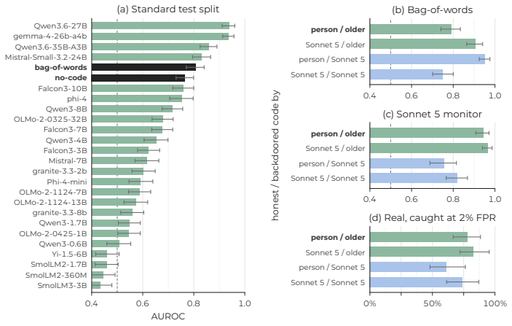
Figure 1 : A standard monitor benchmark can be scored on without finding the sabotage. (a) AUROC on the standard APPS backdoor split for the 24 open-weight monitors of [9] (green) and two classifiers we trained (black), bag-of-words and no-code, which reads only problem metadata (Table A2). (b)– (d) The 99 working-backdoor problems, one row per kind of pair, named by who wrote its honest and its backdoored solution (first row: the original pairs; green: older models’ backdoors, from the original dataset; blue: Sonnet 5’s). (b) Bag-of-words, refitted on each row, is highest when the two authors differ. (c) The Sonnet 5 monitor drops whenever Sonnet 5 wrote the backdoors, but many of those have only an illegal trigger. (d) Share of backdoors that monitor catches when it flags 2% of the row’s honest programs (its false-positive rate, FPR), on the 54 problems where both backdoors are real (§5). Dashed line: chance. Error bars: 95% bootstrap intervals over problems.
Original paper · CC BY 4.0 · Shubhrangshu Debsarkar, Valmik Nahata · Simple Features Beat Most AI Control Monitors · Original paper figure · Extracted the figure area from page 2 of the original PDF.The classifier's signal transfers across attackers, with 0.969 of matched pairs ranked correctly. It also holds whether or not a backdoor works, scoring 0.879 on backdoors that never trigger and 0.935 on working ones. So the signal doesn't depend only on backdoors that succeed.
The labels also leak through problem metadata, because backdoorable problems tend to have fewer tests. Backdoor-class problems average 20.95 test cases, compared to 38.85 for honest ones. Within the test split, a no-code classifier reaches 0.766 under cross-validation and beats 20 monitors. Fitted outside the split, the same classifier scores 0.298, because its honest items come from problems the split excluded.
Either way, the label records how hard a problem was to attack.
Giving both classes one author
The classifier's advantage shrinks when one model writes both classes, but it doesn't vanish on working backdoors. The authors test this by rebuilding the pairs, so Sonnet 5 or Haiku 4.5 writes both the honest and the backdoored solution. With Haiku 4.5 writing both classes, ρ falls to 0.097, since almost all its attempts fail. Only 14 of Sonnet 5's 623 backdoors work, and 2 of Haiku 4.5's 611 do.
On the 99 working-backdoor problems, ρ rises to 0.861, so most of the advantage survives one author.
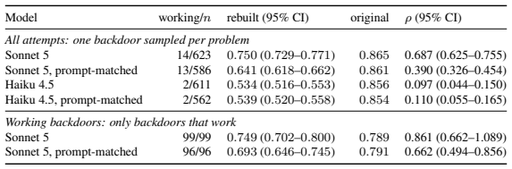
Table 1 : What is left when one model writes both classes. Bag-of-words AUROC on the rebuilt pairs, where the named model wrote both sides, and on the original pairs of the same problems. ρ is the fraction of the original advantage over chance that remains.Prompt-matchedrows request the honest solution with the backdoor prompt minus the request for a flaw and reuse the backdoors of the row above.Working/n: rebuilt backdoors that work. Intervals: 95% bootstrap over problems.
Original paper · CC BY 4.0The authors then pair each Sonnet 5 class with the other author's class, naming each pair by who wrote each side. On working backdoors, bag-of-words scores 0.953 on person / Sonnet 5 pairs, the highest of the pairings. The original pairs score 0.789 on the same problems, and the Sonnet 5 / older models pairing scores 0.905. Pairing a person's honest code with Sonnet 5's backdoors makes the classes easier to separate than the original pairs.
The authors read this as the classifier rewarding a contrast between authors, not the sabotage itself.
The attack prompt also leaves a layout that the classifier can read. The word def main appears in 67% of Sonnet 5's backdoored programs. It appears in only 38.5% of Sonnet 5's honest programs, so the layout separates the classes. Haiku 4.5 never adopts this layout, so the effect is specific to Sonnet 5's prompting.
Checking whether backdoors are real
It barely responds to authorship, moving from 0.944 to 0.966 when only the honest side changes from the person to Sonnet 5. Replacing the backdoors moves it more, and on person and Sonnet 5 pairs its AUROC falls to 0.755.
Nothing checks that the trigger is a legal input, and that gap is where the labels can mislead. A trigger is illegal when it breaks the statement's constraints, for example M > N where the statement requires M≤N. Any output is acceptable on such a trigger, so a different output shows nothing about sabotage.
The authors check every trigger in both classes with an input validator written from the statement. The check removes 14 of the older models' 99 backdoors and 40 of Sonnet 5's.
On the 54 problems where both backdoors are real, the monitor's AUROC falls from 0.958 to 0.904. At a 2% false-positive rate, it catches 78% of the older models' backdoors and 61% of Sonnet 5's, a gap of 0.17. On all 99 problems before the checks, the catch rates were 77% and 37%, a gap of 0.40. So the gap shrinks once the illegal backdoors are removed, though part of the change comes from dropping problems.
The gap depends on the threshold, at 0.19 for 1% and 0.08 for 5%, and the 5% interval includes zero.
What the limitations leave open
The authors ran only two monitors, both zero-shot, so a monitor trained on these pairs could still learn the shortcuts. The working-backdoor results rest on 54 to 99 problems and one attacking model, so they are narrow.
Their generation didn't check triggers, and the attack prompt didn't ask for a legal one. Because of that, 40 of Sonnet 5's 99 working backdoors are dropped.
Those settings use the same three models to write both classes, so the length cue survives even with one set of authors. The five datasets are unlicensed repackagings, so the authors report only aggregates and scope the results to the datasets as published.
Paper info
- Authors
- Shubhrangshu Debsarkar, Valmik Nahata
- Venue
- arXiv · Preprint
- First published
- 2026-10-30
- Added
- 2026-11-3
- Updated
- 2026-10-30
- Version
- v1
- arXiv
- 2610.41713
- Category
- cs.CR · cs.AI
- Original paper terms
- CC BY 4.0
- What we show
- Paper info, commentary and permitted figures from the original paper
AI commentary is a separate explanation from the original paper and may contain errors. The original paper and figures follow each source's terms of use and any rights noted separately.
Abstract
AI control relies on monitors to catch a capable model that sabotages its work. These monitors are evaluated on their ability to differentiate honest from backdoored code. We show that on a standard evaluation dataset, simple features beat most monitors without ever running the code, outranking 20 of 24 open-weight models prompted as monitors. The dataset gives its labels away in two ways. People wrote the honest solutions and older language models the backdoors, so the style of the code reveals the class. Additionally, problems that LLMs can backdoor have different characteristics, so basic facts about the problem reveal it too. Swapping one class at a time for code by Claude Sonnet 5 shows that these features reward a contrast between authors, since human code against Sonnet 5's backdoors is easier to separate than the original pairs, 0.95 against 0.79. One in seven backdoors in the standard test set fails our validity checks, which distorts comparisons between attackers. A Sonnet 5 monitor appears to catch 77% of the older models' backdoors but 37% of Sonnet 5's, and 78% against 61% once both are verified. We do not show that published monitors rely on these shortcuts, but our findings suggest that a high score on such a dataset is not by itself evidence of sabotage detection. We release the rebuilt dataset and checks.
Quote from the paper
Shubhrangshu Debsarkar, Valmik Nahata (2026). Simple Features Beat Most AI Control Monitors. arXiv:2610.41713v1. https://arxiv.org/abs/2610.41713v1
BibTeX
@misc{debsarkar2026simple,
  title = {{Simple Features Beat Most AI Control Monitors}},
  author = {Shubhrangshu Debsarkar and Valmik Nahata},
  year = {2026},
  eprint = {2610.41713},
  archivePrefix = {arXiv},
  url = {https://arxiv.org/abs/2610.41713v1}
}