Paper commentary
End-to-End Guarantees for Masked Diffusion Models under Conditional Mixing
Masked diffusion denoisers can be trained with sample sizes independent of sequence length
- Problem Learned masked diffusion denoisers had no guarantees for the masking patterns that parallel decoding visits. Training bounds covered only the masking distribution used during training.
- Method The authors assume conditional mixing, where revealing distant visible tokens shifts a masked token's posterior exponentially little on average.
- Results The empirical risk minimizer reaches per-token excess ε′ from samples scaling as (1/ε′) to a power of order τc log|V|, with no dependence on sequence length N.
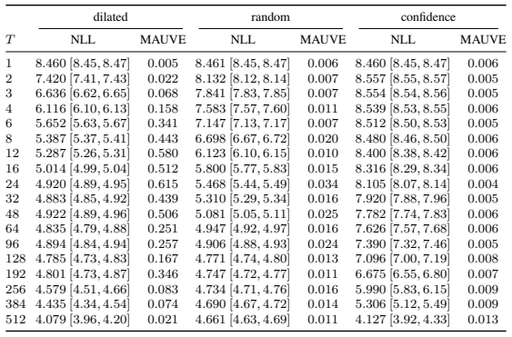
Table 5 : Generation quality on the released MDLM checkpoint at every step count of the sweep and the extended grid: mean per-sequence NLL under GPT-2-large (nats per token, 95% bootstrap intervals over sequences) and MAUVE against the held-out reference, for the three decoding orders at matched per-step commit sizes.
Original paper · CC BY 4.0 · Fareed Sheriff · End-to-End Guarantees for Masked Diffusion Models under Conditional Mixing · Original paper figure · Extracted the figure area from page 25 of the original PDF.Where parallel sampling and learning guarantees stop
Masked diffusion language models trade the autoregressive factorization for conditional independence between tokens within a step, so they can fill several positions at once. That independence is an approximation, and the error it introduces is the part the analysis has to control. The sampling literature bounds this error, but it usually assumes an exact denoiser or leaves the denoiser's error as a free parameter.
Training theory covers the other side, but only at the masking distribution the model was trained on. Parallel decoding visits many other masking patterns, and the bounds on those patterns don't cover them. Without structural assumptions, the training rates scale with the full state space, |V| to the N. So the open question is whether one per-token sample budget can cover every decoding schedule while staying independent of the sequence length N.
The factorization error is the total correlation of the true conditional, summed over sampling steps. Earlier bounds on it are global quantities, so they neither localize the error nor address learning. The authors therefore bound the per-token excess risk by ε′ and the factorization error by ε. That split gives KL(π∥palg) ≤ ε + Nε′, which ties the learning and sampling halves together.
Influence that fades with distance
The authors' key idea is conditional mixing: on average, revealing visible tokens far from a masked token barely changes its posterior. The averaged influence coefficient takes the supremum over visible sets A outside the ball B(i, d), and it averages the total variation over the source. Conditional mixing requires this coefficient to decay exponentially with correlation length τc and prefactor C0.
Ball B(i, d) collects every position j with |j − i| ≤ d, so the distance d measures how far the revealed tokens sit from the target. The formal statement is κ̄(d) ≤ C0 e^(−d/τc) for all d ≥ 0.
Strong conditional mixing replaces that average with a worst case over visible configurations that agree near the masked token. Strong conditional mixing implies conditional mixing with the same constants, but the converse doesn't hold. Conditional mixing tolerates configurations with large influence when they are rare under π, so it is the weaker of the two.
A decaying influence lets a window of nearby tokens serve as a good predictor, which is why the denoiser can read only a bounded context. Tokens committed b positions apart carry no factorization error whenever the influence at distance b minus one is zero.
Two families satisfy the stronger condition with constants that don't grow with sequence length. The first family is order-r Markov sources with a transition floor qmin, where the correlation length is τc = r/log(1/ϑr). That correlation length is at most r/(2 q^r_min), so a larger floor shortens the memory the denoiser must read. The second family is hidden Markov sources whose kernel satisfies a two-sided Doeblin condition, with τc = 1/log(1/ϑΓ).
Conditional mixing is still a strong requirement, because it excludes sources whose pairwise mutual information decays as a power law, as reported for text.
Training a window-restricted denoiser
The denoiser is trained by minimizing the unweighted masked cross-entropy, averaged over masking times and over the masked positions of each sequence. Excess risk subtracts the risk of the true conditionals, and for admissible weightings it equals an expected KL between the true and learned conditionals. Training under the uniform masking distribution is empirical risk minimization, and other noise schedules change the weighting instead.
The hypothesis class F_w lets each prediction read only the w positions on each side of the masked target. Every output probability is floored at pmin, which keeps the log loss below ℓmax = log(1/pmin). The window width w = ⌈τc log(4C0(ℓmax + 1)/ε′)⌉ shrinks the approximation error when the decay is strong. The estimation error comes from fitting the |V| to the 2w possible window contents with n samples.
A Hoeffding argument with a union bound over a grid of these probabilities gives the estimation error its order.
Theorem 1 states that the per-token excess at any masking distribution ω is at most ε′ with probability at least 1 − δ. The sample size needed is (1/ε′) raised to a power of order τc log|V|, with no dependence on the sequence length N. The authors say the exponent's order can't be improved, and Theorem 2 gives a matching lower bound for a family of order-d sources.
Theorem 2 assumes τc ≥ 1, C0 ≥ 16 and |V| ≥ 2. For text the exponent is large: with the GPT-2 vocabulary (log|V| ≈ 10.8) and a local decay scale of about 26, it lies in the hundreds. Corollary 4 gives a polynomial alternative for order-r Markov sources, with rate ˜O(|V|^(r+1)/ε′^2).
From training error to the sampler's KL
The sampler is a monotone procedure that fills each commit set conditionally independently, given the visible tokens, over T steps. Its stepwise KL splits exactly into a sum of per-token KL terms, which training controls, plus a total correlation of the true conditional on that commit set. The total correlation term is untouched by training, so the authors call the summed total correlation the factorization error.
Summing these terms gives a learning part and a factorization part, and the learning part is at most N ε′ when each per-token excess is ε′. Existing theory bounds the factorization error with global functionals, which neither localize it nor address learning.
The dilated schedule unmasks the positions {t, t+b, t+2b, ...} at step t, so tokens committed in the same step sit at least b positions apart. Choosing b of order τc log(C0N|V|/ε) makes the factorization error at most ε in T = b steps.
The end-to-end guarantee reads KL(π∥palg) ≤ ε + N ε′ with probability at least 1 − δ. The learning term uses the denoiser trained under the weighting that the decoding strategy itself induces. A fixed random order can't match this step count on an explicit conditional mixing source, which the next comparison makes precise.
Why a fixed random order needs many steps
A fixed random order draws its step sizes independently of the data and commits positions in a uniformly random order. Two neighboring tokens committed in the same step add a penalty to the factorization error. Under a uniform order, any given pair is a neighbor with probability of order 1/N, so a step that commits many tokens accumulates many such penalties.
A step that commits g tokens contains g(g − 1)/2 pairs committed together, and each pair adds at least cq/N.
Corollary 2 is stated for a two-state Markov chain with flip probability q in (0, 1/2), using the exact conditionals. The constant cq is defined as 8q^4(1−q)^4(1−2q)^2, and the bound holds for all N≥2 and ε>0. The expected number of steps grows linearly in N at fixed ε, which the authors write as E[T] = Ω(N). Dilated decoding needs only O(τc log(N/ε)) steps on the same kind of source, so the gap widens with N.
The proof uses the fact that, with step sizes summing to N, the sum of squared step sizes is at least N²/T. Corollary 2 differs from that result by giving a per-order KL version with explicit constants.
The next section moves from schedules to architectures, starting with block-autoregressive samplers.
Block and looped architectures: do they add error or sample cost?
Block-autoregressive samplers split the sequence into blocks of size B and generate them left to right. The authors report that these samplers chain across blocks with no added error. Each block's factorization error is summed over the m blocks, and the training term adds Nε′ on top. The dilated schedule at spacing min{b∗(ε), B} inside each block reaches a block factorization error of at most ε.
The authors note that with the fitted constants b∗(ε) exceeds practical block sizes. So likelihood comparisons across B measure training error rather than the factorization term.
The looped result replaces the block structure with a shared width-r kernel applied repeatedly. The authors don't analyze transformer computation, so the looped result concerns an idealized class. The loop count is Λ = ⌈(τc/r) log(6C0(ℓmax + 1)/ε′)⌉. Each loop shrinks the approximation error by a factor of e^(−r/τc) until Λr reaches τc log(1/ε′).
The estimation error depends only on the |V| to the r+1 kernel entries, which gives a polynomial sample complexity in |V| and 1/ε′. With the dilated schedule, inference needs T Λ loop iterations, which the authors write as Õ(τc log N · (τc/r) log(1/ε′)).
Table 1 lists the block-size check on a synthetic order-3 source with exact conditionals. Held-out excess stays at most 0.031 nats for every block size B. The authors didn't test looped denoisers against block samplers on the same source in this section.
Checking influence on MDLM's conditionals
The influence check asks whether influence on a trained model's conditionals decays the way the averaged assumption needs. The authors use a trained model's conditionals in place of the data's, so they treat these results as qualitative evidence. They don't read these numbers as a test of the data distribution itself.
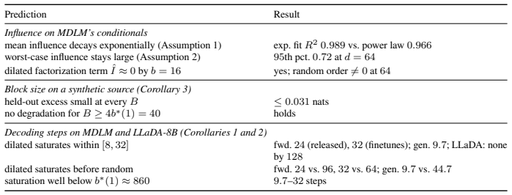
Table 1 : Theory-motivated checks and results. Single runs; setups and estimators in Section B.
Original paper · CC BY 4.0They then record the shift of the model's conditional in total variation over random masking patterns. Mean influence decays exponentially, with a decay scale of about 26 at short distances and about 81 in the tail.
The worst case behaves differently, since the 95th percentile is still 0.72 at d = 64. The authors read this as ruling out Assumption 2 with useful constants on this model. The averaged form stays consistent with the measurements, which matches what Theorem 1(a) and Corollary 1 need. The same probe ties to the dilated factorization term, which is indistinguishable from zero by spacing 16.
Random order still gives a nonzero estimate at spacing 64, so the averaged assumption separates the two schedules.
Block size on an exactly computable source
The authors ask whether the block size B changes held-out error when the source is known exactly. They train six block-autoregressive models that are identical except for B in {4, ..., 128}. Each model trains on an order-3 synthetic source with exact conditionals. Decoding uses T = N/4 steps, so the within-block spacing is B/4.
Corollary 3(ii) bounds the factorization error by 1 nat once B is at least 4b∗(1) = 40. The value b∗(1) = 10 comes from influence constants fitted on the source. The held-out excess stays at most 0.031 nats at every B. Generation KL shows a factorization penalty only at B = 4, and none above the threshold.
So the block size mainly affects the factorization term, and the training error stays flat across the tested range. Dilated decoding saturates earlier than random order on the released models, which is the next experiment.
Dilated versus random decoding on released models
The authors score held-out text by teacher-forced cross-entropy and generated samples by NLL under GPT-2-large and by MAUVE. For random order, the held-out score uses one fixed order per window, as in Corollary 2. On the released MDLM, dilated decoding saturates at T = 24 steps, compared to 96 for random order. On the finetuned variants the same comparison gives 32 steps for dilated against 64 for random order.
Dilated decoding also lies below random order at every matched step count T ≥ 2.
The generation-NLL fit saturates at 9.7 steps for dilated, with a bootstrap interval of [7.9, 18.2].
The authors call the loop-count experiment qualitative and incomplete, though it moves in the direction Corollary 4 suggests. Loop count saturation moves right with training, from 2.42 to 2.53 to 2.62 at 1B, 2B and 4B tokens.
The authors also point to the released and finetuned models sharing the same ordering. They didn't test samplers that revise decoded tokens, which they list as future work.
Limitations and open questions of the end-to-end guarantees
The main limit is conditional mixing itself, which excludes text whose pairwise mutual information decays as a power law. Remark 1 argues that for such sources, with the first dilated step committing positions with nothing visible, the factorization error forces polynomially many steps. The paper states that Assumption 1 fails however small the influence is when context is present.
Dilated decoding therefore does not reach the O(τc log(N|V|/ε)) step count on such text.
The influence probes run on a trained MDLM's conditionals rather than the data's, so the authors treat them as qualitative evidence. On this model the mean influence decays exponentially, and the 95th percentile stays at 0.72 at d = 64. The measurements support the averaged decay used by Theorem 1(a) and Corollary 1, but they rule out Assumption 2 with useful constants.
The fitted constant b*(1) of about 860 is 27 to 89 times larger than the observed saturation points. So the theorem's constants are loose, although the predicted ordering of dilated and random decoding holds. The block-size threshold also exceeds practical block sizes, so likelihood comparisons across B measure training error.
Theorem 1 covers a denoiser trained and evaluated at the same weighting. The paper points to this mask-training design question as a separate issue. The loop-count experiment is qualitative and incomplete, and the authors don't claim it confirms Corollary 4 quantitatively.
Paper info
- Authors
- Fareed Sheriff
- Venue
- arXiv · Preprint
- First published
- 2026-10-29
- Added
- 2026-11-1
- Updated
- 2026-10-29
- Version
- v1
- arXiv
- 2610.39444
- Category
- cs.LG
- Original paper terms
- CC BY 4.0
- What we show
- Paper info, commentary and permitted figures from the original paper
AI commentary is a separate explanation from the original paper and may contain errors. The original paper and figures follow each source's terms of use and any rights noted separately.
Abstract
Masked diffusion models train a denoiser on masked cross-entropy and generate by unmasking many positions in parallel. Existing MDM sampling bounds assume an exact denoiser or leave its error uncontrolled while training bounds cover only the masking distribution on which the model was trained. We present an end-to-end guarantee for a learned denoiser under conditional mixing (CM): stationary sources (e.g. floored order-$r$ Markov and two-sided-Doeblin hidden-Markov sources) for which revealing distant visible tokens moves a masked token's posterior on average exponentially little in the distance with correlation length $τ_c$. We show the empirical risk minimizer trained under any masking distribution attains per-token excess $\varepsilon'$ on that distribution from $\varepsilon'^{-\mathcal{O}(τ_c\log|\mathcal{V}|)}$ training sequences, independent of sequence length $N$ -- one sample budget serves every decoding schedule when each schedule's denoiser is trained under its own weighting. We further show that the exponent's order $Θ(τ_c\log|\mathcal{V}|)$ is minimax-optimal up to constants; more efficient rates require added structure. With this, we bound the end-to-end KL as $\mathrm{KL}(π\Vert p_{\mathrm{alg}})\leq \varepsilon+N\varepsilon'$ under a dilated schedule of $T=\mathcal{O}(τ_c\log(N|\mathcal{V}|/\varepsilon))$ denoising steps versus $Ω(N)$ steps for a fixed random order on an explicit CM source. Finally, we show that block-autoregressive samplers chain across blocks with no added error and that a $Λ$-looped order-$r$ message-passing class on order-$r$ sources achieves polynomial sample complexity, with approximation error improving per loop until saturation at $Λr\approx τ_c\log(1/\varepsilon')$. Experiments on released and retrained models support our results' qualitative predictions.
Quote from the paper
Fareed Sheriff (2026). End-to-End Guarantees for Masked Diffusion Models under Conditional Mixing. arXiv:2610.39444v1. https://arxiv.org/abs/2610.39444v1
BibTeX
@misc{sheriff2026guarantees,
  title = {{End-to-End Guarantees for Masked Diffusion Models under Conditional Mixing}},
  author = {Fareed Sheriff},
  year = {2026},
  eprint = {2610.39444},
  archivePrefix = {arXiv},
  url = {https://arxiv.org/abs/2610.39444v1}
}