Paper commentary
The Diffusion Duality
Duo narrows the gap between uniform-state diffusion and autoregressive text models
- Problem Uniform-state diffusion models could generate text fast by self-correcting, but they trail masked diffusion and autoregressive models. Discrete diffusion also has no few-step sampling method.
- Method Duo transfers Gaussian diffusion techniques to discrete text models. It trains on a restricted time window and distills to few steps with Discrete Consistency Distillation.
- Results Duo scores a PPL of 33.7 on LM1B, against 36.7 for UDLM.
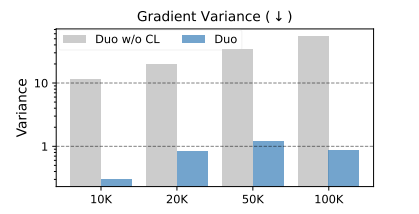
Figure 2 : Curriculum learning drastically lowers the gradi- ent variance in Duo trained with a fixed τ=0.001 . The fig- ure shows the summed gradient variance of the 100 weights with the highest variance, comparing Duo with CL (blue) and without CL (grey).
Original paper · CC BY 4.0 · Subham Sekhar Sahoo, Justin Deschenaux, Aaron Gokaslan, Guanghan Wang, Justin Chiu, Volodymyr Kuleshov · The Diffusion Duality · Original paper figure · Extracted the figure area from page 6 of the original PDF.Why discrete diffusion lags behind
Uniform-state diffusion models (USDMs) trail masked diffusion models (MDMs) because they have historically underperformed them. Gaussian diffusion is well studied, yet discrete diffusion still relies on mean parameterization and slow ancestral sampling. MDLM is the reference point among the MDMs that the paper compares against. Because tokens can keep changing during reverse sampling, USDMs naturally exhibit a self-correcting property.
That self-correction is useful, but it has not been enough to close the gap with MDMs on its own.
Few-step distillation depends on the implicit property of Gaussian diffusion models with Probability Flow ODEs, a deterministic mapping from noise to data. MDMs lack this mapping because their deterministic prior forces them to rely on stochastic sampling to model the data distribution. The authors ask whether USDMs can be made competitive with MDMs, and whether the implicit property of the underlying Gaussian diffusion can enable fast, few-step generation.
Duo enriches the design space of USDMs by incorporating Gaussian diffusion, which reduces the performance gap with MDMs and AR models. Duo reduces NFEs from 1024 to 8 with minimal effect on sample quality, and it outperforms MDMs in the low-NFE regime.
The baselines for Duo include SEDD Uniform, UDLM, and the Gaussian method PLAID, alongside MDMs such as MDLM, SEDD Absorb, and D3PM Absorb. The authors set τ to 0.001 for the first 500K steps and to 0 for the remaining steps up to 1M. A larger τ introduces more bias but reduces training variance. For τ=0.1, the loss drops sharply, which indicates excessive bias, so that value is suboptimal.
Duo with τ=0.001 closely follows the blue curve while showing significantly lower variance.
A Gaussian process behind the discrete one
A discrete Uniform-state process appears when Gaussian latents are rounded to tokens with arg max. Applying arg max to Gaussian latents converts their marginals into discrete ones, but the two processes stay separate Markov processes. The authors treat the discrete process as an emergent phenomenon of the Gaussian one, so continuous-side techniques can move across.
Gaussian diffusion already has many established training and sampling techniques, which is why this link matters.
On the discrete side, the marginal at time t is a categorical distribution that mixes the clean token with the uniform prior. The weight alpha_t on the clean token decreases in t, and the authors write it as a map T applied to the Gaussian parameter. The map gives alpha_t = T(alpha-tilde_t), so the discrete schedule is set by the Gaussian one.
For USDMs, the transition matrix is Q_t = alpha'_t / (K alpha_t) [11^T - K I_K], which describes how each token jumps uniformly.
Sampling starts from the uniform prior, with z_1 drawn from 1/K. Each step draws the next state from an approximate reverse posterior. That posterior replaces the clean token x with the network output x_theta(z_t, t), because x is unavailable at inference. The network is therefore trained to predict the clean token from the noisy state.
This link is what lets Duo carry Gaussian-diffusion techniques into a discrete language model. The next section uses this link to build a curriculum that restricts the training window.
Curriculum learning and the new loss
Duo's training has two changes, a curriculum on the Gaussian time window and a tighter objective. The curriculum restricts the training window to t in [β, γ] with β=0.03 and γ=0.15 when training on Gaussian latents. Outside that window, the diffusion NELBO is weighted by α′t, which is near zero there, so those time steps offer little learning signal.
Prior work used a linear schedule for αt and didn't face this issue, but the window keeps training away from that region. Inside the window, the Gaussian latent keeps a higher signal level than its discrete counterpart, which makes the clean signal easier to recover.
The arg max is relaxed to a softmax, with τ=0.001 for the first 500K steps and τ=0 for the remaining steps up to 1M. A larger τ introduces more bias but reduces training variance, so the authors tested τ values of 0, 0.001, 0.01 and 0.1 on LM1B over 150K steps. For τ=0.1, the loss drops sharply, which indicates excessive bias, so the authors found it suboptimal.
Among the tested values, τ=0.001 is the most desirable, because it closely follows the blue curve while showing significantly lower variance. For the top 100 weights with the highest variance, curriculum learning reduces the gradient variance by an order of magnitude.
The second change is the Rao-Blackwellized ELBO, which replaces the UDLM objective. Duo without the curriculum still surpasses prior Uniform-state and Gaussian diffusion approaches.
After 10K steps of fine-tuning, Duo reaches a PPL of 35.2 at 510K steps. That PPL is almost 1.5 points better than UDLM trained for 1M steps. The authors read this as the curriculum accelerating convergence by at least 2×. The loss curve of Duo lies below the others because it is a biased estimate of the ELBO, so the authors do not treat the curve as a direct comparison.
Likelihood against USDMs, MDMs and AR
On LM1B with sentence packing, Duo reaches a test PPL of 33.7, where UDLM reaches 36.7. MDLM stays ahead in that packed column with 31.8, so the absorbing baseline keeps the lead. Duo narrows the gap with absorbing diffusion to below 2 PPL points, beating SEDD Uniform and UDLM along the way. Without sentence packing, Duo scores 29.9 on LM1B, against 31.3 for UDLM and 27.0 for MDLM.
The authors retrained PLAID on LM1B without self-conditioning, so its parameter count matches their denoising model. Within 100K steps, that PLAID run reached a PPL of 89.9, while Duo reached 43.0 in the same number of steps. They left this comparison out of the table because the PLAID training was incomplete. For OWT, the authors report PLAID numbers from Lou et al.
after 1.3M steps at higher precision, which they say favors the baseline.
On Lambada, Duo scores 49.78 against 51.28 for the autoregressive transformer. On Pubmed and Arxiv, Duo scores 44.48 and 40.39, against 49.01 and 41.73 for the autoregressive model. That makes 3 of 7 datasets where Duo beats the autoregressive model.
On PTB, Wikitext, LM1B and AG News, Duo stays above the autoregressive model, with 89.35 on PTB against 82.05. Against SEDD Uniform, Duo has lower PPL on all seven datasets, such as 89.35 against 105.51 on PTB.
Distilling a discrete model with DCD
Discrete Consistency Distillation carries consistency distillation over to discrete tokens by building both noisy states from arg max over Gaussian inputs. Standard consistency distillation trains a student to match a teacher's clean-sample estimate after one probability-flow ODE step. The teacher there is usually the EMA of the student, so the student learns from a slowly moving copy of itself.
Duo's distillation starts from the same pattern but changes how the two noisy states are formed.
Each step samples a sequence x and a time t, then sets s to the larger of t minus δ and 0. The method maps the Gaussian noisy latent at time s and at time t to discrete latents with arg max. The loss is the KL divergence between the denoiser's output at time t and the teacher's output at time s. The teacher is the denoising model from the previous round, so the authors don't use the EMA copy that standard consistency models use.
After each round the discretization step δ is doubled.
The authors run N=5 distillation rounds on OWT, starting from δ=1/512 and doubling it every M=10K steps. Duo distilled this way reaches a Gen PPL of 77.69 at 1024 steps, matching the base model's quality in 16 steps with ancestral sampling. With Greedy-Tail sampling, the distilled model needs only 8 steps, at a slight cost in sample diversity.
Using the denoising model weights as the teacher leads to a better distilled model than using EMA weights, as the ablation shows.
Overall, DCD reduces sampling steps from 1024 to 8 with minimal effect on sample quality. The algorithm returns the EMA weights of the trained denoiser as its final model.
Few-step sampling results with distilled Duo
Undistilled Duo is scored with GPT-2 Large Gen PPL and sequence entropy, computed in float64 precision. At 1024 steps, Duo scores 77.69 Gen PPL with entropy 5.55, compared to 104.85 for MDLM. At 8 steps, Duo scores 198.27 Gen PPL, compared to 830.82 for MDLM. Duo gives lower Gen PPL than MDLM at every step count, with a slight trade-off in entropy.
The distilled Duo is compared with MDLM distilled by SDTT, after five rounds of DCD. Under ancestral sampling, distilled Duo performs significantly better than MDLM for T≤32. MDMs generate many tokens independently and can't revise them, which leads to incoherence at low NFEs. At higher NFEs, MDLM outperforms the distilled Duo, and MDLM with SDTT matches the Gen PPL of the AR model.
Its lower entropy, 5.4 versus 5.6, indicates reduced diversity.
Greedy-Tail reaches the same range in 8 steps with slightly reduced diversity. Greedy-Tail gives a 128× reduction in sampling steps, against a 64× speedup from the ancestral sampler. The authors also found that using EMA weights as the teacher gives a worse distilled model.
Limitations of the curriculum and the scope of the evidence
The curriculum learning scheme has two hyperparameters, τ and the curriculum duration, and τ controls the degree of arg max relaxation. The same settings work well on LM1B and OWT, but other domains may require manual tuning. When such tuning is infeasible, the authors recommend using Duo without curriculum learning. Even without the curriculum, Duo still outperforms prior work because of the Rao–Blackwellized training objective (17).
The authors set τ to 0.001 for the first 500K steps and to 0 for the remaining steps up to 1M. The curriculum window uses β=0.03 and γ=0.15, and the authors chose these values to keep αt in a range that avoids the region where αt′ ≈0. They didn't test other domains, so the same window may not transfer to them.
Duo's LM1B PPL of 33.7 is still above the 27.0 that MDLM reaches in the no-packing setting. Duo reaches 25.2 on OWT, while MDLM reaches 23.2 in the same table.
The PLAID LM1B run stopped at 100K steps because the open-source codebase made further training infeasible. For OWT, the authors report PLAID results from Lou et al. (2023), trained at higher precision for 1.3M steps. The experiments cover only LM1B and OpenWebText as training sets. The zero-shot evaluation uses seven datasets, all evaluated from models trained on OWT.
Paper info
- Authors
- Subham Sekhar Sahoo, Justin Deschenaux, Aaron Gokaslan, Guanghan Wang, Justin Chiu, Volodymyr Kuleshov
- Venue
- arXiv · Preprint
- First published
- 2025-6-12
- Added
- 2026-10-30
- Updated
- 2025-12-19
- Version
- v3
- arXiv
- 2506.10892
- Category
- cs.LG · cs.AI · cs.CL
- Original paper terms
- CC BY 4.0
- What we show
- Paper info, commentary and permitted figures from the original paper
AI commentary is a separate explanation from the original paper and may contain errors. The original paper and figures follow each source's terms of use and any rights noted separately.
Abstract
Uniform-state discrete diffusion models hold the promise of fast text generation due to their inherent ability to self-correct. However, they are typically outperformed by autoregressive models and masked diffusion models. In this work, we narrow this performance gap by leveraging a key insight: Uniform-state diffusion processes naturally emerge from an underlying Gaussian diffusion. Our method, Duo, transfers powerful techniques from Gaussian diffusion to improve both training and sampling. First, we introduce a curriculum learning strategy guided by the Gaussian process, doubling training speed by reducing variance. Models trained with curriculum learning surpass autoregressive models in zero-shot perplexity on 3 of 7 benchmarks. Second, we present Discrete Consistency Distillation, which adapts consistency distillation from the continuous to the discrete setting. This algorithm unlocks few-step generation in diffusion language models by accelerating sampling by two orders of magnitude. We provide the code, model checkpoints, and video tutorials on the project page: http://s-sahoo.github.io/duo
Figures from the paper
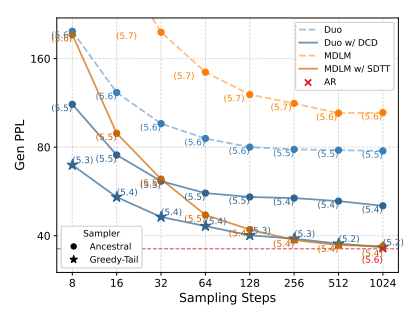
Figure 3 : Sample quality comparison of Duo vs. MDLM. Duo outperforms MDLM in Gen PPL (↓) for base models and in low-NFE regime after 5 distillation rounds.
Original paper · CC BY 4.0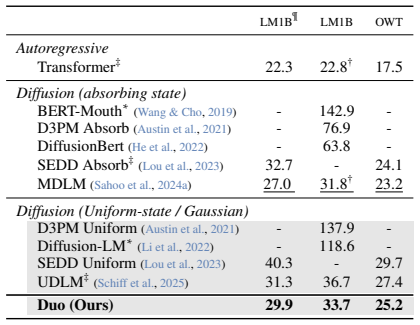
Table 1 : Test perplexities (PPL;↓) on LM1B. ∗Reported in He et al. (2022). Best uniform/Gaussian diffusion value is bolded. ¶Denotes the dataset didn’t incorporate sentence packing. †Reported in Arriola et al. (2025). For diffusion models, we report the bound on the likelihood. Best diffu- sion value is underlined. ‡Denotes retrained models.
Original paper · CC BY 4.0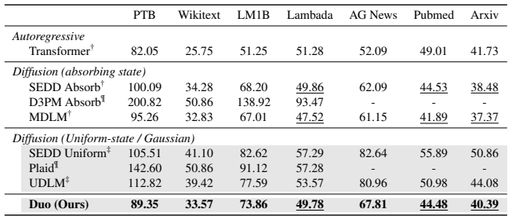
Table 2 : Zero-shot perplexities (↓) of models trained for 1M steps on OWT. All perplexities for diffusion models are upper bounds. † Taken from Sahoo et al. (2024a). ¶ Taken from (Lou et al., 2023) models were trained for 1.3Msteps as opposed to the baselines that were trained for 1Msteps. All perplexities for diffusion models are upper bounds. Best uniform / Gaussian diffusion values areboldedand diffusion values better than AR are underlined . ‡ denotes retrained model.
Original paper · CC BY 4.0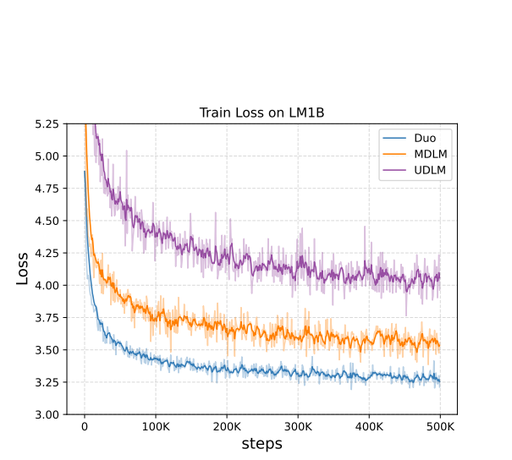
Figure 7 : Training loss curves for Duo (ours) with curriculum learning, UDLM, and MDLM. We see observe that curriculum learning leads to low-variance training. Duo’s curve is lower because its a biased estimate of the ELBO.
Original paper · CC BY 4.0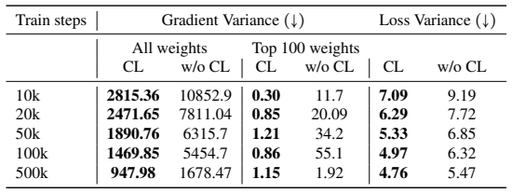
Table 4 : Curriculum learning drastically lowers the gradient variance in Duo trained with a fixed τ=0.001 . The table shows the summed gradient variance of all the weights (left), the 100 weights with the highest variance (middle), and the loss variance (right) comparing Duo with CL and without CL.
Original paper · CC BY 4.0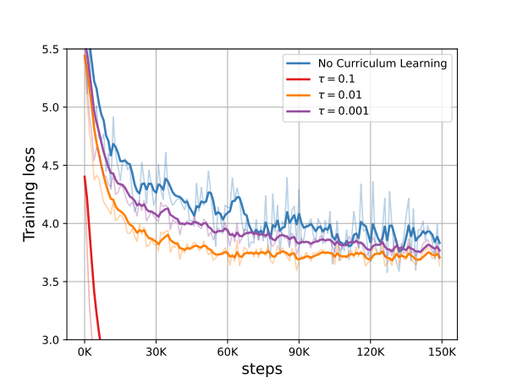
Figure 8 : We study the training bias and variance introduced byτ>0. Models were trained on the LM1B dataset.
Original paper · CC BY 4.0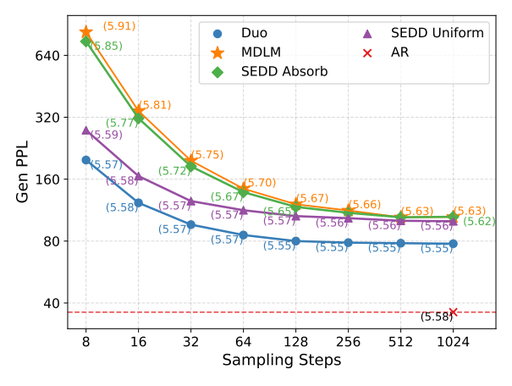
Figure 9 : Sample quality comparison using Gen PPL (↓) between Duo (ours), MDLM, SEDD (Absorb / Uniform), and AR. Values in brackets indicate sample entropy (↑). Among USDMs, Duo achieves lower Gen PPL than SEDD-Uniform, indicating higher sample quality. Compared to MDMs, Duo yields lower Gen PPL with a slight trade-off in entropy. Exact quantitative numbers for Gen PPL can be found in Table 5.
Original paper · CC BY 4.0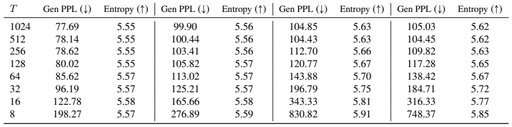
Table 5 : Gen PPL (↓) and Entropy (↑) for Duo (ours), MDLM and SEDD (Absorb / Uniform).
Original paper · CC BY 4.0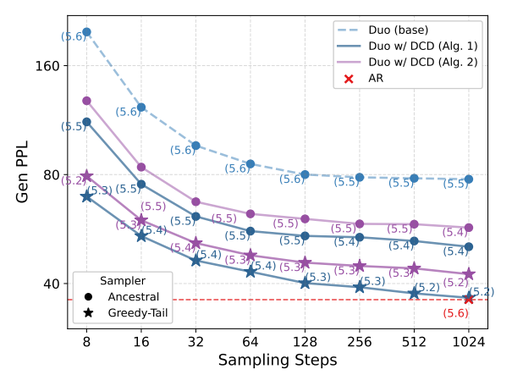
Figure 10 : We compare DCD using denoising weights (Alg. 1) vs. EMA weights (Alg. 2) as the teacher. Using the denoising model yields a more effective distilled model. Quantitative numbers for Gen PPL can be found in Table 6.
Original paper · CC BY 4.0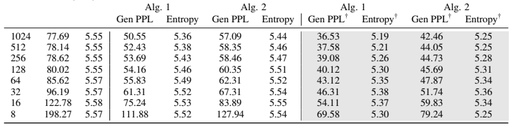
Table 6 : We compare Gen PPL (↓) and entropy (↑) of the base model and its DCD-distilled variants using denoising weights (Alg. 1) vs. EMA weights (Alg. 2) as the teacher. †Indicates use of the Greedy-Tail sampler instead of the ancestral sampler.
Original paper · CC BY 4.0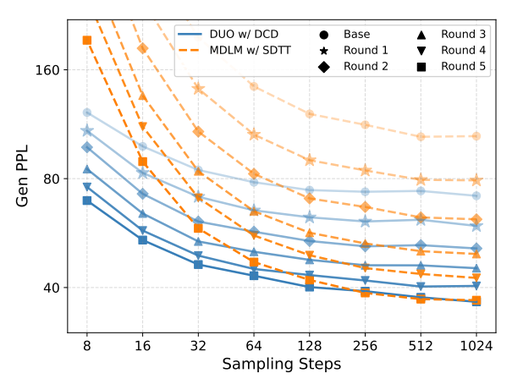
Figure 11 : Sample quality comparision using Gen PPL (↓) of Duo (Ours) distilled with our proposed DCD algorithm and MDLM distilled with SDTT after successive distillation round. Duo always dominates in the low sampling steps regime. Refer Table 7 for the exact quantitative numbers.
Original paper · CC BY 4.0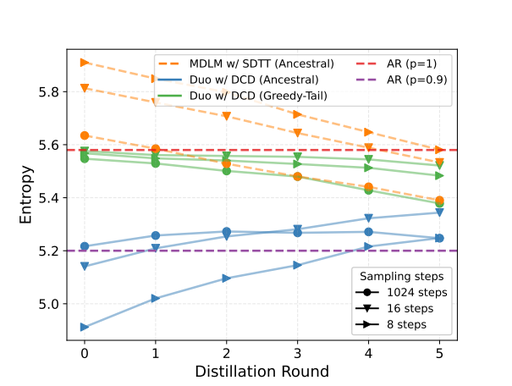
Figure 12 : Entropy of MDLM distilled using SDTT, and of Duo distilled using CDC. The entropy of the SDTT-distilled MDLM decreases with distillation, while the entropy of the CDC-distilled Duo model increases. The curves corresponding to a higher number of sampling steps are displayed with lighter colors to emphasize the low sampling step regimes.
Original paper · CC BY 4.0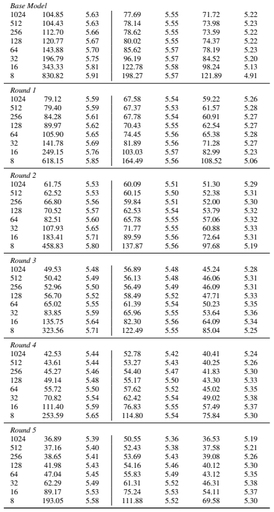
Table 7 : Generative perplexity and entropy for Duo distilled using Discrete Consistency Distillation (DCD) (Alg. 1) and MDLM distilled SDTT.
Original paper · CC BY 4.0Quote from the paper
Subham Sekhar Sahoo, Justin Deschenaux, Aaron Gokaslan, Guanghan Wang, Justin Chiu, Volodymyr Kuleshov (2025). The Diffusion Duality. arXiv:2506.10892v3. https://arxiv.org/abs/2506.10892v3
BibTeX
@misc{sahoo2025diffusion,
  title = {{The Diffusion Duality}},
  author = {Subham Sekhar Sahoo and Justin Deschenaux and Aaron Gokaslan and Guanghan Wang and Justin Chiu and Volodymyr Kuleshov},
  year = {2025},
  eprint = {2506.10892},
  archivePrefix = {arXiv},
  url = {https://arxiv.org/abs/2506.10892v3}
}