Paper commentary
The Geometry of Refusal in Large Language Models: Concept Cones and Representational Independence
Refusal in LLMs is governed by multiple directions forming concept cones
- Problem Prior work assumed one refusal direction controls whether an LLM refuses, which leaves jailbreak mechanisms unclear. Those analyses extracted that direction from prompt activation means, without checking side effects.
- Method RDO finds refusal directions by gradient descent instead of prompt-pair means. It keeps side effects low by adding a retain loss on harmless prompts.
- Results RDO reduced TruthfulQA error by 40% on average compared with DIM, the difference-in-means baseline.
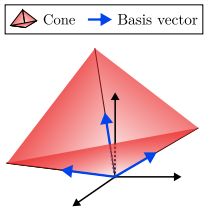
Figure 1 . An example of a 3D concept cone with its basis vec- tors. All directions in the cone mediate refusal.
Original paper · CC BY 4.0 · Tom Wollschläger, Jannes Elstner, Simon Geisler, Vincent Cohen-Addad, Stephan Günnemann, Johannes Gasteiger · The Geometry of Refusal in Large Language Models: Concept Cones and Representational Independence · Original paper figure · Extracted the figure area from page 1 of the original PDF.Why a single refusal direction is an open question
Jailbreaks slip past safety tuning, yet the mechanism behind them remains poorly understood. A widely cited account holds that a single refusal direction in activation space decides whether a model refuses. That direction is usually extracted as a difference of means between harmful and harmless prompts. If that picture were complete, a jailbreak would only need to suppress one vector, which makes the mechanism look simple.
The authors argue this assumption needs testing rather than acceptance, because it sets the scope of every later analysis.
The difference-in-means recipe reads only the model's activations on pairs of prompts. The authors want the search to account for side effects, which prompt-pair extraction does not address directly. RDO reduces the TruthfulQA error by 40% on average, so the side-effect gap is measurable. So the question becomes whether a refusal direction can be found that also keeps side effects low.
Learning a refusal direction with gradients
RDO turns the two refusal properties into loss terms and then searches for a direction by gradient descent. Monotonic scaling asks that the model's refusal probability scale monotonically with the coefficient α when the direction is added to activations. Surgical ablation asks that projecting the direction out makes the model answer previously refused harmful prompts while harmless behavior is preserved.
The addition term uses a modified forward pass that adds αr̂ at layer l_add to harmless prompts, with refusal targets as the goal. Directional ablation replaces each residual activation x with x̃ = x − r̂r̂ᵀx, where r̂ is the unit vector of r.
The ablation term pushes the ablated model toward a harmful answer on harmful prompts. The retain term is a KL divergence that keeps the ablated behavior on harmless prompts close to the original model. The total loss is L = λ_abl L_ablation + λ_add L_addition + λ_ret L_retain, with weights λ_abl = 1.0, λ_add = 0.2 and λ_ret = 1.0. The retain term is needed because the ablation alone would change behavior on harmless inputs as well.
The retain loss is averaged across tokens, covering the target tokens and the last instruction token.
The authors use the DIM direction to generate the harmful answers, ablating DIM and generating 30 tokens. Refusal targets come from activation addition on harmless instructions, rather than from uncensored LLMs as in Zou et al. (2024). Retained answers come from the unmodified model over 29 tokens, and the retain loss covers the last 30 tokens.
The last 30 tokens include the final token of the model's chat template.
Each step takes a gradient step on r and then divides r by its norm, so the direction stays unit length. Training uses AdamW with a base learning rate of 0.01 and a total batch size of 16. For activation addition, the scaling coefficient α is set to the norm of the DIM direction, which keeps the comparison with DIM fair.
RDO against the DIM baseline
On JailbreakBench, RDO is competitive with DIM when the direction is used for directional ablation. Under activation subtraction, RDO outperforms DIM on average, even though it was never explicitly optimized for subtraction. Attack success is judged with the StrongREJECT fine-tuned judge, using greedy decoding and a maximum of 512 tokens.
For activation addition on harmless instructions, RDO induces refusal more effectively than DIM and slightly outperforms it for most models.
Arditi et al. find that DIM ablation has little impact on benchmarks, except for TruthfulQA. RDO reduces the TruthfulQA error by 40% on average relative to DIM. For Qwen2.5 14B, DIM scores 63.3 and RDO scores 67.9, against 70.8 without intervention. The authors read this gap as evidence that the retain loss works.
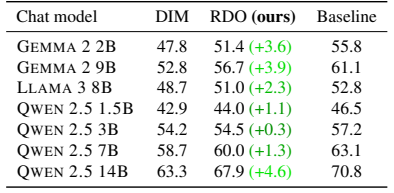
Table 1 . TruthfulQA benchmark performance for directional abla- tion with the DIM or RDO directions, compared to the baseline (no intervention). Higher values indicate better performance.
Original paper · CC BY 4.0Over-refusal is checked on XSTest, which contains benign prompts designed to measure inappropriate refusal. RDO refuses more harmful inputs while keeping benign over-refusal the same or lower than DIM. The sweep sets activation addition strength for Gemma 2 2B from 0 to the norm of the DIM direction. Across this sweep, RDO gives equal or better trade-offs than DIM, so its directions may suit safety gains at the same over-refusal rate.
The retain loss weight λret sets how strongly side effects are penalized during training. On Qwen2.5-3B-Instruct, weights up to λret = 4 reduce side effects with only a marginal ASR reduction. Beyond λret = 4, ASR drops drastically, so excessive retain weighting blocks effective refusal directions. For many models, especially in the Qwen 2.5 family, most DIM directions have side effects too high to be useful.
Extending one direction to a cone
The search extends RDO to higher dimensions by looking for a region of activation space where every vector controls refusal. It optimizes an orthonormal basis B = [b_1, ..., b_N] that spans an N-dimensional polyhedral cone. The cone is the set of combinations with non-negative coefficients λ_i, excluding zero. Because every direction in the cone serves the same refusal concept, the authors call it a concept cone.
The non-negativity constraint keeps all directions strengthening refusal, since negative coefficients could add opposing effects. Orthogonality of the basis vectors stops the search from finding co-linear directions.
RCO optimizes the basis with the same losses as RDO, computed on sampled directions and on the basis vectors themselves. A sample is drawn by taking a unit vector s from the non-negative orthant and mapping it to r = Bs. The authors sample unit vectors rather than normalized convex combinations, because normalizing combinations would bias samples toward the basis vectors.
The basis loss is added because the basis vectors form the cone boundary and tend to degrade first. After each step, Gram–Schmidt orthogonalization projects the basis back onto the cone.
The authors train cones of increasing dimensionality with the same setup as in Section 4. They measure each cone by sampling 256 vectors and computing their ASR under directional ablation. Cones with dimensions up to five mediate refusal across all tested models, shown in Figure 3. The directions in these cones also keep the desired refusal properties, as Figure 20 confirms.
The authors read this as refusal being encoded in multi-dimensional cones rather than a single linear direction.
How far cones extend
The authors trained cones of growing dimension and sampled 256 vectors from each one for directional ablation. Refusal-mediating cones with dimensions up to five were found across all tested models. Figure 3 shows the sampled ASRs as box plots for Gemma 2, Qwen 2.5 and Llama 3. The authors read this as refusal being encoded in multi-dimensional cones rather than in a single linear direction.
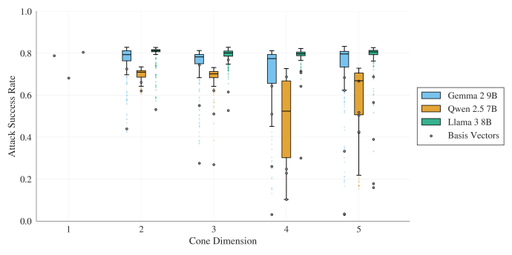
Figure 3 . Attack success rate for multi-dimensional cones for Gemma 2, Qwen 2.5 and Llama 3. The cone performance is measured via the performance of Monte Carlo samples which are depicted as boxplot.
Original paper · CC BY 4.0In the Qwen 2.5 family, the lower bounds of cone performance degrade as dimensionality increases, in every model size. The authors offer a plausible explanation: larger residual streams allow more distinct and orthogonal directions, for example 5120 for the 14B model versus 1536 for the 1.5B model. Figure 18 shows that directions sampled from these cones also induce refusal when added.
For Gemma 2 2B, the authors sample from the four-dimensional cone because performance degrades significantly at larger dimensions. With a small number of samples, best-of-N sampling from this cone reaches higher ASR than temperature sampling with the single RDO direction. For larger sample counts, the randomness dominates the success of the attack.
ASR rises with cone dimension but plateaus at four dimensions, which the authors attribute to the model not supporting higher-dimensional cones.
Orthogonal directions can still interfere
Orthogonality is often read as a sign of causal independence, because an orthogonal direction shouldn't disturb a projection along another. For a single layer, r^T v = 0 implies r^T(x - v v^T x) = r^T x, so ablating v leaves the projection onto r unchanged. Park et al. (2024) argue that conclusions about causal independence can't be drawn from Euclidean orthogonality in language models.
Their experiments still suggest that independent directions are almost orthogonal, which motivates a closer empirical look at refusal directions.
The authors use RDO to find a direction r that is orthogonal to the DIM direction v, so r^T v = 0. They track cosine similarity between the prompt's residual stream representation and both directions, at the last token position. The tracking covers all layers from 0 to L, on 128 harmful instructions in the validation set. The logic is that ablating a causally independent direction in earlier layers shouldn't interfere with the reference direction in later layers.
Any effect that remains would come from the non-linear transformations of the network.
The left plot shows RDO's cosine similarity on a normal forward pass and while ablating DIM, and the right plot shows the reverse. The effect is reciprocal, so orthogonality alone doesn't guarantee independence through the network. The authors show results for additional models in Figure 21.
This observation motivates a stricter notion, Representational Independence (RepInd), which the authors define in Definition 6.1. Under RepInd, the cosine similarity of each direction must stay unchanged when the other direction is ablated, at every layer in the set. Because cosine similarity is tracked at every layer, non-linear distortions earlier in the network are captured downstream.
A stricter test: representational independence
The authors call two directions representationally independent when ablating one doesn't shift how strongly the other shows up in the activations. Cosine similarity is tracked at every layer, so nonlinear distortions from early layers get caught further downstream. This is stricter than orthogonality, because no linear, non-linear or cumulative interaction should change how strongly the other direction is represented.
Each ablation is applied again after the residual addition, so the test follows the already ablated activations through the network.
To enforce this property, the authors extend Algorithm 1 with an extra loss term, called the RepInd loss. Its two squared differences cover the refusal direction r and the DIM direction v, one term for each. The authors weight the RepInd loss by 200 and apply it over the first 90% of layers.
With this loss, the authors find a direction that is RepInd from the DIM direction while still meeting the refusal properties. They then search for further directions that are RepInd to DIM and to all earlier RepInd directions. For each RepInd direction, they train five candidate vectors and keep the one with the lowest refusal score on validation.
Run-to-run variance is high, so the selection step is repeated five times and the reported RepInd results depend on it.
Finding several independent directions
The authors search for directions that are RepInd to DIM and to all earlier RepInd directions. Despite these strong constraints, several such directions exist, and each keeps an ASR significantly above random vector intervention. ASR falls as the search adds more directions. The authors attribute this either to a harder optimization problem under additional constraints or to a limited number of directions that contribute independently to refusal.
They read the results as refusal being mediated by several independent mechanisms rather than one.
The authors test whether ablating several RepInd directions together does more than ablating one. Figure 8 compares ablating the top-k RepInd directions with ablating the DIM direction. For Gemma 2 2B, ASR rises monotonically with k and passes the DIM baseline at k of 4 or more. The gains show diminishing returns beyond k of 4. Stacking several DIM directions taken from different layers didn't improve results.
The authors take the additive gains in ASR as evidence that the RepInd directions capture different aspects of refusal rather than one mechanism.
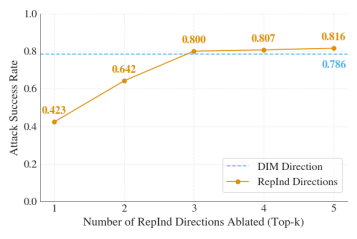
Figure 8 . Compositionally ablating the top–k RepInd directions compared to ablating the DIM direction
Original paper · CC BY 4.0Reaching independent directions through input suffixes
The last question is whether an input can reach these directions or whether they lie where no prompt can go. The authors use GCG to train adversarial suffixes, which extend the prompts so that they aim to circumvent the safety alignment. This design asks whether the suffix can steer the model away from a direction that the authors had already shown to be independent.
The authors measure the cosine similarity between RepInd-1 and the model activations on harmful prompts from JailbreakBench, with and without adversarial suffixes. The suffixes markedly reduce how much RepInd-1 is represented in the activations, which the authors show in Figure 9. The suffixes jailbreak the model in 36% of cases. The authors note that 36% is similar to the ASR of RepInd-1 itself.
The authors read this as evidence that the directions are accessible from the input, not only latent in the network. Their claim is that these independent directions correspond to distinct underlying concepts that input manipulations can reach. The authors frame this as support for representational independence as a general way to analyze representational interventions in LLMs.
The authors also note a limitation: all refusal directions were optimized on the same targets. Diverse targets or reinforcement learning with a judge-based reward could help find more independent mechanisms, as the authors suggest with a citation to Geisler et al.
Limitations of the refusal geometry findings
That suggestion cites Geisler et al. (2025), so the authors leave it as future work rather than testing it.
The cone results establish higher-dimensional refusal cones, but the authors can't rule out other regions in the model that mediate refusal. The paper's cone experiments cover Gemma 2, Qwen 2.5 and Llama 3, so the claim is tied to those tested models. The over-refusal trade-off analysis appears for the Gemma 2 2B model only. Within that model, RDO's trade-off is better or equivalent to DIM across all strength configurations.
They didn't run this trade-off analysis on the other models in the paper.
Paper info
- Authors
- Tom Wollschläger, Jannes Elstner, Simon Geisler, Vincent Cohen-Addad, Stephan Günnemann, Johannes Gasteiger
- Venue
- arXiv · Preprint
- First published
- 2025-2-24
- Added
- 2026-10-30
- Updated
- 2026-2-8
- Version
- v2
- arXiv
- 2502.17420
- Category
- cs.LG · cs.AI · cs.CL
- Original paper terms
- CC BY 4.0
- What we show
- Paper info, commentary and permitted figures from the original paper
AI commentary is a separate explanation from the original paper and may contain errors. The original paper and figures follow each source's terms of use and any rights noted separately.
Abstract
The safety alignment of large language models (LLMs) can be circumvented through adversarially crafted inputs, yet the mechanisms by which these attacks bypass safety barriers remain poorly understood. Prior work suggests that a single refusal direction in the model's activation space determines whether an LLM refuses a request. In this study, we propose a novel gradient-based approach to representation engineering and use it to identify refusal directions. Contrary to prior work, we uncover multiple independent directions and even multi-dimensional concept cones that mediate refusal. Moreover, we show that orthogonality alone does not imply independence under intervention, motivating the notion of representational independence that accounts for both linear and non-linear effects. Using this framework, we identify mechanistically independent refusal directions. We show that refusal mechanisms in LLMs are governed by complex spatial structures and identify functionally independent directions, confirming that multiple distinct mechanisms drive refusal behavior. Our gradient-based approach uncovers these mechanisms and can further serve as a foundation for future work on understanding LLMs.
Quote from the paper
Tom Wollschläger, Jannes Elstner, Simon Geisler, Vincent Cohen-Addad, Stephan Günnemann, Johannes Gasteiger (2025). The Geometry of Refusal in Large Language Models: Concept Cones and Representational Independence. arXiv:2502.17420v2. https://arxiv.org/abs/2502.17420v2
BibTeX
@misc{wollschlger2025geometry,
  title = {{The Geometry of Refusal in Large Language Models: Concept Cones and Representational Independence}},
  author = {Tom Wollschläger and Jannes Elstner and Simon Geisler and Vincent Cohen-Addad and Stephan Günnemann and Johannes Gasteiger},
  year = {2025},
  eprint = {2502.17420},
  archivePrefix = {arXiv},
  url = {https://arxiv.org/abs/2502.17420v2}
}