Paper commentary
Reward-Augmented Data Enhances Direct Preference Alignment of LLMs
Reward-augmented data lifts DPO alignment of LLMs
- Problem Direct alignment methods like DPO widen the chosen-rejected gap, so they unlearn good rejected answers and miss rare top responses. They ignore the judge scores in the data.
- Method The authors relabel each preference pair under two goal rewards, the chosen and the rejected score. Each pair becomes two pairs, doubling the dataset, and unchanged DPO trains on it.
- Results DPO on reward-augmented UltraFeedback raised Gemma-2-9B-It's academic average to 59.75, versus 58.02 for the base model.
Where direct alignment gets stuck
Direct alignment methods such as DPO train on chosen and rejected pairs and widen the gap between them. Their loss focuses on the implicit reward difference, so it doesn't use how good each response is. The judge scores sit in the data, yet the loss never reads them. That blindness causes three failures, and each one is a case where response quality matters but the loss can't see it.
The first failure is unlearning. A rejected answer that is only slightly worse than the chosen one gets pushed down, even though it has real value. Pushing the reparameterized reward gap harder risks overfitting and probability decrease on high-quality responses. The second failure is a ranking error, because the dataset gives only a sample estimate of true preferences.
With a noisy judge, the rejected response can be more preferred than the chosen one in expectation, meaning p∗(yl ≻ yw | x) > 0.5.
The third failure is indiscriminate learning of chosen answers. When one chosen response y2 is of low quality, the optimal policy still generates it with probability a. The model also misses the rare top-scoring responses, because the highest-reward responses are sparse in the preference data.
A single pair makes the first failure concrete. With rewards of 9 for y1 and 8 for y2, the optimal policy puts all probability on y1, so y2 is never generated. Nothing in the loss pushes the model toward the sparse optimal responses, which is why the authors propose conditioning on quality.
The idea: condition the policy on quality
The policy learns to produce responses at a target quality, rather than only learning which of two answers wins. Rejected answers stay useful because they show what one quality level looks like, instead of being pushed away. The same mechanism helps with low-quality chosen answers, since the policy separates them from higher-scored responses by score.
The goal-conditioned reward is R(x, y, g) = -(g - r(x, y))^2, where r is the judge reward. Maximizing R is the same as making the judge reward r(x, y) match the goal g. For each pair, the method sets two goals, one equal to the chosen reward r_w and one equal to the rejected reward r_l. Under the second goal, the pair reverses, so the rejected response becomes the preferred one for that goal.
Each preference pair thus yields two new pairs, so the reward-augmented dataset has size 2N.
The policy is implemented as the LLM with a system prompt such as generate responses of score g. Any direct alignment algorithm, such as DPO, can then train on this goal-conditioned dataset without changes. At inference, the model is conditioned on g* = r_max = 10, the highest possible reward. The authors expect this to help generalization, since shared patterns across quality levels can carry the model to top scores.
Under different goals, the same prompt maps to different responses, as the Table 2 example illustrates.
How the relabeling runs
Each preference pair becomes two relabeled pairs, one for each goal reward that the pair defines. For pair i, the first goal is the chosen reward r^i_w and the second goal is the rejected reward r^i_l. Figure 1 shows the flow from the original pairs to the two relabeled sets that are combined for DPO. The two relabeled sets are merged, and the combined set becomes the reward-augmented dataset.
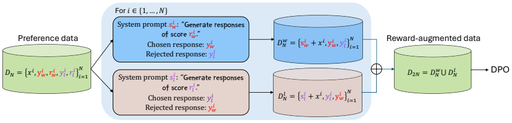
Figure 1 . Illustration of our method: construction of reward-augmented preference datasets followed by direct alignment algorithms.
Original paper · CC BY 4.0 · Shenao Zhang, Zhihan Liu, Boyi Liu, Yufeng Zhang, Yingxiang Yang, Yongfei Liu, Liyu Chen, Tao Sun, Zhaoran Wang · Reward-Augmented Data Enhances Direct Preference Alignment of LLMs · Original paper figure · Extracted the figure area from page 4 of the original PDF.Under goal r^i_w, the chosen response gets reward 0 while the rejected response gets -(r^i_w - r^i_l)^2. The original ranking stays the same, so the chosen response remains preferred under this goal. Under goal r^i_l, the rewards swap, so the rejected response y^i_l becomes the preferred one in a new pair. Because each of the N original pairs yields two pairs, the reward-augmented dataset has size 2N.
The authors implement the policy as the LLM with a system prompt such as generate responses of score g. When system prompts aren't supported, the goal goes into a prefix before the user prompt x. DPO then trains on this combined set, and any direct alignment algorithm could take its place. At inference, the authors condition the LLM on g* = r_max, which they set to 10.
What the theorem claims about reward-augmented DPO
The theorem is the guarantee behind the relabeling, and it is stated only in informal form. It covers the policy obtained from reward-augmented DPO with an SFT regularizer under mild assumptions. With probability at least 1 − δ, the suboptimality against the optimal policy is bounded by an expression that shrinks as the dataset grows. The authors state the rate as N^{-1/2}, where N is the size of the reward-augmented dataset.
The performance measure J(π) is the expected ground-truth goal-conditioned reward, evaluated at the optimal goal g⋆. The bound depends on the partial coverage coefficient, the upper bound B of the reward models, and a KL term against the reference policy. The authors say the bound holds only under their assumptions, so it describes the setting of the proof.
They don't test the rate empirically in this section, so the theorem is a theoretical justification rather than a measured result.
The analysis assumes the judge reward r is bounded in [0, rmax], which the authors adopt for simplicity. The detailed proof is provided in A.5 of the appendix. The authors contrast their result with prior goal-conditioned supervised learning, which typically gives weaker local improvements or a lower bound on J(π).
Instruction-following and academic results of reward-augmented DPO
The authors fine-tune Mistral-7B-Instruct-v0.3, Qwen2-7B-Instruct, Llama-3.1-8B-Instruct, Gemma-2-9B-It and SPPO with DPO on UltraFeedback and on its reward-augmented version. They score each model on AlpacaEval 2.0, MT-Bench and Arena-Hard-Auto, benchmarks that use strong LLMs such as GPT-4 as judges. The authors report that the augmented models outperform both the base models and the UltraFeedback DPO models by a considerable margin.
DPO on the original preference data sometimes lowers scores on Arena-Hard-Auto, which involves more complex reasoning tasks. Figure 2 shows these results for all three benchmarks, with the length-controlled and raw win rates on AlpacaEval 2.0.
On six academic QA benchmarks, Gemma-2-9B-It's average rose from 58.02 for the base model to 59.22 with DPO on UltraFeedback. With DPO on reward-augmented UltraFeedback, the same average reached 59.75. Qwen2-7B-Instruct shows the same ordering, with averages of 53.65, 53.74 and 54.54. Mistral-7B-Instruct-v0.3 is the exception, with an average of 50.05 for augmented data compared to 50.34 for UltraFeedback DPO.
The authors report that they didn't observe severe alignment tax after DPO. Their method improves the base models on most of the benchmarks, according to the same passage. These are averages over six tasks, so the score on any single benchmark can move differently from the average.
Is the gain more than extra data?
The authors ask whether augmentation makes better use of the existing preference data, and whether dataset size alone explains the gain. They start from SPPO, which was already trained with DPO on UltraFeedback. Another DPO round on the same raw pairs lowers SPPO's LC WR from 55.60 to 52.75. Reward-augmenting the same data instead lifts SPPO's LC WR to 60.97.
So extra rounds on the raw pairs hurt, but the relabeled version still helps.
The second test relabels the data with the implicit reward from a DPO model instead of judge scores. Qwen2-7B-Instruct trained on this implicit-reward-augmented data reaches an LC WR of 32.61. That compares with 31.17 for judge-score relabeling and 21.46 for plain DPO on UltraFeedback. The authors read this as evidence that DPO doesn't fully use the data.
The same result shows the method works on binarized pairs, so it doesn't need a judge model.
To check dataset size, the authors augment only the first half of UltraFeedback, so the dataset matches the original size. This half-data version reaches an LC WR of 29.56 for Qwen2-7B-Instruct. That is above 21.46 for DPO on the full UltraFeedback. It is close to 31.17 for augmentation on the full dataset. So the gain doesn't come only from a larger training set.
Does DPO unlearn rejected answers?
The authors test this claim on the UltraFeedback test set using Qwen2-7B-Instruct, comparing the base model, DPO (UF) and DPO (RA). For each rejected response, they calculate the log probability and then average it over responses whose reward scores are 5 or more. The averaged value is plotted against the quality score, which ranges from 5 to 10 in Figure 3.
Plain DPO on UltraFeedback pushes these high-quality rejected responses to lower log probability, so the unlearning problem shows up in practice. DPO on reward-augmented data reduces this drop, which the authors describe as alleviating the issue. The log probability under DPO (RA) still sits slightly below the base model, and the authors tie this to a known property of DPO.
They cite Rafailov et al., 2024a, Zhang et al., 2024 and Xu et al., 2024b for that property.
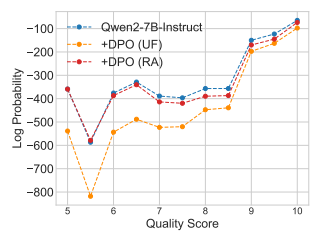
Figure 3 . Our method helps mitigate the unlearning issue of DPO.
Original paper · CC BY 4.0This check fits the paper's argument in Section 3.1 that DPO can unnecessarily unlearn rejected responses of high quality. The figure only covers one model and one reward threshold, so it doesn't show the drop for other families. The paper moves on to multi-attribute rewards, which it describes as a separate setting.
Multi-attribute rewards and the inference goal
The authors test whether the method extends from a scalar judge score to a vector of reward attributes. They rank on-policy Llama-3-8B-Instruct responses with ArmoRM, which predicts fine-grained attributes as well as a scalar reward. The data is then relabeled by conditioning on this 5-dimensional reward, following the ArmoRM implementation from the previous part.
Relabeling on this 5-dimensional reward gives an LC win rate of 56.57, compared to 53.70 for SimPO. SimPO is also trained on on-policy data ranked by ArmoRM, so the comparison keeps the data source fixed. The average length is 1840 for this model and 1777 for SimPO, so length is part of the comparison. OpenChat, fine-tuned with Conditioned-RLFT from the same Llama-3-8B-Instruct model, reaches an LC win rate of 17.48.
The authors also compare against conditional fine-tuning baselines on the offline UltraFeedback dataset, namely DPA, SteerLM and (Info)NCA. Because those baselines target user-controllable profiles, the authors plot win rates across varying preference profiles in Figure 4. Fine-tuned from Zephyr-SFT, the method achieves the best AlpacaEval 2.0 win rate in that comparison.
The authors move the goal reward in the system prompt to see whether generations change, as Table 8 shows. For Qwen2-7B-It with DPO (RA), LC WR is 31.17 at g=10, 28.66 at g=8 and 25.56 at g=6. The AlpacaEval scores of this model change as g varies, so the goal acts as a working control.
Using the same g=10 prompt with DPO (UF) gives an LC WR of only 24.44, so the prompt alone doesn't explain the gain. The authors read this as evidence that the method works beyond the extra system prompt. The conclusion summarizes the approach as conditioning the policy on response quality, then applying DPO to the relabeled data.
Limitations of reward-augmented DPO
The method depends on a judge that gives scalar rewards, and the theory assumes those rewards stay within a bounded range. The paper assumes the judge reward function r is bounded in [0, rmax], which the authors use to simplify the discussion. UltraFeedback's ratings come from GPT-4 as a LLM-as-Judge, with values between 1 and 10, so the reported gains are tied to that judge.
The theorem's bound uses an upper bound B on the reward models, and it holds under mild assumptions stated only informally in the main text. The authors present the theorem as an informal version, and the formal statement sits in Appendix A.4 and A.5.
Unlearning is reduced but not removed, and the log probability of high-quality rejected responses stays slightly below the base model. Mistral-7B-Instruct-v0.3's academic average is slightly lower with reward augmentation, at 50.05, than with UltraFeedback alone, at 50.34. The authors ran most ablations on Qwen2-7B-Instruct, so the evidence for the utility and size tests rests mainly on that one model.
The multi-attribute test uses only Llama-3-8B-Instruct, with on-policy responses ranked by ArmoRM.
The inference-goal sweep covers g from 6 to 10 only, and the paper doesn't test goals below 6. The paper doesn't report results from a comparison that varies the number of rewards per response beyond the 5-dim setting.
Paper info
- Authors
- Shenao Zhang, Zhihan Liu, Boyi Liu, Yufeng Zhang, Yingxiang Yang, Yongfei Liu, Liyu Chen, Tao Sun, Zhaoran Wang
- Venue
- arXiv · Preprint
- First published
- 2024-10-10
- Added
- 2026-10-29
- Updated
- 2025-5-11
- Version
- v6
- arXiv
- 2410.08067
- Category
- cs.LG · cs.AI
- Original paper terms
- CC BY 4.0
- What we show
- Paper info, commentary and permitted figures from the original paper
AI commentary is a separate explanation from the original paper and may contain errors. The original paper and figures follow each source's terms of use and any rights noted separately.
Abstract
Preference alignment in Large Language Models (LLMs) has significantly improved their ability to adhere to human instructions and intentions. However, existing direct alignment algorithms primarily focus on relative preferences and often overlook the qualitative aspects of responses, despite having access to preference data that includes reward scores from judge models during AI feedback. Striving to maximize the implicit reward gap between the chosen and the slightly inferior rejected responses can cause overfitting and unnecessary unlearning of the high-quality rejected responses. The unawareness of the reward scores also drives the LLM to indiscriminately favor the low-quality chosen responses and fail to generalize to optimal responses that are sparse in data. To overcome these shortcomings, our study introduces reward-conditioned LLM policies that discern and learn from the entire spectrum of response quality within the dataset, helping extrapolate to more optimal regions. We propose an effective yet simple data relabeling method that conditions the preference pairs on quality scores to construct a reward-augmented dataset. The experiments across various benchmarks and diverse models demonstrate that our approach consistently boosts DPO by a considerable margin. Through comprehensive ablation studies, we demonstrate that our method not only maximizes the utility of preference data but also mitigates the issue of unlearning, demonstrating its broad effectiveness beyond mere data expansion. Our code is available at https://github.com/shenao-zhang/reward-augmented-preference.
Quote from the paper
Shenao Zhang, Zhihan Liu, Boyi Liu, Yufeng Zhang, Yingxiang Yang, Yongfei Liu, Liyu Chen, Tao Sun, Zhaoran Wang (2024). Reward-Augmented Data Enhances Direct Preference Alignment of LLMs. arXiv:2410.08067v6. https://arxiv.org/abs/2410.08067v6
BibTeX
@misc{zhang2024reward,
  title = {{Reward-Augmented Data Enhances Direct Preference Alignment of LLMs}},
  author = {Shenao Zhang and Zhihan Liu and Boyi Liu and Yufeng Zhang and Yingxiang Yang and Yongfei Liu and Liyu Chen and Tao Sun and Zhaoran Wang},
  year = {2024},
  eprint = {2410.08067},
  archivePrefix = {arXiv},
  url = {https://arxiv.org/abs/2410.08067v6}
}