Paper commentary
Decodability Is Not Validity: Evaluating Nuisance Sensitivity in Language Model Concept Probes
Decodable concept probes can still track nuisance attributes, and selection can reduce this
- Problem Concept probes that predict a concept accurately can still be swayed by a correlated nuisance attribute. Accuracy alone, measured as held-out AUROC, does not reveal this, so equally decodable probes can differ several-fold in nuisance sensitivity.
- Method The authors score probes by how much nuisance-only edits move them.
- Results On CEBaB with correlated training, equally decodable extractors ranged from .54 to .83 in CF N.
Why held-out accuracy can't certify a score
A concept probe turns a hidden state into one scalar, and the usual check is whether that scalar predicts held-out labels of the concept. Decodability measures how well the score ranks positives above negatives, and it says nothing about what else moves the score. Take a target score s1 equal to T and a second score s2 equal to T plus alpha times N, with alpha between 0 and 1.
Both scores rank every positive above every negative, so both reach AUROC 1. Yet only s2 changes when the nuisance N changes, while the target T stays fixed.
Measurement theory treats this gap as construct validity, a property of how a score is interpreted rather than a single number. Its discriminant part asks that a score not depend on a correlated construct once the target is held fixed.
They also ask whether that sensitivity persists without training-set correlation, and whether development diagnostics can choose better extractors. Their edits change the input text of frozen models, so they measure what a score tracks in the input. The study covers four settings and two models, with judge-filtered, placebo-controlled edits.
The authors report that under correlated training data, extractors equivalent in held-out AUROC differ in nuisance sensitivity. Decodability isn't a reliable proxy for this sensitivity, because the rank correlation changes sign across settings. A fixed-method comparison finds the logistic and nuisance-erased probes equivalent in DEC on BiasBios, yet they differ in sensitivity on Amazon-1P.
Turning nuisance dependence into comparable scores
An extractor applies a linear map to the hidden state, s(h) = w⊤z(h) + b, with z the standardization fitted on training data. Because subspace methods also read out linearly, every extractor in the study reduces to one scalar score. Each setting names a binary target T, a binary nuisance N, and a set of input edits that change the text. Extractors are trained at training correlations of 0.5, 0.7 and 0.9, and test metrics are computed on one fixed pool.
DEC is the AUROC of the score for T at the training correlation, which is the standard decodability criterion. |LEAK| measures how far the AUROC for N moves from 0.5 within each target class, so it holds T fixed. CONFLICT computes the AUROC for T only on cells where T and N disagree, and the authors treat it as a stress test. Under CONFLICT, a score equal to negative N also ranks T perfectly, so high values don't prove validity.
That mean is divided by the mean score gap between the T classes on the decorrelated pool, giving ∆T as the scale. Because a signed mean can hide opposite changes, the authors also report |CF N|, the mean absolute change over ∆T. Placebo edits replace neutral words with synonyms and change neither variable, so they set a floor for the comparison.
Only pairs accepted by both LLM judges enter the counterfactual results, so a nuisance flip must leave the target unchanged.
For BiasBios, 1561 gender edits were generated, and 93% of the jointly judged pairs were accepted. On Amazon, negation and first-person edits are checked exactly against word lists, so each flip is verified. CF T is reported for CEBaB only, where edits that flip service sentiment serve as convergent evidence. Qwen2.5-7B and Gemma-2-9B are frozen, and their residual streams are mean-pooled at 7 depths.
Standard families give 70 extractors per setting, and the nuisance-erased probe adds 35 more.
Settings, edits and judges
The study covers four target–nuisance pairs, with CEBaB pairing service sentiment against food sentiment. BiasBios pairs surgeon against nurse with gender, and Amazon pairs negative sentiment with negation or first person. CEBaB edits are human-written, while gpt-oss-120b generates the BiasBios and Amazon edits. Amazon checks each nuisance flip exactly with word lists, which show negation in .64 of negative reviews and .30 of positive ones.
First person appears in .66 of negative and .68 of positive reviews, so it is uncorrelated with sentiment in these reviews. Both judges accept 41% of CEBaB pairs and 93% of BiasBios pairs that they jointly judge.
Qwen2.5-7B-Instruct and Gemma-2-9B-it stay frozen, and their residual stream is mean-pooled at 7 depths. Each layer yields a difference of class means, an ℓ2 logistic regression and partial least squares with k in 2, 4, 8 and 16. The nuisance-erased probe removes within-class nuisance mean differences fitted on training data alone, before logistic regression.
Three standard families need no nuisance labels, giving 70 extractors per setting, and the erased probe adds 35. An extractor is near-best if its test DEC lies within 0.01 of the best, and equivalent if a 90% paired-bootstrap CI stays inside ±0.01. The correlated regimes are resampled, and they match natural rates for BiasBios and roughly for CEBaB.
The generator, gpt-oss-120b, suggests phrase swaps that add or delete the nuisance, and the study applies them by exact string match. Two judges check each pair in random order, unaware of which text was edited. Pairs survive only if both judges see the target untouched and the nuisance altered. For Amazon, the word list checks the nuisance flip, and both judges must also find the opinion strength unchanged.
Placebo edits replace neutral words with synonyms, and all counterfactual results use accepted pairs only.
Equally decodable extractors differ in nuisance sensitivity
Extractors that match on decodability can still differ sharply in how their scores respond to a nuisance edit. With correlated training at ρtr = 0.9, extractors equivalent to the best in DEC span CF N from .54 to .83 on CEBaB with Qwen2.5-7B-Instruct. Gemma-2-9B-it gives a narrower range of .25 to .63 on the same setting. On BiasBios, DEC sits at ceiling for nearly all extractors, yet gender edits shift the occupation score by .09 to .42 of the surgeon–nurse gap.
On Amazon-Neg, by contrast, every near-best extractor is only weakly sensitive, at .03 to .12.
First person is unrelated to sentiment in natural reviews, but competitive extractors trained at ρtr = 0.9 show a median CF N of .12 to .17 for it. For negation, the same extractors show a median CF N of .05 to .06. Relative to decorrelated training, first person rises by .11 to .16 while negation rises by .09 to .11. The probe's training data, not the nuisance's natural association with sentiment, appears to drive this reliance.
Placebo edits move scores little, with median |CF N| between .01 and .06.
With decorrelated training at ρtr = 0.5, near-best extractors show little net shift on BiasBios and both Amazon settings, within ±0.08. On CEBaB the net shift is .02 to .28 for Qwen, though individual examples still move. This geometry approximately predicts the food sensitivity of a difference of means trained on decorrelated data, with mean absolute error .11.
Target edits don't settle it either: near-best CEBaB extractors respond fully to service edits, with CF T of .84 to 1.19. Their food sensitivity still ranges from −.10 to .89. Figure 1 plots test decodability against CF N for competitive Qwen2.5-7B extractors, showing the same spread.
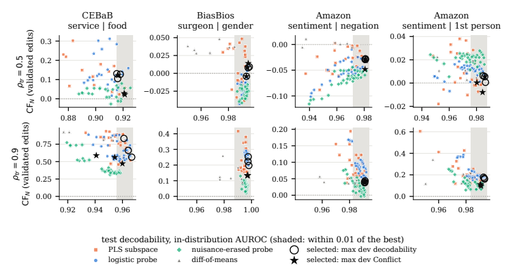
Figure 1 : Competitive extractors (DECwithin 0.05 of the best; Qwen2.5-7B; mean over 3 training samples): test decodability vs. nuisance sensitivity CF N on accepted edits (0: no net shift; 1: the nuisance edit shifts the score as much as a change of target class; note the different y scales). Black symbols: the extractor that each training sample selects on development data by maximal DEC(ring) or maximal CONFLICT(star), standard extractors only. Gemma-2-9B: Appendix B.
Original paper · CC BY 4.0 · Ayal Klein · Decodability Is Not Validity: Evaluating Nuisance Sensitivity in Language Model Concept Probes · Original paper figure · Extracted the figure area from page 4 of the original PDF.Choosing extractors with nuisance-aware diagnostics
This section asks whether development-set diagnostics can pick extractors with lower nuisance sensitivity, without any counterfactual edits. The usual choice keeps the extractor with maximal development DEC, and the authors compare it with two nuisance-aware picks. The two picks are maximal CONFLICT and minimal |LEAK|, both chosen among extractors within 0.01 of the best development DEC.
Among standard extractors, choosing by CONFLICT lowers CF N wherever the default DEC choice is sensitive. On CEBaB with Qwen2.5-7B, CF N falls from .69 to .54 under the CONFLICT choice. The same gain appears on BiasBios and Amazon-1P, by .02 to .15 in every training sample but one. The mean DEC cost is at most .012, and it reaches .020 in the worst training sample.
CONFLICT also lowers |CF N|, the mean absolute change over the decorrelated pool. On Amazon-Neg, where the default choice is already insensitive, CONFLICT changes little.
The leakage-constrained rule is less reliable, and it raises CF N on Amazon-Neg. For Qwen2.5-7B on Amazon-Neg, CF N rises from .04 to .07 under that rule. When the nuisance-erased probe is available, CONFLICT selects it in every training sample. The mean DEC cost of this selection is at most .007. With the erased probe, CEBaB with Qwen2.5-7B reaches .34, against .69 for the standard maximal DEC choice.
Erasure lowers nuisance sensitivity but does not remove it.
These selection results depend on accepted edits, which two LLM judges filter rather than new human annotation. Each setting examines one named nuisance, with Amazon examining two, so gains for other nuisances are unknown.
Limitations of the nuisance-sensitivity evidence
Each setting examines one named nuisance, and Amazon examines two, tested separately. Selectivity for unexamined nuisances is unknown, so the results don't say whether other nuisances behave the same way. The edits are filtered by two LLM judges rather than by new human annotation. Accepted pairs may be a selective subset, and the code generates a blinded stratified sample for human annotation.
Most of these flagged edits involve a negation that was added.
The correlated regimes come from resampling, and they match natural rates for BiasBios, where P(male|surgeon) is 0.85 and P(female|nurse) is 0.91. For CEBaB and Amazon-Neg the correlated regimes match natural rates approximately, at 0.80 and 0.73 for CEBaB. For Amazon-1P the correlated regime is a stress test rather than a natural rate. Strict equivalence is established for few extractors on CEBaB.
The authors study only linear readouts of mean-pooled representations of two 7 to 9B models. They also run last-token representations as an ablation. Nonlinear probes, SAE features and other models remain untested.
Paper info
- Authors
- Ayal Klein
- Venue
- arXiv · Preprint
- First published
- 2026-11-5
- Added
- 2026-11-6
- Updated
- 2026-11-5
- Version
- v1
- arXiv
- 2611.07805
- Category
- cs.CL · cs.LG
- Original paper terms
- CC BY 4.0
- What we show
- Paper info, commentary and permitted figures from the original paper
AI commentary is a separate explanation from the original paper and may contain errors. The original paper and figures follow each source's terms of use and any rights noted separately.
Abstract
Two concept probes can be equally accurate at predicting a concept from a language model's hidden states while their scores contain different mixtures of the target concept and a correlated nuisance attribute. In four target--nuisance settings (two aspect sentiments in CEBaB; occupation and gender in BiasBios; Amazon review sentiment with negation, and with first-person framing), two LLMs, and a population of concept extractors, we compare decodability with discriminant evidence: the score's dependence on the nuisance at fixed target, and its response to input edits intended to change only the nuisance, filtered by two LLM judges and compared against placebo edits. Under correlated training data, extractors that are statistically equivalent in held-out AUROC differ up to several-fold in nuisance sensitivity in three of the four settings, and decodability is not a reliable proxy for it: their rank correlation changes sign across settings. The effect follows the probe's training data, not the nuisance's natural association with the target: first-person framing, unrelated to sentiment in natural reviews, is absorbed at least as much as negation, which co-occurs with negative sentiment, and decorrelated training removes the systematic effect. Selecting extractors with nuisance-aware development diagnostics, which need nuisance labels but no counterfactuals, lowers counterfactual nuisance sensitivity wherever the default choice is sensitive, at a small accuracy cost. Concept measurements should be validated, not just decoded.
Quote from the paper
Ayal Klein (2026). Decodability Is Not Validity: Evaluating Nuisance Sensitivity in Language Model Concept Probes. arXiv:2611.07805v1. https://arxiv.org/abs/2611.07805v1
BibTeX
@misc{klein2026decodability,
  title = {{Decodability Is Not Validity: Evaluating Nuisance Sensitivity in Language Model Concept Probes}},
  author = {Ayal Klein},
  year = {2026},
  eprint = {2611.07805},
  archivePrefix = {arXiv},
  url = {https://arxiv.org/abs/2611.07805v1}
}