Paper commentary
Evolution Strategies at the Hyperscale
EGGROLL makes evolution strategies practical at billion-parameter scale using low-rank perturbations
- Problem Naive evolution strategies become prohibitively expensive on GPUs because each population member needs its own full-rank perturbation, giving low arithmetic intensity. Batched matrix products with these unstructured perturbations cannot keep the hardware busy.
- Method EGGROLL samples each perturbation as the product of two thin random matrices, instead of a full-rank matrix. Workers rebuild the noise from shared seeds and share only scalar fitness values.
- Results EGGROLL reached up to 91% of the throughput of pure batch inference on billion-parameter models. It also trained about a hundredfold faster than naive evolution strategies at large population sizes.
Why naive ES stalls on GPUs
Evolution strategies (ES) don't need gradients of the fitness, so they can handle discontinuous, discrete or noisy objectives. Their weak point is scale, and the authors locate the cost in the matrix products that score each population member. Naive ES gives each member a full-rank perturbation of every weight matrix, which inflates memory and forces large tensors to move.
Batched matrix multiplication with these perturbations has low arithmetic intensity, the ratio of arithmetic operations to memory traffic.
So the cost grows roughly with population size and sequence length, and at billion-parameter scale it confines ES to small models and small populations. Earlier ES work on LLM reasoning kept populations near a hundred perturbations per update. Salimans et al. (2017) used a maximum population of 1440, far below the population of over a million that this paper targets.
Low-rank perturbations as the key idea
EGGROLL replaces each full-rank perturbation with the product of two thin random matrices. The authors sample A in R^{m×r} and B in R^{n×r} with r much smaller than min(m,n), and form E = (1/√r) A Bᵀ. The idea borrows from LoRA, which applies low-rank approximations to matrix multiplications during gradient-based adaptation. Storage per layer falls from mn to (m+n)r, which also reduces how much tensor data moves.
A counter-based deterministic random number generator rebuilds the noise on demand, so the perturbation matrices don't need to persist in memory.
One forward pass then applies all the AB⊤ updates through specialised batched matrix multiplications with significantly higher arithmetic intensity. Naive ES, by contrast, has an arithmetic intensity of at most 1, because each perturbation needs its own matrix-vector multiplication. For r = 1, the uiBi term reduces to a batch of N vector-vector dot products, which the batched LoRA inference path handles efficiently.
Why should low-rank factors still estimate full-rank ES? The authors answer with the central limit theorem. Most widely used ES algorithms assume Gaussian population distributions, so the Gaussian limit is the natural target for the score. EGGROLL therefore uses the Gaussian approximate score function ˆS(E) = −E, because the true low-rank score has no analytic form.
Even with this approximation, the overall update has rank min(Nr, m, n), so it isn't restricted to be low-rank.
How one EGGROLL iteration runs
Each worker starts from the shared mean matrix M and samples its own factors A and B from their distributions. It forms its low-rank perturbation E_i as the scaled product of those factors and evaluates the perturbed model at M+σE_i. Each worker then shares only its resulting scalar fitness with the other workers. Because only scalars cross workers, communication stays small, whereas backpropagation has to aggregate gradients across devices.
Each worker then reconstructs every perturbation E_j from the shared random seeds, so the perturbations never need to be stored. The mean matrix moves by the learning rate times the average of each E_i multiplied by its fitness, with the constant 1/σ absorbed into the learning rate. Each E_i has rank r, but the update sums many such matrices, so the update rank is min(Nr,m,n).
For all experiments in Section 6, Nr is larger than min(m,n), so the EGGROLL parameter updates are full-rank.
For a linear layer, the perturbed product splits into a shared part and a cheap low-rank part. The shared part is one ordinary matrix multiplication with M, and it carries most of the compute. At rank 1, the product with B reduces to a batch of N vector-vector dot products. The authors say this decomposition is why EGGROLL reaches the same speeds as batched LoRA inference systems.
Naïve ES can't do this, because each perturbation needs its own matrix-vector multiplication, which caps arithmetic intensity at 1. When the rank is 1, the sum of E_i f_i is computed as (diag(f)A)^T B, so the individual E_i are never materialised.
The score function of the low-rank distribution has no analytic form except in degenerate cases, so the authors use an approximation. They set the approximate score to S(E) = -E, which is the score function of the standard Gaussian N(0, I_m, I_n). The central limit theorem motivates this choice, because P(E) converges to that Gaussian as the rank r increases.
Mean-field alternatives are derived in Appendix D.1 but weren't the top performers.
Does the theory support the shortcut?
The authors first ask when Gaussian ES stays well behaved as the parameter dimension d grows. As d grows, the noise concentrates in thin shells, so the noise scale sigma_d has to shrink with d. The exponent alpha comes from a Hölder continuity assumption, and the fitness may still be discontinuous away from the explored ball.
Above that rate the picture changes, and the authors show this with cubic objectives. For cubic objectives the gap to the gradient is of order \( \Theta(\sigma_d^2 d) \). At the critical rate the third-order term remains, so the limit stays a nonlinear update. For larger noise the update diverges in non-degenerate cases.
For EGGROLL, Theorem 3 gives convergence to the Gaussian ES update as d grows, for any fixed rank r including r = 1. The theorem needs sub-Gaussian factor tails and a Lipschitz second derivative, together with the condition \( L_d(\sigma_d d)^2 = o(1) \).
The result needs a bounded fitness and i.i.d. factor entries with unit variance.
Pretraining an integer language model with EGGROLL
The integer test uses EGG, a recurrent language model with 6 layers and hidden dimension 256. Every weight is int8, and the model has no explicit activation function. Its only nonlinearity comes from clipping in int8 operations, so EGGROLL trains a nonlinear RNN without gradients. The model learns character-level prediction on the minipile dataset.
EGGROLL updates parameters after every 100 tokens for each population member. It keeps the hidden state across these chunks and resets only at document boundaries.
Test loss falls as the population grows, and the best run reaches 3.40 bits/byte. The baseline is an fp32 Transformer trained with backprop SGD on the same data batch size. That Transformer reaches 3.58 bits/byte, while the best EGG run reaches 3.40 bits/byte. The two models differ in datatype, so the comparison pits different model classes against each other.
A population size of 2 underperforms larger populations on the same data batch, which the authors liken to MeZO.
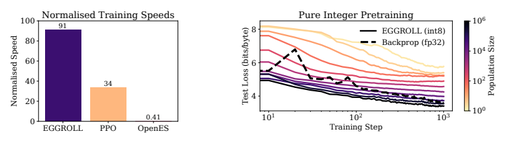
Figure 2 : (a) Relative speed of our method, EGGROLL, in terms of experience throughput versus prior methods, where 100 is the maximum batch inference throughput. See Appendix E for more details. (b) We use EGGROLL to train an int8 RNN language model from scratch, scaling population size from 2 to 1,048,576 with a fixed data batch size of 16. The dotted line is a fp32 Transformer trained with backprop SGD. EGGROLL’s test next-token cross-entropy of 3.40 bits/byte while backprop only gets 3.58 bits/byte.
Original paper · CC BY 4.0 · Bidipta Sarkar, Mattie Fellows, Juan Agustin Duque, Alistair Letcher, Antonio León Villares, Anya Sims, Clarisse Wibault, Dmitry Samsonov, Dylan Cope, Jarek Liesen, Kang Li, Lukas Seier, Theo Wolf, Uljad Berdica, Valentin Mohl, Alexander David Goldie, Aaron Courville, Karin Sevegnani, Shimon Whiteson, Jakob Nicolaus Foerster · Evolution Strategies at the Hyperscale · Original paper figure · Extracted the figure area from page 2 of the original PDF.The authors present this as compute-only scaling in limited data regimes. The largest population is three orders of magnitude above the 1440 maximum used by Salimans et al. (2017). The authors say a single GPU suffices for training at that population size.
Reinforcement learning against OpenES
The authors compare EGGROLL with OpenES on 16 tabula rasa environments spanning Navix, Craftax, Brax, Kinetix, and Jumanji. Both methods use a fixed 3-layer MLP policy with 256 hidden units, so the policy architecture doesn't differ between them. Each method gets per-environment hyperparameter optimisation before the selected configuration is evaluated over 10 random seeds.
The comparison tests whether low-rank perturbations change how ES optimises in standard control settings.
Results are reported as mean performance normalised by PPO, together with uncertainty. Normalised by PPO, EGGROLL was competitive with OpenES on 7 environments, underperformed on 2 and outperformed on 7. The shaded region in Figure 4a is the standard error of the mean.
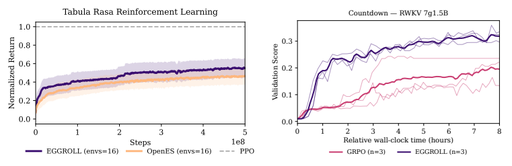
Figure 4 : (a) Comparison of reinforcement learning returns normalised by PPO performance across 16 environments for 10 seeds. The shaded region is the standard error of the mean.(b) Validation score of 3 seeds of EGGROLL v.s. 3 seeds of GRPO in countdown task with an RWKV 7g1.5B model on a single GPU. EGGROLL allows 1024 parallel generations per GPU (618 updates) whereas GRPO only 64 (915 updates).
Original paper · CC BY 4.0The authors attribute the wall-clock gains to EGGROLL's batched low-rank structure, rather than to a change in what ES optimises. EGGROLL often delivered substantial wall-clock improvements over OpenES in these environments. Learning curves, timing comparisons, and complete HPO ranges are given in Appendix N.4, which the authors don't reproduce in the main text.
Fine-tuning RWKV-7 against GRPO
The authors fine-tune pretrained RWKV-7 models, which have a constant state size, so memory that would otherwise hold a KV cache serves population members instead. RWKV is a recurrent model, so its memory is spent on evaluating population members rather than on a growing cache. On Countdown with a 1.5B model, EGGROLL converged to a validation accuracy of 35%, compared to 23% for GRPO under the same hardware and wall-clock time.
EGGROLL ran 1024 parallel generations per GPU in 618 updates, while GRPO ran 64 generations in 915 updates. The comparison uses 3 seeds per method on a single GPU.
On GSM8K with a 7B model on 8 GPUs, EGGROLL used 8192 parallel generations, against 256 for GRPO. Each GRPO generation batch was 32 per GPU across 340 updates, while EGGROLL ran 1024 per GPU across 260 updates. The authors report that EGGROLL outperforms GRPO on this task, with three seeds per method.
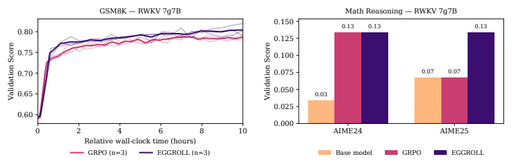
Figure 5 : (a) Comparison of the validation score of 3 seeds of EGGROLL v.s. 3 seeds of GRPO in GSM8K task with an RWKV 7g7B model on 8 GPUs. EGGROLL allows 8192 parallel generations (1024 per GPU with 260 updates) whereas GRPO only 256 (32 per GPU with 340 updates). (b) Performance of our finetuned RWKV 7G 7 billion model on hard reasoning tasks using 128 GPUs for 12 hours. The model was trained using the DeepScaleR dataset and the best checkpoint was chosen by evaluating on AIME24.
Original paper · CC BY 4.0EGGROLL scores each noise direction by its accuracy on several questions, so the scores reflect how each direction performs across a batch. Each question's score is normalised with the global variance, and the authors average these normalised scores over all questions. This scoring weights all questions in the same batch equally across population members, which resembles the group relative advantage of GRPO.
The 14B RWKV-7 model trained on DeepScaleR rose from 13% to 30% AIME24 accuracy, with a thinking budget of 5000 tokens. That run used 32 GPUs for 12 hours, and the authors state that GRPO is infeasible at this scale because of the extra memory used by the Adam optimiser.
Distilling an int8 quantised RWKV-7 model with EGGROLL
The authors quantise RWKV-7 to int8 by dividing each weight matrix by its per-channel maximum and mapping it into [−127,127]. EGGROLL with Adam then distils the original, non-quantised RWKV-7 into this int8 model using teacher-forced GSM8K examples. The distillation matches the next-token distributions of the two models over the vocabulary at each token.
Each population member's fitness is the summed KL divergence between the non-quantised and quantised next-token distributions over a subsequence of GSM8K solution tokens. The fitness is written as a sum over t from 1 to T of KL(p_t || q_t(·; µ_i)). Because the score is a distribution match rather than a correctness reward, the model gets a dense signal even when it solves no problems.
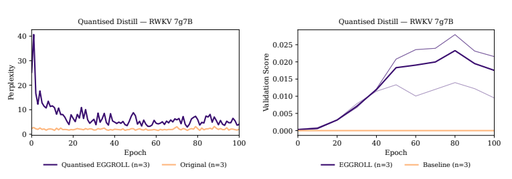
Figure 6 : (a) Average per token perplexity (during training) of 3 seeds of a quantised (int8) RWKV 7G 7 billion parameter model on distillation from the non quantised model using examples from GSM8K. (b) Validation score on unseen examples of GSM8K of 3 seeds of a quantised RWKV 7G 7 billion parameter model. Initially the model is unable to solve any problems, but progressively it is capable of solving more problems. The baseline here indicates the validation score of a quantised model without any further training.
Original paper · CC BY 4.0Figure 6a plots the average per-token perplexity over training for 3 seeds of the int8 RWKV 7G 7 billion parameter model. Figure 6b plots the validation score on unseen GSM8K examples for 3 seeds of the same quantised model. The validation baseline is the quantised model without any further training.
The quantised model starts unable to solve any problems, so its validation score begins near zero. The authors report this gradual rise across the 3 seeds, and they don't report a final accuracy for this experiment.
Limits of the evidence
The convergence results are stated as the parameter dimension grows, so they describe a limit rather than a fixed network size. Theorem 3 also rests on sub-Gaussian tails for the perturbation distribution, a Lipschitz second derivative, and a decay condition on the Lipschitz constant. The authors note that the Lipschitz constant is expected to decay at a rate of d to the minus one half, depending on the network architecture.
Substituting that rate into the bound yields convergence rates of O(σ2dd 32) or O(σ 2dd) respectively.
The pretraining comparison sets an int8 RNN against an fp32 Transformer, so the 3.40 and 3.58 bits/byte figures don't isolate the optimiser alone. The authors present this cost as the price of compute-only scaling in limited data regimes. A population size of 2, analogous to MeZO, significantly underperformed larger populations on the same data batch.
On 7 of 16 RL environments, EGGROLL was competitive with OpenES, and on 2 of 16 it underperformed. The fine-tuning comparisons use 3 seeds per method, which is a small sample for the reported gains. The authors list neurosymbolic systems and agents trained against inference-time harnesses as future directions.
Paper info
- Authors
- Bidipta Sarkar, Mattie Fellows, Juan Agustin Duque, Alistair Letcher, Antonio León Villares, Anya Sims, Clarisse Wibault, Dmitry Samsonov, Dylan Cope, Jarek Liesen, Kang Li, Lukas Seier, Theo Wolf, Uljad Berdica, Valentin Mohl, Alexander David Goldie, Aaron Courville, Karin Sevegnani, Shimon Whiteson, Jakob Nicolaus Foerster
- Venue
- arXiv · Preprint
- First published
- 2025-11-20
- Added
- 2026-10-29
- Updated
- 2026-2-16
- Version
- v2
- arXiv
- 2511.16652
- Category
- cs.LG · cs.AI
- Original paper terms
- CC BY 4.0
- What we show
- Paper info, commentary and permitted figures from the original paper
AI commentary is a separate explanation from the original paper and may contain errors. The original paper and figures follow each source's terms of use and any rights noted separately.
Abstract
Evolution Strategies (ES) is a class of powerful black-box optimisation methods that are highly parallelisable and can handle non-differentiable and noisy objectives. However, naïve ES becomes prohibitively expensive at scale on GPUs due to the low arithmetic intensity of batched matrix multiplications with unstructured random perturbations. We introduce Evolution Guided GeneRal Optimisation via Low-rank Learning (EGGROLL), which improves arithmetic intensity by structuring individual perturbations as rank-$r$ matrices, resulting in a hundredfold increase in training speed for billion-parameter models at large population sizes, achieving up to 91% of the throughput of pure batch inference. We provide a rigorous theoretical analysis of Gaussian ES for high-dimensional parameter objectives, investigating conditions needed for ES updates to converge in high dimensions. Our results reveal a linearising effect, and proving consistency between EGGROLL and ES as parameter dimension increases. Our experiments show that EGGROLL: (1) enables the stable pretraining of nonlinear recurrent language models that operate purely in integer datatypes, (2) is competitive with GRPO for post-training LLMs on reasoning tasks, and (3) does not compromise performance compared to ES in tabula rasa RL settings, despite being faster.
Quote from the paper
Bidipta Sarkar, Mattie Fellows, Juan Agustin Duque, Alistair Letcher, Antonio León Villares, Anya Sims, Clarisse Wibault, Dmitry Samsonov, Dylan Cope, Jarek Liesen, Kang Li, Lukas Seier, Theo Wolf, Uljad Berdica, Valentin Mohl, Alexander David Goldie, Aaron Courville, Karin Sevegnani, Shimon Whiteson, Jakob Nicolaus Foerster (2025). Evolution Strategies at the Hyperscale. arXiv:2511.16652v2. https://arxiv.org/abs/2511.16652v2
BibTeX
@misc{sarkar2025evolution,
  title = {{Evolution Strategies at the Hyperscale}},
  author = {Bidipta Sarkar and Mattie Fellows and Juan Agustin Duque and Alistair Letcher and Antonio León Villares and Anya Sims and Clarisse Wibault and Dmitry Samsonov and Dylan Cope and Jarek Liesen and Kang Li and Lukas Seier and Theo Wolf and Uljad Berdica and Valentin Mohl and Alexander David Goldie and Aaron Courville and Karin Sevegnani and Shimon Whiteson and Jakob Nicolaus Foerster},
  year = {2025},
  eprint = {2511.16652},
  archivePrefix = {arXiv},
  url = {https://arxiv.org/abs/2511.16652v2}
}