Paper commentary
Sparser, Faster, Lighter Transformer Language Models
Sparse kernels make feed-forward layers in LLMs run faster on GPUs
- Problem Sparse kernels often run slower than dense ones on modern GPUs, because GPU software and hardware are tuned for dense computation. Earlier sparsity methods also changed the standard training recipe, so they were rarely adopted.
- Method The authors introduce TwELL, a sparse packing format written directly from matrix multiplication output. Their fused kernels skip the zero activations, and L1 regularization keeps the training recipe standard.
- Results The 2B sparse model ran inference 20.5% faster than dense, with accuracy of 48.8% against 49.1% for the dense model.
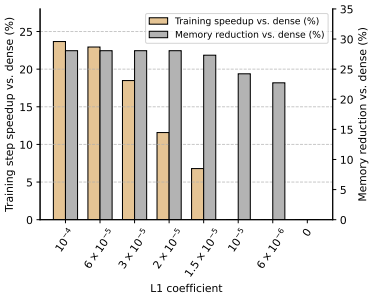
Figure 5 | Training speedups and peak memory reduction from our sparse LLM training kernels across L1 regularization levels.
Original paper · CC0 1.0 · Edoardo Cetin, Stefano Peluchetti, Emilio Castillo, Akira Naruse, Mana Murakami, Llion Jones · Sparser, Faster, Lighter Transformer Language Models · Original paper figure · Extracted the figure area from page 8 of the original PDF.Why sparse feed-forward layers still run slow on GPUs
Feed-forward blocks hold most of an LLM's parameters and FLOPs in larger models, so they look like the obvious place to find savings. If only a small fraction of hidden neurons fire for each token, a sparse kernel could skip most of that work. In practice, though, sparse kernels can run slower than dense ones on modern GPUs even when they perform far less arithmetic.
The mismatch sits between unstructured sparsity and GPU hardware and software stacks, which were heavily tuned for dense computation patterns. Heterogeneous workloads and the overhead of materializing and managing sparse indices add further cost that keeps savings from reaching the wall clock. Earlier attempts to gain efficiency relied on considerable deviations from modern training recipes.
Because of those deviations, these attempts have yet to see practical adoption.
The authors target this gap with new kernels for modern NVIDIA GPUs that keep the standard training recipe in place. Their kernels build on Tile-wise ELLPACK (TwELL), a packing format that can be materialized in the epilogue of matrix multiplication kernels. This design removes a canonical bottleneck of prior packing schemes, which is where the storage overhead used to appear.
Keeping the training recipe nearly unchanged
The core idea is to make feed-forward activations sparse with a small change to training, leaving the rest of the model standard. The authors use ReLU as the activation function after the gate projections, so the kernels can exploit the exact zeros it produces. They add a simple L1 loss to the standard cross-entropy, scaled by a tunable coefficient L1 that promotes sparsity across all layers.
The L1 term averages the absolute values of the hidden activations over layers, batch positions and hidden units. Sparse models use the same training hyperparameters as the non-sparse baselines, because adding L1 regularization did not seem to affect other choices.
The main experiments use the Transformer++ architecture with a gated feed-forward block, following recent LLMs such as Qwen and Llama. The gate and up projections both take the block input, and their outputs are combined by elementwise multiplication before the down projection. Because the sparsity of the gate activations decides which columns of the up projection and rows of the down projection are needed, one sparse pattern drives all three matrix products.
The authors also keep a non-gated variant in Appendix C, where the up projection determines the sparsity pattern instead.
The authors chose the recommended coefficient L1 = 2 × 10⁻⁵ from earlier results on the 1.5B model. They then checked that choice across model scales, from a 0.5B model on 10B tokens to a 2B model on 40B tokens. Across these scales, the authors found no performance drops beyond random deviations when mild L1 regularization was added. They didn't test sparsity levels from a separate tuning run at each scale.
How TwELL and the fused kernels run
The ELLPACK format pads every row to the largest number of non-zeros, and it packs values and column indices at the front of each row. That padding helps a matmul kernel fetch data quickly, but it spends storage on empty slots. TwELL instead divides each row into tiles, and each tile keeps its own count of non-zeros, so the format can be written directly from a matrix multiplication's epilogue.
Algorithm 1 walks through each tile of the gate projection, records the positive entries with their column index, and stores the final count for that tile.
The authors pack the TwELL values, indices and counts into a single 32-bit matrix. The count sits in the first column of each tile row, and the 16-bit value and index fill the remaining entries. They set the compression factor to 8 for the recommended regularization, which keeps the average of 39 to 24 non-zeros per row well inside the storage.
The fused kernel takes the TwELL gate activations and, for each non-zero, computes one up-projected value and scales the matching row of the down projection. Algorithm 2 shows the same loop: each non-zero column index selects one column of W_u and one row of W_d. Because the dense zeros are never touched, the kernel skips the work that a dense matmul would spend on them.
Each accumulation reads a column of the up projection, so the authors store that matrix in transposed form for coalesced reads.
Training needs the activations again for backpropagation, so the training kernels convert the sparse gate activations into a hybrid format. The hybrid format has a fixed-size ELL part and a dense backup matrix for rows that overflow the ELL slots. A small helper kernel copies the overflowing entries into the dense backup rows after the main kernel finishes.
When the structures overflow, the excess values are discarded and a flag tells the CPU to resize the structures and repeat the step.
Speed, energy and memory across model scales
Forward throughput from the sparse inference kernels reaches up to 30% across the L1 levels above zero. At 0.5B, forward throughput rose from 410 to 480 input tokens per ms, a gain of 17.0%. At 2B, the same measure moved from 87.8 to 106 input tokens per ms, a gain of 20.5%. At 2B, energy per token fell 17.0%, from 7.85 mJ to 6.51 mJ, for the sparse model at L1 = 2× 10⁻⁵.
Training speed across the L1 levels rose to 24% for the sparser models. At 2B, training throughput rose 21.9%, from 22.4 to 27.3 input tokens per ms. The authors tie this 2B training gain to a larger micro-batch size that the sparse model can use. At 2B, however, peak memory rose 22.3%, from 46.7 GB for dense to 57.1 GB for the sparse model.
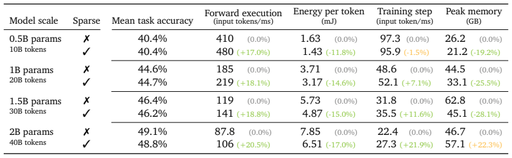
Table 1 | Comparison of performance and efficiency statistics of sparse LLMs leveraging our kernels with traditional models.
Original paper · CC0 1.0Task accuracy stays within random deviations at all four scales, with 40.4% against 40.4% at 0.5B. At 2B the sparse model scores 48.8% against 49.1% for the dense model. The average number of non-zeros falls from 39 at 0.5B to 24 at 2B, so larger models need fewer active neurons per token. The authors read this trend as LLMs becoming more effective at supporting sparsity as they scale.
They didn't test scales beyond 2B in this table, so the trend is shown only across these four sizes.
Where the sparsity sits across layers and tokens
Activity in the feed-forward layers is uneven, and the layer-wise pattern explains much of the inference speedup. The average non-zero count is lowest in the first two layers and then forms a hump across the first half of the network. The authors connect this early-middle peak to prior work placing much of an LLM's reasoning and knowledge retrieval at these depths.
Within each layer, the maximum non-zero count often exceeds the layer's mean by more than an order of magnitude, with no consistent pattern across the architecture.
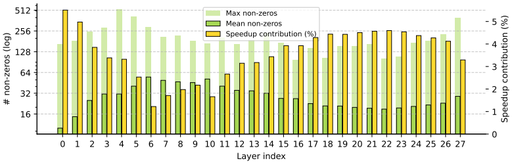
Figure 6 |Sparsity statistics and speedup contributions across different layers of our sparse LLMs.
Original paper · CC0 1.0The layer's average non-zero count tracks its relative speedup closely, with a Pearson coefficient of over -0.996. The maximum count matters much less, showing a noticeable effect only in layer 8.
Sparsity also depends on the input tokens, so the authors checked which tokens drive the peaks and troughs. Tokens from common web links such as doi, nlm, gov and nih, and contractions such as doesn and couldn, produce the fewest non-zeros. Tokens with more contextual content, such as the verbs loud and enduring, and place or substance nouns such as Vermont and formaldehyde, produce the most.
The model allocates many more non-zeros to the very first tokens of a sequence, and the count then decreases exponentially with position. The authors read this as the model focusing its computation on tokens with high information content.
Gated versus non-gated, and ReLU versus SiLU
Swapping the gated block for the original two-layer block changes which projection carries the sparsity pattern. With ReLU, the non-gated sparsity pattern is set by the up projection rather than the gate projection. Because of this, the non-gated variant runs the up projection through the TwELL matmul kernel instead of the gate projection.
The authors also wrote a separate kernel that performs only the down projection starting from the TwELL format. Across the three sparsity levels, the two variants differ only slightly in mean task accuracy, which the authors attribute to random variation.
The gated variant gains more from the kernels, because its inference kernel can fuse the up and down projections. The authors read these gaps as evidence that the benefits extend beyond a single architectural choice.
Next, the authors swap ReLU for SiLU in the gated 1.5B model trained on 30B tokens. The SiLU dense model reaches 47.1% mean task accuracy, against 46.4% for the ReLU dense model. Cross-entropy is 2.240 for SiLU and 2.255 for ReLU, so the two look nearly equivalent on that metric.
SiLU can't use the sparse kernels, so its accuracy edge comes with no efficiency gain. The authors note that the advantages of smooth activations seem minor and could be offset by efficiency considerations.
Dead neurons and two mitigation attempts
Over 30% of the feed-forward neurons become permanently inactive on average across layers at the recommended L1 coefficient of 2× 10⁻⁵. That share rises for higher regularization, so the L1 penalty creates dead neurons as a side effect of sparsity. The authors checked the activity of each hidden feedforward neuron over training, counting a neuron as dead once it stayed silent for a whole step of about 1M tokens.
They found that the sparsity levels settle after roughly 1000 steps, and the dead neuron share follows the same early trend. Because dead neurons appear so early, the authors reasoned that changing the schedule of the L1 penalty could reduce them.
The first attempt keeps the L1 coefficient at zero for 5000 steps, then raises it linearly over another 5000 steps. The authors made this setup artificially similar to prior work on finetuning and continued pretraining. The second attempt applies a targeted reinitialization to the gate projection's weights, which lowers the magnitude of the dead neurons.
Both attempts are presented as preliminary extensions to the simple L1 recipe from Section 2.
Table 5 compares these runs with the standard recipe at the same 30B-token budget for the 1.5B model. At L1 coefficient 2× 10⁻⁵, dead neuron reinitialization raised mean task accuracy from 46.2% to 46.6%. The same run lifted forward throughput from +17.9% to +19.1%, while energy per token fell from -12.1% to -14.0%. These are single runs, so the small accuracy gains don't establish a reliable improvement.

Table 5 | Comparison of performance and efficiency statistics of sparse LLMs leveraging our kernels with traditional baselines trained using our standard recipe, or with dead neuron mitigation strategies such as warming up the coefficient of the L1 loss and applying targeted reinitialization to the gate projection’s weights.
Original paper · CC0 1.0Limitations and open questions
Performance starts to degrade once the share of activated neurons falls below 0.5%, so the sparsity gains have a floor. That share rises with stronger regularization, and the authors say reducing it could allow higher sparsity before performance degrades. The authors observe that this symptom does not visibly reflect on downstream performance at the recommended coefficient.
The SiLU comparison shows that smooth activations gain slightly in task accuracy, but they are non-sparse and cannot use the kernels. They conclude that the advantage of smooth activations appears minor and could be offset by efficiency considerations, following Mirzadeh et al. (2023).
The authors chose this discard-and-retry design to avoid a hard failure and any deterioration in the learning dynamics.
The per-task results cover seven benchmarks at the 1.5B scale, and the authors did not test them beyond the 2B model. The mitigation attempts were preliminary, and the authors describe their strategies as explorations rather than tuned methods.
Paper info
- Authors
- Edoardo Cetin, Stefano Peluchetti, Emilio Castillo, Akira Naruse, Mana Murakami, Llion Jones
- Venue
- arXiv · Preprint
- First published
- 2026-3-24
- Added
- 2026-10-29
- Updated
- 2026-5-8
- Version
- v2
- arXiv
- 2603.23198
- Category
- cs.LG · cs.CL
- Original paper terms
- CC0 1.0
- What we show
- Paper info, commentary and permitted figures from the original paper
AI commentary is a separate explanation from the original paper and may contain errors. The original paper and figures follow each source's terms of use and any rights noted separately.
Abstract
Scaling autoregressive large language models (LLMs) has driven unprecedented progress but comes with vast computational costs. In this work, we tackle these costs by leveraging unstructured sparsity within an LLM's feedforward layers, the components accounting for most of the model parameters and execution FLOPs. To achieve this, we introduce a new sparse packing format and a set of CUDA kernels designed to seamlessly integrate with the optimized execution pipelines of modern GPUs, enabling efficient sparse computation during LLM inference and training. To substantiate our gains, we provide a quantitative study of LLM sparsity, demonstrating that simple L1 regularization can induce over 99% sparsity with negligible impact on downstream performance. When paired with our kernels, we show that these sparsity levels translate into substantial throughput, energy efficiency, and memory usage benefits that increase with model scale. We will release all code and kernels under an open-source license to promote adoption and accelerate research toward establishing sparsity as a practical axis for improving the efficiency and scalability of modern foundation models.
Quote from the paper
Edoardo Cetin, Stefano Peluchetti, Emilio Castillo, Akira Naruse, Mana Murakami, Llion Jones (2026). Sparser, Faster, Lighter Transformer Language Models. arXiv:2603.23198v2. https://arxiv.org/abs/2603.23198v2
BibTeX
@misc{cetin2026sparser,
  title = {{Sparser, Faster, Lighter Transformer Language Models}},
  author = {Edoardo Cetin and Stefano Peluchetti and Emilio Castillo and Akira Naruse and Mana Murakami and Llion Jones},
  year = {2026},
  eprint = {2603.23198},
  archivePrefix = {arXiv},
  url = {https://arxiv.org/abs/2603.23198v2}
}