논문 해설
The Diffusion Duality
디퓨전 이중성
- 연구 문제 균일 상태 이산 확산 모델은 자기회귀 모델과 마스크 확산 모델보다 성능이 낮아, 가우시안 확산의 기법을 이산 설정으로 옮기는 방법이 필요합니다.
- 연구 방법 가우시안 잠재 변수에 arg max를 적용해 균일 상태 이산 확산을 얻고, 이 연결로 커리큘럼 학습과 이산 일관성 증류를 구성합니다.
- 주요 결과 커리큘럼 학습은 학습을 2배 빠르게 하고, DCD로 증류한 Duo는 샘플링 단계를 크게 줄이며 낮은 NFE에서 증류 MDLM보다 우세합니다.
이산 확산 언어 모델의 성능 격차
이산 데이터인 텍스트를 생성하는 확산 모델은 가우시안 확산 모델이 잘 다듬어진 연속 데이터와 달리 설계 공간이 상대적으로 제한되어 있습니다. 균일 상태 이산 확산 모델(USDM)은 토큰이 전이 중 여러 번 갱신될 수 있어 자기 수정 성질을 가지지만, 자기회귀 모델과 마스크 확산 모델(MDM)보다 성능이 낮다고 보고됩니다. 이 논문은 이 격차를 줄이고, 가우시안 확산에서 발전한 학습·샘플링 기법을 이산 설정으로 옮길 수 있는지를 묻습니다. 또한 적은 단계의 생성을 가능하게 하는 증류를 USDM에 적용할 수 있는지도 함께 검증합니다.
arg max로 잇는 가우시안과 이산 확산의 연결
이 연구의 핵심 연결은 가우시안 잠재 변수 w_t에 arg max 사상을 적용하는 것입니다. 원-핫 벡터 z_t = arg max(w_t)로 바꾸면, 가우시안 확산의 주변 분포가 확산 파라미터 α_t = T(α̃_t)를 가진 Uniform-state 이산 확산 과정의 주변 분포와 일치합니다. 여기서 T는 적분식으로 정의되는 확산 변환 연산자입니다. 저자들은 이 주변 분포가 이산 확산의 상미분방정식을 따른다는 것을 보이지만, 가우시안 궤적을 이산화한 경로가 항상 이산 확산 과정이 되는 것은 아니라고 부록에서 구분합니다.
Rao-Blackwellized 목적과 학습 손실
이산 확산의 NELBO를 계산할 때 원-핫 벡터를 명시적으로 만드는 대신, 분산을 줄이도록 해석적으로 계산한 목적 f_Duo를 사용합니다. 이 목적은 학습 메모리 사용과 학습 시간을 줄이고 분산을 낮추며, 원문은 이것이 perplexity 개선에 기여한다고 보고합니다. 이 목적은 아래 커리큘럼의 기준이 되는 NELBO 재정식화와 함께 쓰입니다.
tempered softmax 커리큘럼 학습
커리큘럼 학습은 가우시안 잠재 변수의 arg max를 온도 τ를 가진 tempered softmax로 완화합니다. 학습 초기에는 입력이 연속적으로 완화되어 있고, τ를 점차 낮춰 최종적으로 이산 입력에 가까워집니다. 원문은 τ=0.001을 처음 500K 단계에 쓰고 이후 τ=0으로 두며, 학습 시간 구간은 β=0.03, γ=0.15로 설정했다고 보고합니다. 이 완화된 손실은 τ가 0이고 β=0, γ=1일 때만 유효한 NELBO가 되며, 그 외의 경우 편향이 있는 추정치입니다.
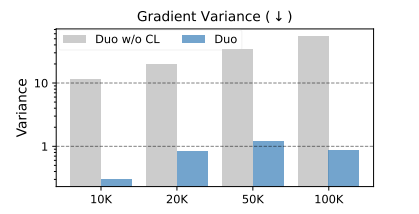
Figure 2 : Curriculum learning drastically lowers the gradi- ent variance in Duo trained with a fixed τ=0.001 . The fig- ure shows the summed gradient variance of the 100 weights with the highest variance, comparing Duo with CL (blue) and without CL (grey).
원문 · CC BY 4.0 · Subham Sekhar Sahoo, Justin Deschenaux, Aaron Gokaslan, Guanghan Wang, Justin Chiu, Volodymyr Kuleshov · The Diffusion Duality · 원문 그림 인용 · 원본 PDF 6쪽에서 그림 영역을 추출했습니다.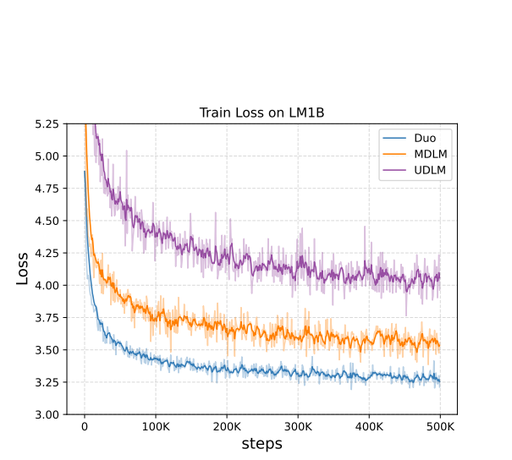
Figure 7 : Training loss curves for Duo (ours) with curriculum learning, UDLM, and MDLM. We see observe that curriculum learning leads to low-variance training. Duo’s curve is lower because its a biased estimate of the ELBO.
원문 · CC BY 4.0 · Subham Sekhar Sahoo, Justin Deschenaux, Aaron Gokaslan, Guanghan Wang, Justin Chiu, Volodymyr Kuleshov · The Diffusion Duality · 원문 그림 인용 · 원본 PDF 27쪽에서 그림 영역을 추출했습니다.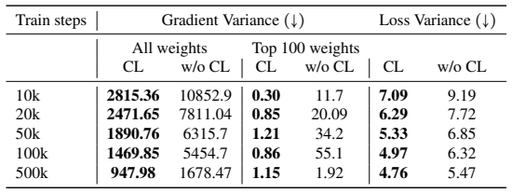
Table 4 : Curriculum learning drastically lowers the gradient variance in Duo trained with a fixed τ=0.001 . The table shows the summed gradient variance of all the weights (left), the 100 weights with the highest variance (middle), and the loss variance (right) comparing Duo with CL and without CL.
원문 · CC BY 4.0 · Subham Sekhar Sahoo, Justin Deschenaux, Aaron Gokaslan, Guanghan Wang, Justin Chiu, Volodymyr Kuleshov · The Diffusion Duality · 원문 그림 인용 · 원본 PDF 27쪽에서 그림 영역을 추출했습니다.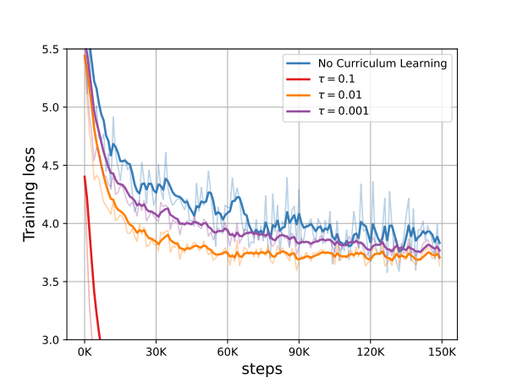
Figure 8 : We study the training bias and variance introduced byτ>0. Models were trained on the LM1B dataset.
원문 · CC BY 4.0 · Subham Sekhar Sahoo, Justin Deschenaux, Aaron Gokaslan, Guanghan Wang, Justin Chiu, Volodymyr Kuleshov · The Diffusion Duality · 원문 그림 인용 · 원본 PDF 28쪽에서 그림 영역을 추출했습니다.Discrete Consistency Distillation
증류에서는 가우시안 확산의 PF-ODE를 사용할 수 없으므로, 학습된 denoising 모델로 역 PF-ODE 경로를 구성하고 arg max로 이산 결정 궤적 P_DDT를 만듭니다. 학생 모델은 인접한 두 잠재 변수 쌍에서 교사 모델의 출력과의 KL 손실로 학습합니다. 각 라운드가 끝나면 교사 가중치를 학생으로 갱신하며, 원문은 이 방식이 EMA 교사를 쓴 경우보다 나은 증류 모델을 얻는다고 보고합니다.
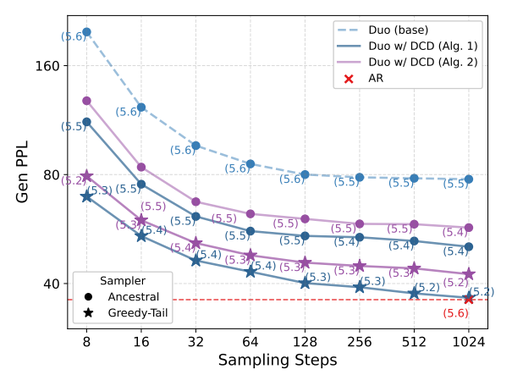
Figure 10 : We compare DCD using denoising weights (Alg. 1) vs. EMA weights (Alg. 2) as the teacher. Using the denoising model yields a more effective distilled model. Quantitative numbers for Gen PPL can be found in Table 6.
원문 · CC BY 4.0 · Subham Sekhar Sahoo, Justin Deschenaux, Aaron Gokaslan, Guanghan Wang, Justin Chiu, Volodymyr Kuleshov · The Diffusion Duality · 원문 그림 인용 · 원본 PDF 30쪽에서 그림 영역을 추출했습니다.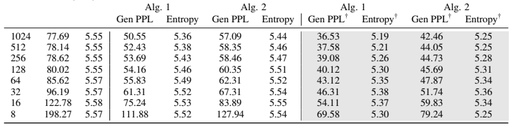
Table 6 : We compare Gen PPL (↓) and entropy (↑) of the base model and its DCD-distilled variants using denoising weights (Alg. 1) vs. EMA weights (Alg. 2) as the teacher. †Indicates use of the Greedy-Tail sampler instead of the ancestral sampler.
원문 · CC BY 4.0 · Subham Sekhar Sahoo, Justin Deschenaux, Aaron Gokaslan, Guanghan Wang, Justin Chiu, Volodymyr Kuleshov · The Diffusion Duality · 원문 그림 인용 · 원본 PDF 30쪽에서 그림 영역을 추출했습니다.LM1B와 OpenWebText의 학습 결과
LM1B에서는 커리큘럼 학습이 학습을 2배 빠르게 하고, 절제 표에서 Duo의 PPL은 33.7, 커리큘럼 학습을 제외하면 35.0, 개선된 학습 손실을 제외하면 36.7입니다. OpenWebText에서 제로샷 평가를 수행했을 때 Duo는 7개 데이터셋 중 3개에서 자기회귀 모델보다 낮은 PPL을 보입니다. 이 제로샷 확산 perplexity는 상한값입니다.
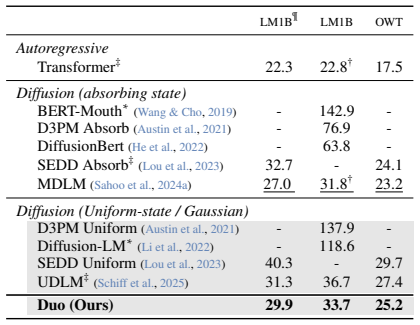
Table 1 : Test perplexities (PPL;↓) on LM1B. ∗Reported in He et al. (2022). Best uniform/Gaussian diffusion value is bolded. ¶Denotes the dataset didn’t incorporate sentence packing. †Reported in Arriola et al. (2025). For diffusion models, we report the bound on the likelihood. Best diffu- sion value is underlined. ‡Denotes retrained models.
원문 · CC BY 4.0 · Subham Sekhar Sahoo, Justin Deschenaux, Aaron Gokaslan, Guanghan Wang, Justin Chiu, Volodymyr Kuleshov · The Diffusion Duality · 원문 그림 인용 · 원본 PDF 8쪽에서 그림 영역을 추출했습니다.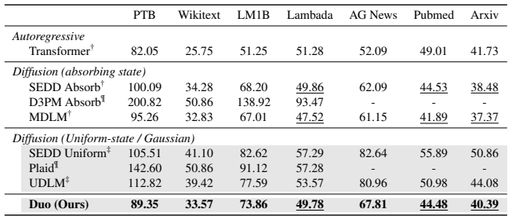
Table 2 : Zero-shot perplexities (↓) of models trained for 1M steps on OWT. All perplexities for diffusion models are upper bounds. † Taken from Sahoo et al. (2024a). ¶ Taken from (Lou et al., 2023) models were trained for 1.3Msteps as opposed to the baselines that were trained for 1Msteps. All perplexities for diffusion models are upper bounds. Best uniform / Gaussian diffusion values areboldedand diffusion values better than AR are underlined . ‡ denotes retrained model.
원문 · CC BY 4.0 · Subham Sekhar Sahoo, Justin Deschenaux, Aaron Gokaslan, Guanghan Wang, Justin Chiu, Volodymyr Kuleshov · The Diffusion Duality · 원문 그림 인용 · 원본 PDF 9쪽에서 그림 영역을 추출했습니다.DCD 증류와 Greedy-Tail 샘플링 결과
DCD로 5라운드 증류한 Duo는 Greedy-Tail 샘플러와 결합해 샘플링 단계를 1024에서 8 수준까지 줄입니다. 원문은 ancestral 샘플링에서 16단계가 기준 품질에 맞고, Greedy-Tail에서 8단계가 필요하지만 샘플 다양성이 약간 줄어든다고 보고합니다. 평가는 GPT-2 Large Gen PPL과 평균 시퀀스 엔트로피로 수행되었으며, 비교 기준은 SDTT로 증류한 MDLM입니다. 낮은 NFE에서는 Duo가 우위에 있고 높은 NFE에서는 MDLM이 더 나은 것으로 원문에 나타납니다.
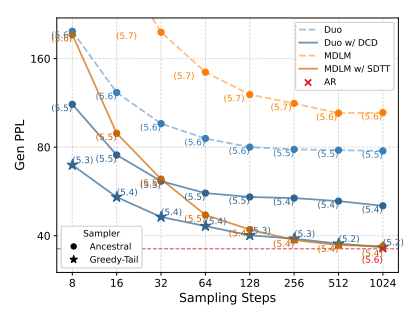
Figure 3 : Sample quality comparison of Duo vs. MDLM. Duo outperforms MDLM in Gen PPL (↓) for base models and in low-NFE regime after 5 distillation rounds.
원문 · CC BY 4.0 · Subham Sekhar Sahoo, Justin Deschenaux, Aaron Gokaslan, Guanghan Wang, Justin Chiu, Volodymyr Kuleshov · The Diffusion Duality · 원문 그림 인용 · 원본 PDF 8쪽에서 그림 영역을 추출했습니다.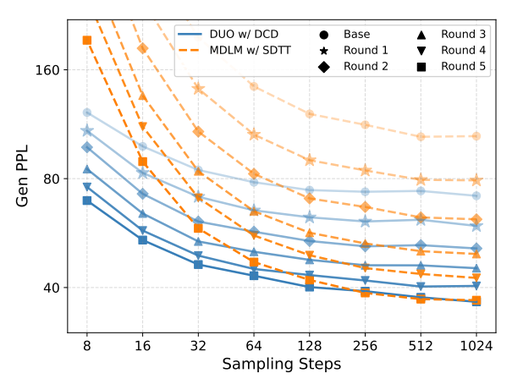
Figure 11 : Sample quality comparision using Gen PPL (↓) of Duo (Ours) distilled with our proposed DCD algorithm and MDLM distilled with SDTT after successive distillation round. Duo always dominates in the low sampling steps regime. Refer Table 7 for the exact quantitative numbers.
원문 · CC BY 4.0 · Subham Sekhar Sahoo, Justin Deschenaux, Aaron Gokaslan, Guanghan Wang, Justin Chiu, Volodymyr Kuleshov · The Diffusion Duality · 원문 그림 인용 · 원본 PDF 31쪽에서 그림 영역을 추출했습니다.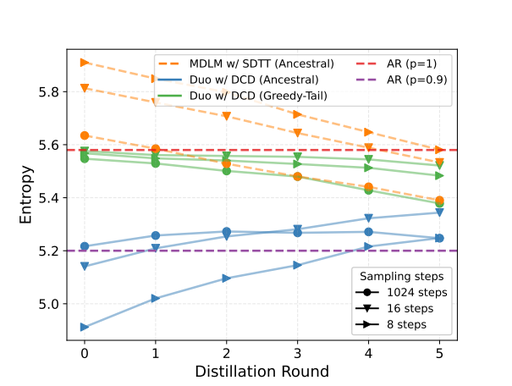
Figure 12 : Entropy of MDLM distilled using SDTT, and of Duo distilled using CDC. The entropy of the SDTT-distilled MDLM decreases with distillation, while the entropy of the CDC-distilled Duo model increases. The curves corresponding to a higher number of sampling steps are displayed with lighter colors to emphasize the low sampling step regimes.
원문 · CC BY 4.0 · Subham Sekhar Sahoo, Justin Deschenaux, Aaron Gokaslan, Guanghan Wang, Justin Chiu, Volodymyr Kuleshov · The Diffusion Duality · 원문 그림 인용 · 원본 PDF 31쪽에서 그림 영역을 추출했습니다.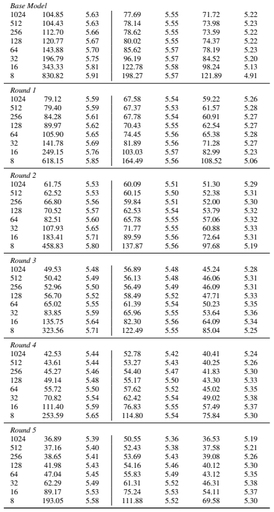
Table 7 : Generative perplexity and entropy for Duo distilled using Discrete Consistency Distillation (DCD) (Alg. 1) and MDLM distilled SDTT.
원문 · CC BY 4.0 · Subham Sekhar Sahoo, Justin Deschenaux, Aaron Gokaslan, Guanghan Wang, Justin Chiu, Volodymyr Kuleshov · The Diffusion Duality · 원문 그림 인용 · 원본 PDF 32쪽에서 그림 영역을 추출했습니다.적용 범위와 한계
저자들은 커리큘럼 학습에 τ와 커리큘럼 기간이라는 두 하이퍼파라미터가 있으며, LM1B와 OWT에서는 같은 설정이 잘 작동했지만 다른 도메인에서는 수동 조정이 필요할 수 있다고 밝힙니다. 그런 조정이 어려우면 커리큘럼 학습 없이 Duo를 쓰는 것을 권장합니다. 또한 MDLM과 비교한 Gen PPL 결과는 특정 샘플링 설정과 데이터셋에서 얻은 것이며, 높은 NFE에서는 MDLM이 우세합니다.
논문 정보
- 저자
- Subham Sekhar Sahoo, Justin Deschenaux, Aaron Gokaslan, Guanghan Wang, Justin Chiu, Volodymyr Kuleshov
- 학회·저널
- arXiv · 프리프린트
- 최초 공개일
- 2025년 6월 12일
- 등록일
- 2026년 10월 30일
- 수정일
- 2025년 12월 19일
- 버전
- v3
- arXiv
- 2506.10892
- 분류
- cs.LG · cs.AI · cs.CL
- 원문 이용 조건
- CC BY 4.0
- 제공 범위
- 논문 정보, 해설, 허용된 원문 그림
AI 해설은 논문 원문과 별개의 설명이며 오류가 있을 수 있습니다. 원문과 그림은 각 출처의 이용 조건과 따로 표시된 권리를 따릅니다.
초록
Uniform-state discrete diffusion models hold the promise of fast text generation due to their inherent ability to self-correct. However, they are typically outperformed by autoregressive models and masked diffusion models. In this work, we narrow this performance gap by leveraging a key insight: Uniform-state diffusion processes naturally emerge from an underlying Gaussian diffusion. Our method, Duo, transfers powerful techniques from Gaussian diffusion to improve both training and sampling. First, we introduce a curriculum learning strategy guided by the Gaussian process, doubling training speed by reducing variance. Models trained with curriculum learning surpass autoregressive models in zero-shot perplexity on 3 of 7 benchmarks. Second, we present Discrete Consistency Distillation, which adapts consistency distillation from the continuous to the discrete setting. This algorithm unlocks few-step generation in diffusion language models by accelerating sampling by two orders of magnitude. We provide the code, model checkpoints, and video tutorials on the project page: http://s-sahoo.github.io/duo
원문 인용
Subham Sekhar Sahoo, Justin Deschenaux, Aaron Gokaslan, Guanghan Wang, Justin Chiu, Volodymyr Kuleshov (2025). The Diffusion Duality. arXiv:2506.10892v3. https://arxiv.org/abs/2506.10892v3
BibTeX
@misc{sahoo2025diffusion,
  title = {{The Diffusion Duality}},
  author = {Subham Sekhar Sahoo and Justin Deschenaux and Aaron Gokaslan and Guanghan Wang and Justin Chiu and Volodymyr Kuleshov},
  year = {2025},
  eprint = {2506.10892},
  archivePrefix = {arXiv},
  url = {https://arxiv.org/abs/2506.10892v3}
}