Paper commentary
When Does Test-Time Search Help World Action Models? An Empirical Audit of Candidate Selection and Simulator Integrity
Test-time search gives world action models little gain under audit
- Problem Success rates alone cannot show whether extra inference compute helps world action models. A gain may come from weak candidate signal, unrealized speedup, or simulator artifacts.
- Method The authors audit three premises for test-time scaling on Cosmos Policy. They check candidate selection with a hindsight oracle, measure end-to-end speedup, and check rendering integrity.
- Results A learned value selector scored 1.66 pp worse than random selection. Token pruning cut per-forward FLOPs by up to 47% but gave at most a measured 1.15× end-to-end speedup.
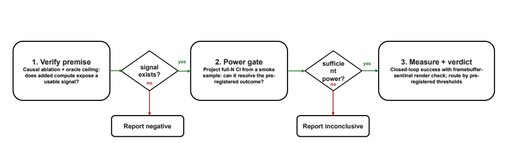
Figure 5 . The premise-first methodology as a chain of gates. Each candidate test-time-scaling gain passes three checks in order before it is credited: verify that the decision signal exists (causal ablation and oracle ceiling); a statistical power gate that halts a run which cannot resolve the pre-registered outcome; and closed-loop measurement under framebuffer-sentinel render-integrity checking. A “no” at the first gate reports a negative result and at the second an inconclusive one, separating a genuine negative from an underpowered or invalid measurement.
Original paper · CC BY 4.0 · Jun Liu, Dajie Sun, Zhenglun Kong, Zhenjiang Fan, Peiyan Dong, Fan Yang, Wenbin Zhangg, Geng Yuan, Xue Lin, Yanzhi Wang, Dong Huang · When Does Test-Time Search Help World Action Models? An Empirical Audit of Candidate Selection and Simulator Integrity · Original paper figure · Extracted the figure area from page 11 of the original PDF.Why a success rate can't settle the question
World-action models such as Cosmos Policy generate actions, future states and values inside one shared latent diffusion process. Extra inference compute can therefore flow into sampling candidate actions and scoring them with the model's own value output. That spending pays off only if candidates differ in ways a selector can exploit, nominal savings become real speedup, and evaluation stays reliable.
A rising success rate alone can't separate a weak selection signal from unrealized compute savings and simulator artifacts. Each of these conditions can fail on its own, so a success gain may reflect none of them. Their audit asks whether useful signal is present, whether savings translate into end-to-end gains, and whether the evaluation path stays reliable under added computation.
The three findings map onto these premises: a selection-signal result, a latency result and a rendering-integrity result. Token pruning cuts per-forward FLOPs by up to 47% but yields at most a 1.15× end-to-end speedup. These results stay scoped to the tested configuration, so the chain works as an audit rather than a verdict on test-time scaling.
Three premises and the test for each
For best-of-N planning, the audit first asks whether candidates for a query state differ in outcome, before it measures any gain. The audit replays all N candidates under a fixed continuation policy, and a hindsight oracle selects a successful one. The oracle uses outcome information a deployed system doesn't have, so it only bounds how much a selector could gain.
The audit reads this headroom as a premise check, so a weak candidate pool stops the planning claim before any selector is tuned.
A power gate comes next, and it stops runs that cannot resolve the pre-registered outcome. The thresholds are fixed before the data are inspected, and the full run launches only if the projected width falls below the pre-registered separation. Otherwise the run isn't launched, so compute isn't spent on an experiment that can't yield a verdict.
Closed-loop success is measured by snapshot replay, which restores a saved state, executes a candidate action chunk and continues under a fixed dense base policy. Each reported comparison states its bootstrap resampling unit and interval, so a result that depends on that choice is flagged as such. The render-integrity check runs alongside this measurement, so a corrupted frame can't pass as a closed-loop success.
Does the value selector beat random choice?
The selection test uses N=8 candidates per state with common continuation seeds, so the value selector, random selection and the oracle see the same candidate sets. This controls for a single candidate switch, but it does not reproduce the full deployment distribution.
Most of that gap comes from TurnOnStove, at -3.87 percentage points. Dropping that task still leaves a negative estimate of -0.77 percentage points, so the gap isn't confined to one task, though no task shows a benefit for the selector.
The episode interval spans zero and the replicate-consistency gate was missed, so the authors read this as weak, inconclusive evidence. The underlying reason is structural: outcomes vary in only 48 of 263 states, while 215 states show identical outcomes across candidates.
Why FLOPs cuts don't become speedups
Token pruning removes 47.9% of per-forward FLOPs, yet the wall-clock gain on the full query is much smaller. The pruning drops all future frames plus the value frame, a fixed whole-frame mask that adds no per-token scoring. With future-image decode excluded, the speedup rises to 1.253×, and neither number reaches the pre-registered 1.5× target.
VAE encode (238.0 ms) and future-image VAE decode (434.4 ms) are not reduced by token pruning, so they cap the gain. Savings therefore reach only the share of time that pruning touches, however large the FLOPs cut looks.
Table 1 places per-forward FLOPs beside the timed end-to-end speedup at each pruning level, so the gap between the two is easy to see. Panel (b) times the complete query directly, dense against pruned, rather than composing component times. Full settings and per-level latency percentiles appear in Supplement Section 9 and Table 3.
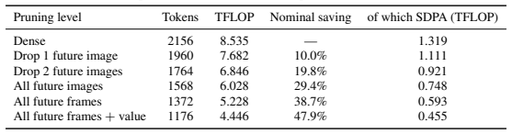
Table 1 . Measured per-forward FLOPs (a), measured end-to-end query speedup under whole-frame token pruning (b), and the measured dense-query component breakdown (c), on Cosmos Policy (RoboCasa, batch 1, 5 denoising steps, 11 latent frames×196 tokens=2156; NVIDIA RTX A6000, bf16, eager,N= 30). Panel (b) directly times the complete query, dense against pruned, not a composition of component times: the deployed path is the query as the eval calls it (future-image decode and value extraction included); the decode- excluded path removes future-image decode on both sides and is most favorable to pruning. This is a latency-only measurement (dropped frames receive zero output), so action quality is not assessed; no pruning level on either path reaches the pre-registered1.5×target. Setup, environment and result-file paths are in Supplement Section 9.
Original paper · CC BY 4.0Joint allocation falls below the noise floor
The authors cross 2 and 5 denoising steps with full, key-token and uniform-token selection, then measure the uniform-token interaction. The interaction is IU = D(2,U) − D(2,F) − D(5,U) + D(5,F), where D(k,s) is the paired closed-loop success at denoising schedule k under selection s. Each D term is taken relative to the baseline D(5,F) = 0, so the terms compare against the dense, full-token run.
Under exact additivity the expected value of this interaction is zero, so any nonzero value would signal a joint allocation effect.
After noise-bias removal from the 16-state smoke sample, the systematic component is about 0.0045, which sits below the mean noise floor. The temporal main effect is 0.0053, so the systematic component is also close to the main effect in the same states. Because the decisive comparison doesn't depend on a chosen threshold, this measurement can't resolve the joint effect at any threshold.
The full factorial wasn't launched because the power gate failed, so the authors call this inconclusive rather than a null result. Whether joint allocation helps on this stack remains open, and the authors don't claim it has no effect.
How the rendering corruption arises
The corruption starts in OpenGL context management during environment resets, and the stack gives no sign of it. On a hard reset, the stack constructs a new simulation instance while an orphaned instance remains eligible for garbage collection. That free silently invalidates the framebuffer of the live environment, so the live environment keeps running.
Subsequent renders then return corrupted observations, which are frozen or noise-like frames, and no error is raised.
The sentinel flags any target that is left substantially untouched after rendering, which catches the corrupted frames. Figure 1 sets a corrupted frame beside the correct render of the same state, so the difference is visible by eye. The authors' fix removes the corruption, but they attribute the root cause to this path without maintainer confirmation.
Table 2 shows the paired bug-versus-fix comparison under the official direct-policy protocol. Because the failure is silent, an evaluation can report numbers computed from corrupted frames without any warning.
Corruption rises with compute, not with the official score
The official direct-policy number is the first thing to check, because the bug could still shift it. The comparison covered four tasks with corruption in the baseline run, over 50 consecutive episodes each, giving 200 paired episodes. Fixing the bug added 3 successes over 200 paired episodes, and all three flips moved from failure to success.
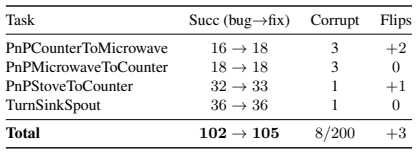
Table 2 . Paired bug-vs-fix comparison under the official direct- policy protocol. All three outcome flips are corrupted episodes moving from failure to success; none move the other way. Among the 192 uncorrupted episodes, success is identical in both arms.
Original paper · CC BY 4.0The direct-policy result alone doesn't bound the risk for test-time scaling, because corruption depends on how much computation each query uses. Direct policy runs one forward pass per query and shows 0.67% of episodes corrupted. Direct-mode best-of-N with N=8 candidates shows 0 of 40 episodes corrupted, with 29 of 40 successes in both arms.
Extra sampling alone doesn't raise the rate, so the trigger lies elsewhere. Planning mode, which makes separate future-state and value calls per query, reaches up to 65% of episodes corrupted.
RoboCasa provides no native planning-mode evaluation, so that rate isn't the rate of any standard benchmark. The official repository exposes best-of-N planning only for a real-robot platform that doesn't pass through robosuite. The authors expect LIBERO to be unaffected, because its hard reset destroys the prior simulation before building a new one.
They didn't run that LIBERO environment, so that expectation is an inference from the source code.
For practitioners, the split is clear: the official direct-policy score barely moves, but planning paths carry the exposure. Studies that use this stack should check render integrity before crediting gains to inference-time methods. The planning result doesn't claim that planning is useless, only that its evaluation path needs this check.
Limits of the audited setup
The findings cover only Cosmos Policy on RoboCasa, and the paper scopes its conclusions to that configuration. Selection was tested with one candidate-generation scheme and one continuation policy, so other choices remain untested. The authors note that this continuation controls the candidate's single-switch effect but doesn't reproduce the full deployment distribution.
The sample requirement of hundreds to roughly two thousand states is an extrapolation, not a verified power result. The authors frame the allocation result as inconclusive, so the joint allocation question stays open on this stack. Timing was measured only on an NVIDIA RTX A6000 in bf16 with eager execution, so other hardware is untested.
The rendering corruption was measured on the RoboCasa and robosuite stack, and the fix is tied to that stack. The authors didn't run the LIBERO environment, so they only infer that its reported figure is unaffected.
What other test-time compute audits can reuse
The audit's authors argue that its components are not tied to one model, so other test-time compute studies can borrow them. They name four pieces: premise-first verification, the oracle headroom bound, the power gate, and render-integrity checks. Premise-first verification keeps a study from building on a signal that doesn't exist.
Scope is the authors' main caveat, so a reuse claim should be checked against it. The audit components can inform audits of other diffusion control policies, according to the paper. The render fix itself is stack-specific, while the detector principle may transfer across backends.
The authors release the detector, the fix, the scripts, and the pre-registered protocols, so other teams can repeat the audits. They don't present the audits as a verdict against inference-time computation.
Paper info
- Authors
- Jun Liu, Dajie Sun, Zhenglun Kong, Zhenjiang Fan, Peiyan Dong, Fan Yang, Wenbin Zhangg, Geng Yuan, Xue Lin, Yanzhi Wang, Dong Huang
- Venue
- arXiv · Preprint
- First published
- 2026-10-30
- Added
- 2026-11-3
- Updated
- 2026-10-30
- Version
- v1
- arXiv
- 2610.41970
- Category
- cs.AI
- Original paper terms
- CC BY 4.0
- What we show
- Paper info, commentary and permitted figures from the original paper
AI commentary is a separate explanation from the original paper and may contain errors. The original paper and figures follow each source's terms of use and any rights noted separately.
Abstract
World-action models increasingly apply test-time scaling, spending extra inference computation on candidate selection and adaptive allocation to improve control. Such gains are credible only when candidates carry exploitable signal, nominal compute savings become real speedup, and evaluation stays reliable. We audit all three on Cosmos Policy and RoboCasa with a premise-first, pre-registered methodology. On clean data, a learned value selector is 1.66 pp worse than random; a hindsight oracle gains only 1.40 pp, with an episode-level interval spanning zero; and 82% of states show identical candidate outcomes, leaving little selection headroom. Token pruning cuts per-forward FLOPs by up to 47% but yields at most a measured 1.15$\times$ end-to-end speedup on the deployed path (1.25$\times$ on a decode-excluded path), short of a 1.5$\times$ target, and our adaptive-allocation experiment is inconclusive under a power gate. We further identify and fix a silent rendering corruption whose rate rises sharply along compute-heavy planning paths while leaving the official direct-policy result unaffected, and release a detector, fix, and scripts. These findings show why test-time scaling should be audited as a chain of premises (decision signal, realized efficiency, evaluationintegrity) rather than by success rate alone. Conclusions are scoped to the tested configuration.
Quote from the paper
Jun Liu, Dajie Sun, Zhenglun Kong, Zhenjiang Fan, Peiyan Dong, Fan Yang, Wenbin Zhangg, Geng Yuan, Xue Lin, Yanzhi Wang, Dong Huang (2026). When Does Test-Time Search Help World Action Models? An Empirical Audit of Candidate Selection and Simulator Integrity. arXiv:2610.41970v1. https://arxiv.org/abs/2610.41970v1
BibTeX
@misc{liu2026when,
  title = {{When Does Test-Time Search Help World Action Models? An Empirical Audit of Candidate Selection and Simulator Integrity}},
  author = {Jun Liu and Dajie Sun and Zhenglun Kong and Zhenjiang Fan and Peiyan Dong and Fan Yang and Wenbin Zhangg and Geng Yuan and Xue Lin and Yanzhi Wang and Dong Huang},
  year = {2026},
  eprint = {2610.41970},
  archivePrefix = {arXiv},
  url = {https://arxiv.org/abs/2610.41970v1}
}