Paper commentary
Pretraining Data Scale Reverses the Muon-AdamW Fine-Tuning Gap
AdamW overtakes Muon after fine-tuning once pretraining data grows large
- Problem Muon gives lower pretraining loss than AdamW, but it is unclear whether that advantage survives fine-tuning. Lower pretraining loss alone does not guarantee a better model after fine-tuning.
- Method The authors treat fine-tuning as a perturbation of the outputs. They measure robustness with the margin-to-spread ratio, which compares the correct logit with the wrong ones.
- Results Beyond 2.4B pretraining tokens, AdamW reaches lower fine-tuning loss with less forgetting than Muon. Muon keeps the lower pretraining loss at every budget studied.
Where a lower pretraining loss may not carry over
Muon updates each hidden weight matrix as a whole, moving it along the orthogonalized momentum instead of scaling each coordinate on its own. Muon is meant for the two-dimensional hidden matrices, while embeddings, the output layer and normalization gains stay with AdamW. In the paper's pretraining sweeps, Muon reaches lower pretraining loss than AdamW when the pretraining hyperparameters are tuned for loss.
But a lower pretraining loss doesn't guarantee a better model once it is fine-tuned, so the authors ask whether Muon's advantage carries over.
The authors summarize each base model by every outcome that fine-tuning it can reach, not by a single fine-tuned checkpoint. Learning is read from the fine-tuning loss, while forgetting is read from the pretraining loss measured after fine-tuning. Taking the lower-left Pareto frontier of these outcomes gives the learning–forgetting frontier for that base model.
They compare the two optimizers on this frontier with the fine-tuning gap, which is positive when AdamW dominates and negative when Muon dominates. A single fine-tuned checkpoint can't show how well a base model adapts, because both losses depend on the fine-tuning hyperparameters.
The crossover TPR is the smallest token-parameter ratio at which the AdamW frontier overtakes the Muon frontier for a fixed model size and dataset. Figure 2 shows that this crossover TPR decreases as model size grows, so pretraining loss alone can mislead the choice of optimizer.
Pretraining budget decides the fine-tuning winner
The study pretrains OLMo-style 30M to 600M models on 150M to 154B DCLM tokens, comparing AdamW and Muon. Each base model is then fine-tuned on four datasets, GSM8K, StackMathQA, Alpaca and MusicPile, while the fine-tuning optimizer and learning rate are swept. In total the study runs nearly 600 pretraining runs and 29,000 fine-tuning runs.
Beyond 2.4B tokens the trend reverses, and AdamW reaches lower fine-tuning loss with less forgetting than Muon. This happens even though Muon keeps the lower pretraining loss at every budget studied, so pretraining loss alone would not predict the winner after fine-tuning.
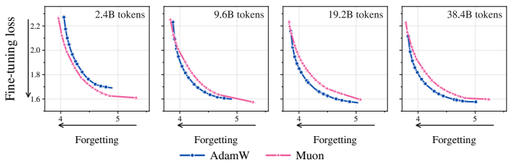
Figure 1 : Beyond a sufficiently large data budget, AdamW outperforms Muon.We pretrain OLMo-60M models with Muon and AdamW and fine-tune on StackMathQA. For each pretraining optimizer, we take the pretrained model with the lowest pretraining loss, sweep across all fine-tuning configurations, and plot the resulting learning–forgetting frontier, from 2.4B to 38.4B pretraining tokens. At 2.4B tokens, Muon’s frontier dominates AdamW’s; at larger budgets the trend reverses and AdamW surpasses Muon. This reversal happens despite Muon achieving lower pretraining loss across all data budgets.
Original paper · CC BY 4.0 · Catherine Li, Jingchu Gai, Andrej Risteski, Jacob Mitchell Springer, Aditi Raghunathan · Pretraining Data Scale Reverses the Muon-AdamW Fine-Tuning Gap · Original paper figure · Extracted the figure area from page 2 of the original PDF.The same reversal holds when pretraining hyperparameters are swept for the best learning-forgetting frontier instead of the lowest loss. The best-frontier setting lets each optimizer pick from pretrained models at several learning rates, not only the loss-optimal one. The authors also see the trend on the other fine-tuning datasets in Section D.
How the crossover moves with model size
The crossover TPR is the minimum token-parameter ratio at which the AdamW frontier overtakes the Muon frontier, for a fixed model size and fine-tuning dataset. The exact crossover value depends on the fine-tuning dataset, but the trend that it falls as model size grows holds across the four datasets. Figure 2 shows this pattern for Alpaca, GSM8K, MusicPile and StackMathQA in the lowest-pretraining-loss setting.
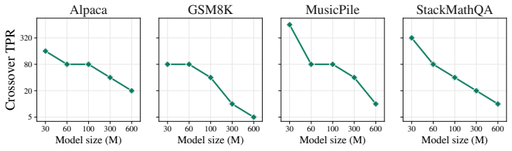
Figure 2 : Crossover TPR decreases with model size.In the lowest-pretraining-loss setting, where each pretraining optimizer’s lowest-loss pretrained model is swept across all fine-tuning hyperparameters, Muon’s advantage reverses at substantially smaller pretraining data budgets as model size increases. The exact crossover TPR varies depending on the fine-tuning dataset, but the high-level trend is consistent.
Original paper · CC BY 4.0The authors offer two drivers for this shift, both measured in the lowest-pretraining-loss setting on StackMathQA. First, the pretraining loss gap between Muon and AdamW shrinks as model size grows at a fixed TPR, so Muon loses its advantage as a lower-loss base model. Second, at a fixed TPR and fine-tuning loss, Muon forgets more than AdamW as model size grows.
Together these two effects let AdamW overtake Muon at progressively smaller pretraining budgets.
Margin-to-spread ratio as a robustness score
Fine-tuning changes the output distribution, so the authors treat it as a perturbation of the outputs. They then ask which pretrained model keeps its predictions under such perturbations. The margin-to-spread ratio, or MSR, answers this using only the output logits. For each prediction, it compares the correct logit with the average of the incorrect logits, scaled by how spread out those incorrect logits are.
For fact i, the pairwise margins are m_ij = s_ii(W) - s_ij(W) for every j not equal to i. Their mean is h_i, and their variance kappa_i squared is taken over the competitors j. The per-fact MSR is rho_i = h_i / kappa_i, so it measures the average margin in units of the spread. The model-level MSR averages the h_i and the kappa_i squared over facts first, giving rho = h-bar / kappa-bar.
Under isotropic Gaussian noise on the logits, the MSR bounds the fraction of wrong answers that stay below the correct one. That bound is rho_i squared divided by (rho_i squared + 1 + 2 sigma squared over kappa_i squared), in expectation. For a fixed noise level relative to the spread, this bound improves as the MSR grows. The authors use this property to connect the MSR to robustness in their later analysis.
The one-step result in the linear memory
The linear associative memory stores N facts in a d-by-d matrix W, with keys and values drawn as independent standard Gaussians. A query scores each candidate value as s_ij(W) = v_j^T W u_i, and fact i is recovered when its correct score is highest. Training uses softmax cross-entropy, and the authors hold the data budget γ = N/d fixed while d grows.
They compare exact-orthogonalization Muon with full-batch gradient descent, not with the Newton–Schulz approximation used in practice.
Starting from zero, one GD step gives W = G, and one Muon step gives W = polar(G). The theorem says that for large γ, GD's MSR exceeds Muon's, so the ratio R = ρ_GD/ρ_Muon rises as γ grows. The ratio approaches 3π/8 ≈ 1.18 from below at rate 1/γ. These claims hold with probability tending to one as d grows.
The mean margins come from h̄(W) = ⟨W, G⟩/(N−1), which gives ‖G‖_F²/(N−1) for GD and ‖G‖_*/(N−1) for Muon. For GD the variance is about d³(γ+2), coming from the other facts and from the query and candidate terms. For Muon, isotropy and orthogonality give a variance of about d.
Muon's MSR comes out smaller than GD's at large budgets, so the one-step answer to the question is GD. The authors note that other data distributions can change the optimizer ordering, since the analysis uses isotropic Gaussian data. Figure 4 checks these one-step numerics against the theory, and the extended-training runs follow in the next section.
Extended training in the linear memory
After many full-batch steps, the linear memory still shows the budget trend that the one-step theory predicts. Data budgets past the memory's capacity are excluded, because the two optimizers then recover different item sets.
The σ50 ordering turns over in the same direction as the budget grows. The turnover points are γ≈0.5, 1.3 and 11 for d=128, 256 and 512. At d=64, GD is already the more robust one at the smallest data budget the authors ran.
The one-step theory predicts that the ratio of GD's MSR to Muon's grows with the budget. Since 3π/8 is greater than 1, GD has the larger MSR at sufficiently large budgets. The extended-training runs show the same ordering flip, so the trend persists beyond the first step. The authors use this linear setting with GD as the baseline and report no separate extended-training theory.
Checking the MSR trend in pretrained language models
The authors compute the MSR for AdamW and Muon models spanning five sizes, evaluated on held-out DCLM text. At each token position, they take the median over correctly predicted positions, rather than the mean-based form of Definition 4.1. The median reduces sensitivity to outliers, so the language-model MSR is a slightly different quantity from the theoretical one.
Figure 5 shows the three sizes with the widest budget ranges, 30M, 60M and 100M.
Muon has the larger MSR at small budgets, while AdamW has the larger MSR at sufficiently large budgets. As the budget grows, the gap between AdamW's and Muon's MSRs widens, and the ratio ρAdamW/ρMuon crosses one at every model size. It also parallels the reversal in relative robustness to fine-tuning seen in Section 3.
Across 72 pretrained language models, the MSR and the perturbation level δ* that raises held-out loss by ΔL are strongly correlated. The Spearman correlation is +0.83 at both ΔL = 0.05 and ΔL = 0.1. Within each optimizer, the correlation stays positive, at +0.87 to +0.89 for AdamW and +0.92 to +0.93 for Muon.
The MSR and fine-tuning crossovers need not fall at exactly the same budget. The learning–forgetting tradeoff also depends on pretraining loss, so the two crossovers can differ.
Gaussian weight perturbation as a simpler probe
Springer et al. (2025) showed that adding isotropic Gaussian noise to pretrained weights tracks forgetting after fine-tuning, so the authors use it as a simpler probe. Each weight matrix gets isotropic Gaussian noise scaled to a fraction δ of the matrix's norm. The authors measure the loss increase as the perturbed pretraining loss minus the unperturbed pretraining loss.
A smaller increase means the checkpoint is more robust to perturbation, so the comparison is between optimizers at the same checkpoints as in Section 3.
The gap in loss degradation, Muon minus AdamW, stays positive across the token budgets tested. That gap grows with the pretraining budget, so AdamW's loss increase stays smaller and its advantage widens as data grows.
Limitations
The fine-tuning evidence uses four datasets, each for 20M tokens, so other fine-tuning distributions aren't covered. The crossover depends on the fine-tuning dataset, although the broader trend persists. The authors note that fine-tuning on data close to the pretraining data is essentially continued pretraining, so they don't expect the same result for every fine-tuning distribution.
The theory covers one GD step and one Muon step from zero, with exact orthogonalization and Gaussian keys and values. Other data distributions can change the optimizer ordering, and this paper does not test them. The multi-step checks use three seeds and exclude budgets past the memory's capacity.
The language-model MSR uses a median over correct positions rather than the mean form of Definition 4.1. The MSR crossover need not match the fine-tuning crossover.
Paper info
- Authors
- Catherine Li, Jingchu Gai, Andrej Risteski, Jacob Mitchell Springer, Aditi Raghunathan
- Venue
- arXiv · Preprint
- First published
- 2026-11-2
- Added
- 2026-11-4
- Updated
- 2026-11-2
- Version
- v1
- arXiv
- 2611.03633
- Category
- cs.LG
- Original paper terms
- CC BY 4.0
- What we show
- Paper info, commentary and permitted figures from the original paper
AI commentary is a separate explanation from the original paper and may contain errors. The original paper and figures follow each source's terms of use and any rights noted separately.
Abstract
Muon has recently emerged as a promising optimizer for pretraining large language models, offering a speedup over AdamW in minimizing pretraining loss. However, it remains unclear whether Muon's advantage persists after fine-tuning. In this paper, we study the downstream behavior of Muon and AdamW and uncover a surprising trend: beyond a sufficiently large pretraining data budget, AdamW outperforms Muon after fine-tuning. Moreover, as model size increases, AdamW overtakes Muon at progressively smaller pretraining token-parameter ratios. To explain this reversal, we view fine-tuning as a perturbation of the outputs and introduce the margin-to-spread ratio, which measures how far the correct logit lies above the wrong ones relative to how widely the wrong logits are spread. In language models, Muon has the larger margin-to-spread ratio at small data budgets and AdamW at large ones, mirroring the fine-tuning trend. In a linear associative memory, we prove that after one update the margin-to-spread ratio of gradient descent gains on that of Muon as the data budget grows, and simulations show that this trend persists after extended training.
Quote from the paper
Catherine Li, Jingchu Gai, Andrej Risteski, Jacob Mitchell Springer, Aditi Raghunathan (2026). Pretraining Data Scale Reverses the Muon-AdamW Fine-Tuning Gap. arXiv:2611.03633v1. https://arxiv.org/abs/2611.03633v1
BibTeX
@misc{li2026pretraining,
  title = {{Pretraining Data Scale Reverses the Muon-AdamW Fine-Tuning Gap}},
  author = {Catherine Li and Jingchu Gai and Andrej Risteski and Jacob Mitchell Springer and Aditi Raghunathan},
  year = {2026},
  eprint = {2611.03633},
  archivePrefix = {arXiv},
  url = {https://arxiv.org/abs/2611.03633v1}
}