Paper commentary
Improving Large Audio-Language Model Embedding Baselines for Instruction-Aware Speech Retrieval
IRIS-Embed turns audio-language models into instruction-aware speech retrieval embedders
- Problem A spoken query alone doesn't reveal whether the user wants a matching continuation, an answer, or a speaker match. Earlier audio-language model embeddings ignored that goal, and no single audio layer suits every retrieval goal.
- Method IRIS-Embed turns a large audio-language model into an embedding model with contrastive training. Instead of fixing one audio-encoder layer, the instruction sets how much each layer counts in a weighted sum.
- Results On INSPIRE, IRIS-Embed with Qwen2.5-Omni-3B reaches 62.92% macro-average Recall@50, compared with 45.15% for the strongest baseline.
Why one speech embedding can't serve every retrieval goal
Speech retrieval takes a spoken query and returns matching spoken documents from a collection. One spoken query can point to several goals, such as continuing a conversation, finding an answer, or matching a speaker. The spoken query alone doesn't distinguish these goals, so the goal has to be stated in words. That stated goal is an instruction that names the speech attributes a document must match.
An instruction can refer back to the query, as in matching its speaker, or set a value directly, as in asking for happy speech. A relevant document must satisfy every requirement, so matching one attribute isn't enough. Large audio-language models (LALMs) connect an audio encoder to a language model, so they can process speech and text inside one network.
That ability makes LALMs a natural starting point for instruction-aware speech retrieval.
The catch is that the audio side has no single best representation for every retrieval goal. The authors evaluated each frozen audio-encoder layer by mean-pooling its hidden states and ranking documents by cosine similarity, without instructions. Figure 2 reports Recall@50 for dialogue continuation, speaker matching, speaking-style matching, and answer retrieval.
Weighting audio layers by instruction
The model lets the instruction decide how much each audio-encoder layer counts, instead of fixing one layer in advance. Figure 2 reports Recall@50 for each frozen layer on dialogue continuation, speaker matching, speaking-style matching, and answer retrieval. The analysis ranks spoken documents by cosine similarity with mean-pooled frozen hidden states, without instructions, the audio projection, or the language model.
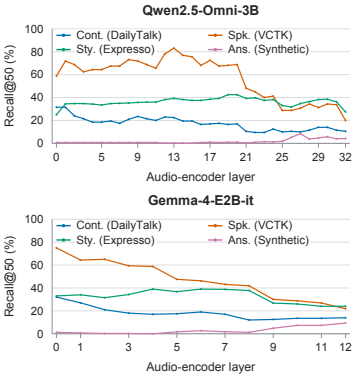
Figure 2 : Recall@50 across frozen audio-encoder layers. Layer 0 represents pre-encoder hidden states; layers 1 and above represent encoder hidden states.
Original paper · CC BY 4.0 · Chen-An Li, Cheng-Han Chiang, Hung-yi Lee · Improving Large Audio-Language Model Embedding Baselines for Instruction-Aware Speech Retrieval · Original paper figure · Extracted the figure area from page 3 of the original PDF.For each recording, the model takes the pre-encoder hidden states H0 and the hidden states H1 through HL of the L audio-encoder layers. It combines them at the same time step as a weighted sum, He equals the sum from l equals 0 to L of w_l times H_l. The weights come from a softmax over L+1 layer scores, so they are nonnegative and sum to one.
Because the softmax normalizes the scores, the weights stay on a common scale, and that is why the paper can read them as relative layer shares.
The function g combines a frozen pretrained sentence encoder, all-MiniLM-L6-v2, with a learned linear layer. For queries, the prompt p contains the instruction z, so the layer weights change with each retrieval task. Documents use one fixed prompt, so every document shares the same layer weights. The instruction therefore enters the embedding path twice, once through the layer weights and once through the language-model prompt.
The weighted audio hidden states are pooled and projected before they enter the language model. The audio projection maps audio hidden states to the language model's embedding dimension. The language model reads its own prompt, which carries the instruction for queries, together with these audio states. The embedding is the final-layer hidden state at the last non-padding token, and documents are ranked by cosine similarity to the query embedding.
During training, the audio encoder and the sentence encoder stay frozen, so the audio encoder is never updated. The audio projection, the linear layer in g, and the LoRA parameters of the language model are trained. The authors use LoRA to adapt the language model rather than the audio encoder.
Training pairs and masked contrastive loss
Each training sample holds a spoken query, an instruction, a positive spoken document and a negative spoken document. The positive document must satisfy every requirement in the instruction, while the negative violates at least one. The dataset contains about 900K samples, with 800K from real data and 100K from synthetic data. About 890K samples go to training and 10K to validation.
Real samples come from public corpora whose annotations cover speaking style, speaker identity, gender, accent, sentiment, dialogue and environmental sound. The pipeline removes uninformative labels such as unknown and other, and it keeps only recordings between 1 and 120 s. Corpus metadata supplies the attribute values that build the retrieval requirements and select the query-document pairs.
Synthetic samples start from MS MARCO hard triplets, and text-to-speech models turn those texts into speech.
Each batch holds B samples, and the batch-level document pool C collects every positive and negative document in the batch. Documents from other samples can also be relevant to the same query and instruction, so treating them as negatives would add false negatives. The training labels identify those extra relevant documents, and the model masks them out of each sample's pool Ci.
Each Ci still keeps the paired positive document d+i, so the InfoNCE denominator always includes it. The InfoNCE loss then pushes the paired positive above the remaining negatives in Ci, scaled by the temperature τ.
Classifier predictions don't serve as training labels; they only mask additional relevant in-batch documents. During training, the audio encoder and the sentence encoder in g stay frozen, while LoRA and the audio projection learn. Training uses a global batch size of 512.
INSPIRE results and whether instructions steer retrieval
The Gemma version of IRIS-Embed reaches 47.41%, so both model families pass the strongest baseline. The gains come from comparisons with the corresponding LALM baselines, which use the same backbones without the training.
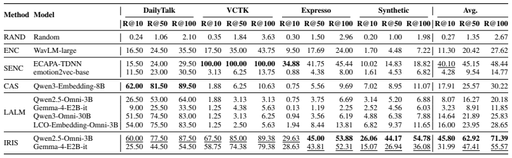
Table 1 : INSPIRE Recall@ K. Avg.: macro-average across the four subsets. Bold / underline: best / second best. RAND: random; ENC / SENC: general / specialized encoders; CAS: cascaded retrieval; LALM: large audio–language models; IRIS: IRIS-Embed.
Original paper · CC BY 4.0The largest jump is on VCTK, where audio layer weighting lifts Qwen2.5-Omni-3B from 48.75% to 85.00% Recall@50 compared to using only the final audio-encoder output. On the same subset, LCO-Embedding-Omni-3B reaches only 2.50%. IRIS-Embed with Qwen2.5-Omni-3B also reaches 85.00% and 45.00% on VCTK and Expresso, both above every LALM embedding baseline.
Across the 21 instruction-type settings, IRIS-Embed with Qwen2.5-Omni-3B improves Recall@50 over its LALM baseline in all 21. The Gemma version improves in 20 of 21, and its exception is speaking style with a specified environmental sound on Synthetic, scoring 1.25% against 1.50%.
The comparison that isolates instruction-aware weighting uses Mean Layer and Static Weight, and neither variant conditions on the instruction. Both score higher than instruction-aware weighting on Synthetic. Instruction-aware weighting beats them on the other three subsets, with macro-average Recall@50 gains of 5.60 and 4.61 points over Mean Layer and Static Weight.
Because the weights change with the instruction, this result suggests the instruction carries signal beyond simply combining more layers.
The authors then changed the instruction while keeping queries, documents and labels fixed. With short instructions, the matching instruction gave the highest Recall@50 in all four Synthetic settings for both models. Multi-attribute instructions followed the same pattern, with the matching instruction winning in all four settings for Qwen2.5-Omni-3B and in three of four for Gemma-4-E2B-it.
The matching instruction didn't always win, because Qwen2.5-Omni-3B did best with the answer-retrieval instruction on DailyTalk.
MAEB results beyond speech retrieval
The MAEB evaluation asks whether IRIS-Embed still helps on audio tasks that fall outside INSPIRE. The authors evaluate 15 MAEB audio tasks covering classification, clustering, pair classification, reranking, and retrieval. These tasks include gender and accent tasks that INSPIRE doesn't cover. Each recording gets a task instruction through the query prompt, while retrieval documents use the document prompt without an instruction.
The models stay frozen during evaluation, so the scores reflect the embeddings alone. Tasks derived from the retrieval training corpora are excluded, which keeps the test separate from training data.
On the 15 MAEB tasks, IRIS-Embed with Qwen2.5-Omni-3B reaches a macro-average score of 53.5. The Gemma version of IRIS-Embed reaches a macro-average score of 52.9. These scores exceed the corresponding LALM baselines by 9.4 and 19.8 points, respectively. The Qwen2.5-Omni-3B IRIS-Embed score also approaches the 54.2 of LCO-Embedding-Omni-3B.
Both IRIS-Embed models outperform all comparison baselines on IEMOCAP gender classification. They also outperform all comparison baselines on VoxPopuli gender clustering and VoxPopuli accent pair classification. The macro-average hides task-level differences, since the per-task scores vary widely. The authors read these results as evidence that IRIS-Embed generalizes beyond instruction-aware speech retrieval.
What the limitations section leaves untested
The study trained IRIS-Embed with only two LALM backbones, so its scalability to larger models wasn't tested. The authors say they prioritized smaller embedding models for computational efficiency, which is why larger backbones stayed out of scope. IRIS-Embed combines hidden states from frozen pretrained audio encoders, so its results depend on what those encoders preserve.
They didn't explore alternative or complementary encoders that might capture broader speech attributes.
The layer-weight visualizations don't establish how much individual layers contribute to retrieval performance. Retrieval requirements rely on annotations that cover only limited speech attributes and values.
The cascaded baseline uses transcripts and audio captions, and the authors didn't compare finer-grained cascaded approaches.
Paper info
- Authors
- Chen-An Li, Cheng-Han Chiang, Hung-yi Lee
- Venue
- arXiv · Preprint
- First published
- 2026-11-6
- Added
- 2026-11-10
- Updated
- 2026-11-6
- Version
- v1
- arXiv
- 2611.09122
- Category
- cs.SD · cs.CL · eess.AS
- Original paper terms
- CC BY 4.0
- What we show
- Paper info, commentary and permitted figures from the original paper
AI commentary is a separate explanation from the original paper and may contain errors. The original paper and figures follow each source's terms of use and any rights noted separately.
Abstract
Speech retrieval finds relevant spoken documents given a spoken query. The spoken query alone may not reveal the retrieval goal, such as finding an answer or matching speaker identity. Instruction-aware speech retrieval expresses this goal through a natural-language text instruction. Large audio-language models (LALMs) effectively process speech and text, and our analysis shows that different retrieval requirements favor hidden states from different audio-encoder layers. We introduce IRIS-Embed, which adapts LALMs into embedding models through contrastive training and instruction-aware audio layer weighting. We construct about 900K training samples from real data and synthetic data, with instructions expressing requirements for one or more speech attributes. On INSPIRE, an instruction-aware speech retrieval benchmark, IRIS-Embed consistently outperforms the corresponding LALM baselines. The best model achieves 62.92% macro-average Recall@50, surpassing the strongest baseline at 45.15%. Controlled comparisons demonstrate instruction awareness and the benefits of audio layer weighting. On MAEB, a massive audio embedding benchmark, macro-average gains of 9.4-19.8 points over the corresponding baselines show generalization beyond speech retrieval.
Quote from the paper
Chen-An Li, Cheng-Han Chiang, Hung-yi Lee (2026). Improving Large Audio-Language Model Embedding Baselines for Instruction-Aware Speech Retrieval. arXiv:2611.09122v1. https://arxiv.org/abs/2611.09122v1
BibTeX
@misc{li2026improving,
  title = {{Improving Large Audio-Language Model Embedding Baselines for Instruction-Aware Speech Retrieval}},
  author = {Chen-An Li and Cheng-Han Chiang and Hung-yi Lee},
  year = {2026},
  eprint = {2611.09122},
  archivePrefix = {arXiv},
  url = {https://arxiv.org/abs/2611.09122v1}
}