Paper commentary
LAION-Audio-XL: A Web-Scale Corpus and Scaling Studies for Contrastive Language-Audio Pretraining
CLAP2 scales audio-language pretraining on a 365 million pair web corpus
- Problem Open audio-text datasets have been small and poorly documented, so teams cannot tell whether a fixed compute budget should go to a bigger model or to more samples. Earlier scaling studies had too little data to answer this.
- Method LAION-Audio-XL pools public, web and YouTube audio, then cleans, deduplicates and captions it into 365 million text-audio pairs. The authors train CLAP2 on this corpus and sweep model size against sample count.
- Results CLAP2-L reaches 53.6% on MAEB-30, compared with 35.2% for LAION-CLAP and 44.1% for GLAP. The authors release the dataset, captions, checkpoints and code.
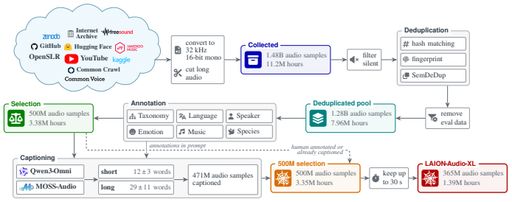
Figure 2 :Overview of the LAION-Audio-XL dataset curation pipeline.We collected 1.48B audio samples from online platforms, of which 1.47B entered deduplication. Removing silent audio, duplicates (including SemDeDup [59]), and evaluation data leaves 1.28B audio samples. We then selected 500M audio samples based on categorical taxonomy annotations. The same annotations were used to prompt Qwen3-Omni [61] and MOSS-Audio [42] to generate short and long captions for 471M audio samples without textual descriptions, resulting in 500M captioned audio samples in total (the 500M selection). The 365M audio samples that are up to 30 seconds long form LAION- Audio-XL.
Original paper · CC BY 4.0 · Gijs Wijngaard, Felix Förster, Ross Wightman, Marianna Nezhurina, Christoph Schuhmann, Jenia Jitsev, A. Sophia Koepke · LAION-Audio-XL: A Web-Scale Corpus and Scaling Studies for Contrastive Language-Audio Pretraining · Original paper figure · Extracted the figure area from page 5 of the original PDF.Why audio-text data limits scaling studies
Contrastive audio-language models map audio clips and their text descriptions into one shared embedding space.
Without enough open data, a team can't tell whether a fixed compute budget should go to a bigger model or to more samples. Earlier work such as SODA shows that the compute-optimal data amount grows faster than the number of training parameters. Tseng et al. train contrastive and captioning models on 0.4M, 1M, 4M, and 10M audio-language pairs.
They find that a pretrained model helps most at smaller scales, while training from scratch helps most at larger scales. The authors therefore study how to split one compute budget between model size and the number of samples a model sees. To build that study, they combine public audio datasets with four other source groups, which lifts the amount of data.
Building the 365 million pair corpus
The authors start from 1.48 billion raw audio samples and end with 365 million text-audio pairs. The dataset passes through cleaning, deduplication, annotation, selection and captioning, and the final audio is at most 30 seconds. Academic datasets are the largest group by source count, at 316 of the 425 sources. Those academic sources often bring cleaner audio and were tested in practice before reuse.
YouTube audio is segmented at silence boundaries into samples between 5 and 120 seconds. Long recordings still have to be cut, because the final training audio is capped at 30 seconds. The authors compared random crops, quality-filtered crops and silence cuts on the same YouTube pool. Each method used about 1M clips, the XS model, three seeds and about 8M samples seen per run.
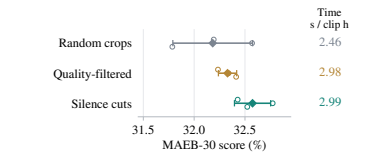
Figure 7 : Segmentation comparison after 8M samples per run. Diamonds and whiskers show the MAEB-30 mean and standard deviation over three seeds. Open circles show individual runs. Time: seconds from read- ing the source audio to written FLAC clips, per hour of written clips, on the same 227 hours of YouTube audio using 72 CPU cores.
Original paper · CC BY 4.0Deduplication runs in three layers, and each layer catches what the previous one misses. Exact matching converts all data to 16 kHz mono signed 16-bit PCM and compares MD5 hashes together with the audio length. Exact matching removes 151,056,336 audio samples, and ten repeated files account for 73.6M of the removals. Olaf fingerprints then link copies that were re-encoded, level-changed, cropped or padded, using q(a, b) = m/√(n_a n_b).
Pairs with q of at least 0.50 are linked, and this stage removes 1,196,096 samples beyond exact matching.
The semantic stage targets near-duplicates that the fingerprint stage misses, such as wake words and single utterances. Dasheng-base embeds each clip, and the embeddings are clustered with k-means at k = 65,536 and compared only inside each cluster. Because Dasheng-base is trained without text and is separate from CLAP2, the screen doesn't depend on the models being trained.
The screen runs on 1,263,840,901 pool samples of at least 2 seconds, out of 1,412,277,595 stored embeddings.
Captioning with metadata prompts
Many clips arrive without usable text, so the authors generate short and long captions for them. Qwen3-Omni was chosen for speed, while MOSS Audio in think-ON mode was chosen for its diversity and quality despite being slow. Both models captioned disjoint halves of the roughly 471 million audio samples, balanced within each source dataset.
The captioning run took 3,884 node-hours on 4×GH200 nodes.
Prompt design came next, with three options that the authors tested against each other. The first option passes only general instructions with the audio. The second attaches the whole raw JSON metadata string to the prompt. The third adds only selected JSON fields, converted to natural language. Both captioning models ran these three prompts on 976 audio samples, chosen to cover the dataset's duration and domains.
The judge never saw the metadata, so it couldn't simply confirm the specialists' predictions. Attaching the raw JSON string gave the best average rank across the two models, as shown in Table 5. For that reason, the captioning process includes the raw metadata JSON string in its prompts.
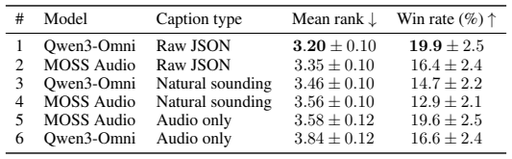
Table 5 :Attaching raw metadata strings leads to the highest accuracy.Overall ranking of two captioning models with three prompt types across the same 976 audio samples, evaluated with Gemini 3.6 Flash (thinking: low). Mean rank ranges from 1 (best) to 6 (worst). Win rate refers to being the best caption for a clip (higher-is-better). The±values give 95% percentile confidence intervals overB= 20,000resamples of the 976 audio samples.
Original paper · CC BY 4.0A check on 50 human-annotated samples tested whether the LLM judge behaves like a human rater. The authors present this set as validation of the LLM review rather than as a leaderboard.
CLAP2 encoders and their parameter split
The CLAP2 audio encoder is a NaFlex audio transformer that accepts variable-length audio. The text encoder is based on ModernBERT, but it swaps GeGLU and LayerNorm for SwiGLU and RMSNorm. The authors train both encoders from scratch, so they don't inherit confounding effects from prior model weights. The architecture scales easily across the tested sizes, which makes the scaling laws easier to display.
The authors align the five model scales with established encoder widths and depths, and with known small-scale ViT dimensions. Table 6 shows the hardware-aligned tiers, running from XXS with 27.3M parameters up to L with 340M parameters. Per clip, the forward pass costs an average of 26.1 GFLOPs at XXS and 357.9 GFLOPs at L on the training length distribution.
The authors adopt RoPE and SwiGLU as proven mechanisms, and they test other choices in their own design studies. The parameter ratio between audio and text encoders is a main design choice, and it depends on benchmarks, model size and training corpus.
OpenCLIP and SigLIP2 allocate up to about 78% of their parameters to the vision encoder. LAION-CLAP and MS-CLAP do the opposite, assigning about 51% to 73% of parameters to the text encoder. The authors explain that vision models see large visual variety, so scaling their vision encoder raises benchmark scores. Older CLAP models, by contrast, overfit under data scarcity, and they depend on pre-trained component sizes.
The authors tested four parameter allocations, changing the audio-to-text ratio from 2.36:1 to 1:2. That change shows no significant difference in the MAEB mean score with D≤64M. At D=512M, the two XS ratios differ by 2.2 points, and the authors stopped after the runs in Figure 9 for computational reasons. Shifting parameters to the text encoder generally gives faster inference speeds.
Scaling results on MAEB-30 and HEAR
CLAP2-M, with 153M parameters, gains 2.2 points on average on MAEB-30 each time the seen samples double between 1M and 1024M. Across more than four orders of magnitude of compute, the gain works out to around 1.8 points per doubling of compute. The authors treat this as a fitted trend over the range they swept, so they don't claim it holds beyond that range.
CLAP2-L reaches 53.6% on MAEB-30, compared to 35.2% for LAION-CLAP and 44.1% for GLAP. GLAP is the best other contrastive model the authors evaluated, and the paper states it has 2.5 times more parameters. CLAP2-S through CLAP2-L beat every other audio-text model on HEAR.
The authors also find that the optimal number of samples seen grows about 1.4 times faster than the optimal model size. That result backs their focus on smaller models trained on more samples, instead of on more parameters.
The authors tested audio-to-text ratios from 2.36:1 to 1:2 across four parameter allocations. At data up to 64M, the mean MAEB score shows no significant difference between these ratios. At D=512M, the two XS ratios tested differ by 2.2 points, and differences may grow as D increases further.
Limitations and untested claims
The authors didn't train larger models on more than 1B samples, so whether the scaling trend continues beyond that point is left open. The audio-to-text ratio comparison stopped at D=512M, because the authors stopped the runs for computational reasons. They didn't test how the audio-to-text ratio affects performance at larger data scales, since performance differences might appear as D increases further.
The scaling trend is a fitted trend over the range they swept, so they don't claim it holds beyond that range.
Most of the caption quality ranking relies on Gemini 3.6 Flash as the judge, which only received the audio and six captions. The ranking was checked against only n=50 human-annotated samples, which is meant to validate the LLM review rather than serve as a leaderboard. The 1,350 to 6,800 node-hour figure is a theoretical compute estimate, while the captioning run took 3,884 node-hours.
The CLAP2 benchmark numbers come from the authors' own evaluations on MAEB-30 and HEAR. They report CLAP2-L at 53.6% on MAEB-30 against 35.2% for LAION-CLAP and 44.1% for GLAP.
Paper info
- Authors
- Gijs Wijngaard, Felix Förster, Ross Wightman, Marianna Nezhurina, Christoph Schuhmann, Jenia Jitsev, A. Sophia Koepke
- Venue
- arXiv · Preprint
- First published
- 2026-11-8
- Added
- 2026-11-10
- Updated
- 2026-11-8
- Version
- v1
- arXiv
- 2611.11592
- Category
- cs.SD · cs.CL
- Original paper terms
- CC BY 4.0
- What we show
- Paper info, commentary and permitted figures from the original paper
AI commentary is a separate explanation from the original paper and may contain errors. The original paper and figures follow each source's terms of use and any rights noted separately.
Abstract
Recent progress on contrastive audio-language models can be attributed mainly to the scale and quality of their training data. Larger training datasets expose models to a broader range of sounds and corresponding audio captions. To exploit this, we collect 1.48 billion audio samples from academic datasets, internet datasets, web collections, Common Crawl, and YouTube, and process them with a multi-stage curation pipeline. Furthermore, we generate short and long captions for samples in our corpus that lack them. We use our dataset to study the scaling behavior of contrastive audio-language models based on the NaFlex architecture for the audio encoder. Our experiments identify trade-offs between model size and training data for a given compute budget. Moreover, our resulting models, CLAP2, outperform prior audio-text models of comparable size on the MAEB and HEAR benchmarks. We release our dataset, captions, model checkpoints, and code.
Quote from the paper
Gijs Wijngaard, Felix Förster, Ross Wightman, Marianna Nezhurina, Christoph Schuhmann, Jenia Jitsev, A. Sophia Koepke (2026). LAION-Audio-XL: A Web-Scale Corpus and Scaling Studies for Contrastive Language-Audio Pretraining. arXiv:2611.11592v1. https://arxiv.org/abs/2611.11592v1
BibTeX
@misc{wijngaard2026laion,
  title = {{LAION-Audio-XL: A Web-Scale Corpus and Scaling Studies for Contrastive Language-Audio Pretraining}},
  author = {Gijs Wijngaard and Felix Förster and Ross Wightman and Marianna Nezhurina and Christoph Schuhmann and Jenia Jitsev and A. Sophia Koepke},
  year = {2026},
  eprint = {2611.11592},
  archivePrefix = {arXiv},
  url = {https://arxiv.org/abs/2611.11592v1}
}