Paper commentary
Hand in Silhouette: Synthetic-to-Real Multi-View Hand Reconstruction via Binary Masks
SilHand reconstructs multi-view hands from binary masks trained on synthetic data
- Problem Multi-view hand reconstruction needs costly real captured data that is limited in hand geometry and often poorly annotated. Synthetic data gives exact labels but suffers an appearance gap from real images.
- Method SilHand is a calibrated multi-view framework that works from binary hand masks instead of RGB features. It projects 3D grid points into each view, fuses the mask evidence with cross-view attention, then decodes the hand pose and shape.
- Results SilHand reaches an MPVPE of 2.07 on DexYCB-MV, compared to 5.45 for JUMP-Hand, the lowest-error baseline there.
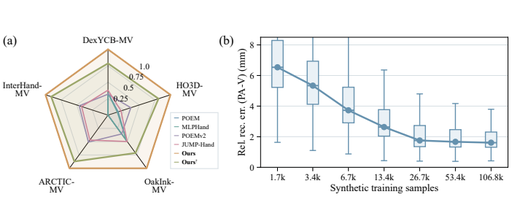
Figure 2 :Overview of SilHand.(a) Reconstruction result across five real-world multi-view hand benchmarks using reconstruction error (MPVPE). Despite being trained on the synthetic dataset, SilHand demonstrates strong reconstruction capabilities on real-world geometry. † uses corrupted input masks calibrated to match SAM3 segmentation performance (Carion et al., 2026), demonstrat- ing robustness to segmentation noise. (b) Relative reconstruction error (PA-V) as a function of the number of synthetic training samples across the same five datasets.
Original paper · CC BY 4.0 · Leiyao Cui, Lecheng Ruan, Zihang Zhao · Hand in Silhouette: Synthetic-to-Real Multi-View Hand Reconstruction via Binary Masks · Original paper figure · Extracted the figure area from page 2 of the original PDF.Why real data limits multi-view hand reconstruction
Calibrated multi-view hand reconstruction has improved quickly, but training data remains the bottleneck. Real multi-camera datasets show realistic hands, yet they are expensive to record and limited in hand-geometry diversity. They are also hard to label accurately, because hand configurations form a complex manifold. Synthetic data gives exact labels and can cover far more geometry, which makes it attractive.
The catch is a persistent appearance gap between synthetic renderings and real observations, and photorealistic rendering stays hard.
Most recent methods work from multi-view RGB images and improve by aggregating cross-view information. POEM lifts multi-view features into 3D using keypoints taken from RGB images. MLPHand adds an efficient design for real-time estimation, but it still works from RGB-based multi-view features. The authors reconsider the observation itself and ask whether the input can be made easier to transfer from synthetic data.
Binary masks as an appearance-free interface
A binary mask keeps the projected shape of the hand and drops color, texture, illumination and background. The authors remove texture from the reconstruction input, so each view is represented by one binary mask. Masks can be obtained inexpensively and with high accuracy through automatic segmentation or manual annotation. Synthetic observations only need to reproduce projected hand geometry rather than appearance, so the synthetic-to-real gap has less to act on.
This ambiguity is strongest under occlusion, where a single view offers the least information about the hand. Each extra calibrated view adds a geometric constraint on the same underlying hand state. The set of hand states consistent with all views shrinks as the constraints from multiple views intersect. The authors also restrict this feasible set to hand states that are anatomically and kinematically valid.
SilHand takes the calibrated multi-view masks as input and never relies on RGB features for lifting. Under known cameras, the multiple masks give complementary constraints on the same 3D hand geometry, which makes them a natural interface. The authors formulate the task as estimating a hand state consistent with this geometric evidence, factored into a fusion stage and a decoding stage.
The mask-centric formulation lets SilHand train on 46.8k grasping poses and 60k free-hand samples.
Querying mask and ray features at grid points
Each grid point collects its evidence by being projected into every calibrated view, so the query starts with geometry rather than image appearance. SilHand first encodes each view's binary mask and its Plücker-ray representation with shared mask and ray encoders. Each grid point x_k is projected with the camera projection, as in u_{n,k} = π_n(x_k; C_n).
Bilinear sampling then reads the mask and ray features at that pixel, giving m_{n,k} and p_{n,k} for each view. This association links observations across views without requiring RGB-based correspondences.
At each grid point, cross-view attention decides how much each view should count. The attention score adds a mask-similarity term and a view-similarity term, scaled by the square root of 2d. The mask-similarity term captures mask consistency, while the view-similarity term captures view geometry from the rays. A softmax over the views turns these scores into weights, and the output is a weighted sum of the mask value features.
Because the aggregated feature stays mask-centric, the fused point feature keeps no RGB appearance cues. A few attention blocks refine these point features, and a 3D CNN then models their spatial interaction into the shared representation Z. The paper omits the query, key and value projections in the formula, so Fig. 3 gives the full computation graph.
The shared representation Z feeds the next stage, which recovers the global hand pose from auxiliary world-space joints. Those joints are weighted averages over the metric grid, so each joint reads the same grid points that the views filled. Using joints as anchors, rather than an unstructured global feature, keeps the representation close to hand structure.
From the shared volume to pose, articulation and shape
The shared 3D representation first yields the global hand pose, because the rigid palm fixes orientation and the wrist fixes translation. SilHand predicts auxiliary world-space joints as weighted averages over the metric grid, so each joint becomes a learned location in space. The predicted palm joints come from the wrist, the thumb carpometacarpal joint, and the metacarpophalangeal joints of the other four fingers.
Orthogonal Procrustes alignment then maps the predicted palm onto the canonical MANO palm, which gives the global rotation.
With the frame estimated, SilHand moves each grid point into the canonical frame using the inverse of the global pose. A token-query decoder then predicts the intrinsic articulation and a neutral canonical geometry, and the articulation is constrained to prescribed anatomical ranges. The predicted geometry is projected onto the fixed MANO shape basis, which yields the shape without adding learned shape parameters.
MANO then maps the pose, articulation and shape to canonical vertices and joints, and the global pose moves them into the world frame.
Training supervises the articulation, canonical shape and world-space joints with smooth L1 losses. A rotation loss on the predicted global rotation is added alongside these terms. The total objective is a weighted sum of the pose, shape, joint and rotation losses, and the loss weights are given in the appendix. The synthetic data provides the ground-truth global pose, articulation, world-space joints and neutral canonical geometry for these losses.
Building the synthetic hand geometry
SilHand trains on synthetic hand geometry made of free-hand and grasping configurations. Free-hand poses come from sampling the MANO pose PCA space. Samples that break prescribed anatomical joint ranges or show hand self-collision are rejected. For grasps, the authors adapt Dexonomy to the MANO-based hand-state parameterization. Beyond filtering hand self-collisions, they run hand-object collision checks so that the grasps stay geometrically valid.
After anatomical and collision filtering, the final dataset holds 60k free-hand configurations and 46.8k grasping configurations. Camera parameters are randomized using the setups of HO3D, InterHand2.6M, DexYCB, OakInk and ARCTIC, as in POEMv2. The camera perturbation broadens the viewing distribution before global hand poses are sampled and masks are rendered.
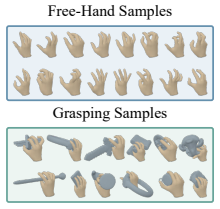
Figure 4 : Examples from our synthetic dataset.
Original paper · CC BY 4.0Rendered masks are perturbed through varying hand-region visibility and forearm extent. Morphological and boundary perturbations, plus localized boundary artifacts, further degrade the masks. Random view dropout adds another augmentation on top of these mask changes. All perturbations modify only the observations, so the underlying target stays unchanged, and the aim is robustness to imperfect observations.
Annotation-consistent evaluation on five real benchmarks
The authors render input masks from the annotated hand geometry and keep object-induced occlusions in place. SilHand is trained only on synthetic data and tested on the held-out splits, with no real-data fine-tuning. The baselines are POEM, MLPHand, POEMv2, and JUMP-Hand, plus a mask-based visual hull. The authors follow the dataset-specific splits set by POEM and POEMv2 for the learning-based baselines.
On DexYCB-MV, SilHand reaches an MPVPE of 2.07, compared to 5.45 for JUMP-Hand, the lowest-error baseline there. The same pattern appears on the other four datasets, where SilHand's MPVPE stays near 3 while the baselines' errors are higher. The reported MPVPE of the baselines includes POEM at 6.13 and MLPHand at 6.20 on DexYCB-MV.
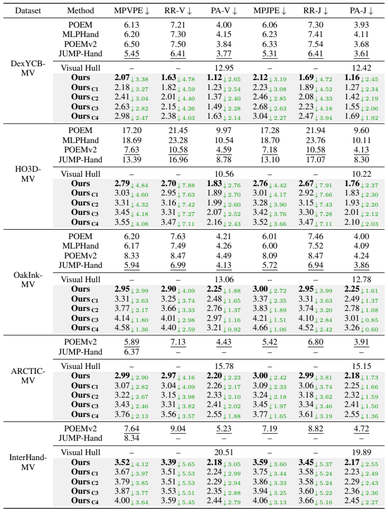
Table 1 :Quantitative results of SilHand.↓indicates lower is better. Best results arebold, and the best baseline results are underlined . Green values indicate the absolute improvement over the best baseline result. C1, C2, C3, and C4 indicate progressively stronger synthetic mask corruption.
Original paper · CC BY 4.0PA-V stays far lower for SilHand too, with 1.12 on DexYCB-MV against 3.77 for JUMP-Hand. The authors read the gains under Procrustes alignment as improved articulation, not only better global placement. Root-relative errors follow the same ordering, with RR-V at 1.63 for SilHand on DexYCB-MV.
Held-out-view agreement with real masks
Only ARCTIC-MV and InterHand-MV have enough cameras to hold one out for evaluation. Agreement is scored by IoU between the projected hand mask and the reference hand mask on the held-out view. Visible object pixels are excluded, so object occlusion doesn't count against the hand. In both experiments, SilHand takes masks extracted from real images as input, not masks rendered from annotated geometry.
On ARCTIC-MV, SilHand scores a held-out IoU of 81.9, compared to 79.0 for POEMv2 and 80.1 for the annotation. On InterHand-MV, SilHand scores 83.1, compared to 81.8 for POEMv2 and 83.9 for the annotation. SilHand beats POEMv2 on both datasets, but on InterHand-MV it stays just below the annotation.
The authors read this as complementary evidence that SilHand transfers to real-image observations. That evidence covers two splits only, so it supports the transfer claim on ARCTIC-MV and InterHand-MV alone. The held-out check is separate from the annotation-oriented MPVPE results, which use masks rendered from annotated geometry. Scaling the synthetic training set is the next question the authors examine.
Scaling the synthetic training set
SilHand's reconstruction error keeps falling as the synthetic training set grows from 1.7k to 106.8k samples.
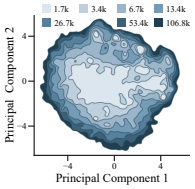
Figure 6 : Geometry diver- sity as training size grows.
Original paper · CC BY 4.0Growing the training set mainly adds more diverse hand poses rather than new shapes. Figure 6 projects the generated hand geometries onto the first two principal components, so the coverage growth is visible. The training set moves from 1.7k to 106.8k samples while its coverage progressively broadens. The authors treat this scaling as a way to gain geometric coverage without the acquisition and annotation burden of real-capture datasets.
The authors argue that this kind of diversity is practical with masks, even though it is hard to collect from real captures. Masks can be obtained inexpensively, so the synthetic geometry needs to reproduce only projected hand shape rather than appearance. The trend is shown only over the sample range from 1.7k to 106.8k, so they didn't test whether it continues beyond that range.
Behaviour under corrupted masks
SilHand is tested against four corruption levels, C1 to C4, that are calibrated to SAM3 mask quality. The corruption operators are calibrated so that their mask quality reproduces different levels of SAM3 performance. C1 to C4 get progressively worse, and C3 is the level that most closely matches SAM3. SAM3 reaches an IoU of 0.90 and a boundary F1 of 0.84.
C3 reaches an IoU of 0.89 and a boundary F1 of 0.81 on the same two metrics.
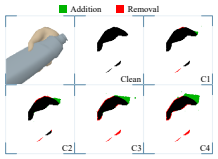
Figure 7 : Illustration of mask corruption levels.
Original paper · CC BY 4.0Table 1 reports the reconstruction results for each corruption level on the five real-world datasets. On OakInk-MV, the MPVPE of clean SilHand is 2.95, and it rises to 4.58 at C4. On HO3D-MV, the MPVPE rises from 2.79 to 3.55 at C4.
Even at the most severe corruption, SilHand's reconstruction error stays within the range the authors report for the other levels. They conclude that SilHand doesn't need highly accurate masks to keep its accuracy. This conclusion rests on simulated corruption calibrated to SAM3 levels, not on SAM3's own outputs.
Limitations of SilHand: camera dependence, mask ambiguity, and limited evaluation
SilHand projects 3D grid points into 2D views, so it depends on accurate camera parameters. The authors name improving robustness to calibration uncertainty as a direction for less controlled capture settings. Fewer input views weaken the geometric constraints on the hand configuration, as Eq. (6) describes. The view-count ablation appears only as a qualitative figure, Fig.
8, in the main text.
Binary masks discard color, texture, and local visual patterns that could separate hand configurations. Distinct hand geometries can therefore produce similar 2D masks. Self-occlusion and hand-object occlusion make this ambiguity worse. Informative contours can be missing across views, so multiple viewpoints don't always determine the geometry.
The authors suggest adding appearance cues later, but they warn that this could bring back the synthetic-to-real gap.
The real-data evidence covers five benchmarks, and the held-out-view IoU check covers only ARCTIC-MV and InterHand-MV. The scaling study covers only the tested range, from 1.7k to 106.8k synthetic samples. The corruption study covers only the levels C1 to C4, which the authors calibrate against SAM3. The authors didn't test SilHand on real-world fine-tuning, since it trains only on synthetic data.
Paper info
- Authors
- Leiyao Cui, Lecheng Ruan, Zihang Zhao
- Venue
- arXiv · Preprint
- First published
- 2026-11-12
- Added
- 2026-11-13
- Updated
- 2026-11-12
- Version
- v1
- arXiv
- 2611.16339
- Category
- cs.CV
- Original paper terms
- CC BY 4.0
- What we show
- Paper info, commentary and permitted figures from the original paper
AI commentary is a separate explanation from the original paper and may contain errors. The original paper and figures follow each source's terms of use and any rights noted separately.
Abstract
Calibrated multi-view hand reconstruction has advanced rapidly, yet the effectiveness of existing methods depends strongly on real captured data, which is costly to acquire, limited in hand-geometry diversity, and often affected by imperfect annotations. Synthetic data offers a scalable alternative with accurate supervision, but a substantial synthetic-to-real appearance gap hinders its use. To address this, we introduce Hand in Silhouette (SilHand), a calibrated multi-view hand reconstruction framework that operates on binary hand masks, obtainable at low cost either automatically or manually, to reduce the synthetic-to-real observation gap. Rather than relying on RGB features for 3D lifting, SilHand projects metric 3D hypotheses into each view to query and fuse mask-ray evidence for hand reconstruction. This mask-centric formulation enables training on a large-scale synthetic dataset comprising 46.8k grasping poses and 60k free-hand samples, providing broad coverage of hand geometry while directly transferring to real captured hand geometry. Across five real-world benchmarks, SilHand improves relative reconstruction accuracy from 49.2% to 63.4% using masks rendered from reference hands. Moreover, reconstruction accuracy improves consistently as the synthetic training set grows, indicating that broader geometric coverage translates into better real-world performance. While achieving such diversity is difficult with real captured data, it becomes practical under our mask-centric formulation. Finally, SilHand remains robust under mask corruption, with reconstruction error increasing by at most 1.63 mm. Together, these results support binary masks as an effective interface for learning hand reconstruction from synthetic geometry.
Quote from the paper
Leiyao Cui, Lecheng Ruan, Zihang Zhao (2026). Hand in Silhouette: Synthetic-to-Real Multi-View Hand Reconstruction via Binary Masks. arXiv:2611.16339v1. https://arxiv.org/abs/2611.16339v1
BibTeX
@misc{cui2026hand,
  title = {{Hand in Silhouette: Synthetic-to-Real Multi-View Hand Reconstruction via Binary Masks}},
  author = {Leiyao Cui and Lecheng Ruan and Zihang Zhao},
  year = {2026},
  eprint = {2611.16339},
  archivePrefix = {arXiv},
  url = {https://arxiv.org/abs/2611.16339v1}
}