Paper commentary
Studies on Sign Language Retrieval in Low-Resource Dictionary Settings
Pose encoder trained on ASL transfers to unseen sign language dictionaries
- Problem Most sign languages have only small dictionaries with one or a few videos per sign, too few to train retrieval models. Earlier evidence of transfer across sign languages covers only one or two languages and comes from single training runs.
- Method The authors train a pose encoder on ASL-Citizen with metric learning and freeze it. They then test it on six unseen sign languages, unlike methods that need target-language training.
- Results With one enrolled clip per sign, the encoder retrieves the correct sign first in 36.4 to 80.7 % of queries. The best learning-free method reaches 16.0 to 69.6 % on the same trials.
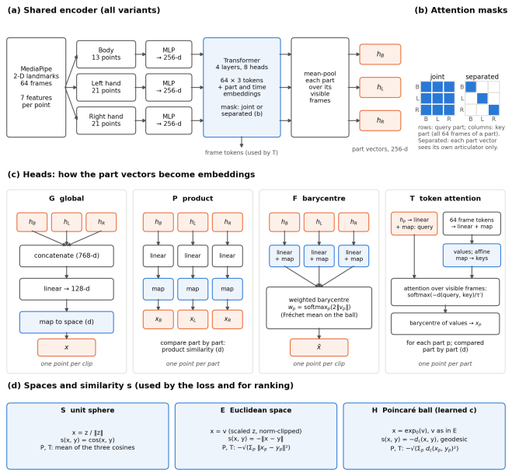
Fig. 4 Block diagram of the encoder and of every variant. (a) Shared encoder: per-part MLPs turn the landmarks of each frame into 64 × 3 tokens, a Transformer processes them, and each part is averaged over its visible frames into a part vector (hB, hL, hR). (b) Attention masks over the part blocks (rows: query part, columns: key part): joint, every token attends to every other; separated, only within its own part. (c) The four heads. G concatenates the part vectors into one embedding; P keeps one embedding per part; F merges the per-part embeddings into one point by a weighted barycentre, with vp the scaled projection of part p; T lets each part’s embedding attend over the frame tokens of that part. (d) The three spaces: how a projection z (or its scaled, norm-clipped version v) becomes a point, and the similarity s used both by the loss and for ranking; heads with one point per part (P, T) combine the parts as shown.
Original paper · CC BY 4.0 · Ushnish Sarkar, Vineet Kumar Rakesh, Bhaswar Chattopadhyay, Tapas Samanta · Studies on Sign Language Retrieval in Low-Resource Dictionary Settings · Original paper figure · Extracted the figure area from page 9 of the original PDF.Why few-example sign retrieval is hard
The Indian Sign Language dictionary documents 10,000 terms with demonstration videos, while a corpus built from it and a second online dictionary has about 1.5 videos per word.
Which properties transfer, and which design choices make them transfer, is less clear.
Earlier work has shown that pose embeddings carry information across sign languages. That evidence usually covers one or two target languages, comes from single training runs, and lacks a controlled comparison of design choices.
The authors therefore ask three questions about this gap. First, they ask how far zero-shot transfer reaches, since earlier reports cover one or two languages. Third, they ask how reliable the answers are, since earlier results are single runs. They address all three with one source language, six unseen target languages, a real dictionary, a crossed ablation and repeated training seeds.
A pose encoder trained only on ASL
The encoder works on keypoints, which remove appearance and background and leave the articulation itself.
Each frame's landmarks are split into body, left hand and right hand, and a two-layer MLP turns each part into a 256-dimensional token, so a clip gives 64 × 3 tokens.
A head then turns the three part vectors into the retrieval embedding: G concatenates them, P keeps one embedding per part, F merges the parts by a weighted barycentre, and T uses token attention over the frames. Each head is placed in the unit sphere, in Euclidean space or in the Poincaré ball, where hyperbolic similarity is the negative geodesic distance.
Euclidean and hyperbolic variants share the learned scale and norm clipping, so comparing them isolates curvature.
Training uses one of four objectives: SupCon, InfoNCE, ProxyNCA++ or a cross-entropy classifier. InfoNCE divides each positive pair's score only by the anchor's negatives, while SupCon divides it by all other clips in the batch. The classifier is dropped at test time, so retrieval uses the head's similarity in every case. The reference configuration is S-G trained with SupCon, using AdamW for 40 epochs of 300 steps and keeping the epoch with the best ASL-Citizen validation Hit@1.
How retrieval is scored
Retrieval is scored under a few-shot protocol that simulates a dictionary in sampled episodes. Each of 100 trials draws one query clip and k clips of that sign, with k set to 1 or 4. The query is ranked against the k clips of every sign, which gives the 1+1 and 4+1 protocols. The cross-signer variants exclude the query's signer from the gallery, so the encoder has to match different people.
Trials depend only on labels and signers and are drawn once with a fixed seed.
The primary metric is Hit@1, the top-1 accuracy averaged over queries. MAP@R scores the whole ranking and is reported in the supplementary material.
Six reference methods are scored on the same trials, and none of them is trained on ASL-Citizen. The two published DTW methods are nDTWpp and angle DTW, which reaches 69.6 % one-shot Hit@1 on LSA64 under signer control. The OpenHands SL-GCN and ST-GCN encoders, trained on WLASL, are used frozen with cosine similarity, so they act as ASL-trained references.
Transfer to six unseen languages
The S-G encoder trained with SupCon scored 36.4 to 80.7 % Hit@1 across the six target languages with one enrolled clip per sign. Angle DTW, the strongest learning-free method, scored 16.0 to 69.6 % on the same trials. That gives a mean gain of +23.0 points for the encoder over angle DTW.
The ASL-trained OpenHands SL-GCN reached a six-target mean of 39.3 %, which is well below the S-G reference encoder. The best configuration, H-G separated with InfoNCE, raises the six-target one-shot mean from 59.0 to 68.0 %.
On the ASL-Citizen test split, the in-language reference, the S-G encoder scored 40.3 % one-shot Hit@1. The best configuration reached 47.3 % on the same split, against 5.3 % for raw keypoints.
Which design choices move accuracy
Blocking attention between articulators is the largest single change in the crossed grid. For the global and barycentre heads, it raises whole-population Hit@1 by +3.8 to +5.1 points with SupCon. With InfoNCE, the same change adds +2.2 to +4.0 points, and it holds on every target. Separation helps inside the encoder, but keeping the parts apart in the retrieval space doesn't.
With the separated encoder, the product and token heads sit 1.3–6.0 points below the corresponding global head.
The objective is the second factor that moves accuracy, and the spherical global head shows it most clearly. For that head, cross-entropy gives 76.4±0.9 %, SupCon 78.9±0.4 % and InfoNCE 82.1±0.4 %. InfoNCE beats SupCon in all twelve geometry–aggregation configurations of the joint encoder. ProxyNCA++ fails for the hyperbolic global and barycentre heads, and the authors trace this to proxy optimisation on the ball.
They don't read it as evidence about the geometry itself.
Geometry matters much less than the objective, even with eight seeds on the joint encoder. The hyperbolic token-attention head sits 1.4–2.0 points below the other two geometries, so geometry is a minor factor.
Clip length is the last choice the ablation varies, and it moves the six-target mean very little. The largest one-shot change is a decline of close to one point at 128 frames.
What the hands carry
Removing parts at test time shows which articulators the transferable signal depends on. The spherical global head on the joint encoder reaches 78.9 % six-target Hit@1 with all parts present. Without hands, the six-target Hit@1 falls to 30.2 %, the largest drop of the four tests. Without the body it falls to 72.9 %, without the left hand to 63.5 %, and without the right hand to 50.7 %.
The occlusion reuses the trained S-G models and changes only the test clips, without any retraining.
The authors read this as the hands carrying most of the transferable information. The right hand, dominant for most signers, carries the most of it. That pattern fits the benefit of encoding the hands without interference from the body, which the separated attention mask provides. Blocking attention between body and hands raised accuracy for the global and barycentre heads.
The occlusion result is a test-time check, so it doesn't show how the encoder would behave if retrained without a part. The comparison with published work below uses the same encoder family under other protocols. For AUTSL, the joint S-G encoder reaches 66.1±0.8 % Recall@1, against 28.7 % for the WLASL-trained OpenHands SL-GCN.
Dictionary search on CISLR
On CISLR, the encoders find the correct word first in 17.3 to 19.0 % of queries, above the 16.8 % of the original RGB baseline. The dictionary has 4,765 words with one video per word, and the 2,285 queries are scored against those entries. Every seed of every trained configuration beats the WLASL-trained I3D features on Hit@1, with the lowest seed at 17.1 % against 16.8 %.
At Hit@10 the gap grows to 3.4 to 6.3 points, so the advantage is not limited to the top rank. The comparison is not an architecture comparison, since the I3D baseline uses RGB input and WLASL, while the encoders use keypoints and ASL-Citizen.
Training on ASL adds 4.3 to 7.2 points over the untrained encoder and raw keypoints, so the learned encoder carries the gain. The configurations keep the ordering of the six-target ablation, with InfoNCE above SupCon and the separated encoder above the joint one under SupCon.
Removing videos with faulty headers raises Hit@1 by 0.7 to 1.3 points for every model, so their inclusion does not favour the results.
Comparison with published results
The subset isn't published, so the authors redrew it 100 times, and every model in this comparison shares those draws. Under this protocol, the joint S-G encoder reaches 66.1±0.8 % Recall@1, compared to 28.7 % for the WLASL-trained OpenHands SL-GCN. The best separated encoder, H-G with InfoNCE, reaches 74.0±0.5 %, and the published 3.5 % sits well below that.
Because of that gap, the authors suspect that their sample, preprocessing or training differ from the published setup. For that reason they call the comparison indicative only. The like-for-like comparison with WLASL-trained models is therefore the OpenHands rows in Table 4.
On the earlier study's signer-uncontrolled protocol, the present encoders score higher on both LSA64 and INCLUDE. Table 3 and Figure 6 use the stricter cross-signer protocols, so these numbers are not directly comparable with them.
Table 5 sets the in-language results against published ASL-Citizen retrieval figures. With that caveat, the reference S-G encoder reaches 57.3 % Recall@1, and the best configuration reaches 65.4 %.
Limits of the evidence
The signer controls depend on what each dataset records, and that bounds the cross-signer claims. CISLR has no signer identities either, so signer overlap between entry and query can't be excluded there. The CISLR queries are dictionary videos, not recordings by people searching the dictionary.
The low-resource setting is simulated on six corpora that are not themselves low-resource, by enrolling one or four clips per sign. Only one source language is studied, and the targets were chosen as publicly available isolated-sign corpora. Language relatedness may favour some targets, since French Sign Language influenced both ASL and Russian Sign Language.
Paper info
- Authors
- Ushnish Sarkar, Vineet Kumar Rakesh, Bhaswar Chattopadhyay, Tapas Samanta
- Venue
- arXiv · Preprint
- First published
- 2026-11-12
- Added
- 2026-11-13
- Updated
- 2026-11-12
- Version
- v1
- arXiv
- 2611.16621
- Category
- cs.AI
- Original paper terms
- CC BY 4.0
- What we show
- Paper info, commentary and permitted figures from the original paper
AI commentary is a separate explanation from the original paper and may contain errors. The original paper and figures follow each source's terms of use and any rights noted separately.
Abstract
Most sign languages have no annotated corpus, only small dictionaries with one or a few example videos per sign. This study examines how well a pose encoder trained on a single sign language serves such languages without any target-language training. An encoder trained with metric learning on American Sign Language (ASL-Citizen) is evaluated frozen on six datasets of Turkish, Russian, Indian, Argentinian, Pakistani and Sri Lankan sign languages, with one or four clips per sign enrolled and, where signer identities are available, the query's signer excluded from the gallery. With one enrolled clip, the encoder retrieves the correct sign first in 36.4-80.7 % of queries, against 16.0-69.6 % for the best learning-free method (angle-based dynamic time warping) and a six-target mean of 39.3 % for an ASL-trained OpenHands graph network. In a crossed ablation of the encoder (embedding geometry, aggregation of body and hand embeddings, training objective, and attention between articulators), two choices matter: a per-pair InfoNCE objective outperforms supervised contrastive and cross-entropy training, and blocking attention between body, left hand and right hand inside the encoder raises accuracy by up to 5.1 points. The best configuration reaches 68.0 % one-shot accuracy (59.0 % for the reference encoder). On CISLR, an Indian Sign Language dictionary of 4,765 words with one video per word, the encoders find the correct word first for 17.3-19.0 % of queries, above the 16.8 % of the original RGB baseline. Over eight seeds with the joint encoder, spherical, Euclidean and hyperbolic embedding spaces differ by at most 1.6 points, except the hyperbolic token-attention head trained with InfoNCE, which is 1.4-2.0 points worse, so the geometry is a minor factor.
Quote from the paper
Ushnish Sarkar, Vineet Kumar Rakesh, Bhaswar Chattopadhyay, Tapas Samanta (2026). Studies on Sign Language Retrieval in Low-Resource Dictionary Settings. arXiv:2611.16621v1. https://arxiv.org/abs/2611.16621v1
BibTeX
@misc{sarkar2026studies,
  title = {{Studies on Sign Language Retrieval in Low-Resource Dictionary Settings}},
  author = {Ushnish Sarkar and Vineet Kumar Rakesh and Bhaswar Chattopadhyay and Tapas Samanta},
  year = {2026},
  eprint = {2611.16621},
  archivePrefix = {arXiv},
  url = {https://arxiv.org/abs/2611.16621v1}
}