Paper commentary
Data-Efficient LLM Safety Alignment Guided by Interpretable Features
2.4K-prompt safety dataset beats much larger alignment sets
- Problem Safety alignment usually needs massive fine-tuning datasets of 20K to 300K+ samples. Those sets often cause over-refusal, where models reject harmless prompts and lose usability.
- Method LIS picks prompts covering many SAE safety features and adds over-refusal prompts.
- Results LIS, with only 2.4K samples, outperforms TRIDENT-Core (26K), TRIDENT-Edge (19K) and WildJailbreak (262K) overall on four safety and five over-refusal benchmarks.
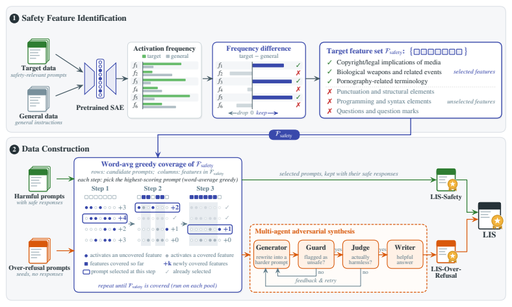
Figure 1 : Overview of the LIS construction pipeline.Stage 1: Identifying safety features by comparing SAE activations of the safety data against other data.Stage 2: Seeds from over-refusal data are processed through a multi-agent adversarial synthesis framework to produce the final over-refusal subset. The safety subset is obtained directly by filtering safety data.
Original paper · CC BY 4.0 · Hongyu Li, Zhan Yu, Zhe Zhao, Kimmo Yan, Xiong Kuang, Renfen Hu · Data-Efficient LLM Safety Alignment Guided by Interpretable Features · Original paper figure · Extracted the figure area from page 4 of the original PDF.Why large safety datasets cause trouble
Safety fine-tuning usually runs on large SFT datasets, typically 20K to 300K+ samples. Those sets often cause over-refusal, where models reject harmless prompts and lose usability. Early work such as HH-RLHF highlighted the need to balance safety and usability. Most of these safety sets focus solely on improving safety. BeaverTails, TRIDENT and STAR-1 don't address over-refusal in their evaluation or data design.
Their finding also shows that excessive data, over 2,000 samples, increases over-refusal. That leaves a narrower question: can a compact, carefully chosen set keep the safety gain without the usability loss?
LIS covers both safety and over-refusal subsets, so the authors don't rely on safety data alone. Fine-tuning with LIS on NVIDIA H20 requires only 0.99 GPU-hours. By contrast, TRIDENT and WildJailbreak require 11.5 and 289.2 GPU-hours, respectively.
The key idea: cover safety features and add boundary cases
The core move is to score prompts by the safety features they activate in a sparse autoencoder, then pick the prompts that cover the most of them. Earlier SAE-based filters treat all features equally, so a sample can gain weight just by activating features unrelated to the task. Restricting the count to safety-related features makes the selection signal a measure of risk coverage rather than of general text traits.
The second move targets the boundary between harmful and harmless requests. Jailbreak prompts appear harmless but are actually harmful, while over-refusal prompts appear harmful but are actually harmless. So the authors add a synthesized over-refusal subset next to the safety subset, built by a multi-agent adversarial framework. Their discussion frames safety alignment as teaching a model where the boundary lies, instead of memorizing refusal and compliance.
They found that models trained on safe data tend to over-refuse, while models trained only on over-refusal data lose safety.
The authors expected a small set to work because, in their view, coverage and boundary placement matter more than raw scale. Their ablation confirms that neither subset alone gives the best balance, which supports combining both. LIS reaches this balance with 2.4K samples, against 19K to 262K for the compared datasets.
Finding safety-related SAE features
Each prompt passes through a pre-trained SAE encoder, which turns the hidden state at every token position into a feature vector of size D. The authors then max-pool over the valid, non-padding token positions, so each prompt gets a single vector. Max-pooling keeps a feature active whenever it fires at any token in the prompt.
A feature counts as active for a prompt when its pooled value is greater than zero. The authors compute, for each feature, the fraction of prompts that activate it in the safety set and in the general set. Safety data and over-refusal data also activate general features, such as those tied to a particular word or sentence structure.
Each frequency enters a log-odds term with a small constant epsilon for numerical stability. The Score is the log-odds on the safety set minus the log-odds on the general set. Features with a Score above zero form the safety feature set, Fsafety. A higher Score means the feature is more likely to fire on safety data than on general data.
Log-odds capture relative differences, so a rare feature can still earn a high Score. The authors chose log-odds over a raw difference in activation frequency, written as delta p. Table 2 shows a copyright-related feature at 15.87 and a punctuation feature at −7.27, with interpretations from Neuronpedia. The paper uses TRIDENT-Edge for these examples and lists the feature indices next to the scores.
Greedy selection with word-count normalization
With a fixed sample budget, the goal becomes covering as many safety features as possible. At each step, the method picks the candidate with the largest number of newly covered features per word. Here NewCov counts the safety features a prompt newly covers in this step, and |xi| is its word count. Ties go to the candidate whose newly covered features have the larger sum of Scores.
Each candidate's Score comes from the log-odds comparison, so a rare but safety-related feature can still add a high value.
The authors chose a greedy algorithm because the objective is coverage of safety features under a fixed number of samples. Yang et al. found that longer samples activate more features, so an unnormalized greedy rule would tend to prefer long prompts. The authors argue that this drift would make the selected data converge and reduce the model's generalization ability.
The two examples from the initial step show how the normalization changes the ranking. Case A is a 17-word question about fraudulent corporate activities and legal loopholes, and it ranks 8th. Case B is a 212-word justification of violent protests, and it ranks 18,773rd. Its harmful content has a single theme, repeated three times, so its features center on one concept and add little per word.
Synthesizing over-refusal prompts
The over-refusal subset starts from seeds in OR-Bench-80K, and 1,200 of them feed LIS-Over-Refusal. Generator rewrites each seed so that its risk points become more prominent. Guard, a safety-aligned model, then checks the rewritten prompt for a refusal. Guard is Qwen3Guard-Gen-8B, and a prompt counts as over-refused when Qwen3Guard labels it Unsafe or Controversial.
If Guard refuses, Judge decides whether the prompt is truly harmful or only appears harmful. A prompt that only appears harmful is valid and stays in the subset.
A prompt that Guard does not flag gets pushed to look more harmful, so Generator keeps revising it. If Judge finds the revised prompt genuinely harmful, Generator revises it again using Judge's feedback to make it harmless. Generator, Judge, and Response-Writer are all instantiated with Gemini-3.0-Flash. Response-Writer answers the harmless parts and either avoids the risk points or gives positive guidance on them.
The authors draw this design from FalseReject, which also uses a rewrite-and-check loop.
To check quality, the authors randomly sampled 200 LIS-Over-Refusal instances. A professional annotator with over three years of safety content review experience labeled each sample. Among the 200 samples, 91% were labeled qualified, which the authors read as high synthesis quality.
The synthesis step matters because the over-refusal subset alone keeps precision high but lowers safety recall. LIS-Over-Refusal alone reached precision 81.89 but recall only 72.60.
Experimental setup: models, judges and benchmarks
TRIDENT-Edge supplies 1,200 samples as LIS-Safety, the safety subset of the dataset. OR-Bench-80K supplies another 1,200 samples, which serve as seeds for LIS-Over-Refusal. Alpaca is the general dataset that the safety-feature identification compares against. Gemini-3.0-Flash instantiates the Generator, Judge and Response-Writer.
Guard is Qwen3Guard-Gen-8B, which the authors chose for its stable classification outputs. Qwen3Guard was trained on large-scale safety data before the authors used it here. A prompt counts as triggering over-refusal when Qwen3Guard labels it Unsafe or Controversial. The SAE is LlamaScope, trained on the 24th-layer residual stream of LLaMA3.1-8B-Base at 32x.
Unsafe rate is reported on four safety benchmarks: HarmEval, S-Eval, SALAD-Bench and Jailbreak-Distillation. S-Eval and SALAD-Bench each split into jailbreak prompts and simple harmful prompts. Refusal rate is reported on five over-refusal benchmarks: XSTest, FalseReject, EvoRefuse, PHTest and OKTest. Recall equals one minus the average unsafe rate, and precision equals one minus the average over-refusal rate.
F1 combines these two scores to measure the balance between safety and usability, as WildJailbreak also does.
Each benchmark's own safety classifier scores its unsafe rate. HarmEval and Jailbreak-Distillation publish no such classifier, so the authors use LLaMA-Guard4 for them. Over-refusal is judged by DeepSeek-V4-Flash as LLM-as-Judge, following each benchmark's original protocol. TRIDENT Core, TRIDENT Edge and WildJailbreak serve as comparison datasets under the same checkpoint and training method.
LIS against larger datasets
The comparison uses the same checkpoint, method and hyperparameters for every training set, so the data is the only variable. Each model was fine-tuned on LIS, on size-matched 2.4K random subsets of TRIDENT-Edge, TRIDENT-Core and WildJailbreak, and on the full datasets. The size-matched baselines are there to separate data quality, dataset size and training procedure.
Two model families were tested: LLaMA3.1-Alpaca and Qwen3.5-9B-Base.
Against the full datasets, LIS beats 66.96 for full TRIDENT-Edge (19K), 65.48 for full TRIDENT-Core (26K) and 79.38 for full WildJailbreak (262K). Full WildJailbreak has the lowest unsafe rates on several benchmarks, yet its precision of 71.48 stays below LIS.
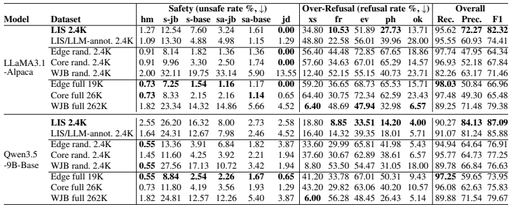
Table 3 : Size-matched (2.4K) and full-dataset comparison on two model families understrictly unified settings. rand. = random equal-size subset. Recall = 1−avg(unsafe rate) , Precision = 1−avg(over-refusal rate) (Jiang et al., 2024). Best result in each column within each model family is inbold.
Original paper · CC BY 4.0The full TRIDENT-Edge run reaches 73.95 and the full TRIDENT-Core run reaches 75.83 on this model. The authors read the result as LIS being tied to the diversity signal rather than to one model, since LIS was built with LLaMA3.1-8B-Base and its SAE.
The evidence covers only these two model families, so the claim of generality rests on two checkpoints. They didn't test other architectures or larger model sizes in this comparison.
Word-average Greedy against other selection rules
The authors selected 1,200 samples from TRIDENT-Core with five strategies and fine-tuned LLaMA3.1-Alpaca on each set. The five strategies were Random, Anti-Greedy, K-means clustering with Qwen3-Embedding, Greedy without length normalization, and Word-average Greedy. Every run used the same training hyperparameters, so the comparison isolates the effect of the selected data.
The unsafe rate was measured on four safety benchmarks, and Table 4 reports the results.
Word-average Greedy gives the lowest unsafe rate on five of the six safety columns in Table 4. K-means lands between Random and Word-average Greedy on most columns, and it doesn't match Word-average Greedy on sa-base.
Anti-Greedy, which minimizes coverage, was worse than random on hm, s-jb and sa-jb. The authors read this weak result as support that feature coverage is a valid signal of diversity. This comparison uses a single fine-tuning setup, and the samples come only from TRIDENT-Core.
Why both subsets are needed
The authors fine-tuned LLaMA3.1-Alpaca on only LIS-Safety or only LIS-Over-Refusal, each at 2.4K samples, to test each subset's role. They kept the training setup and evaluation protocol identical to the Table 3 comparison, so the subsets are the only change. Training on LIS-Safety alone gave the highest recall at 97.91, but its precision was only 43.52, so it over-refuses heavily.
Training on LIS-Over-Refusal alone gave the best precision at 81.89, but its recall fell to 72.60.
Neither subset alone reaches a balanced trade-off, so the full LIS is the only option that keeps both metrics high. The authors read this as confirmation that both subsets are indispensable. The 91% qualified rate on 200 sampled over-refusal instances supports the quality of the synthesized subset.
Their experiments on this question cover LLaMA3.1-Alpaca only, so the subset effect is not shown on Qwen3.5-9B-Base. The paper's general comparison shows the full LIS reaching F1 82.32 on LLaMA3.1-Alpaca.
Selection and training cost of LIS
The SAE-based selection step runs at 10.7 ms per sample on one NVIDIA H20 GPU. The same measurement for K-means with Qwen3-Embedding-8B reaches 15.5 ms per sample. The authors read this gap as a sign that the SAE route is cheaper than an embedding-based route. They argue that the feature-guided selection gains effectiveness in Table 4 without adding cost.
The authors fine-tuned LLaMA3.1-Alpaca on LIS using eight NVIDIA H20 GPUs. That run used a batch size of 32 and trained for two epochs. The full run took 0.99 GPU-hours. The TRIDENT fine-tuning pipeline would need 11.5 GPU-hours, and the WildJailbreak pipeline would need 289.2. Both comparisons use the same base model, so the difference comes from the data and the pipeline.
The paper reports selection cost and training cost separately, and it doesn't give a combined total. They didn't report the cost of the multi-agent adversarial synthesis step for the over-refusal subset. So the 0.99 GPU-hours figure covers the fine-tuning run only, not the data construction around it.
LLM-labeled safety features
The authors test whether an LLM can replace the score-based rule for picking safety features. DeepSeek-V4.1-Flash reads the explanations of all 129,130 LlamaScope features and labels each one as safety-related or not. It marks 11,470 features as safety-related, and that set replaces the score-based set for both subsets.
On Qwen3.5-9B-Base the gap is smaller, with F1 falling from 87.09 to 85.88. The authors read this as LLM labels being an accurate selection signal for safe data. Over-refusal data is safety-related too, yet its distribution differs enough that LLM-labeled features select it poorly.
The data-driven route instead labels features that match the dataset's own distribution. The authors say it also offers faster processing and lower costs than asking an LLM. When LLM-annotated features serve as ground truth, LIS-Safety (1.2K) covers 91.7% of safety features. A random set of the same size covers only 70.8%, and the authors argue that recall matters more than purity here.
Safety-adapted SAE: does tuning on safety text help?
The LIS authors tested whether a safety-tuned encoder would improve their selection pipeline. LlamaScope's SAE was first trained on diverse text, so the authors kept training it. They continued training on a 1:1 mixture of safety text and general text, detailed in Appendix H.2. Then they re-ran the LIS pipeline with this adapted SAE in place of the original one.
On Qwen3.5-9B-Base, F1 rose to 87.97, compared to 87.09 with the original SAE. On LLaMA3.1-Alpaca, F1 fell to 79.39, versus 82.32 with the original SAE.
The clearest gain appears on jailbreak prompts, which the authors connect to the adapted features. The authors say a safety-adapted SAE mainly adds robustness to jailbreak prompts.
The authors conclude that a public general-purpose SAE is sufficient for LIS. So the extra safety tuning isn't needed for the pipeline's main result.
General capability cost of LIS
The authors fine-tuned LLaMA3.1-8B-Instruct on LIS and on TRIDENT-Edge, then tested general skills on four benchmarks. The benchmarks are MMLU with 5-shot prompting, GSM8K with 8-shot CoT, MATH-500 with 0-shot CoT, and ARC-Challenge with 0-shot prompting. The unmodified instruct model serves as the reference point before any fine-tuning. The benchmark sources are Hendrycks et al., 2020, Cobbe et al., 2021, Hendrycks et al., 2021, and Clark et al., 2018.
LIS scores above TRIDENT-Edge on all four benchmarks, but it sits below the unmodified model on MMLU, GSM8K and MATH-500.
The authors read this as LIS having a smaller negative impact on general ability than TRIDENT-Edge. They don't claim that fine-tuning on LIS leaves general ability unchanged. They advise that the data composition should be chosen according to actual needs. Their conclusion ties this trade-off to a dataset of 2.4K samples built from interpretable safety features and over-refusal prompts.
Limitations of the LIS safety dataset
The safety score can mislabel features, because it only measures a difference in activation frequency between safety and general data. Features with Score>0 may still be safety-irrelevant, and some indirectly related features, such as health-related statistics, get selected as safety features. Alpaca can't fully offset the general features that TRIDENT activates, so some noise stays in the selected data.
Academic role-playing in safety data triggers the feature for academic roles and positions, and Alpaca fails to offset it.
When LLM-annotated safety features serve as ground truth, LIS-Safety (1.2K) covers 91.7% of safety features. A random set of the same size covers only 70.8% of them, so the authors treat recall as more important than purity. They argue that missed risks are costlier than redundant ones in safety alignment. This coverage check uses LLM labels as the reference, so it doesn't measure safety directly.
The quality and diversity of the synthesized over-refusal data are limited by the models inside the synthesis framework. Gemini-3.0-Flash instantiates the Generator, Judge and Response-Writer, so the synthesized data inherits that model's ability.
The authors position their contribution as data construction rather than a complete alignment paradigm. That extension is untested in the paper, which only evaluates safety alignment.
Paper info
- Authors
- Hongyu Li, Zhan Yu, Zhe Zhao, Kimmo Yan, Xiong Kuang, Renfen Hu
- Venue
- arXiv · Preprint
- First published
- 2026-11-12
- Added
- 2026-11-13
- Updated
- 2026-11-12
- Version
- v1
- arXiv
- 2611.16183
- Category
- cs.CL · cs.AI
- Original paper terms
- CC BY 4.0
- What we show
- Paper info, commentary and permitted figures from the original paper
AI commentary is a separate explanation from the original paper and may contain errors. The original paper and figures follow each source's terms of use and any rights noted separately.
Abstract
Existing large language models typically rely on massive fine-tuning datasets for safety alignment, which results in higher costs for safety alignment and often leads to the problem of over-refusal. We propose Less is Safer (LIS), a compact yet highly effective dataset for safety alignment, constructed through interpretable feature-guided selection and adversarial synthesis. Specifically, we leverage Sparse Autoencoder (SAE) activations to efficiently select prompts that cover diverse and interpretable safety features. Then, we employ a multi-agent adversarial synthesis framework to generate harmless prompts that nevertheless elicit unnecessary refusals. LIS contains only 2.4K samples, yet outperforms much larger datasets, e.g., TRIDENT-Core (26K), TRIDENT-Edge (19K) and WildJailbreak (262K), in overall performance on four safety and five over-refusal benchmarks. Through ablation experiments, we demonstrate that neither safety data nor over-refusal data alone can achieve optimal results. We also used safety features from SAE, annotated by an LLM, for data filtering, but the results were inferior to those obtained using the pipeline proposed in this paper.
Quote from the paper
Hongyu Li, Zhan Yu, Zhe Zhao, Kimmo Yan, Xiong Kuang, Renfen Hu (2026). Data-Efficient LLM Safety Alignment Guided by Interpretable Features. arXiv:2611.16183v1. https://arxiv.org/abs/2611.16183v1
BibTeX
@misc{li2026data,
  title = {{Data-Efficient LLM Safety Alignment Guided by Interpretable Features}},
  author = {Hongyu Li and Zhan Yu and Zhe Zhao and Kimmo Yan and Xiong Kuang and Renfen Hu},
  year = {2026},
  eprint = {2611.16183},
  archivePrefix = {arXiv},
  url = {https://arxiv.org/abs/2611.16183v1}
}