Paper commentary
ORCHID-SAGE: Fully Reproducible CALPHAD Assessment from Evidence to Phase Diagram
ORCHID-SAGE records CALPHAD assessments so machines can regenerate databases
- Problem Published CALPHAD databases can't be rebuilt or updated, because the expert decisions behind their parameters are rarely recorded.
- Method ORCHID-SAGE records each assessment as formal protocols and run cards, instead of only final parameters, so a script or AI agent can rerun it.
- Results An AI agent regenerated the Cr–Ni database from its record in 46 turns, with the same predictions.
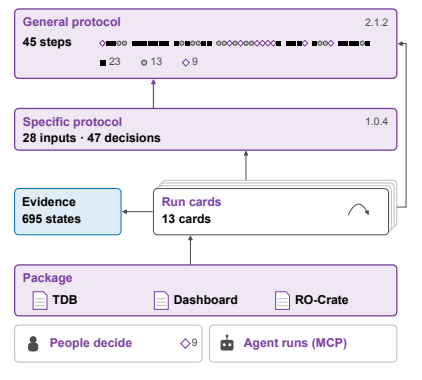
Figure 3 : The ORCHID-SAGE standard, shown for Cr–Ni. The general protocol describes the method in steps of three kinds (deterministic, numerical and judgment), the specific protocol applies it to one database with its inputs, runs and decisions, and the run cards record each execution. The pack- age delivers the database with its header, the dashboard, and the record as an RO-Crate, in which the arrows correspond to PROV relations. People decide at the judgment steps, and an agent can run the specific protocol through the ORCHID- SAGE server.
Original paper · CC BY 4.0 · Raymundo Arróyave · ORCHID-SAGE: Fully Reproducible CALPHAD Assessment from Evidence to Phase Diagram · Original paper figure · Extracted the figure area from page 4 of the original PDF.Why a published CALPHAD database can't be rebuilt
CALPHAD databases describe each phase with fitted models, and computational thermodynamic software predicts phase stability through constrained Gibbs free energy minimization. They select a model for each phase and adjust model parameters until the calculated phase diagram agrees with observations. The level of agreement is often assigned through subjective expert opinion, and many of those decisions are rarely recorded in published assessments.
So the published file holds the final parameters, while the decisions behind them stay out of view.
Knowing the final parameters is not enough to regenerate an assessment from scratch. A rebuild also needs the observations used in the fit, their uncertainties, the choices made during the fit, and the code and settings. Automation makes this worse, because every algorithmic step adds decisions that can't be examined from the resulting publications.
Software workflow managers and provenance standards solved this in other fields, but CALPHAD model development hasn't adopted them.
The stakes rise with self-driving laboratories, which use CALPHAD predictions to choose the next synthesis experiment. A database used in that loop can't stay fixed, because new phase stability observations should refine its parameters. ESPEI stores thermodynamic observations as machine-readable datasets, and ORCHID links each observation to its original measurement.
Yet these tools don't record the decisions that connect the steps of an assessment.
ORCHID-SAGE addresses this gap by recording each assessment so that others, including machines, can regenerate it.
A three-level record that a machine can rerun
The key idea is to keep the assessor's judgment inside the record, so that a machine can run the assessment again rather than only read its output. ORCHID-SAGE sets this up at three levels: a general protocol with rules for any assessment, a specific protocol for one system, and a run card for each executed step. Because each step has recorded hashes, a rerun can be compared with what was originally recorded.
Figure 1 shows this record wrapped around the Cr–Ni assessment, including the decisions people made.
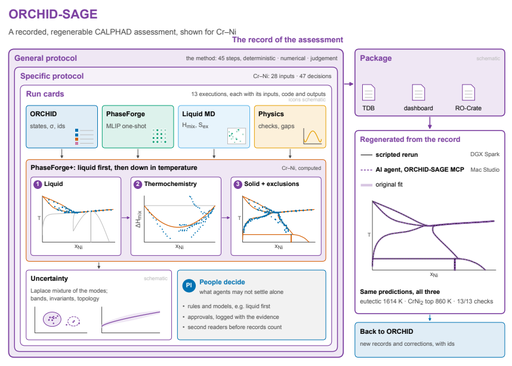
Figure 1 : ORCHID-SAGE, shown for Cr–Ni. The record (general protocol, specific protocol with its decisions, run cards) wraps the assessment: ORCHID evidence, the PhaseForge one-shot model, liquid molecular dynamics, physical checks, the PhaseForge+ sequence from liquid to solid, uncertainty and the decisions made by people. The record is packaged and regenerated from itself, by a script and by an AI agent, with the same predictions. Icons are schematic. ORCHID v2026.10 and records extracted for this work; record identifiers are provided with the source data.
Original paper · CC BY 4.0Before the fit, the evidence is checked and then frozen in a versioned evidence bundle. The bundle holds the datasets and the excluded-phase files exactly as the objective function reads them. A manifest lists the SHA-256 hash of each file and a hash of the bundle as a whole. Since a bundle is never overwritten, a correction produces a new bundle version, which a new protocol version then cites.
Only derived facts enter the bundle, while restricted sources appear only through their hashes, so a rerun needs only the bundle.
The protocols are written so that a script or an AI agent can follow them, and the server exposes the same steps through the Model Context Protocol. For each step, the agent reads the exact commands, inputs, outputs and tolerances, and checks that the inputs match the recorded hashes. For a judgment step, the server returns the decision already recorded, so the agent applies that decision instead of making its own.
The same server can also start a new assessment, opening a request for each decision a person must make. The model construction procedure belongs to the general protocol, so it can't change between assessments without a recorded decision.
Building the one-shot model and the liquid
The one-shot model starts from energetics computed with a machine-learned potential, while the pure-element Gibbs energies come from SGTE. For the bcc and fcc solutions, the mixing energies come from 128-atom special quasirandom structures generated with m_scraps. Two seeds per composition give a spread that estimates the configurational uncertainty.
The authors use GRACE-2L-SMAX-OMAT-large for these structures and GRACE-2L-OMAT as a cross-check. Some structures transform during relaxation, so the authors relax in stages: volume first, then volume and ionic positions, then cell shape. In Cr–Ni, bcc structures with xNi ≥ 0.5 and fcc structures with xNi ≤ 0.31 transform at the intermediate stage.
Rather than discarding these structures, the model uses the midpoint of the relaxation interval as the value and half of it as the uncertainty. The mixing energies are fitted with Redlich–Kister polynomials, with the solutions described as disordered FCC_A1 and BCC_A2 phases. CrNi2, which has the Pt2Mo structure, is kept as a stoichiometric compound with a formation energy from the same potential.
Liquids have no static structure, so the mixing energy comes from molecular dynamics with the same potential. The simulations use 108 atoms at five compositions, at 2200 K, just above the melting point of Cr, and at 1900 K. Each production run covers 100 ps after the cell has melted and equilibrated, and the liquid character is confirmed by the mean-square displacement.
A single Redlich–Kister parameter fits the enthalpies, and the pV term is included in the average total energy. Two temperatures cannot fix the temperature dependence of the liquid parameter, so the excess entropy of the liquid is estimated as well. Each observation carries an uncertainty of 9.7 kJ/mol of atoms, which the authors tie to the typical gap between DFT and calorimetry.
The entropy is split into a vibrational part, taken from the velocity autocorrelation function, and a chemical mixing part. The original chemical term doesn't reduce to the ideal entropy of mixing for random labels, so the authors replace it with a pair (quasi-chemical) estimator. That estimator is built on the neighbor graph and satisfies the ideal limit exactly, because its mutual information term vanishes for random labels.
For Cr–Ni the excess entropy is small and negative, between about −0.1 and −1.0 J/(K mol), and the vibrational part dominates. Because the corrected estimator hasn't been independently reviewed, these excess entropies are kept as provisional. A cell-size check gave a 0.45% difference in vibrational entropy between 108 and 864 atoms, inside the 5% criterion.
Refining the one-shot model from liquid to solid
The cause lies in the fcc Cr end-member, because fcc Cr is mechanically unstable. As a consequence, the eutectic between the liquid, bcc and fcc lands near 1935 K, instead of the 1618 K reported in ORCHID.
The authors follow the standard CALPHAD order, fitting the solid state last. Each observation is weighted by its uncertainty rather than by hand, and partial tie-lines enter as zero-phase-fraction conditions. It uses the liquid excess entropy and the one-shot energies as additional constraints. The compound stays too stable because changes in the solution phases displace its field, whose energy has not yet been adjusted.
Every observed state needs a list of excluded phases, including single-phase states. The strength of an exclusion depends on the thermodynamic distance from the excluded phase field, measured relative to the state's uncertainty. Three tiers set the energy scale: 10 J/mol of atoms far from any observed field with no source reporting the phase.
The scale is 100 J/mol when the state is next to a boundary or the exclusion is contested. The tier is only a lower bound, since the larger of the tier and the state's uncertainty, converted through the entropy change, is used.
Before the fit, the AI agents checked the data for internal consistency. They found that the activity of 0.112 from Pugliese and Fitterer cannot be reconciled with the cell potential in the same row.
Regenerating the Cr–Ni database from its record
The main test asks whether the Cr–Ni database can be rebuilt from its record alone, with no other information. Two independent regenerations were run, one by a script and one by an AI agent, and both were compared with the original assessment. The script ran on an NVIDIA DGX Spark, a machine that differs from the Mac Studio in its processor, operating system and numerical libraries.
Only the records files, identified by their SHA-256 hashes, were available on the DGX Spark. The eutectic and CrNi2-top temperatures showed no difference.
Because of this, the authors compare the parameters only as a note and judge the model's predictions against the tolerances. The second regeneration gave an AI agent, Claude Opus 5.5, access to the ORCHID-SAGE server tools and read-only file tools. The agent received no information about the assessment beyond the identifier of its specific protocol.
It read the protocol, staged its inputs, executed each step through the server and compared the results with the recorded ones.
All 13 checks passed, eleven with no difference at all. The final fit has two near-equal minima, modes A and A2, which differ by 0.0045 log units.
A refit from a clean copy of the public repository reproduced the selected solution, the eutectic and the top of CrNi2 exactly. The validity of the standard rests on the tolerances, which the protocol sets for predictions rather than for parameters.
Limitations and open questions in the Cr–Ni rerun
The final step of the Cr–Ni fit ends in two minima that are nearly equal in objective value. The two modes differ by only 0.0045 log units, yet their first-order Redlich–Kister terms for bcc and fcc differ by up to 5.9 times the parameter tolerance. The record therefore lists these terms as undetermined instead of reporting them as known values.
The corrected excess-entropy estimator hasn't been independently reviewed, so the authors treat its excess entropies as provisional. For Cr–Ni these excess entropies range between about −0.1 and −1.0 J/(K mol), and the vibrational part dominates. Those excess entropies set the temperature coefficient of the liquid parameter, so that provisional status carries into the liquid description.
Liquid simulations on GPUs aren't bitwise deterministic, so the authors compare predictions within tolerances rather than exact values. With a 5 ps averaging window, states on two DGX Sparks differed by up to 3.5 kJ/mol of atoms, more than their statistical errors suggest. The equiatomic mixing enthalpy stayed between −2.3 and −4.4 kJ/mol of atoms across all three windows, against −3.2 kJ/mol of atoms in the assessment.
That spread stays well below the 9.7 kJ/mol of atoms uncertainty assigned in the fit.
Cr–Ni is only a first test of the standard, and the authors don't claim it covers other systems. Binary systems with ordered phases, wide homogeneity ranges or magnetic contributions will place new demands on the general protocol. Ternary systems that combine several binary descriptions will likewise demand changes, and the authors expect the protocol to grow version by version.
Some evidence was extracted by a single reader and isn't yet part of a released ORCHID version. The Cr–Ni rerun on a second machine reproduced the predictions within the declared tolerances, which is the strongest result the authors report.
Paper info
- Authors
- Raymundo Arróyave
- Venue
- arXiv · Preprint
- First published
- 2026-11-12
- Added
- 2026-11-13
- Updated
- 2026-11-12
- Version
- v1
- arXiv
- 2611.16308
- Category
- cond-mat.mtrl-sci · cs.AI
- Original paper terms
- CC BY 4.0
- What we show
- Paper info, commentary and permitted figures from the original paper
AI commentary is a separate explanation from the original paper and may contain errors. The original paper and figures follow each source's terms of use and any rights noted separately.
Abstract
Knowledge of phase stability is the first requirement for materials design, and predicting the conditions under which new materials can be synthesized has become a key capability of self-driving laboratories (SDLs). For inorganic materials, notably alloys, these predictions come from thermodynamic databases built with the CALPHAD method. Building a database, however, requires expert judgment at many steps, and because these decisions are rarely recorded, others can use a database but cannot regenerate or update it. Machines can already collect the data, build a first model with machine-learned interatomic potentials and refine it against experiments. The assessment itself, the sequence of judgments that turns these parts into a reliable database, is still carried out by human experts. We argue that it can be automated reproducibly only if the expert knowledge behind an assessment is encoded in formal protocols, so that an assessment delivers a record of its construction and not only its parameters. We introduce ORCHID-SAGE, a standard that organizes this record into reproducible and automatable protocols. In this first attempt, applied to Cr-Ni, the database was regenerated from its record by a script on a second machine, by an AI agent working only through the Model Context Protocol (MCP) and by a refit from public sources only, with the same predictions. Recorded in this way, a database need no longer be fixed at publication but can be updated by AI agents as SDLs and other sources provide new evidence, while the judgment remains with people and on the record.
Quote from the paper
Raymundo Arróyave (2026). ORCHID-SAGE: Fully Reproducible CALPHAD Assessment from Evidence to Phase Diagram. arXiv:2611.16308v1. https://arxiv.org/abs/2611.16308v1
BibTeX
@misc{arryave2026orchid,
  title = {{ORCHID-SAGE: Fully Reproducible CALPHAD Assessment from Evidence to Phase Diagram}},
  author = {Raymundo Arróyave},
  year = {2026},
  eprint = {2611.16308},
  archivePrefix = {arXiv},
  url = {https://arxiv.org/abs/2611.16308v1}
}