Paper commentary
From LoRA to Language: Recovering Skill Documents from Adapters
Writer models recover skill documents from LoRA adapters by running them
- Problem LoRA skill adapters keep behaviour but lose the readable text.
- Method The Executing Writer trains a small writer adapter on top of the frozen adapted model, which then writes the skill document. Unlike weight readers, it runs the adapter, so the adapter's effect is visible to it.
- Results The Executing Writer recovers 39-44% of the key instructions of held-out skills, against 1.3-1.5% with another skill's adapter.
Why a LoRA's skill is hard to read back
A skill is normally placed in the model's prompt when a task needs it, and that costs context on every call. Compiling a skill into a LoRA removes that prompt cost, but the result is a block of numbers rather than readable text. A recovered document would make an adapter inspectable and editable, and it could be re-compiled for another model.
Recovery is harder than it looks for three reasons, and the first is that adapters for different skills look alike.
Text similarity is a weak yardstick here, since shared generic wording inflates the score. The authors therefore score each recovered document against a frozen checklist of key instructions, extracted once per skill. A judge assigns each checklist item one of four verdicts, and full items count as one while partial items count as one half.
Invented content is measured separately, as the share of instruction units that the original does not support. Every method also runs with a wrong adapter, so a method that truly depends on the adapter must fall close to zero. Retrieval of the training document closest to the adapter serves as the second control.
The first reader treats the adapter's numbers as data and encodes the complete adapter into a writer's prompt. Only the Executing Writer runs the adapter, which is why the authors expect it to carry more of the document.
Letting the adapted model do the reading
The core idea is to let the network do the reading, because an adapter shows its content only through what the network computes with it. The adapter changes an output only through its products with the hidden states, so a reader that ignores those products has to rebuild them from the raw numbers. The authors compare three readers: one treats the weights as data, one reads words and retrieves similar instruction lines, and one runs the adapter.
The first two readers never run the adapter, while the Executing Writer is the only one that does. A reader of raw numbers must learn, from a few thousand examples, a map that imitates what the frozen network already does with the update.
The authors separate recitation adapters, whose text is stored and recovered by extraction, from behavioural adapters, whose text is recovered by inference.
To check that a reader really uses the adapter, the authors define the adapter gap as the change in log-likelihood when the correct adapter replaces another skill's adapter. Multiplying by the document length and dividing by ln 2 converts the gap into bits the adapter adds to the document's probability. The authors treat the gap as a diagnostic rather than a bound on mutual information, which is why it shows where information is lost.
Training and running the Executing Writer
The Executing Writer keeps the base model and the skill's adapter frozen and trains only one small writer adapter on top. The writer is a rank-16 adapter with 43.6M parameters, placed on the same Qwen3-8B base model. Training uses document and adapter pairs, so the writer learns to produce each skill's document from its own adapter. The loss is the negative log-likelihood of the document under the adapted model, counted on the document tokens only.
Only the writer's weights phi move during training, while the base model and the adapter Delta(s) stay fixed.
The prompt x(s) is the request to write the SKILL.md document, and the two variants differ in what else it holds. EW-A sees only that request, so everything it writes has to come from the adapter. EW-T also receives the keywords and retrieved instruction lines from the second reader, with the lines of the target skill itself removed. Removing those lines stops the text from leaking the answer, so EW-T's gain has to come from the adapter as well as the text.
EW-T is trained on document-fitted adapters, while EW-A is trained on task-tuned ones.
The adapter gap measures how much a reader takes from the adapter, and it is zero for a reader that ignores the adapter. The gap is computed in nats per token, comparing the correct adapter against a different skill's adapter. At test time the adapter is attached to the frozen Qwen3-8B base model, and the trained writer decodes the document.
Decoding is greedy, with a repetition penalty of 1.1 that keeps the output from looping on repeated phrases.
How the readers compare on held-out skills
EW-T still receives the correct text in that control, so it follows the adapter over the text. The authors expect this behaviour from adapters that store their document. The best weight-only writer reaches 22.3% under judge 1, and retrieval of a similar document reaches 26.9%.
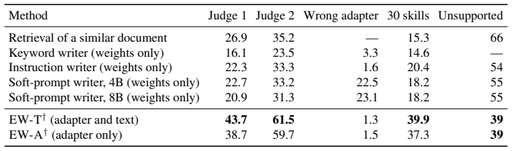
Table 3 :Recovery on the 37 test skills (percent). Coverage by two judges, coverage with a wrong adapter, coverage on the 30 skills without near-copies, and the unsupported share (lower is better). †: runs the adapter. EW-T reads document-fitted and EW-A task-tuned adapters; the other rows use document-fitted adapters.
Original paper · CC BY 4.0 · Saranya Dintakurthy Swadha, Pavan C Shekar, Arpit Jain, Aswanth Krishnan · From LoRA to Language: Recovering Skill Documents from Adapters · Original paper figure · Extracted the figure area from page 8 of the original PDF.The soft-prompt writers score about the same with a wrong adapter as with the right one. The adapter gap explains this, because soft-prompt readers never exceed 0.006 nats per token. EW-T's adapter gap is 3.645 nats per token, so the executing writer draws far more from the adapter. The authors checked for overfitting, and the gap stays at 0.002–0.003 on training skills at scale.
Capacity doesn't explain the weakness of the soft-prompt channel. A rank-16 adapter on 252 blocks has 43.6M parameters. The paper puts a document's need beyond the base model at roughly 2.5 bits per token. The authors also find that better weight encoders may close part of the gap.
The Executing Writers also invent less, with 39% of their units unsupported by the original. The other methods leave 54–66% of their units unsupported. That lower share of invented content is part of why the executing writers read the adapter better.
Transfer to new adapters and the role of rank
The writers still work on adapters they never saw, and rank changes how much they recover. The authors fitted new recitation adapters at ranks 16, 32 and 64 for the 37 test skills and for 41 SkillsBench skills. They then applied both writers to these adapters without any retraining. At rank 64 the writers restore 92% of the instructions on the test skills.
On the 41 external skills they restore 90 to 93% of the prose at rank 64.
Rank matters because recitation adapters are read back more accurately as rank rises. On the 37 skills the writers recover 72 to 80% of the instructions at rank 16. On the 41 external skills they recover 80 to 84% of the prose at rank 16. The effective rank of these updates is about 40 directions by participation ratio.
All fitted adapters reproduce their document exactly, so rank doesn't limit storage. The code and structure scores follow the same pattern as the prose scores, and so does a judge-free count of identifiers.
These adapters were trained to recite their document, so this shows transfer between recitation adapters. It doesn't show that behaviour alone can be read. Behavioural adapters tell a different story, since the authors fitted them on the 41 external skills without the document in any training text. Both writers recover only 1 to 2% of the prose from them.
The documents restore almost none of the task gain from behavioural adapters, at −4 to +1%.
Why documents from behavioural adapters fail
The authors wrote 323 tasks, eight per skill, that each need three to six behaviours from the original skill. Table 6 reports the share of the original's gain over no skill that each condition restores. Documents recovered from recitation adapters restore 74% to 91% of the original's gain on all tasks.
Behavioural adapters behave differently from recitation adapters. Attached with no document, a behavioural adapter restores 47–58% of the gain, so it carries the skill. The documents the writers produce from these adapters restore none of it, at −4 to +1%. The gap between the adapter itself and the document it yields is therefore large. The authors did not study why.
Testing recovered documents with an agent
The two reconstructions reached 82.5–83.1% of verifier tests, against the same 85.0% for the original. The gap between the original and the reconstructions is about −2 points, with intervals of about −12 to +7. The reconstructions are therefore close to the original, though the authors don't claim they are equal.
Per task, every skill takes the agent on the 3D-model parser task from 0/8 to 8/8. Table 7 shows the per-task counts, with the finance QA and PDDL plan tasks reaching 1/8 to 4/8. Only two of the four tasks respond to a skill at all, so the test is small.
This test used documents from recitation adapters, so it doesn't show that behavioural adapters yield usable documents. The Findings list summarises the result as 82–83% of verifier tests against 85% with the original.
Reading behavioural adapters with an executing agent
A behavioural adapter never stored its text, so there is nothing to extract, and the authors turn to a reader that needs no training. It works through a tool called fx, which observes only the models' outputs, so the reader works from behaviour alone. The agent asks three questions, all judged by tasks solved.
Controls run a wrong adapter from another task, a hidden task, only the task text and ten expert demonstrations instead of the adapter. A control that scores like the real arm means the skill did not come from the adapter.
The main benchmark is ALFWorld, a text-based household game with 134 unseen test games. The actor is Qwen2.5-7B-Instruct, playing greedily, and its LoRA wins 81.3% of test games. The base model wins 25–26% of the same games, so the LoRA leaves a large gain to recover. The authors also use a docker-compose adapter, synthetic tool-calling tasks on Qwen3.5-4B, and ALFWorld LoRAs trained to follow hidden rules.
They report the share of the LoRA's gain a skill recovers as R = (skill − base)/(LoRA − base).
On ALFWorld, the skills recover 58–71% of a LoRA's gain. The same skills carry over to Llama-3.1-8B, lifting it from 5% to 55%.
Where the reported results stop
The trained writers were fitted only to recitation adapters, so they reach behavioural adapters poorly. The documents they write from behavioural adapters restore none of the task gain, at −4 to +1%. Recitation results set an upper bound, because the adapter already stores the text a reader must recover.
The test set has 37 skills, drawn from the corpus, hand-written tasks and a split the hypernetwork never saw. Differences below about four coverage points fall within noise on 37 skills. The second judge scores every method higher, by 7 to 21 points, so absolute coverage depends on the judge.
The agent results rest on four SkillsBench tasks, and two of them respond to a skill. The behavioural results rest mainly on ALFWorld, with five synthetic tasks as a further check. A recovered skill comes from the adapter only when the adapter's behaviour cannot be guessed.
Paper info
- Authors
- Saranya Dintakurthy Swadha, Pavan C Shekar, Arpit Jain, Aswanth Krishnan
- Venue
- arXiv · Preprint
- First published
- 2026-11-6
- Added
- 2026-11-9
- Updated
- 2026-11-6
- Version
- v1
- arXiv
- 2611.09454
- Category
- cs.LG · cs.AI · cs.CL
- Original paper terms
- CC BY 4.0
- What we show
- Paper info, commentary and permitted figures from the original paper
AI commentary is a separate explanation from the original paper and may contain errors. The original paper and figures follow each source's terms of use and any rights noted separately.
Abstract
Agent skills are short documents that teach a language model how to handle a class of tasks. To save context, these documents are increasingly compiled into low-rank adapters (LoRA), which keep the behaviour but lose the text: an adapter is hard to read, edit, audit or move to another model. We ask whether the skill document can be written back from the adapter and its frozen base model, and we score each recovered document by the share of the original's key instructions it states and by the tasks it solves. Reading the weights alone recovered little with the methods we tried; a learned map from weights to text passed on about one bit of the document. Running the adapter worked much better. The Executing Writer, a small writer trained on top of the adapted model, recovers 39-44% of the key instructions of held-out skills, against 1.3-1.5% with another skill's adapter, and on adapters fitted to 41 external skills its documents restore 85-91% of the original's task gain. These strongest results are on adapters whose training stored the document; adapters trained on behaviour alone are much harder for trained writers (1-2% of instructions). For these adapters we test an agent that runs the base and adapted models and writes a skill from where they differ. On ALFWorld its skills recover 58-71% of a LoRA's gain and carry over to models that cannot load the LoRA, lifting Llama-3.1-8B from 5% to 55%. Whether such a skill comes from the adapter depends on what the adapter learned: when its behaviour cannot be guessed, the adapter is the source; when it can, a reward loop without the adapter does as well.
Quote from the paper
Saranya Dintakurthy Swadha, Pavan C Shekar, Arpit Jain, Aswanth Krishnan (2026). From LoRA to Language: Recovering Skill Documents from Adapters. arXiv:2611.09454v1. https://arxiv.org/abs/2611.09454v1
BibTeX
@misc{swadha2026from,
  title = {{From LoRA to Language: Recovering Skill Documents from Adapters}},
  author = {Saranya Dintakurthy Swadha and Pavan C Shekar and Arpit Jain and Aswanth Krishnan},
  year = {2026},
  eprint = {2611.09454},
  archivePrefix = {arXiv},
  url = {https://arxiv.org/abs/2611.09454v1}
}