Paper commentary
Neural Compression for Scientific Particle Data: Perspectives on How Learning Can Help
Neural point cloud codecs gain little on scientific particle data compared with vision data
- Problem Neural point cloud codecs beat G-PCC on vision scans, but they barely beat it on scientific particle data. Octree-based codecs assume locally planar surfaces, and particle geometry breaks that assumption.
- Method The authors run existing neural codecs, OctAttention and RENO, on quantized particle data from cosmology, molecular dynamics and plasma physics. They compare them with G-PCC, and test whether the parent occupancy code helps the octree context model.
- Results RENO scored 35.55 bpp on Quijote halos, compared with 35.92 bpp for G-PCC. The best neural gain on scientific data is about 10 percent, against about 17 percent on LiDAR.
Why octree codecs struggle with particle data
Particle simulations produce data volumes that grow quickly with fidelity, so storage and data movement become the bottleneck. Neural point cloud codecs beat G-PCC by a wide margin on LiDAR and human scans, which raises the question of whether that gain carries over to particles. Most of these codecs build on the octree, so the octree is the first suspect for the weak transfer.
An octree splits the bounding volume into eight sub-volumes at each node and writes an 8-bit occupancy code that marks which children are occupied. The codec then compresses the breadth-first traversal of these occupancy codes instead of the plain coordinates. For a consistently planar point cloud, Botsch et al. showed the bit-per-point cost of the octree is upper-bounded by 8/3, about 2.67.
Particle data breaks this bound because its fractal dimension d exceeds 2 at coarse levels but quickly approaches 0. At d close to 0, voxels stop merging, so an 8-bit occupancy code carries at most 3 bits and five bits are wasted per point. Hand-designed flags or learned entropy coding can recover part of this waste, but the authors argue the octree may not suit particles.
Table 1 shows that OctAttention and RENO gain little over G-PCC on scientific data. The best neural gain on scientific data is a 10% bitrate reduction, achieved by RENO on YiiP. On CV data the same codecs reach about 17% on LiDAR and 30% on human scans. To probe the cause, the authors test whether conditioning on the parent occupancy code helps coding.
On MVUB, the parent context significantly reduces coding costs at almost all levels. On Quijote halos, the parent context only mildly helps, and it mainly helps at coarser levels.
The authors also compare against SZ3 and LCP, two error-bounded scientific compressors. SZ3 predicts each value from its previously reconstructed neighbors, and it stores unpredictable values losslessly. On Quijote halos and particles, spatially unordered coordinates make SZ3 fall back to lossless storage, giving a compression ratio below 1.
LCP re-orders and groups points into small local blocks, so its ratio comes close to G-PCC and RENO. The authors read this as evidence that point ordering and grouping matter, so the octree's order need not be the only option.
How fractal dimension separates CV surfaces from particles
Fractal dimension gives one scale for comparing CV clouds with particle datasets, so the authors can read geometry from occupied voxel counts. The authors split the bounding volume into a grid of 2 to the power l cells along each axis and mark each cell occupied if it holds at least one point. The fractal dimension at level l is computed as d_l = log2(N_l / N_l-1), so it tracks how fast the occupied count grows as the grid doubles in resolution.
The human body scan from MVUB stays near 2 at all levels, which fits a locally planar surface. Its scan rings look locally linear up close and appear denser when coarsened, a effect the authors tie to the physical nature of spinning LiDAR sensors. Cosmology and molecular dynamics both rise quickly from 0 to 3, a sharp move from sparse to volume-filling geometry.
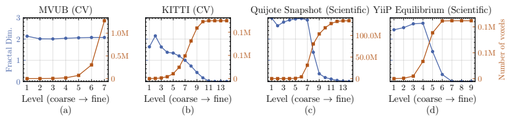
Figure 1 :Fractal dimension reveals a geometric difference between CV and scientific point clouds. (a) Human body scan.The dimension remains near 2 at all levels, consistent with locally planar surface geometry.(b) V ehicular LiDAR.Fractal dimension increases from near 0 at fine levels to approximately 2 at coarse levels. This reflects the physical nature [16] of spinning LiDAR sensors: scan rings appear locally linear at finer levels and appear denser at coarser levels. (c) Cosmology N -body simulations.Fractal dimension rises quickly from 0 to 3, indicating a sharp transition from sparse to volume-filling geometry.(d) Molecular dynamics simulations show the same sharp sparse-to-dense transition as cosmology simulations. This contrast illustrates the fundamental geometric difference between CV point clouds and scientific particle data discussed in Sec. 2.1.
Original paper · CC BY 4.0 · Tian Qiu, Carolina Cuesta-Lazaro, Sheng Di, Haewon Jeong · Neural Compression for Scientific Particle Data: Perspectives on How Learning Can Help · Original paper figure · Extracted the figure area from page 2 of the original PDF.The authors describe cosmic structures of voids, filaments, sheets and dense halos as spanning a wide range of intrinsic dimensionalities. Molecular dynamics atoms are constrained by covalent bonds, while intermolecular forces arrange molecules relative to each other. Plasma beams, shaped by beam dynamics and instabilities, also lack surface-like structure.
So a geometry that suits CV surfaces doesn't automatically suit these datasets. That premise motivates the octree analysis that follows in the next section.
Where the octree wastes bits on sparse particles
The octree splits the bounding volume into eight sub-volumes at each node, and each node stores an 8-bit occupancy code. The codec then compresses the breadth-first traversal of these codes instead of the raw coordinates. Botsch et al. bound the octree cost for a consistently planar point cloud at 8/3, about 2.67 bits per point.
Particle data loses that bound, because the fractal dimension exceeds 2 at coarse levels but drops toward 0 at fine levels. The octree reduces data only by merging voxels, so it stops saving bits once merging stops. When no voxels merge, an 8-bit occupancy code carries at most log2 8 = 3 bits of information. The authors count five of the eight bits per point as wasted.
That waste accumulates over multiple levels, so the loss grows with the depth of the octree.
Hand-designed flags [36] can recover part of this waste, and learned entropy coding can recover part of it too. The authors still suspect the octree may not suit scientific particle data, even though it dominates CV compression.
Neural codecs against G-PCC on particle data
The comparison pits G-PCC, RENO and OctAttention against each other on the Quijote, YiiP and WarpX particle datasets, and on CV data. Each entry reports bits per point after quantization, with the compression ratio in parentheses beside it. The two neural codecs were trained on multi-frame datasets, and the authors used one quantization step per dataset.
Because the goal is near-lossless coding, a single operating point suffices for this comparison.
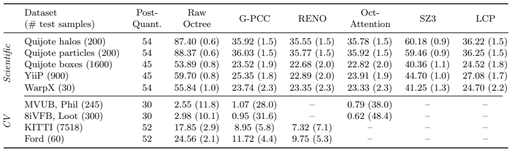
Table 1 :Neural methods achieve far smaller gains on scientific particle data than on CV data.Bit-per-point (bpp) by method, with compression ratio in parentheses, computed over post-quantization bitrate. General-purpose scientific compressor SZ3 suffers on particle data, while particle compressor LCP performs on par with neural CV point cloud codecs on scientific data. “–” marks entries where the method was not evaluated on the dataset originally.
Original paper · CC BY 4.0On Quijote halos, G-PCC reaches 35.92 bpp, RENO 35.55 bpp and OctAttention 35.78 bpp. All three codecs sit in a narrow band of under half a bit per point, so the learned context models add little here. The same pattern holds on Quijote particles, where G-PCC scores 36.03 bpp and RENO 35.77 bpp. Across the Quijote variants, the post-quantization bitrates are 87.40, 88.37 and 53.89 bpp, so the codecs are working on very different raw sizes.
The largest neural gain on scientific data is about 10%, from RENO on YiiP, which is a 10% bitrate reduction over G-PCC. That gain is set against about 17% on LiDAR and about 30% on human scans, so the scientific gains are much smaller. Because G-PCC's octree assumes locally planar surfaces, the authors read these small gains as a sign that the octree's assumptions don't fit particle geometry.
Fractal dimension shows the mismatch: CV surfaces stay near 2, while particle data moves from sparse to volume-filling.
To see where the context model loses its edge, the authors condition each occupancy code on its parent node. On CV data, the parent context significantly reduces coding costs for MVUB at almost all levels. On Quijote, the parent context only mildly helps, which matches the flat bitrates in the table.
Parent context helps CV but barely helps particles
The authors test whether conditioning on the parent node helps the context model, using a level-only model against one that adds the parent occupancy code. They start from a context model based on level marginals, P(O|depth), and compare it with P(O|Oparent,depth). Conditioning on the parent code can significantly reduce coding costs for the CV dataset MVUB at almost all levels.
Points on a surface make a child's occupancy easy to predict from its parent, which is why the gain is large on MVUB. The same conditioning helps Quijote halos only at the coarser levels, and the authors summarize it as only a mild help for particles.
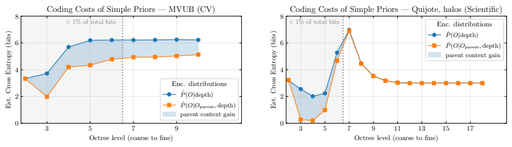
Figure 2 :CV point cloud compression benefits across levels from conditioning on a single parent node, while particle datasets only benefit from it at coarser levels. (a)On MVUB (human body scans), points concentrate on surfaces, so a child’s occupancy can be strongly predicted by its parent’s: conditional entropy drops significantly across levels.(b)Quijote halo data benefits from the same model only on coarser levels. Gains in these levels are less significant, because the number of voxels to code here is negligible compared to the entire octree. Gray area indicates levels that contribute less than 1% of the total bitstream – gains in these levels have little effect on overall bpp.
Original paper · CC BY 4.0The authors use this test to explain the marginal gains of the neural codecs, since the context model has little left to predict. Gains at the fine levels of Quijote halos matter little, because the number of voxels to code there is negligible compared to the entire octree.
The authors then ask whether neural CV codecs beat scientific compressors, comparing against SZ3 and LCP. SZ3 is a general-purpose lossy compressor built on interpolation- and prediction-based coding, suited to multi-dimensional field data. LCP re-orders and groups points by spatial location into small local blocks, which induces local correlation within each block.
LCP's compression ratio comes close to that of the best CV compressors, G-PCC and RENO, which suggests point ordering matters.
Scientific compressors and point ordering
SZ3 suits smooth multi-dimensional fields, while LCP re-orders points by location into small local blocks. The authors set both scientific compressors' absolute error bound to half the position quantization step, matching the worst-case error of the neural codecs.
SZ3 scored 60.18 bpp on Quijote halos, a compression ratio of 0.9. Those raw floating-point values inflate the output, which pushes the compression ratio below 1. LCP scored 36.22 bpp on Quijote halos, compared to 35.92 bpp for G-PCC.
LCP's compression ratio comes close to that of the best CV codecs, G-PCC and RENO. The authors read this as evidence that point ordering and grouping have a substantial impact on compression ratio. They conclude that the octree's order need not be kept for scientific particle data.
How the particle datasets were prepared
The codecs need integer voxel coordinates, so every position is first mapped onto a grid before compression. Each coordinate x is quantized to an index with xi = ⌊x/∆⌉, and de-quantization returns x̂ = ∆ · xi. The step ∆ is picked to keep the quantization error negligible for the downstream analyses of each domain. Duplicate points created by this rounding are removed before the data goes to the codecs.
The Quijote variants come from 2000 simulations at redshift zero, each tracking 512 3 particles in a (1 h−1 Gpc)3 volume. The halos and particles variants each keep 100,000 subsampled points per snapshot, drawn at random with a per-realization seed. The boxes variant instead extracts 8 randomly sampled blocks of (125 h−1 Mpc)3 from each snapshot, to capture finer cosmological detail.
Because no physical structure is resolved below the softening length, the discarded information is effectively lossless for downstream analyses.
The YiiP equilibrium dataset stores coordinates for 111,815 atoms across two trajectories with 901 and 9001 frames. The authors used the longer 9001-frame trajectory, because they needed enough data to train neural compression models. The coordinates are stored at 0.001 nm resolution, so the quantization step of ∆ = 0.001 nm matches the storage resolution.
For the plasma physics beam, the dataset tracks 1 million particles at 2 iterations, the initial and final snapshots.
Where learned components could help next
Uniform quantization treats all spatial regions alike, yet some regions matter more than others for downstream analysis. The paper calls this common practice straightforward but possibly not optimal, and it points to adaptive quantization as a promising direction. TopoSZp serves as the example, showing that spatially adaptive quantization can keep critical points while allowing aggressive bitrate savings.
A learned quantizer could follow the same logic, spending precision where the physics demands it and less elsewhere.
The authors argue that both choices suit CV point clouds but mismatch the geometry of scientific data. They propose learning both the partitioning and the traversal order from data.
Because of this, they could act as physics-aware priors during predictive coding. The authors extend this framework to MD force fields and plasma, citing Batzner et al. and Gopakumar et al. Joint benchmarks spanning CV and HPC, and co-designed codecs informed by domain physics, are the authors' concrete collaboration proposals.
The preprocessing step behind all these experiments maps each coordinate to a grid index with a fixed quantization step. The quantization step is set so that quantization error stays negligible for downstream analyses, which is why a learned quantizer would need to replace it.
Limitations of the single operating point study
The study fixes one quantization step per dataset, so it covers a single near-lossless operating point. The authors chose this setting because distortion has negligible impact on downstream tasks in that regime. Because no rate-distortion curves are reported, the trade-off at coarser quantization steps is unknown.
The quantization step ∆ was chosen per domain, not swept across several values. Neural codecs and the scientific compressors were all evaluated at this same step. Since SZ3 and LCP use an absolute error bound set to half the quantization step, their behaviour at other steps isn't tested here.
Paper info
- Authors
- Tian Qiu, Carolina Cuesta-Lazaro, Sheng Di, Haewon Jeong
- Venue
- arXiv · Preprint
- First published
- 2026-11-10
- Added
- 2026-11-13
- Updated
- 2026-11-10
- Version
- v1
- arXiv
- 2611.14832
- Category
- cs.CV
- Original paper terms
- CC BY 4.0
- What we show
- Paper info, commentary and permitted figures from the original paper
AI commentary is a separate explanation from the original paper and may contain errors. The original paper and figures follow each source's terms of use and any rights noted separately.
Abstract
As particle-based simulations grow in scale, efficient compression of scientific data becomes critical. Neural point cloud compression (PCC) methods excel on computer vision (CV) benchmarks, but do they transfer to scientific particle data? We highlight that scientific particles differ from CV point clouds in fractal dimension: CV point clouds are locally planar, but particles are not. This key difference limits the effectiveness of the octree data structure that underpins most PCC methods. Neural codecs achieve only marginal bitrate reductions over the traditional G-PCC baseline on scientific data, revealing a significant performance gap. Supported by an evaluation spanning domains of cosmology, molecular dynamics, and plasma physics, we outline where the structure of scientific data limits current neural approaches and where learning can help in the future.
Quote from the paper
Tian Qiu, Carolina Cuesta-Lazaro, Sheng Di, Haewon Jeong (2026). Neural Compression for Scientific Particle Data: Perspectives on How Learning Can Help. arXiv:2611.14832v1. https://arxiv.org/abs/2611.14832v1
BibTeX
@misc{qiu2026neural,
  title = {{Neural Compression for Scientific Particle Data: Perspectives on How Learning Can Help}},
  author = {Tian Qiu and Carolina Cuesta-Lazaro and Sheng Di and Haewon Jeong},
  year = {2026},
  eprint = {2611.14832},
  archivePrefix = {arXiv},
  url = {https://arxiv.org/abs/2611.14832v1}
}