Paper commentary
BiPOP: Partial-Order Planning for Long-Horizon Bimanual Robotic Manipulation
BiPOP plans bimanual robot tasks by scheduling arm actions with partial-order planning
- Problem LLM-only planners often break spatial and temporal coordination rules on bimanual tasks. Earlier LLM-to-PDDL pipelines plan for one agent, so their plans are strictly sequential and miss parallel arm motion.
- Method BiPOP has an LLM write a PDDL problem as Python code, then a temporal planner schedules arm actions so independent arms run in parallel.
- Results BiPOP reached a success rate of 95, compared with 86 for o3 with I/O on StackBlock.
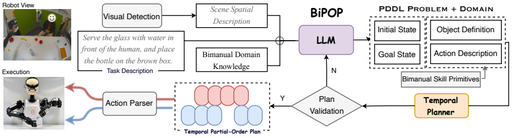
Fig. 1 : Overview of BiPOP, illustrated on the ServeWater task. From the visual scene description, the bimanual domain knowledge, and the natural-language instruction, BiPOP generates a PDDL problem solved by a temporal planner. The validated partial-order plan with the best symbolic makespan found (cf. Fig. 2) is executed by the bimanual robot NICOL [15].
Original paper · CC BY 4.0 · Kun Chu, Xufeng Zhao, Jan-Gerrit Habekost, Cornelius Weber, Stefan Wermter · BiPOP: Partial-Order Planning for Long-Horizon Bimanual Robotic Manipulation · Original paper figure · Extracted the figure area from page 2 of the original PDF.Why bimanual planning breaks down
Bimanual robots must decide which arm acts, in what order, and when both arms can move together. Most learned bimanual work pushes on dexterous skills and leaves high-level planning largely aside. Work centred on skill acquisition doesn't tackle planning for complex, long-horizon tasks.
Symbolic planners give formal validity guarantees, but people have to write their symbolic representations by hand. LLMs can translate instructions into PDDL and keep logical correctness, but they still make long-horizon reasoning errors. LLM-to-PDDL pipelines such as LLM+P, ViLaIn, DELTA and AutoGPT+P plan for a single agent. Their plans come out strictly sequential, so they can't exploit parallel arm motion.
AutoGPT+P runs on bimanual humanoids, yet it doesn't model the two arms as coordinated agents or their action durations. LLM+MAP produces partial-order plans, but it treats coordination mainly as task and resource allocation rather than makespan optimization.
Re-prompting with feedback helps, but it gives no formal guarantee of plan validity. DAG-Plan assigns nodes to arms at run-time using heuristic feasibility and cost estimates, which leaves its dependencies unverified. Neither graph-based method gives a correctness guarantee or an explicit makespan objective.
Key idea: the LLM translates, the planner coordinates
BiPOP splits the work so that an LLM writes a PDDL problem while a temporal planner handles the coordination. The LLM reads the scene description and the instruction, then writes Python code that builds the problem. That code uses the Unified-Planning library, which keeps the LLM output inside a fixed API. The planner returns a partial-order plan, where two unimanual actions run in parallel only when they share no arm, object or region.
The concurrency rules sit in the domain, where predicates such as available and arm_free stop one arm from running two actions. Region membership enters as a precondition, so reachability limits which actions can apply at all. Durative actions split their conditions into start, throughout and end phases, which lets the planner express overlap and ordering between the arms.
TFD runs under several parameter configurations, which produces multiple candidate plans of varying quality. VAL checks these candidates, because TFD sometimes emits schedules that break durative-action conditions. The validated candidate with the shortest makespan goes to the robot controllers. Uniform action durations make the symbolic makespan equal the number of parallel steps.
Generation errors go back to the LLM, and a Python exception triggers regeneration. A no-plan outcome also goes back to the LLM, which then revises the initial state or goal. This split keeps arm assignment and concurrency in a checkable model instead of free-form LLM text. Collision-free motion between concurrent arms is left to the downstream motion planner.
Partitioning the workspace by arm reach
The workspace has two regions that only one arm can reach, plus a shared zone that both arms reach. Actions in separate regions that touch distinct objects are spatially independent, so they can run as parallel unimanual skills. Inside the overlap area the arms become coupled in both space and time. In asynchronous coordination, one arm sets up the preconditions that the other arm needs.
In synchronous coordination, both arms carry out one tightly coupled bimanual action together.
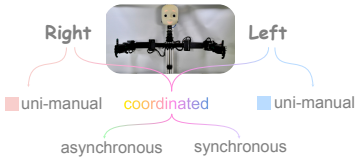
Fig. 3 : Spatio-temporal modelling between the two hands.
Original paper · CC BY 4.0The partition works at the task-planning level, so it asks which arms, objects and regions an action involves. It doesn't check whether the underlying trajectory is geometrically feasible. Two actions may overlap only when they share no arm, no object and no region. Every other pair becomes an explicit ordering constraint, which keeps the schedule sound at the task level.
Collision-free execution of concurrent motions stays with the downstream motion planner, including interference near the overlap area. If a concurrent assignment proves geometrically infeasible, that motion planner can serialize it without invalidating the plan.
The partition therefore gives the planner its reachability facts before it schedules any action. The open-vocabulary detector LocateAnything localizes the task objects in the scene. Its bounding boxes are then mapped onto the workspace partition to show which region each object lies in.
Encoding durative actions and mutual exclusion
A PDDL planning problem bundles objects, predicates, actions, an initial state and a goal, while the domain holds the types and actions. The authors define four object types, arm, area, object and point, and attach predicates that describe their properties and relations. Three execution-state predicates support the durative actions: available, arm_free and is_static.
The available predicate marks an arm that is unoccupied, for example one not holding an object. The arm_free predicate stops one arm from running two actions at once, and is_static stops two actions from moving the same object.
These predicates forbid only conflicting pairs, so independent actions can still run in parallel. Each action is durative, and its predicates split into conditions at the start, conditions held throughout, and effects at the end. In Listing 1, grasp takes an object, an arm and an area, and both grasp and co_move_to have a duration of 1. The grasp action requires arm_access for its arm and area, and it needs arm_free and available at its start.
Its effects clear arm_free and available at the start and restore arm_free at the end. This temporally annotated form lets the planner express overlaps and orderings when two arms act together.
The authors design atomic skills for two identical arms, with single-arm skills taking an arm as a parameter. A single-arm skill maps directly to that arm's controller. A joint skill needs both arms in the available and arm_free states, and it binds both controllers to one synchronized execution. Region membership enters as preconditions such as arm_access, so reachability limits applicability before planning.
Location-dependent skills such as pour take no target parameter and act through the above relation set by an earlier move_above action, as in Fig. 2.
From LLM code to a validated plan
The LLM writes Python code that builds the PDDL problem through the Unified-Planning library, rather than raw PDDL text. The initial state comes from the scene description taken from the camera image, and the goal comes from the natural-language instruction. Writing code lets the model use its coding skill while the output stays inside a well-defined API.
Two kinds of failure send feedback back to the LLM before any plan is accepted. A Python interpreter error is fed back so the LLM can fix syntactic and API-level mistakes. If the code runs but the planner finds no plan before the timeout, the LLM is asked to revise the initial state or the goal. At this task scale, the authors say a no-plan outcome almost always comes from an erroneous specification, so it works as a reliable re-prompting signal.
Temporal Fast Downward (TFD) runs under several parameter configurations and search strategies, so it yields multiple candidate plans of varying quality. TFD occasionally emits schedules that break durative-action conditions or the temporal semantics of the domain. Those flawed schedules mostly appear among the shorter candidates. The VAL plan validator rejects them before execution, and BiPOP dispatches the validated candidate with the shortest makespan to the robot controllers.
With unit durations, the makespan equals the number of parallel steps, and concurrent actions count once. Because TFD runs under a fixed time budget, the returned plan is the best symbolic makespan found in that budget, not a certified optimum.
Baselines and evaluation setup
BiPOP, built on GPT-4.1, is compared against two LLM planners that differ in when they commit to actions. ReAct emits one action at a time and waits for environmental feedback before choosing the next. For I/O, the authors add OpenAI o3, DeepSeek-R1-0528 (R1) and GPT-4.1, the backbone of BiPOP. ReAct re-queries the model at every step, so per-step latency matters and the authors use GPT-4.1 for it.
Holding GPT-4.1 fixed for both BiPOP and ReAct means the remaining difference reflects the planning mechanism alone. Every method gets matching task text, scene details and skill definitions, varying only in their encoding. ReAct gets an observation after each action, and if a two-arm step fails, the executable part still runs. BiPOP receives the general PDDL domain and the predicate specifications used by the temporal partial-order planner.
ReAct uses fixed step budgets of 20, 20 and 40 for ServeFruit, ServeWater and StackBlock. Code as Policies and VoxPoser are left out because they synthesize motion-level behaviour rather than task-level plans.
Each of the three domains, ServeFruit, ServeWater and StackBlock, is evaluated on 100 randomized instances. In ServeFruit the bowl is too large for one hand, so both hands must hold it in the overlap area. Instructions state only the desired outcome, so the LLM must ground arm assignment and action ordering from the scene.
Planning time for BiPOP covers LLM inference plus TFD planning, with TFD budgets of 1s, 1s and 25s. Success rate counts runs whose plan achieves the goal on execution. Optimality gap compares each plan's symbolic makespan with the best makespan any evaluated method found on the same run.
Success rate and planning time
Table I reports planning time for each method on ServeFruit, ServeWater and StackBlock, with BiPOP's LLM and TFD times listed separately. R1 with I/O takes 227.07 s on ServeFruit, while I/O with GPT-4.1 takes 3.42 s on the same task. BiPOP's total planning time on ServeFruit is 6.56 s, made up of 4.95 s of GPT-4.1 code generation and 1.60 s of TFD planning.
Even so, BiPOP stays faster than both reasoning models on every task.
BiPOP matches or exceeds every baseline in all three domains and is the only method at 95% success or higher throughout. Its success rates are 100 on ServeFruit, 100 on ServeWater and 95 on StackBlock. The strongest reasoning run, o3 with I/O, reaches 98, 87 and 86 on the same three domains. The same GPT-4.1 backbone reaches only 25, 0 and 0 with I/O, so the gain comes from the planner coupling rather than the model.
ReAct reaches 100, 45 and 36, so closed-loop feedback improves on I/O with GPT-4.1 but stays below BiPOP on ServeWater and StackBlock. The authors attribute BiPOP's gain to coupling LLM coding with temporal planning and pre-execution validation. I/O agents mostly fail with spatial, temporal and skill errors, while BiPOP's residual errors come from the LLM-written PDDL or TFD timeouts on StackBlock.
Even when ReAct succeeds, its symbolic makespans are markedly longer than those of BiPOP. The authors read this as closed-loop retrying buying coverage at the cost of parsimony.
Optimality gap and failure classes
I/O agents make spatial errors, such as out-of-reach targets and untracked serve-point occupancy. BiPOP shows the same spatial errors, but far less often, and they trace back to the LLM-authored PDDL specification. Its remaining failures are planning timeouts of the TFD planner, and all of them are confined to StackBlock. ReAct fails by misjudging completion, aborting after a detected deadlock, or exhausting its step budget.
ReAct's step budgets were 20, 20 and 40 for ServeFruit, ServeWater and StackBlock, following the I/O plan lengths. LLM-only methods don't ensure physical-action feasibility, so coupling the LLM with a planner moves the residual error into specification and planning.
Each success is graded by its optimality gap, which compares its symbolic makespan with the best plan found by any method on that run. On StackBlock, the larger search space keeps the TFD planner from always converging within its time budget. As a result, the optimality gap of BiPOP spreads above zero on StackBlock. Even there, BiPOP's success rate is 95, compared with 86 for o3, the strongest baseline on StackBlock.
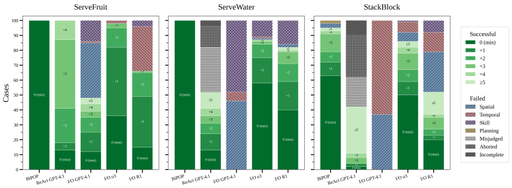
Fig. 5 : Per-method outcome breakdown on ServeFruit, ServeWater, and StackBlock. Each bar aggregates 100 instances: successes (green) are graded byOptimality Gap(0,+1, . . . ,≥5; dark = optimal), and failures are coloured by failure class as shown in the legend.
Original paper · CC BY 4.0Even when ReAct succeeds, its symbolic makespans are markedly longer than those of BiPOP. The authors read this as closed-loop retrying buying coverage at the cost of parsimony.
The authors ask I/O and ReAct for the fewest parallel steps, so all methods face the same makespan objective as BiPOP.
Real-robot validation on ServeWater
The real-robot pipeline swaps the simulated scene for physical objects, and the perception front-end carries most of the transfer work. LocateAnything localizes the task-relevant objects, and one camera-to-table calibration turns the bounding boxes into metric coordinates. Each object is assigned to one workspace region, and that region assignment becomes the scene description the planner reads.
For the real setup, the authors replace the two cups with a glass and a bottle in ServeWater. They replace the brown box with a grey tray in StackBlock.
It localized all task-relevant objects correctly on ServeFruit and ServeWater. Vertically stacked blocks in the initial configuration were mislocalized more often than the tray.
Live human-robot interaction is where those plans run, using hand-crafted atomic skills. Figure 2 shows the ServeWater partial-order plans on NICOL under three different initial scene configurations.
Low-level execution stays with the motion layer, so the transfer needs little extra engineering. The decoupling means a better detector or an extra viewpoint would improve the pipeline without changing the planner. Only ServeWater is run end to end on the real robot in this paper.
Limitations of the evidence and the planning model
BiPOP's symbolic makespan is the best plan TFD finds within a fixed time budget, not a certified optimum. The per-domain optimization budget is 1s, 1s, and 25s for ServeFruit, ServeWater, and StackBlock, so the returned plan depends on that budget. The efficiency results therefore compare the best plans found under these budgets, not the best plans that exist.
Under unit durations, the makespan equals the number of parallel steps, so the schedules don't reflect motion-level timing. TFD can take per-action or state-dependent durations, but the authors leave integrating motion-layer duration estimates for future work.
The simulated evaluation covers three domains, ServeFruit, ServeWater, and StackBlock, each with 100 randomized instances. End-to-end execution on the real robot NICOL is reported only for the ServeWater task. The real-world setup swaps objects: a glass and a bottle replace the two cups, and a grey tray replaces the brown box. The real-world perception check uses 100 real images per task domain, but the robot runs only ServeWater end to end.
The authors suggest execution monitoring and replanning could recover from failures such as unsuccessful grasps. This recovery isn't part of the reported work. BiPOP builds on hand-crafted atomic skills and low-level motion primitives that the robot executes. On StackBlock, the TFD planner sometimes doesn't converge within the time budget, so its optimality gap spreads beyond zero.
Paper info
- Authors
- Kun Chu, Xufeng Zhao, Jan-Gerrit Habekost, Cornelius Weber, Stefan Wermter
- Venue
- arXiv · Preprint
- First published
- 2026-11-11
- Added
- 2026-11-13
- Updated
- 2026-11-11
- Version
- v1
- arXiv
- 2611.15317
- Category
- cs.RO
- Original paper terms
- CC BY 4.0
- What we show
- Paper info, commentary and permitted figures from the original paper
AI commentary is a separate explanation from the original paper and may contain errors. The original paper and figures follow each source's terms of use and any rights noted separately.
Abstract
Bimanual robotic manipulation is versatile, yet its central challenge lies not only in executing dexterous motion with each hand, but also in coordinating the two arms for long-horizon manipulation under coupled spatial and temporal constraints. Prior work has largely focused on endowing robots with human-level manipulation skills, paying less attention to the structure of bimanual behaviour itself: many practical tasks are a coordinated composition of reusable unimanual skills and a small set of synchronous bimanual skills. This makes high-level spatio-temporal coordination, rather than skill acquisition alone, a key bottleneck for efficient bimanual execution. We propose BiPOP, a framework that couples Large Language Models (LLMs) with Temporal Partial-Order Planning for long-horizon bimanual manipulation. At its core is an explicit spatio-temporal model that partitions the workspace by arm reachability and captures inter-arm dependencies, arm assignment, synchronization requirements, and opportunities for safe concurrent execution. Building on this model, an LLM translates natural-language instructions into a formal PDDL specification, while a temporal planner enforces the constraints and schedules actions, yielding plans that are logically consistent at the symbolic level and efficient through parallel execution. On simulated long-horizon tasks of varying complexity, BiPOP outperforms open-loop planning with strong reasoning models and closed-loop ReAct-style planning in success rate, planning time, and plan efficiency, and the full pipeline runs end to end on the real bimanual robot NICOL. A failure analysis further shows that LLM-only planners mainly violate spatial and temporal coordination constraints, which motivates delegating these constraints to a symbolic planner. Code: https://github.com/Kchu/BiPOP
Quote from the paper
Kun Chu, Xufeng Zhao, Jan-Gerrit Habekost, Cornelius Weber, Stefan Wermter (2026). BiPOP: Partial-Order Planning for Long-Horizon Bimanual Robotic Manipulation. arXiv:2611.15317v1. https://arxiv.org/abs/2611.15317v1
BibTeX
@misc{chu2026bipop,
  title = {{BiPOP: Partial-Order Planning for Long-Horizon Bimanual Robotic Manipulation}},
  author = {Kun Chu and Xufeng Zhao and Jan-Gerrit Habekost and Cornelius Weber and Stefan Wermter},
  year = {2026},
  eprint = {2611.15317},
  archivePrefix = {arXiv},
  url = {https://arxiv.org/abs/2611.15317v1}
}