論文解説
BiPOP: Partial-Order Planning for Long-Horizon Bimanual Robotic Manipulation
BiPOP:長期の両手ロボット操作のための部分順序計画
- 課題 長期の両手操作では、2本の腕の割り当て、同時実行、順序制約を同時に満たす必要があります。LLMだけで計画を立てると、空間や時間の制約を破ることが多くなります。
- 手法 LLMが場面と作業の説明をPDDL問題に変換し、時間付き部分順序計画器が2本の腕の同時性と制約を扱います。検証済みの計画のうち、makespanが最も短いものを選びます。
長期の両手操作における調整の問題
両腕のロボットで長い作業を行うには、2本の腕の動作順序、同時実行、腕の割り当てを一緒に決める必要があります。既存研究は主に個々のスキルの習得に焦点を当ててきたため、この上位レベルの時空間の調整は十分に扱えていませんでした。一方、LLMだけで計画を立てると、長い作業では推論の誤りや幻覚が生じ、特に空間の制約や時間の制約を破りやすくなります。この論文は、LLMがPDDLの仕様を作り、時間付き部分順序計画器が制約を強制するという仕組みで、この問題に取り組みます。研究の問いは、LLMと記号計画をどう組み合わせれば、2本の腕の空間的・時間的な調整を効率よく実現できるかです。
作業空間の分割とPDDLの生成
BiPOPはまず、腕の到達可能性にもとづいて作業空間を2つの単独領域と1つの重なり領域に分けます。2本の腕がともに届く重なり領域だけで非同期または同期の調整が必要になり、異なる単独領域にある別々の物体は並列に実行できます。物体検出器が出力したバウンディングボックスをこれらの領域に対応づけると、シーン情報が初期状態になります。LLMは作業の説明を目標状態に変換するPDDL問題を書きます。このとき生のPDDLテキストではなく、Unified-Planningライブラリを使うPythonコードを生成させ、APIのレベルで出力を制約します。実行エラーはインタプリタのメッセージとして、計画が存在しない場合はno-plan結果としてLLMに返し、再生成させます。
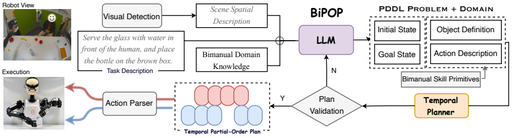
Fig. 1 : Overview of BiPOP, illustrated on the ServeWater task. From the visual scene description, the bimanual domain knowledge, and the natural-language instruction, BiPOP generates a PDDL problem solved by a temporal planner. The validated partial-order plan with the best symbolic makespan found (cf. Fig. 2) is executed by the bimanual robot NICOL [15].
出典 · CC BY 4.0 · Kun Chu, Xufeng Zhao, Jan-Gerrit Habekost, Cornelius Weber, Stefan Wermter · BiPOP: Partial-Order Planning for Long-Horizon Bimanual Robotic Manipulation · 論文の図を引用 · 元のPDFの2ページ目から図の部分を抽出しています。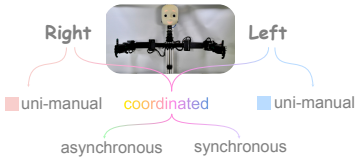
Fig. 3 : Spatio-temporal modelling between the two hands.
出典 · CC BY 4.0 · Kun Chu, Xufeng Zhao, Jan-Gerrit Habekost, Cornelius Weber, Stefan Wermter · BiPOP: Partial-Order Planning for Long-Horizon Bimanual Robotic Manipulation · 論文の図を引用 · 元のPDFの3ページ目から図の部分を抽出しています。時間計画とmakespanによる選択
TFDは開始・終了条件を持つdurative行動をサポートし、独立した行動を同時にスケジューリングします。共有資源のない2つの行動だけが同時に配置され、残りは明示的な順序制約によって直列化されます。複数のパラメータ構成と探索戦略で候補計画を作ったあと、VAL検証器で条件に違反する計画を取り除きます。検証を通過した候補のうち、symbolic makespanが最も短い計画をロボットコントローラに渡します。すべての行動の持続時間を同じにしたので、makespanは並列ステップ数と等しくなります。TFDが固定の時間予算内で見つけた最良の計画であるため、この値は認証された最適解ではありません。
3つのタスクにおけるシミュレーション比較
シミュレーションは、ServeFruit、ServeWater、StackBlockの3つのタスクで行い、タスクごとに100個のランダムなインスタンスを用いました。BiPOPのバックボーンはGPT-4.1で、I/Oのベースラインにはo3、R1、GPT-4.1を使い、ReActはGPT-4.1で実行しました。TFDの最適化予算は、ServeFruit、ServeWater、StackBlockでそれぞれ1s、1s、25sです。Optimality Gapは、各実行について、その方法のsymbolic makespanと、その実行を解いた方法のうち最小のmakespanとの差として計算します。
計画時間と失敗の傾向
計画時間では、GPT-4.1とBiPOPがo3やR1よりはるかに短くなりました。失敗のパターンは、I/Oでは空間・時間・スキルの誤りが、ReActでは誤った完了判断と途中停止が主に見られました。BiPOPの残る失敗は、主にStackBlockでのTFDのタイムアウトでした。
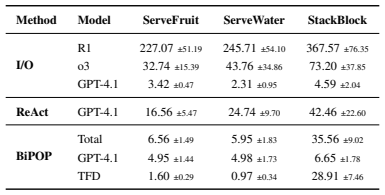
論文の図 TABLE I: Planning Time (s) across the task domains. For BiPOP, LLM inference (code generation) and TFD planning times are listed separately.
出典 · CC BY 4.0 · Kun Chu, Xufeng Zhao, Jan-Gerrit Habekost, Cornelius Weber, Stefan Wermter · BiPOP: Partial-Order Planning for Long-Horizon Bimanual Robotic Manipulation · 論文の図を引用 · 元のPDFの6ページ目から図の部分を抽出しています。効率の差とStackBlockでの収束
Optimality Gapの分析では、BiPOPはServeFruitとServeWaterでほとんどの場合、最小のmakespanの計画を出しました。StackBlockでは探索空間が大きく、TFDが時間予算内に必ず収束するわけではなく、その結果OGが0より大きくなるケースがありました。I/Oエージェントは、StackBlockでBiPOPより短い計画を出したケースもありましたが、全体の成功率はずっと低くなりました。ReActは成功した場合でも、symbolic makespanが長くなりました。
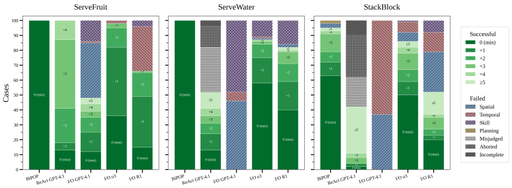
Fig. 5 : Per-method outcome breakdown on ServeFruit, ServeWater, and StackBlock. Each bar aggregates 100 instances: successes (green) are graded byOptimality Gap(0,+1, . . . ,≥5; dark = optimal), and failures are coloured by failure class as shown in the legend.
出典 · CC BY 4.0 · Kun Chu, Xufeng Zhao, Jan-Gerrit Habekost, Cornelius Weber, Stefan Wermter · BiPOP: Partial-Order Planning for Long-Horizon Bimanual Robotic Manipulation · 論文の図を引用 · 元のPDFの7ページ目から図の部分を抽出しています。実機のServeWater検証
実機実験では、NICOLロボットでServeWaterタスクをend-to-endで実行しました。実際のシーンでは、ガラスとボトルが2つのカップの代わりを務めました。物体の位置特定は、タスク領域ごとに様々な配置の実画像100枚で評価しました。結果として、ServeFruitとServeWaterではタスクに関係するすべての物体を正しく配置できました。StackBlockでは、グレーのトレーと垂直に積まれたブロックで一部誤りがありました。この検証はServeWaterを対象としたもので、StackBlockの実機実行は報告されていません。
残された課題
論文では、行動の持続時間をすべて同じにしたことと、モーション層の持続時間推定を統合することを今後の課題として残しています。また、TFDの結果は固定予算内で見つけた最良の計画で、認証された最適解ではありません。実行の監視と再計画はまだ追加されておらず、ドメインファイルをスキルライブラリやデモンストレーションから自動的に作ることも残された課題です。
論文情報
- 著者
- Kun Chu, Xufeng Zhao, Jan-Gerrit Habekost, Cornelius Weber, Stefan Wermter
- 学会・ジャーナル
- arXiv · プレプリント
- 公開日
- 2026年11月11日
- 登録日
- 2026年11月13日
- 更新日
- 2026年11月11日
- バージョン
- v1
- arXiv
- 2611.15317
- カテゴリ
- cs.RO
- ライセンス
- CC BY 4.0
- 掲載内容
- 論文情報・解説・論文の図
この解説は、Refivuの韓国語解説をAIで翻訳したものです。不正確な翻訳や誤りが含まれる可能性があります。論文と図の利用条件は各出典に従います。
アブストラクト
Bimanual robotic manipulation is versatile, yet its central challenge lies not only in executing dexterous motion with each hand, but also in coordinating the two arms for long-horizon manipulation under coupled spatial and temporal constraints. Prior work has largely focused on endowing robots with human-level manipulation skills, paying less attention to the structure of bimanual behaviour itself: many practical tasks are a coordinated composition of reusable unimanual skills and a small set of synchronous bimanual skills. This makes high-level spatio-temporal coordination, rather than skill acquisition alone, a key bottleneck for efficient bimanual execution. We propose BiPOP, a framework that couples Large Language Models (LLMs) with Temporal Partial-Order Planning for long-horizon bimanual manipulation. At its core is an explicit spatio-temporal model that partitions the workspace by arm reachability and captures inter-arm dependencies, arm assignment, synchronization requirements, and opportunities for safe concurrent execution. Building on this model, an LLM translates natural-language instructions into a formal PDDL specification, while a temporal planner enforces the constraints and schedules actions, yielding plans that are logically consistent at the symbolic level and efficient through parallel execution. On simulated long-horizon tasks of varying complexity, BiPOP outperforms open-loop planning with strong reasoning models and closed-loop ReAct-style planning in success rate, planning time, and plan efficiency, and the full pipeline runs end to end on the real bimanual robot NICOL. A failure analysis further shows that LLM-only planners mainly violate spatial and temporal coordination constraints, which motivates delegating these constraints to a symbolic planner. Code: https://github.com/Kchu/BiPOP
この論文を引用
Kun Chu, Xufeng Zhao, Jan-Gerrit Habekost, Cornelius Weber, Stefan Wermter (2026). BiPOP: Partial-Order Planning for Long-Horizon Bimanual Robotic Manipulation. arXiv:2611.15317v1. https://arxiv.org/abs/2611.15317v1
BibTeX
@misc{chu2026bipop,
  title = {{BiPOP: Partial-Order Planning for Long-Horizon Bimanual Robotic Manipulation}},
  author = {Kun Chu and Xufeng Zhao and Jan-Gerrit Habekost and Cornelius Weber and Stefan Wermter},
  year = {2026},
  eprint = {2611.15317},
  archivePrefix = {arXiv},
  url = {https://arxiv.org/abs/2611.15317v1}
}