論文解説
HALO: Human-Aligned Data Collection for WhoLe-body MObile Manipulation
HALO:全身移動マニピュレーションのための人間整合データ収集
- 課題 全身移動の両手操作デモは、既存のインターフェースでは直接制御、知覚の整合、自然な移動を同時に確保しにくいため、収集が難しいです。
- 手法 キネステティック教示と台車部分を外した移動プラットフォームでデモを集めます。手の除去と台車速度の整合で配備条件に合わせたうえで、π0.5をファインチューニングします。
全身移動操作デモ収集の難しさ
全身移動の両手操作を学習させるには、腕の動作と移動が一緒に含まれたデモが必要です。既存のインターフェースは、ロボットを直接制御できること、知覚と行動の整合、人の自然な移動のうち、一つ以上を犠牲にしています。VRベースの遠隔操作は、直接的な力フィードバックが不足しています。Mobile ALOHAのようなリーダー・フォロワー型では、操作者の手と視点、ロボットのエンドエフェクタの間に空間的な分離があるため知覚のずれが生じ、移動も制約されます。
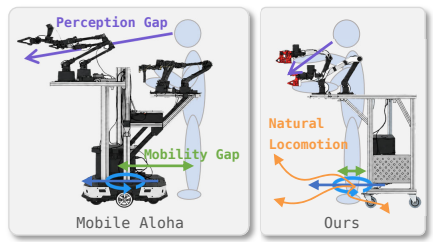
Figure 1 :Interface comparison.Mobile ALOHA exhibits perception and mobility gaps, while our interface aligns human–robot perception and preserves natural operator mobility.
出典 · CC BY 4.0 · Shuai Yang, Fangyi Xu, Yishu Shen, Kecheng Zheng, Yinghao Xu · HALO: Human-Aligned Data Collection for WhoLe-body MObile Manipulation · 論文の図を引用 · 元のPDFの2ページ目から図の部分を抽出しています。この論文は、この問題を解決するためにHALOを提案します。HALOでは、ロボットアームはそのままにして、キネステティック教示でエンドエフェクタを直接つかんで動かします。移動プラットフォームでは台車を取り外して、人が自然に歩いて位置を調整できるようにします。これによりデモの品質は上がりますが、人とロボットが近く結合することで、新たな不一致が生じます。デモ映像には実演者の手が映り、制御信号にはプラットフォームの動力学の違いが混ざります。
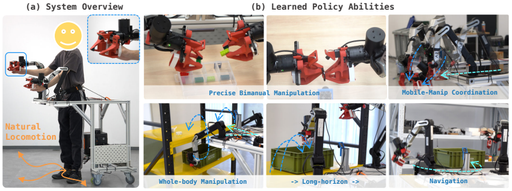
Figure 2 :HALO overview and learned capabilities.(a) Human-aligned data collection with natural locomotion and direct bimanual kinesthetic teaching. (b) Learned policies exhibit precise manipulation, coordinated whole-body control, long-horizon mobile manipulation, and navigation.
出典 · CC BY 4.0 · Shuai Yang, Fangyi Xu, Yishu Shen, Kecheng Zheng, Yinghao Xu · HALO: Human-Aligned Data Collection for WhoLe-body MObile Manipulation · 論文の図を引用 · 元のPDFの3ページ目から図の部分を抽出しています。キネステティック教示と台車のない移動プラットフォーム
操作インターフェースでは、ALOHAのエンドエフェクタをキネステティック教示に合わせて設計し直しました。ハンドルとシザー構造を取り除き、接触面積の大きいコンパクトな形に変えました。これによりエンドエフェクタのサイズを半分以上小さくし、ピッチ角を約40度広げました。操作者はロボットアームを直接つかんで動かすため、視覚と力フィードバックをそのまま受け取れます。
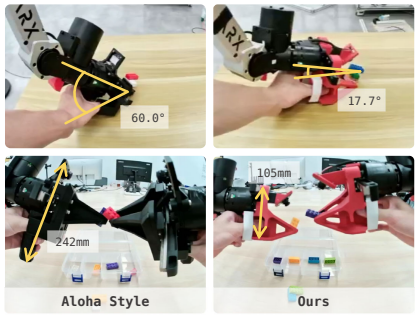
Figure 3 :Kinesthetic end-effector redesign. Compared with the ALOHA end-effector, we remove the handle-and-scissor design for kinesthetic teaching. The handle limits access near the table surface, while the scissor mechanism is less convenient for forceful manipulation. Our design increases hand contact area, enabling compact and stable physical control.
出典 · CC BY 4.0 · Shuai Yang, Fangyi Xu, Yishu Shen, Kecheng Zheng, Yinghao Xu · HALO: Human-Aligned Data Collection for WhoLe-body MObile Manipulation · 論文の図を引用 · 元のPDFの4ページ目から図の部分を抽出しています。移動インターフェースは、配備用のAgileX Tracer AGVの差動駆動台車を収集中に取り外し、受動輪と2つの固定方向輪からなるプラットフォームを使います。車輪の配置は駆動輪の軸に合わせてあり、配備用台車と同じ非ホロノミックな運動空間を機械的に再現しています。エンコーダ2つで測定した動きは、プラットフォーム自体の動力学が配備用台車と異なるため、そのまま配備時の行動にはできません。そのため後の段階で補正します。
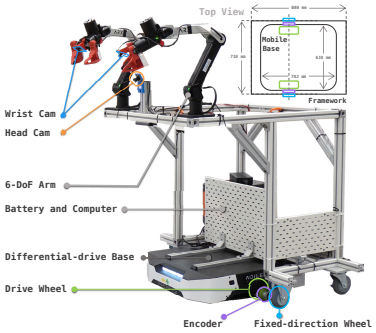
Figure 4 :HALO deployment system overview.Hardware configuration includes the dual-arm manipulation interface, onboard cameras, differential-drive base, encoders, and computing system. The base is removed during data collection.
出典 · CC BY 4.0 · Shuai Yang, Fangyi Xu, Yishu Shen, Kecheng Zheng, Yinghao Xu · HALO: Human-Aligned Data Collection for WhoLe-body MObile Manipulation · 論文の図を引用 · 元のPDFの4ページ目から図の部分を抽出しています。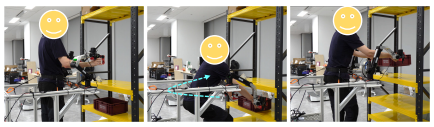
Figure 5 :Implicit base control.The low-resistance collection platform allows base motion to arise naturally from the operator’s movement, without explicit base control that could disrupt hand manipulation, thereby capturing coordinated mobile manipulation behaviors.
出典 · CC BY 4.0 · Shuai Yang, Fangyi Xu, Yishu Shen, Kecheng Zheng, Yinghao Xu · HALO: Human-Aligned Data Collection for WhoLe-body MObile Manipulation · 論文の図を引用 · 元のPDFの5ページ目から図の部分を抽出しています。視覚の後処理と台車運動の整合
視覚の後処理は、デモ映像から実演者の手を消す手順です。CaRE-Egoがキーフレームで左手と右手のマスクを予測すると、SAM2がそれを前後に伝播させます。隣接区間のマスク確率を混ぜたあと、小さな断片を除去し、穴を埋めて膨張させます。最後にDiffuEraserがオプティカルフローで見えている場面を移動し、拡散ベースのインペインティングで隠れた領域を復元します。
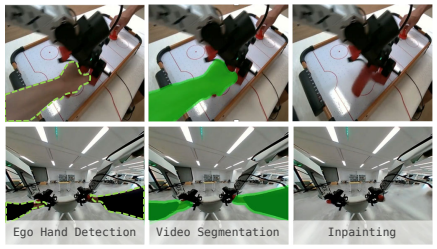
Figure 7 :Visual processing.Our pipeline removes human hands during rapid motion, bimanual manipulation, and egocentric interaction.
出典 · CC BY 4.0 · Shuai Yang, Fangyi Xu, Yishu Shen, Kecheng Zheng, Yinghao Xu · HALO: Human-Aligned Data Collection for WhoLe-body MObile Manipulation · 論文の図を引用 · 元のPDFの6ページ目から図の部分を抽出しています。台車運動の整合では、エンコーダの測定値を左右の車輪速度uL、uRに変換し、次のアフィン写像で配備用台車の並進速度vと角速度ωに合わせます。
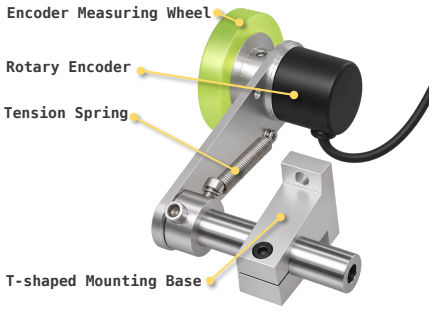
Figure 12 : Off-the-shelf industrial measuring wheel assembly used for wheel odometry. The illustration was redrawn from a real photograph using GPT Image.
出典 · CC BY 4.0 · Shuai Yang, Fangyi Xu, Yishu Shen, Kecheng Zheng, Yinghao Xu · HALO: Human-Aligned Data Collection for WhoLe-body MObile Manipulation · 論文の図を引用 · 元のPDFの15ページ目から図の部分を抽出しています。\[\begin{bmatrix} v \\ \omega \end{bmatrix} = \begin{bmatrix} k_{vL} & k_{vR} \\ k_{\omega L} & k_{\omega R} \end{bmatrix} \begin{bmatrix} u_L \\ u_R \end{bmatrix} + \begin{bmatrix} d_v \\ d_\omega \end{bmatrix}\]
係数とオフセットは、収集プラットフォームの測定値と、配備システムに記録された指令速度のペアで推定します。著者らは、指令と観測された運動の間の遅延も推定して時間の整合に使うと説明しています。行動表現に位置ではなく速度を使う理由は、推定した運動を積分するときに誤差が蓄積するのを避けるためだとしています。
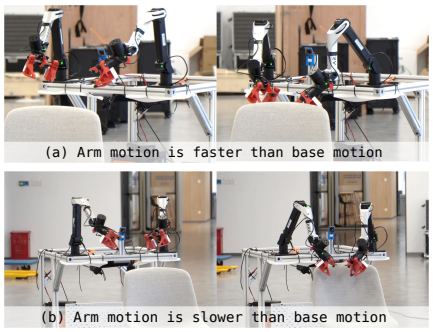
Figure 6 :Failure cases in tasks requiring high mobility.(a) Without compensation for mobile-base latency, the arm motion advances faster than the base motion. (b) Synchronous inference introduces additional control latency, causing the base to travel farther than intended.
出典 · CC BY 4.0 · Shuai Yang, Fangyi Xu, Yishu Shen, Kecheng Zheng, Yinghao Xu · HALO: Human-Aligned Data Collection for WhoLe-body MObile Manipulation · 論文の図を引用 · 元のPDFの5ページ目から図の部分を抽出しています。π0.5のファインチューニングと非同期の行動チャンク実行
方策は、事前学習済みのπ0.5チェックポイントをデモデータでファインチューニングしました。入力は、ヘッドカメラの画像1枚、手首カメラの画像2枚、関節位置、台車の並進速度と角速度です。行動は、アームの行動と台車の並進速度・角速度を連結したベクトルです。オプティマイザはAdamWで、学習率は5×10⁻⁵、バッチサイズは128、学習ステップ数は5kに設定しました。この設定は事前学習済みモデルを使った場合の値です。論文では、事前学習なしで学習したモデルには同じ設定を10kステップで適用したと明記されています。
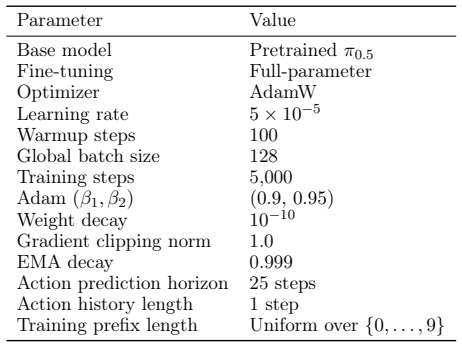
Table 5 : Policy training configuration.
出典 · CC BY 4.0 · Shuai Yang, Fangyi Xu, Yishu Shen, Kecheng Zheng, Yinghao Xu · HALO: Human-Aligned Data Collection for WhoLe-body MObile Manipulation · 論文の図を引用 · 元のPDFの14ページ目から図の部分を抽出しています。実行にはリアルタイム行動チャンク(RTC)を使います。現在のチャンクを実行している間、最新の観測o_tと確定した行動接頭部a_{t+d−1}を条件として、次のチャンクを予測します。
\[a_{t+d:t+d+H-1} \sim \pi(\cdot \mid o_t, a_{t+d-1})\]
ここでdは制御ステップ単位の推論遅延、Hは予測長です。確定した接頭部を条件にすると、連続するチャンクの間で行動が途切れません。学習では、0から9の間の初期行動をクリーンな接頭部としてランダムに選び、この部分はフローマッチング損失から除外すると書かれています。
データ収集効率とMobile ALOHA・VRの比較
データ収集効率は、Push ChairとDisassemble Legoで比較しました。同じ運用者が、同じ課題設定、収集時間の予算、リセット手順のもとで、HALO、Mobile ALOHA、VRを比べました。運用者は3つのインターフェースを事前に使ったことがありません。この比較は、同じ運用者に対して一つの条件にまとめた実験です。
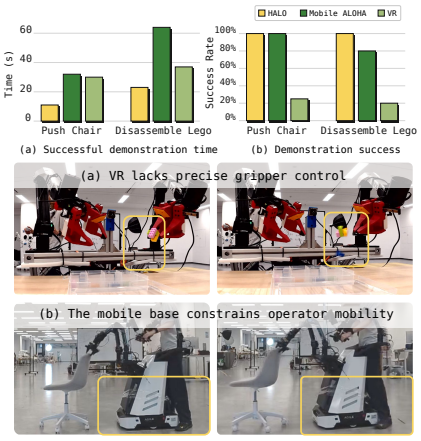
Figure 8 :Comparison and limitations of demonstration data collection. Top: Comparison of human demonstration collection methods in terms of efficiency and reliability. Succ. Rate and Time denote the demonstration success rate and the average duration of successful demonstrations, respectively.Bottom: Representative limitations of existing teleoperation interfaces: VR lacks precise gripper control and force feedback, while the mobile base constrains operator mobility during whole-body demonstration collection.
出典 · CC BY 4.0 · Shuai Yang, Fangyi Xu, Yishu Shen, Kecheng Zheng, Yinghao Xu · HALO: Human-Aligned Data Collection for WhoLe-body MObile Manipulation · 論文の図を引用 · 元のPDFの8ページ目から図の部分を抽出しています。著者らは、Mobile ALOHAでPush Chairのデモ時間が長くなる理由を、台車が操作者の動きを制約し、つかむ前に止まる時間が増えたためだと解釈しています。VRでは、知覚のずれによってエンドエフェクタの精密な制御が難しいと説明されています。
Zip-Tie Fasteningの精密操作の結果
Zip-Tie Fasteningは、短く小さなケーブルタイをつかみ、通し、差し込み、締め、離す過程を含み、サブミリメートルの精度を求めます。この課題は10回の試行で評価しました。表のSucc. Rateは課題の成功率、Timeは平均完了時間です。
HALOで学習した方策の成功率は、10回中30.0%でした。平均完了時間は41秒でした。Mobile ALOHAとVRは、どちらも成功率が0.0%でした。著者らは、Mobile ALOHAでは操作者がタイから遠く離れて細部の動きがよく見えず、VRでは折り曲げて締める精度を確保できず、どちらのインターフェースも成功率が低く、データ品質が落ちたと解釈しています。
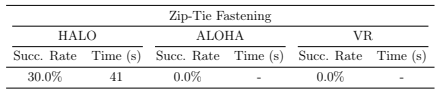
Table 2 :Dexterity evaluation.Zip-Tie Fastening is evaluated over 10 trials. Succ. Rate denotes the task success rate, and Time denotes the average completion time.
出典 · CC BY 4.0 · Shuai Yang, Fangyi Xu, Yishu Shen, Kecheng Zheng, Yinghao Xu · HALO: Human-Aligned Data Collection for WhoLe-body MObile Manipulation · 論文の図を引用 · 元のPDFの8ページ目から図の部分を抽出しています。Disassemble Legoと長期の箱操作の結果
Disassemble Legoでは、方策が台車の位置を正確に合わせ、2つのエンドエフェクタで小さなレゴのピースをつかみ、外し、置く必要があります。40回の試行で30回成功し、成功率は75.0%でした。
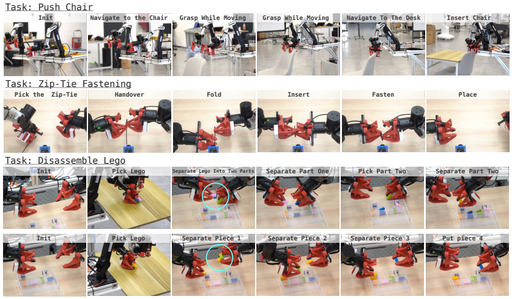
Figure 9 :Push Chair, Zip-Tie Fastening, and Disassemble Lego.In Push Chair, the policy navigates to the chair, grasps it while moving, transports it to the target desk, and inserts it into place. Both Zip-Tie Fastening and Disassemble Lego require precise action prediction. In Disassemble Lego, the randomized separation pattern changes the required disassembly strategy. The policy learns to handle these variations from our demonstrations and generalizes to unseen Lego configurations. In the third row, two Lego pieces of the same color are included, and the policy correctly places both resulting pieces into the correct bin.
出典 · CC BY 4.0 · Shuai Yang, Fangyi Xu, Yishu Shen, Kecheng Zheng, Yinghao Xu · HALO: Human-Aligned Data Collection for WhoLe-body MObile Manipulation · 論文の図を引用 · 元のPDFの9ページ目から図の部分を抽出しています。長期の箱操作タスクは、棚から箱を取り出して物を入れ、箱を持ち上げてコンベアまで運び、置いてから棚に戻る6段階の作業です。15回の試行で11回成功し、成功率は73.3%でした。同じデータ収集時間の予算のもとで、VRとMobile ALOHAで学習した方策は、どちらのタスクも失敗しました。著者らは、デモが遅く、停止が多く、収集の失敗率も高かったため、有効なデータが不足したためだと説明しています。
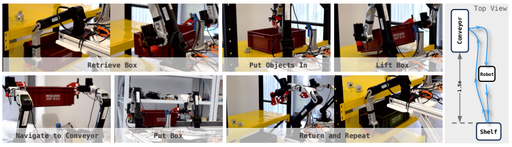
Figure 10 :Long-horizon mobile manipulation with coordinated whole-body control.The policy retrieves a box from the shelf, loads target objects, transports the box to the conveyor, places it at the designated location, and returns to repeat the procedure.
出典 · CC BY 4.0 · Shuai Yang, Fangyi Xu, Yishu Shen, Kecheng Zheng, Yinghao Xu · HALO: Human-Aligned Data Collection for WhoLe-body MObile Manipulation · 論文の図を引用 · 元のPDFの10ページ目から図の部分を抽出しています。推論の実行手法と視覚の後処理の効果
Push Chairで、同期推論と非同期推論を実行長さごとに比較しました。同期推論では、実行長さが8のときは0.0%、25のときは35.0%でした。非同期推論では、実行長さ4で75.0%、6で75.0%、8で85.0%、10で70.0%でした。実行長さが長いほど観測への反応性が下がり、短いほどチャンク間の時間的一貫性が下がるため、中くらいの長さが最も良い結果になりました。
視覚の後処理のアブレーション実験では、非同期推論と実行長さ8に固定し、手の除去処理の有無だけを変えました。処理ありでは成功率が55%から85%に上がりました。この比較は、同じデモと同じ課題設定で、手の除去処理だけを変えた結果です。
限界と確認していない範囲
Mobile ALOHAとVRの失敗結果は、同じデータ収集時間の予算で得られたものです。この条件を増やしたときに結果が同じになるかは、実験していません。実験は同じ運用者で、2つのタスクを中心に行われました。複数の運用者やより多くのタスクで同じ効率を確認してはいません。
推論方式と視覚処理の比較はPush Chairの1つの課題で行われ、実行長さの比較は同期推論の実行長さ8と25だけが報告されているため、その間の値は確認されていません。また、式(1)の係数は収集プラットフォームの測定と配備台車の指令ペアで推定されるため、別の台車ハードウェアで同じ係数をそのまま使えるかどうかは、論文では検証されていません。
論文情報
- 著者
- Shuai Yang, Fangyi Xu, Yishu Shen, Kecheng Zheng, Yinghao Xu
- 学会・ジャーナル
- arXiv · プレプリント
- 公開日
- 2026年11月12日
- 登録日
- 2026年11月13日
- 更新日
- 2026年11月12日
- バージョン
- v1
- arXiv
- 2611.16439
- カテゴリ
- cs.RO
- ライセンス
- CC BY 4.0
- 掲載内容
- 論文情報・解説・論文の図
この解説は、Refivuの韓国語解説をAIで翻訳したものです。不正確な翻訳や誤りが含まれる可能性があります。論文と図の利用条件は各出典に従います。
アブストラクト
Learning whole-body mobile manipulation requires demonstrations that coordinate bimanual actions with locomotion across extended workspaces. However, existing interfaces trade off direct robot control, perception and action alignment, and natural operator mobility, making such demonstrations difficult to collect. We introduce HALO, a human-aligned data collection system for whole-body mobile manipulation. The system aligns the operator's perception and action space with the robot while preserving direct physical feedback and natural locomotion. Operators guide the robot end-effectors through kinesthetic teaching and move a low-resistance platform without the deployed mobile base while performing bimanual manipulation. This interface enables more natural whole-body demonstrations, but the close human-robot coupling introduces discrepancies between the demonstration and deployment settings. We address these discrepancies with deployment-aligned demonstration processing, which calibrates and temporally aligns platform motion with the deployed base response and masks and inpaints demonstrator hands in recorded observations. Compared with Mobile ALOHA and VR teleoperation, HALO enables up to 2.9x faster demonstration collection while maintaining comparable or higher success rates. Policies trained with HALO perform precise manipulation tasks, including zip-tie fastening, and achieve a 73.3% success rate on a six-stage long-horizon mobile manipulation task involving repeated coordinated base and arm motion. Project page: https://robbyant-research.github.io/Lingbot-ALOHA/
この論文を引用
Shuai Yang, Fangyi Xu, Yishu Shen, Kecheng Zheng, Yinghao Xu (2026). HALO: Human-Aligned Data Collection for WhoLe-body MObile Manipulation. arXiv:2611.16439v1. https://arxiv.org/abs/2611.16439v1
BibTeX
@misc{yang2026halo,
  title = {{HALO: Human-Aligned Data Collection for WhoLe-body MObile Manipulation}},
  author = {Shuai Yang and Fangyi Xu and Yishu Shen and Kecheng Zheng and Yinghao Xu},
  year = {2026},
  eprint = {2611.16439},
  archivePrefix = {arXiv},
  url = {https://arxiv.org/abs/2611.16439v1}
}