論文解説
RESYNC: Residual Latent-State Synchronization for Deadline-Bound Streaming Inference
RESYNC:期限付きストリーミング推論のための残差潜在状態同期
- 課題 一定の期限内に観測ごとに予測を出す必要があるストリームでは、大きなモデルは処理が遅く期限を逃し、小さなモデルは品質が落ちます。
- 手法 大きな教師モデルの本体は非同期に実行し、最新の正確な潜在アンカーと、その後の観測から現在の潜在状態を直接推定してから、凍結したヘッドを適用します。
- 結果 教師の利得が実質的にある十二組では、アンカー経過4、8、12のmacro-F1が最良の高速モデルを上回りました。1 ms再生では、到着の99.4%以上を1間隔以内に提供しました。
高速ストリームで期限内の予測が難しい理由
観測が短い間隔Δで届き続けるストリームでは、各観測に対して期限D以内に予測を出す必要があります。モデルの1回の推論時間がΔより長いと、到着は積み重なり、予測は遅れて出てきます。この論文は、観測ごとに1つの予測を求めるサービス契約のもとで、応答遅延、カバレッジ、期限超過をあわせて扱います。大きな教師モデルは精度が高いものの期限を逃し、小さなコンパクトモデルは期限には間に合うものの品質が落ちる、というのが出発点です。教師モデルの最新の正確な潜在状態は非同期に計算できますが、時間がたつと古い状態になります。著者らは、この古い潜在状態を現在の観測区間に合わせて更新すれば、両方式のギャップを縮められるかを問うています。
アンカー以降の観測から潜在状態を直接推定するRESYNC
教師モデルは本体B_Tと予測ヘッドH_Tに分かれ、両方とも学習後に凍結されます。本体は非同期に実行され、ウィンドウw_aに対する正確な潜在アンカーz_a = B_T(w_a)を作ります。到着時には、直近のアンカーと、その後の観測suffix、そしてアンカー間隔nを受け取って潜在変位δを推定し、推定した潜在状態z_a + δに凍結したヘッドを適用します。更新器は、1層のGRUでsuffixをエンコードし、正規化したアンカーとgapの埋め込みをMLPに入れたのち、各次元をゲートα_nで調整します。このゲートにより、ゼロ更新が古い状態のベースラインと一致する解になります。推定は常に最新の正確なアンカーから始まり、推定値を次の予測の基準には使わないため、誤差は蓄積しません。
学習は凍結した本体から得た2つの端点のペアで行うため、タスクラベルは不要です。
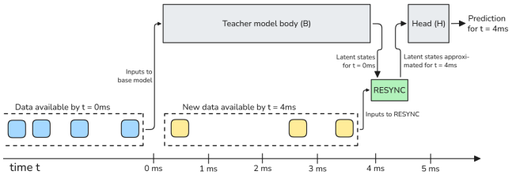
Figure 1 : RESYNC at one arrival. The teacher’s body (B) processed the window available att= 0 ms and delivers its latent att= 4ms, after three newer observations have arrived. RESYNC updates this stale latent with the new observations to approximate the latent of the current window, and the teacher’s unchanged prediction head (H) turns it into the prediction fort= 4ms. The body then starts on the newest window, and every arrival until it finishes is served in the same way from the latest anchor.
出典 · CC BY 4.0 · Eljas Linna, Hao Dong, Juho Kanniainen · RESYNC: Residual Latent-State Synchronization for Deadline-Bound Streaming Inference · 論文の図を引用 · 元のPDFの2ページ目から図の部分を抽出しています。ラベルなし学習と逐次実行
更新器の学習目的は、正規化した潜在復元誤差と、凍結したヘッドが最新の潜在状態と同期した潜在状態から出す予測分布との間のKL項を足し合わせたものです。著者らは、この目的ではタスクラベルを使わないと述べています。実行面では、GRUは因果的なので、観測が1つ届くたびに状態を1ステップ進めます。また、到着1件あたりの作業量はnとLに関係なく一定だと説明しています。候補エンコーダの状態は、本体の処理が動いている間にあらかじめ進めておき、アンカーが完了した時点で有効な状態になります。本体は期限のかかった前景経路の外で動きますが資源は共有するため、著者らは同時再生の条件でシステム全体を測定したと述べています。
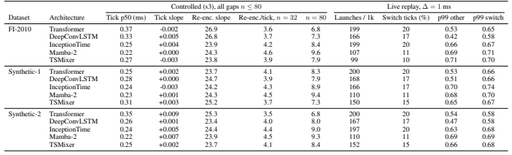
Table 13 : Runtime of the RESYNC tick. Controlled: median tick time over all tested gaps (it varies by less than 0.01 ms), least-squares slope of the tick and of re-encoding the suffix againstninµs per observation, and re-encoding over the tick atn= 32andn= 80. Live replay at∆ = 1ms: body launches per 1,000 arrivals, the share of ticks that install a new anchor, and the p99 latency in ms of the other ticks and of these anchor-switch ticks.
出典 · CC BY 4.0 · Eljas Linna, Hao Dong, Juho Kanniainen · RESYNC: Residual Latent-State Synchronization for Deadline-Bound Streaming Inference · 論文の図を引用 · 元のPDFの21ページ目から図の部分を抽出しています。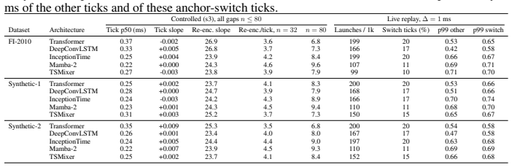
Table 14 : Resources at∆ = 1ms, each method in its own process. CPU cores: process CPU time over wall time, with the RESYNC body worker thread in parentheses. GPU busy: share of the replay with a GPU call in flight. Peak host memory: resident set size. Peak GPU memory: PyTorch’s peak allocation, CUDA context excluded.
出典 · CC BY 4.0 · Eljas Linna, Hao Dong, Juho Kanniainen · RESYNC: Residual Latent-State Synchronization for Deadline-Bound Streaming Inference · 論文の図を引用 · 元のPDFの21ページ目から図の部分を抽出しています。アンカー間隔を固定したときの品質比較
品質評価は、実ストリームFI-2010と2つの合成ストリームSynthetic-1、Synthetic-2を対象に、アンカー間隔nを固定してmacro-F1を測定しました。教師が最良の高速モデルを0.04以上上回る組をregime組として扱い、その十二組において、RESYNCはn=4、8、12のすべての組で最良の高速モデルを上回りました。対応のある95%区間が0より大きい状態で上回ったと報告しています。教師の利得の捕捉率(gain captured)は、FI-2010の4組ではすべて1.00でした。Synthetic-1は中央値0.87、Synthetic-2は中央値0.61でした。Synthetic-1のTransformerは、n=16付近では蒸留したコンパクトモデルと差がなく、n=18からは蒸留モデルが上回りました。
合成ストリームでは、アンカー経過が長くなるほど捕捉率はおおむね低くなりました。
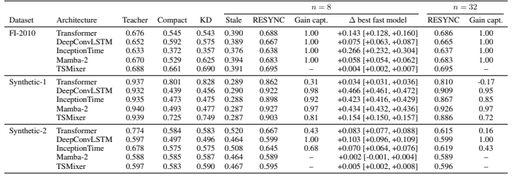
Table 1 : Test macro-F1 of the fresh teacher, the compact model, the distilled compact model (KD), the stale teacher and RESYNC at anchor gapsn= 8andn= 32. Gain captured is the share of the teacher’s gain over the better fast model that RESYNC captures,(F1RESYNC −F1 fast)/(F1teacher − F1fast), capped at 1 (–: teacher’s gain below 0.04).∆best fast model is RESYNC minus the better fast model, with a paired 95% block-bootstrap interval.
出典 · CC BY 4.0 · Eljas Linna, Hao Dong, Juho Kanniainen · RESYNC: Residual Latent-State Synchronization for Deadline-Bound Streaming Inference · 論文の図を引用 · 元のPDFの6ページ目から図の部分を抽出しています。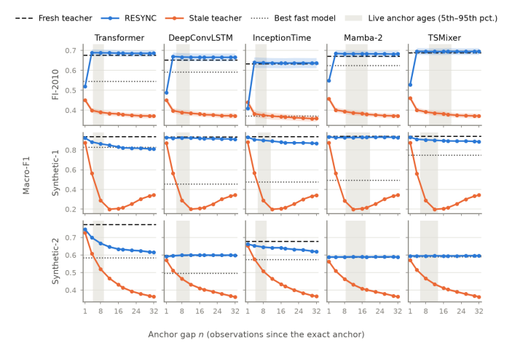
Figure 2 : Test macro-F1 as the anchor ages, for every dataset–architecture pair. RESYNC and the stale teacher are shown with paired 95% block-bootstrap intervals. The fresh teacher and the best fast model (the better of the compact and distilled models) do not depend onn. The shaded band marks the 5th–95th percentile of the anchor ages RESYNC saw in live replay (Table 2).
出典 · CC BY 4.0 · Eljas Linna, Hao Dong, Juho Kanniainen · RESYNC: Residual Latent-State Synchronization for Deadline-Bound Streaming Inference · 論文の図を引用 · 元のPDFの6ページ目から図の部分を抽出しています。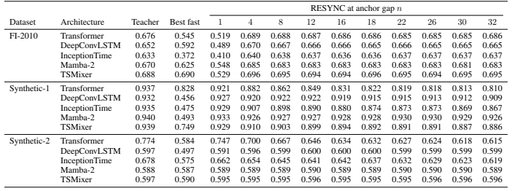
Table 8 : Test macro-F1 of RESYNC at every evaluated anchor gapn, with the fresh teacher and the best fast model (the better of the compact and distilled models), which do not depend onn.
出典 · CC BY 4.0 · Eljas Linna, Hao Dong, Juho Kanniainen · RESYNC: Residual Latent-State Synchronization for Deadline-Bound Streaming Inference · 論文の図を引用 · 元のPDFの17ページ目から図の部分を抽出しています。1 ms到着での期限内サービス性能
live asynchronous replayでは、Δ=1 msで観測を再生し、各到着が自分の予測を受け取るか、1間隔以内に予測が出るかを数えます。同期式の教師モデルは十五組すべてでカバレッジが14~25%にとどまり、1間隔以内に届いた予測はありませんでした。著者らは、期限超過はRESYNCのサービス時間というより、再生プロセスの一時停止に由来すると説明しています。
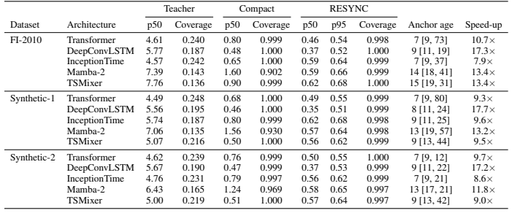
Table 2 : Live asynchronous replay at∆ = 1ms: median arrival-to-output latency (ms) and cov- erage (the fraction of arrivals that received their own prediction) for the synchronous teacher, the compact model and RESYNC, and RESYNC’s p95 latency. Anchor age is the median [p95, max] number of observations since RESYNC’s anchor. Speed-up is the teacher’s median service time over RESYNC’s.
出典 · CC BY 4.0 · Eljas Linna, Hao Dong, Juho Kanniainen · RESYNC: Residual Latent-State Synchronization for Deadline-Bound Streaming Inference · 論文の図を引用 · 元のPDFの7ページ目から図の部分を抽出しています。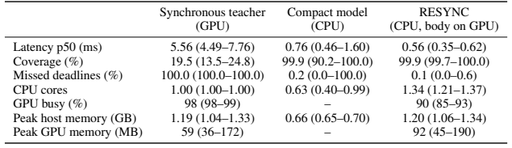
Table 3 : The three systems at∆ = 1ms, as median (range) over the fifteen pairs. Latency, coverage and missed deadlines (D= ∆) come from the replay of Table 2; CPU, GPU and memory from a replay that runs each method in its own process (Appendix G). CPU cores is process CPU time over wall time, GPU busy the share of the replay with a GPU call in flight, and memory the peak. The compact models’ missed deadlines reach 100% only for the three Mamba-2 compact models.
出典 · CC BY 4.0 · Eljas Linna, Hao Dong, Juho Kanniainen · RESYNC: Residual Latent-State Synchronization for Deadline-Bound Streaming Inference · 論文の図を引用 · 元のPDFの7ページ目から図の部分を抽出しています。再帰的な更新との比較
同じモジュールと学習手順を使い、1段階の差分で学習した再帰的な更新器は、n=1ではRESYNCより良い組が十二組ありました。しかし、n=4以上では、RESYNCが13~15組でより良い結果でした。n=32では、RESYNCの平均macro-F1は0.723、再帰的な更新器は0.478、古いアンカーは0.360でした。再帰的な更新器は、各ステップが前の推定の誤差を引き継ぐため、潜在誤差の中央値で見ると5.2倍に拡大しました。RESYNCは1.5倍にとどまりました。この比較は、同じ教師の系列でn=32までの誤差蓄積の差を示していますが、短い間隔のn=1では、再帰方式がより良い結果となった点も併せて報告されています。
適用範囲と残された課題
著者らは、評価が実ストリーム1つと合成ストリーム2つからなると述べています。すべてのモデルは1つの学習シードで学習したため、区間はテストサンプルの変動のみを反映しています。n=1では、FI-2010の組のうち4組でRESYNCが最良の高速モデルより点推定で低く、この弱点は実時間運用の範囲外の短い間隔で現れると論文は説明しています。RESYNCは、教師の潜在状態が復元可能であるという条件を仮定しており、この条件が崩れる状況は実験していません。また、3クラス分類、128観測ウィンドウ、バッチサイズ1、固定の到着間隔、1種類のGPUノードでのみ測定しました。
論文情報
- 著者
- Eljas Linna, Hao Dong, Juho Kanniainen
- 学会・ジャーナル
- arXiv · プレプリント
- 公開日
- 2026年11月12日
- 登録日
- 2026年11月13日
- 更新日
- 2026年11月12日
- バージョン
- v1
- arXiv
- 2611.16523
- カテゴリ
- cs.LG · cs.AI
- ライセンス
- CC BY 4.0
- 掲載内容
- 論文情報・解説・論文の図
この解説は、Refivuの韓国語解説をAIで翻訳したものです。不正確な翻訳や誤りが含まれる可能性があります。論文と図の利用条件は各出典に従います。
アブストラクト
Predicting every observation in a high-rate stream requires a model to finish before the next arrival. A large model may offer better predictions but miss that deadline. We propose RESYNC: the large model runs asynchronously, while a fast path updates its latest exact but stale latent state using the observations received since that state was computed and applies its unchanged prediction head. The updater learns from the frozen model's representations without task labels. Across one real and two synthetic streams and five architecture families, RESYNC beats the best compact or distilled alternative with a paired 95% interval above zero in all twelve dataset--architecture pairs with a material teacher advantage at anchor ages of 4--12 observations, and in eleven pairs at older tested ages up to 32. The share of the teacher's gain preserved remains complete on the real stream but is lower and generally declines with anchor age on the synthetic streams. In live replay with 1 ms arrivals, the synchronous large models cannot deliver any predictions on time while RESYNC serves at least 99.4% of arrivals within the interval, with 0.35--0.62 ms median latency on one CPU thread: around the same speed as or faster than the compact model, and 7.9--17.7$\times$ faster than synchronous large-model inference. RESYNC targets settings with background compute available but a strict per-observation response deadline.
この論文を引用
Eljas Linna, Hao Dong, Juho Kanniainen (2026). RESYNC: Residual Latent-State Synchronization for Deadline-Bound Streaming Inference. arXiv:2611.16523v1. https://arxiv.org/abs/2611.16523v1
BibTeX
@misc{linna2026resync,
  title = {{RESYNC: Residual Latent-State Synchronization for Deadline-Bound Streaming Inference}},
  author = {Eljas Linna and Hao Dong and Juho Kanniainen},
  year = {2026},
  eprint = {2611.16523},
  archivePrefix = {arXiv},
  url = {https://arxiv.org/abs/2611.16523v1}
}