論文解説
Posterior contraction rates for banded approximations of Gaussian processes
ガウス過程のバンド近似における事後収縮率
- 課題 ガウス過程回帰の計算コストO(n^3)を下げるために共分散行列を疎にすると、近似事後分布が正確な事後分布の統計的性質を保つかが問題になります。
- 手法 設計点の対の距離が半径rを超えるカーネル値を0とすることで共分散行列を疎にし、その行列を使って近似事後分布を計算します。
- 結果 二乗指数カーネルで半径をr_n = √(2τ_n^2 log n)とすると、近似事後分布のKL発散は0に収束しつつ最適収縮率を保つと報告されています。
計算コストの限界
ガウス過程回帰では共分散行列の逆行列を計算する必要があるため、学習コストはO(n^3)、メモリと予測コストはO(n^2)です。データが大きくなると、このコストが実用的な適用を妨げます。
疎化された共分散行列と近似事後分布
近似法では、設計点の対の距離が半径r以下の場合にだけカーネル値を残し、それ以外は0とします。1次元ではこの構成がバンド行列になり、高次元でも同じ距離ベースの打ち切りを用います。得られた疎行列で平均と共分散を計算すると近似事後分布Ψrが定義され、行列の対角付近の非零要素数mがメモリと反復計算の規模を決めます。著者らは、この近似を正確な事後分布の事前分布を別のものに置き換えるのではなく、正確なカーネルを計算的に近似するものと捉えています。
KL発散と収縮率の条件
理論では二つの基準を分けて扱います。定理3.1は、疎化誤差の作用ノルムが事後分布のKL発散を制御することを示し、近似誤差‖K̂−K‖_opについて、tr(K K_σ^{-1})の項とnη_n^2の項を併せて置く上界を示します。収縮率では、Hellinger距離に基づく距離で近似事後分布の収縮を扱い、KL発散がnη_n^2程度であれば十分であることを示します。著者らは、この条件のもとではKL発散が0に収束しなくても最適収縮率が得られると説明しています。
二乗指数カーネルにおける打ち切り半径
二乗指数カーネルでは、スケールをτ_n = n^{-1/(2α+d)}と調整して使います。著者らは、半径をr_n = √(2τ_n^2 log n)とすると、近似事後分布は最適収縮率を保ちながらKL発散が0に収束すると報告しています。このとき、行ごとの非零要素数はn^{2α/(2α+d)} log^{d/2} n程度に抑えられます。下限の結果は、半径を対数因子の分だけさらに小さくすると平均のバイアスが大きくなり、多項式的な損失が生じることを示しています。
シミュレーションで見られた帯域幅の効果
m=225では共分散を定義できないか、近似が不正確でした。著者らは、mが十分大きくなると全体の事後分布とほとんど区別できなくなると報告しています。表1では、m=225のときの平均MSEは159、標準偏差は813で、270と400ではそれぞれ32と0.01まで下がりました。全体の事後分布のMSEは0.01です。
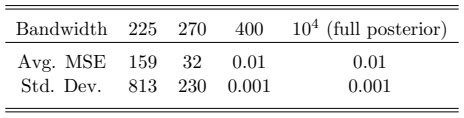
Table 1 : Squared error of the true and approximate posterior based on SE kernel. Average and standard deviation over 100 repetition of the experi- ment.
出典 · CC BY 4.0 · Omar Kassi, Bernhard Stankewitz, Botond Szabo · Posterior contraction rates for banded approximations of Gaussian processes · 論文の図を引用 · 元のPDFの8ページ目から図の部分を抽出しています。打ち切り半径の選択における制約
最適な打ち切り半径は、真の関数の正則性αに依存します。著者らは、αは実際には分からないため半径を直接選ぶのは難しいと指摘し、早期終了のようにデータから半径を選ぶ適応的な手続きを今後の課題として挙げています。また、非定常カーネルやブラウン運動カーネルのように距離に基づく減衰構造がない場合には、距離基準の打ち切りは適切でない可能性があると見ています。
論文情報
- 著者
- Omar Kassi, Bernhard Stankewitz, Botond Szabo
- 学会・ジャーナル
- arXiv · プレプリント
- 公開日
- 2026年11月12日
- 登録日
- 2026年11月13日
- 更新日
- 2026年11月12日
- バージョン
- v1
- arXiv
- 2611.16482
- カテゴリ
- math.ST · stat.ML
- ライセンス
- CC BY 4.0
- 掲載内容
- 論文情報・解説・論文の図
この解説は、Refivuの韓国語解説をAIで翻訳したものです。不正確な翻訳や誤りが含まれる可能性があります。論文と図の利用条件は各出典に従います。
アブストラクト
Gaussian process regression models are widely used in modern statistics and machine learning due to their flexibility, interpretability, built-in uncertainty quantification, and strong theoretical foundations. However, training Gaussian processes (GPs) has a computational cost of $O(n^3)$, while the memory and prediction costs are also $O(n^2)$. For large datasets commonly encountered in practice, this becomes infeasible and necessitates the use of approximate posterior methods. In this work, we propose a class of approximations based on sparse covariance matrices, where the kernel matrix is sparsified according to the spatial proximity of the design points. We analyze the accuracy of the resulting approximate posterior distribution and show that the proposed approach preserves optimal statistical inference properties, provided that the dependencies among a sufficient number of neighboring points for each feature are retained. We derive explicit sufficient and necessary conditions on the number of neighbors required in a general setting and apply these results to standard kernels, including the squared exponential and Matérn kernels. Our theoretical findings are supported by numerical experiments.
この論文を引用
Omar Kassi, Bernhard Stankewitz, Botond Szabo (2026). Posterior contraction rates for banded approximations of Gaussian processes. arXiv:2611.16482v1. https://arxiv.org/abs/2611.16482v1
BibTeX
@misc{kassi2026posterior,
  title = {{Posterior contraction rates for banded approximations of Gaussian processes}},
  author = {Omar Kassi and Bernhard Stankewitz and Botond Szabo},
  year = {2026},
  eprint = {2611.16482},
  archivePrefix = {arXiv},
  url = {https://arxiv.org/abs/2611.16482v1}
}