Paper commentary
VidDub: Replacement-Aware Distillation for Two-Step Video Dubbing
VidDub drops mouth losses on mismatched audio to improve lip sync
- Problem Dubbing editors learn by reproducing the source mouth under its original speech. Once the speech is swapped, that source mouth contradicts the new audio, so standard losses pull the lips toward the wrong speech.
- Method VidDub masks mouth losses on replacement audio and adds a sync loss.
- Results Across three training seeds, masking the conflicting mouth losses raised cross-audio Sync-C by 0.833±0.040. The final two-step model reaches a cross-audio Sync-C of 10.102 on HDTF-30.
Why same-audio reconstruction misleads dubbing
Most dubbing editors learn by reproducing the mouth motion already present in the source video under its original speech. That objective doesn't match dubbing, which must replace mouth articulation under new speech while leaving everything else unchanged. Once the speech is swapped, the source mouth becomes a target that contradicts the new audio.
Standard reconstruction losses don't distinguish these two regimes, so the same loss pulls the lips toward the wrong speech.
Few-step distillation inherits this conflict, because a teacher penalized for deviating from the source mouth can't give a student accurate cross-audio lip synchronization. The face and background stay valid ground truth even under replacement speech, which is why the conflict is local to the mouth. Standard evaluation on short same-audio clips hides the discrepancy, since those clips never test whether the lips follow new speech.
VidDub responds by treating paired and replacement-audio samples differently during training. Paired same-audio samples get standard full-frame reconstruction losses. Replacement-audio samples lose the flow-matching, pixel, and perceptual losses inside the mouth region, and the mouth is supervised only by an audio–visual synchronization loss.
Because the source video still anchors identity, head pose, and background, the dubbing task becomes a well-posed local editing problem.
Muting the mouth loss on replacement audio
VidDub decides valid ground truth per clip by checking whether the driving audio matches the source video. Paired same-audio clips keep full-frame reconstruction, so the mouth, face and background all serve as targets. Unpaired replacement-audio clips drop flow-matching, pixel and perceptual terms inside the mouth region. The unmasked face and background stay supervised, because they remain valid ground truth under replacement speech.
Under replacement audio, the source mouth conflicts with the target utterance, so it can't serve as a reconstruction target.
The flow-matching loss uses a spatial weight q that is applied to the latent interpolation between clean video and Gaussian noise. For paired same-audio samples, q equals 1 plus λ_M times the mouth mask M, which emphasizes mouth reconstruction. For replacement-audio samples, q equals the complement mask 1 minus M, so the mouth receives no velocity regression.
The mouth mask M comes from max-pooling the VACE edit mask into latent resolution.
The latent z is encoded directly from the unedited source video, so its mouth still carries the original speech. The complement mask therefore stops the flow loss from pulling generated lips back toward that conflicting mouth. Non-mouth pixels are kept by an L1 term that compares the decoded window with the source frames under the complement mask.
Masked source frames still supply appearance context, while the target audio governs lip synchronization.
The loss is a cosine-log term applied without any temporal lag search. Gradients flow through the frozen synchronizer and the VAE decoder into the generator, which is how replacement audio steers the mouth. The generator itself is built on Wan-1.3B with VACE context conditioning and a 287M audio adapter over frozen Whisper-small features.
Compressing the teacher into two steps
The student starts from the same Wan-1.3B backbone with VACE context and a 287M audio adapter over frozen Whisper-small features. This fits offline dubbing, because the complete source video and target speech are available before inference. The two-step student shares the teacher's exact network and compresses only the sampling schedule from 48 steps to 2 steps.
Classifier-free guidance is absorbed into a single forward pass per denoising step.
Trajectory regression starts from the teacher's classifier-free audio guidance, v(g) = v(x, ∅) + g[v(x, a) − v(x, ∅)]. Source, audio, noise, boundary state and teacher target stay matched within the same full-window trajectory. The student's two-update map Ψ(2)ϕ is pulled toward a stop-gradient guided terminal latent, and sg blocks teacher gradients.
The frozen set holds 4,096 trajectories, evenly divided between paired and cross-audio conditions. For replacement audio, the regression target is the teacher output conditioned on the replacement speech, not the original source mouth.
Trajectory regression matches individual teacher endpoints but doesn't match the distribution of generated videos. Guided distribution matching therefore runs after trajectory distillation, comparing the frozen guided real score with an online fake score over the full latent window. DMD2 uses the stop-gradient difference d between the fake and real scores, and Lret anchors the output to the frozen initializer.
This stage restores visual realism after step compression, while the trajectory stage keeps the synchronization the teacher learned.
Figure 2 shows masked source latents, a reference latent and frame-aligned audio tokens entering the same bidirectional denoiser. Long videos reuse this two-step window, with consecutive windows advancing by 64 frames and blending a 17-frame overlap.
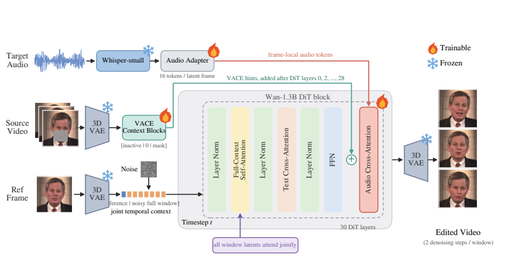
Figure 2 :Full-context two-step dubbing architecture.Masked source frames and a reference image preserve speaker appearance and pose, target-audio tokens drive lip articulation, and bidirectional self-attention jointly denoises the complete latent window in two steps.
Original paper · CC BY 4.0 · Yexin Liu, Yunlong Lin, Zehan Wang, Guangxin He, Xinli Xu, Jiajun Zha, Yaofu Liu, Yueze Wang, Bowen Ping, Yuanming Li, Amie Wang, Bernard Ghanem, Bing Li, Harry Yang · VidDub: Replacement-Aware Distillation for Two-Step Video Dubbing · Original paper figure · Extracted the figure area from page 3 of the original PDF.Did masking the mouth loss improve cross-audio sync
Across three training seeds, masking the conflicting source-mouth reconstruction raises cross-audio Sync-C by 0.833±0.040. The authors treat this seed-level gain as the central evidence that the replacement branch, rather than general training, drives the improvement.
A matched control changes only the replacement probability, from 0 to 0.30, and keeps everything else fixed. On HDTF-30 the control scores 7.986 cross-audio Sync-C at 26.40 FVD. The replacement branch reaches 9.422 at 27.49 FVD on the same benchmark. Across the four benchmarks, replacement-aware refinement raises cross-audio Sync-C by 1.436, 0.954, 1.134 and 1.653.
Paired source bootstraps give 95% intervals of [1.304, 1.560], [0.863, 1.043], [0.984, 1.288] and [1.485, 1.823], and all 160 paired items improve. FVD changes by +1.09, +0.37, +0.40 and −0.84, so the fidelity direction is mixed.
Against external editors on HDTF-30, VidDub reaches a cross-audio Sync-C of 10.102 with two denoising steps. LatentSync 1.6 scores 8.160 at 20 NFE, and Lip Forcing scores 6.884 at 2 NFE on the same cross-audio column. Figure 4 plots this Sync-C against FVD on four benchmarks, which shows the sync lead without a matching FVD lead.
Full-context versus causal execution under the same backbone
The authors compared full-context and causal execution on one backbone, with the same two-step budget, training data and evaluation protocol. That speed matters for online streaming, where the first frames must appear quickly. Offline dubbing is different, because the complete source video and replacement speech are available beforehand.
In that offline setting, full-context execution processes an 81-frame window at 11.3 FPS, compared to 9.4 FPS for the causal variant. It also lowers peak memory from 21.96 GiB to 13.77 GiB, a reduction of 37 percent. Full-context execution won all six independent VSR comparisons, where the causal variant won none, and it improved identity preservation.
Because this is a controlled same-backbone offline test, it supports the full-context choice for dubbing but not a general ranking of the two designs.
The comparison covers HDTF, VoxCeleb2 and VidDub-Bench in the VSR count. They didn't test a causal variant with a different training recipe, so the gap could depend on the shared setup.
Long videos with overlapping 81-frame windows
VidDub handles a minute of video by processing overlapping 81-frame windows, each conditioned on its matching source frames. Each window runs two denoising steps, and consecutive windows advance by 64 frames while blending a 17-frame overlap. The sliding window keeps computation and memory bounded, yet every window still sees bidirectional context inside itself.
The authors use this design instead of one persistent rollout, which they tested against a continuous-cache run over 10, 30, and 60 seconds.
The Long-20 test uses 20 fixed 60-second pairs, and VidDub completes all 20 sequences. VidDub reaches a mean Sync-C of 9.399, compared to 7.861 for Wav2Lip and 7.771 for LatentSync. Its final 5-second segment also scores highest, with a Last-C of 9.585. Each sequence is scored over twelve non-overlapping 5-second SyncNet windows, and failures are counted rather than dropped.
Source preservation over the minute is better as well, with a Keep-L1 of 2.493. That compares to 3.045 for Wav2Lip and 4.018 for LatentSync. Because the windows overlap, the first-to-last change in preservation stays near zero, at −0.034. The stable-face chroma of 0.250 is also the lowest among the three methods, against 1.045 for Wav2Lip and 0.397 for LatentSync.
The authors read these numbers as evidence that the overlapping full-context windows keep speech synchronization and surrounding visual content stable over a minute. Table 10 reports these results, and the Long-20 check covers only the 20 pairs listed there. They didn't test a streaming setting with this long-video protocol, since Table 11 compares causal and full-context execution on short clips.
Independent lip-reading check for VidDub
The lip-reading check asks whether mouths generated by VidDub carry target speech that a separate model can read. The authors read the generated mouths with an LRS3 visual-only reader [25] that is independent of the training synchronizer. The reader is compared against shared Whisper pseudo-references [33], so every model is scored on the same transcripts.
On HDTF, VidDub reaches a WER of 0.503, while Wav2Lip reaches 1.093 under the same reader. On VoxCeleb2, VidDub reaches 0.752, compared with 1.009 for Wav2Lip and 0.949 for X-Dub. On VidDub-Bench, VidDub reaches 0.758, while the Teacher reaches 0.681 and the real same-audio videos reach 0.711. Across all three test sources, VidDub has the lowest WER among the evaluated external methods.
Every paired external comparison favors VidDub, which the authors read as intelligible target speech.
The authors read the agreement between the VSR reader and cross-audio Sync-C as a sign of content-level gain. Replacement-aware training, in their reading, improves recognizable target-speech content rather than only one synchronization score. The Teacher scores 0.632 on HDTF and 0.825 on VoxCeleb2, so the teacher is also close to the real-video reference.
Limits of the evidence
The fidelity evidence for replacement-aware refinement is mixed, because FVD moves in both directions across the four benchmarks. FVD changes by +1.09, +0.37, +0.40 and −0.84, so the fidelity direction isn't uniform. The paper reads this as a cross-audio synchronization gain with mixed FVD changes, not as a general fidelity gain. Cross-audio Sync-C rises by 1.436, 0.954, 1.134 and 1.653 on the four benchmarks, and all 160 paired items improve.
The intervals come from paired source bootstraps over 160 frozen evaluation items, with 10,000 resamples. The teacher-development sets, TalkVid-Bench-50 and H3-Val-50, are kept apart from dev-256 and from the final VidDub-Bench-256 set. Teacher construction is tested in staged checkpoints, which the paper says aren't single-factor causal effects.
The matched replacement-sampling control changes only the replacement probability, from 0 to 0.30, and it also disables audio dropout.
The sampler draws the cross-audio donor from the preceding clip on the same training rank. Training uses the frozen LatentSync-1.6 StableSyncNet checkpoint rather than the official SyncNet-v2 evaluator. The paper's Table 9 human study used 15 raters on 150 trials, and the teacher ties dominate that comparison.
Paper info
- Authors
- Yexin Liu, Yunlong Lin, Zehan Wang, Guangxin He, Xinli Xu, Jiajun Zha, Yaofu Liu, Yueze Wang, Bowen Ping, Yuanming Li, Amie Wang, Bernard Ghanem, Bing Li, Harry Yang
- Venue
- arXiv · Preprint
- First published
- 2026-11-2
- Added
- 2026-11-4
- Updated
- 2026-11-2
- Version
- v1
- arXiv
- 2611.03404
- Category
- cs.CV
- Original paper terms
- CC BY 4.0
- What we show
- Paper info, commentary and permitted figures from the original paper
AI commentary is a separate explanation from the original paper and may contain errors. The original paper and figures follow each source's terms of use and any rights noted separately.
Abstract
Video dubbing aims to synthesize lip movements that match target speech while preserving the speaker identity, head pose, and background of a source video. Existing editors are predominantly trained via self-reconstruction under original paired audio, even though the source mouth becomes a conflicting target when driving speech is replaced. We introduce replacement-aware cross-audio supervision: paired-audio samples use full-frame reconstruction, whereas unpaired replacement-audio samples mask out source-mouth reconstruction losses and supervise the mouth solely through audio-visual synchronization while preserving unmasked facial regions and background. Because offline dubbing provides the complete source video and target speech beforehand, we present VidDub, a full-context diffusion editor distilled into two denoising steps (2 NFE). Our replacement-aware teacher first learns accurate lip synchronization without regressing toward conflicting source mouth movements. Matched trajectory regression then transfers the teacher's CFG-guided trajectories to a two-step student, and distribution matching distillation recovers visual quality after step compression. We will release the curated training dataset, VidDub-Bench, fixed paired- and cross-audio evaluation manifests, preprocessing outputs, and unified evaluation code. Across three training seeds, masking out conflicting source-mouth reconstruction improves cross-audio Sync-C by 0.833; the final two-step model combines strong lip synchronization with superior visual quality, identity preservation, and visual speech recognition across four benchmarks.
Quote from the paper
Yexin Liu, Yunlong Lin, Zehan Wang, Guangxin He, Xinli Xu, Jiajun Zha, Yaofu Liu, Yueze Wang, Bowen Ping, Yuanming Li, Amie Wang, Bernard Ghanem, Bing Li, Harry Yang (2026). VidDub: Replacement-Aware Distillation for Two-Step Video Dubbing. arXiv:2611.03404v1. https://arxiv.org/abs/2611.03404v1
BibTeX
@misc{liu2026viddub,
  title = {{VidDub: Replacement-Aware Distillation for Two-Step Video Dubbing}},
  author = {Yexin Liu and Yunlong Lin and Zehan Wang and Guangxin He and Xinli Xu and Jiajun Zha and Yaofu Liu and Yueze Wang and Bowen Ping and Yuanming Li and Amie Wang and Bernard Ghanem and Bing Li and Harry Yang},
  year = {2026},
  eprint = {2611.03404},
  archivePrefix = {arXiv},
  url = {https://arxiv.org/abs/2611.03404v1}
}