Paper commentary
ForceLDM: A Force-aware Latent Dynamics Model for Contact-Rich Manipulation
ForceLDM teaches a policy to anticipate contact dynamics from current observations alone
- Problem Vision-only robot policies struggle in contact-rich manipulation because contact states and forces are hard to infer from images alone. Existing force-aware policies treat force signals as one more input rather than modeling future interaction dynamics.
- Method ForceLDM distills future dynamics from a teacher into a student. The teacher sees future force/torque and optical flow, and the student learns to match its latent features from current observations only, so no future sensing is needed at deployment.
- Results ForceLDM reached 87.1% average success across five real-world contact-rich tasks, 14.9 percentage points above Seer w/ Force, the strongest baseline.
Why vision-only policies stall on contact
Contact-rich tasks such as USB insertion or component assembly need precise motion and a response to contact forces in real time. Images alone rarely reveal contact states or force magnitudes, so vision-only policies struggle on these tasks. Force-aware policies add a force or torque signal, but most treat it as one more input rather than modeling future interaction dynamics.
Force readings are sparse in time and only effective during the contact stage, so the policy tends to fall back on visual cues.
Predicting future video is a natural fix, since a world model could forecast what the robot will see next. Video models can produce visually realistic output yet fail to capture physically consistent contact dynamics. Predicting pixels also pulls in backgrounds, object appearances and sensor noise, which draws the model toward task-irrelevant information.
Figure 1 contrasts these video-based world action models with the force-aware VLAs and with ForceLDM.
ForceLDM takes the opposite route and uses optical flow and force/torque signals as its dynamics representations. Force/torque captures contact states, while optical flow encodes motion, so both describe the interaction directly. A privileged teacher extracts compact dynamics features from future observations, and a student learns to match them from current observations.
The student then acts at deployment without any future sensory input.
Distilling future dynamics instead of predicting frames
ForceLDM swaps future-frame prediction for distillation from a privileged teacher into a student that sees only current observations. The core idea borrows from knowledge distillation: the teacher receives future force/torque and optical flow, while the student receives only current observations. The teacher extracts compact dynamics features by predicting actions, which encourages it to keep information useful for control.
The student matches these latent representations through a set of learnable query tokens, so it imagines future dynamics without reconstructing future frames in full detail.
The authors use force/torque to capture physical contact and optical flow to capture the motion of the robot and objects. RGB frames change with lighting and appearance and cannot fully capture contact and resistance, so the authors treat them as a weaker source. The student's future queries are aligned at layers {8,12,16}, and the student matches stop-gradient teacher targets with a cosine-based distillation loss.
Distillation is applied in latent space, which keeps the student away from reconstructing future observations. Progressive noise injection perturbs the student's queries so it does not over-rely on the future features.
The teacher's privileged future inputs matter only during training, because inference keeps only the student policy. At inference, the teacher and the future-dynamics encoder are removed, and the student generates actions from current observations alone. The training objective sums the student and teacher flow-matching losses with the distillation loss weighted by λ = 0.5.
The main experiments run on a 7-DoF xArm 7 with a wrist-mounted 6D force/torque sensor and 30 Hz SpaceMouse teleoperation.
How the teacher and student are wired
The model uses a shared π0 backbone, a future-dynamics encoder and two action experts of the same size. The teacher and student both generate action chunks, but only the teacher additionally receives the future force and motion tokens. The overview diagram lays out these parts, including the scheduled noise applied to the student's queries.
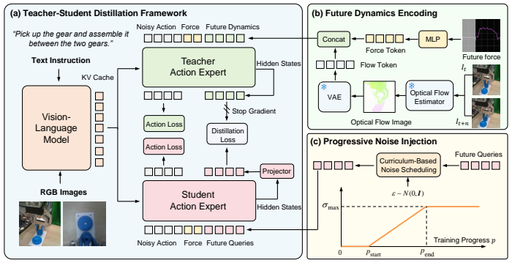
Figure 2 : Overview of ForceLDM. (a) Both teacher and student generate actions from current multimodal observations and language instructions. The teacher additionally receives future force and motion tokens, and its future-aware representations are distilled into the student’s future queries. (b) The future dynamics encoder converts future force/torque and optical flow into compact force and motion tokens. (c) Progressive noise injection perturbs the student’s future queries with scheduled noise to improve generalization.
Original paper · CC BY 4.0 · Peiyuan Tang, Yao Li, Xiaodong Zhang, Wuyang Zhang, Qin Xia, Yanyong Zhang, Zijiang Yang · ForceLDM: A Force-aware Latent Dynamics Model for Contact-Rich Manipulation · Original paper figure · Extracted the figure area from page 5 of the original PDF.The force path flattens ten historical 6D force/torque readings and passes them through a one-layer MLP to give each expert a force token. For motion, RAFT estimates dense optical flow between the current frame and the future frame for both camera views. Each flow field is colorized, with direction mapped to hue and normalized, clipped magnitude setting the color strength on a white background.
A frozen SDXL-VAE encodes these motion images, as \(Z_m = E_m(M_{t\to t+H})\), and 16 learnable motion queries cross-attend to them, as \(m_t = \mathrm{CrossAttn}(Q_m, Z_m)\).
The student owns 17 learnable queries, one for force and 16 for motion, matching the teacher's privileged tokens. Hidden states at layers 8, 12 and 16 are compared with the teacher's, using a cosine-based loss on the force stream and another on the motion stream. Projection heads \(g_f\) and \(g_m\) map the student's states into the teacher's space, and the teacher side is wrapped in a stop-gradient \(\mathrm{sg}(\cdot)\).
The loss averages the per-layer terms, and the motion term averages over the motion queries.
The noise scale stays at zero until \(p_{start}=0.3\), rises linearly to \(\sigma_{max}=0.3\) at \(p_{end}=0.7\), and then holds. Teacher and student are both trained with flow matching, using the same noise sample and interpolation time for each step. The total objective is \(L_{total}=L_S+L_T+\lambda L_{distill}\) with \(\lambda=0.5\), and training runs 30,000 steps at batch size 16 on one A100-80G GPU.
At deployment only the student stays, and it generates action chunks from current observations.
In-distribution results on five real-world tasks
ForceLDM was scored on five real-world tasks, with 25 trials on USB Insertion and 30 trials on Gear Assembly. Box Flipping, Board Wiping and VGA Plugging each got 20 trials under the same evaluation protocol. ForceLDM reached an average success rate of 87.1%, the highest among all compared methods. That average sits 14.9 percentage points above Seer w/ Force, the strongest baseline.
The authors credit learning future contact dynamics for the insertion gains, since insertion needs millimeter-level alignment. They argue that baselines modeling visual dynamics or predicting force directly overfit to irrelevant details or sensor noise. They point to Appendix G for further analysis of these failures.
Generalization to unseen objects and occlusion
The out-of-distribution tests keep the task goals and success criteria fixed while changing the object, the scene or the physical properties. For USB Insertion, the external camera view is partly blocked by an object in one setting, and the USB connector is swapped for a novel instance in another. For Gear Assembly, the authors change the object color and the target assembly height, and for Box Flipping they swap the wooden box for a 3D-printed one and test boxes of different sizes.
Each OOD setting was evaluated over 15 trials.
That is a gain of 20.0 percentage points over Seer w/ Force. Under both an unseen object and visual occlusion, ForceLDM reached 86.7% on USB Insertion.
The authors read this as the policy handling changes in object properties and contact conditions.
Those two cases show that the advantage isn't uniform across every change. The OOD results come from the same fine-tuned policies as the in-distribution runs, so the comparison stays on a shared training setup.
Which future signals and training pieces matter
The modality ablation compares four future targets for dynamics distillation: optical flow alone, force alone, force with RGB, and force with optical flow. The modality table covers only USB Insertion, Box Flipping and VGA Plugging. Future force alone reaches 90.0% on Box Flipping but only 30.0% on VGA Plugging, where precise motion and alignment matter more.
Optical flow alone reaches 92.0% on USB Insertion, yet it performs less well on tasks that need sustained force control, such as Box Flipping. Adding RGB to force doesn't improve performance, which the authors attribute to the model fixating on visual details instead of control-relevant interaction dynamics. Force plus optical flow averages 90.7%, compared to 68.0% for force alone and 70.7% for optical flow alone.
The architecture ablation removes one component at a time: the distillation loss, the teacher action loss, or the stop-gradient operation. Without the distillation loss, the average success rate falls from 85.1% to 42.8%. The authors read this as action supervision alone failing to carry future dynamics from the teacher to the student.
The authors link this drop to direct prediction pulling the model toward irrelevant details and sensor noise. Removing progressive noise moves the average from 85.1% to 74.1%. The drop is larger out of distribution than in distribution, which the authors read as a gain in generalization from the noise. The noise uses a maximum scale of 0.3, with the ramp running from a start of 0.3 to an end of 0.7 in training progress.
What the student queries encode
To check what the future queries hold, the authors freeze the trained policy and fit lightweight probes on its layer 12 hidden states. The probes predict future optical flow and contact force.
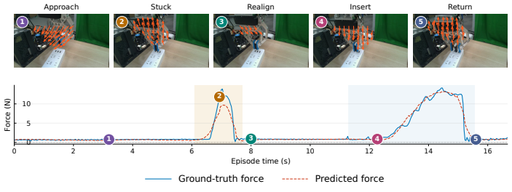
Figure 5 :Probing Latent Dynamics.We freeze the trained model and fit lightweight probes to predict optical flow and contact forces from its intermediate hidden states.Top:Predicted future 2D motion vectors derived from optical flow (bright orange-red arrows) at five stages of the USB insertion task.Bottom:Measured contact force (blue solid) and predicted force (red dashed).
Original paper · CC BY 4.0The run has five stages: approach, stuck, realignment, insertion and return. When the gripper gets stuck, the predicted flow points upward, which the authors read as a recovery motion. During realignment the flow shows the next adjustment, and during insertion it points downward.
It is smoother and skips the high-frequency noise in the measured signal, although the values differ. The authors take this as the queries capturing dynamics without overfitting to noise, shown here for a single USB insertion task.
Horizon, flow estimator and a second robot
The prediction horizon H sets both the action-chunk length and how far ahead ForceLDM predicts future force steps and optical flow. Optical flow is estimated between the current image It and the future image It+H, so H also fixes the flow interval. The authors swept H over 16, 32 and 50 on Box Flipping and Gear Assembly under identical settings.
The authors kept H equal to 32, suggesting that very long horizons add uncertainty to the predicted interaction dynamics.
On the Piper-X setup, the authors replaced the default RAFT flow estimator with DPFlow and kept all other settings fixed.
The second platform is an AgileX Piper-X that uses joint-torque estimates in place of a 6D force/torque sensor. GR00T N1.5 serves as the VLA backbone there, and ForceLDM duplicates its action-decoding head to build the teacher and student experts. Each task uses 100 demonstrations, and each method runs 20 trials per task. Because the robot, torque sensing and backbone all differ from the xArm 7 study with π0, these numbers aren't directly comparable to the main results.
ForceLDM reached 80.0% on USB Insertion and 60.0% on Charger Insertion, averaging 70.0%.
Limitations and the narrow scope of the evidence
ForceLDM's authors name a constraint on data scale: their experiments use small-scale datasets. Because of that, whether the method keeps its advantage as training data grows remains unclear. The paper's dataset statistics show 80 to 100 demonstrations per xArm 7 task, which is the regime they tested. They didn't test larger datasets, so the scaling question stays open.
The ablations cover only three tasks: USB Insertion, Box Flipping and VGA Plugging. Each out-of-distribution setting is evaluated over 15 trials, so each OOD percentage rests on few rollouts. The Piper-X comparison uses a different backbone, GR00T N1.5, and 20 trials per task.
Paper info
- Authors
- Peiyuan Tang, Yao Li, Xiaodong Zhang, Wuyang Zhang, Qin Xia, Yanyong Zhang, Zijiang Yang
- Venue
- arXiv · Preprint
- First published
- 2026-11-2
- Added
- 2026-11-4
- Updated
- 2026-11-2
- Version
- v1
- arXiv
- 2611.03294
- Category
- cs.RO
- Original paper terms
- CC BY 4.0
- What we show
- Paper info, commentary and permitted figures from the original paper
AI commentary is a separate explanation from the original paper and may contain errors. The original paper and figures follow each source's terms of use and any rights noted separately.
Abstract
Contact-rich manipulation requires fine-grained control and complex physical interactions with the environment, posing significant challenges for robot policy learning. Vision-only policies struggle with such tasks, as contact states and interaction forces are difficult to infer from visual observations alone. Existing methods mitigate this issue by incorporating force or tactile sensing. However, they often treat these signals as auxiliary observations without fully exploiting their role in modeling future interaction dynamics. To address this, we propose ForceLDM, a force-aware latent dynamics model that learns future contact and motion dynamics to guide action generation. Rather than directly predicting future observations, which can entangle task-relevant dynamics with irrelevant sensory details, ForceLDM learns a compact representation of future dynamics through knowledge distillation. Specifically, a teacher network with privileged future force/torque and optical flow signals extracts future dynamic features, which are then distilled into a student network trained only on current observations. This enables the student model to reason about upcoming contacts and physical dynamics without relying on future sensory inputs at deployment. To improve robustness and generalization, we further introduce a curriculum-based progressive noise injection strategy to mitigate over-reliance on future features. Experiments on five real-world contact-rich manipulation tasks demonstrate that ForceLDM outperforms state-of-the-art baselines, generalizes effectively to novel objects, and remains robust to environmental perturbations. Project page and code are available at https://tpy001.github.io/ForceLDM/.
Quote from the paper
Peiyuan Tang, Yao Li, Xiaodong Zhang, Wuyang Zhang, Qin Xia, Yanyong Zhang, Zijiang Yang (2026). ForceLDM: A Force-aware Latent Dynamics Model for Contact-Rich Manipulation. arXiv:2611.03294v1. https://arxiv.org/abs/2611.03294v1
BibTeX
@misc{tang2026forceldm,
  title = {{ForceLDM: A Force-aware Latent Dynamics Model for Contact-Rich Manipulation}},
  author = {Peiyuan Tang and Yao Li and Xiaodong Zhang and Wuyang Zhang and Qin Xia and Yanyong Zhang and Zijiang Yang},
  year = {2026},
  eprint = {2611.03294},
  archivePrefix = {arXiv},
  url = {https://arxiv.org/abs/2611.03294v1}
}