논문 해설
ForceLDM: A Force-aware Latent Dynamics Model for Contact-Rich Manipulation
ForceLDM: 접촉이 많은 조작을 위한 힘 인지 잠재 동역학 모델
- 연구 문제 접촉이 많은 조작에서 시각 관측만으로는 접촉과 힘을 충분히 추정하기 어려워, 힘과 미래 동역학을 정책 학습에 어떻게 반영할지가 문제입니다.
- 연구 방법 teacher가 학습 중 미래 힘과 광학 흐름으로 잠재 동역학 표현을 만들고, student가 현재 관측만으로 이를 정렬하도록 증류하는 ForceLDM을 제안합니다.
- 주요 결과 다섯 개 실제 접촉 과제에서 평균 성공률 87.1%를 보였고, OOD 평가에서는 평균 68.9%를 기록했습니다. 증류 손실과 노이즈 주입 제거 실험에서도 전체 모델의 성능 차이가 관찰되었습니다.
접촉이 많은 조작에서 시각만으로는 부족한 이유
접촉이 많은 조작에서는 접촉 상태와 상호작용 힘이 시각 관측만으로 추정하기 어렵습니다. 기존 force-aware VLA는 힘/토크를 현재 관측의 추가 입력으로 넣는 경우가 많아, 미래 상호작용 동역학을 명시적으로 모델링하지 않습니다. 저자들은 이 한계가 힘 신호의 역할을 충분히 활용하지 못하고 전문가 행동에 과적합되는 문제로 이어진다고 설명합니다. 한편 미래 관측을 직접 예측하는 월드 모델은 배경이나 물체 외형 같은 과제와 무관한 세부 정보에 얽힐 수 있습니다. ForceLDM은 이 두 문제를 함께 다루기 위해 미래 접촉과 움직임 동역학을 잠재 공간에서 학습하는 접근을 제안합니다.
미래 힘과 광학 흐름을 teacher에서 student로 증류하는 구조
ForceLDM은 teacher와 student 두 행동 전문가를 둡니다. teacher는 현재 이미지와 언어 지시, 로봇 상태, 과거 힘 이력에 더해 학습 중에만 미래 6D 힘/토크 구간과 현재-미래 프레임 사이의 광학 흐름을 받습니다. 미래 힘은 MLP로 하나의 힘 토큰이 되고, 광학 흐름은 RAFT로 추정한 뒤 색으로 표현한 움직임 이미지를 pre-training VAE로 압축해 16개의 학습 가능한 모션 쿼리로 집계합니다. student는 힘 토큰 하나와 모션 쿼리 16개로 구성된 17개의 학습 가능한 미래 쿼리를 사용하며, 추론 때는 teacher와 미래 동역학 인코더를 제거하고 현재 관측만 사용합니다.
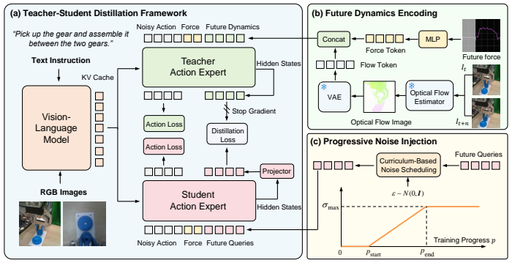
Figure 2 : Overview of ForceLDM. (a) Both teacher and student generate actions from current multimodal observations and language instructions. The teacher additionally receives future force and motion tokens, and its future-aware representations are distilled into the student’s future queries. (b) The future dynamics encoder converts future force/torque and optical flow into compact force and motion tokens. (c) Progressive noise injection perturbs the student’s future queries with scheduled noise to improve generalization.
원문 · CC BY 4.0 · Peiyuan Tang, Yao Li, Xiaodong Zhang, Wuyang Zhang, Qin Xia, Yanyong Zhang, Zijiang Yang · ForceLDM: A Force-aware Latent Dynamics Model for Contact-Rich Manipulation · 원문 그림 인용 · 원본 PDF 5쪽에서 그림 영역을 추출했습니다.증류는 픽셀 수준 재구성이 아니라 잠재 표현 정렬로 이루어집니다. 학습 손실은 선택된 층 8, 12, 16에서 student의 힘 표현과 모션 표현을 각각 투영 헤드를 거쳐 stop-gradient된 teacher 표현과 코사인 거리로 맞춥니다. 전체 목적 함수는 student와 teacher의 flow matching 손실에 증류 손실을 λ=0.5로 더한 형태입니다.
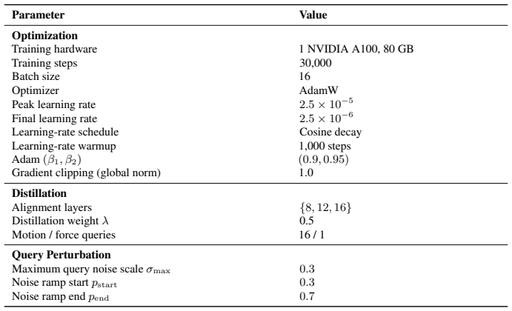
Table 8 : Training hyperparameters for ForceLDM.
원문 · CC BY 4.0 · Peiyuan Tang, Yao Li, Xiaodong Zhang, Wuyang Zhang, Qin Xia, Yanyong Zhang, Zijiang Yang · ForceLDM: A Force-aware Latent Dynamics Model for Contact-Rich Manipulation · 원문 그림 인용 · 원본 PDF 17쪽에서 그림 영역을 추출했습니다.학습 진행에 따른 쿼리 노이즈 주입
student의 미래 쿼리는 teacher 표현과 정렬되는 과정에서 과도하게 의존할 수 있습니다. 이를 줄이기 위해 ForceLDM은 학습 진행률 p에 따라 student 쿼리에 RMS 기반 가우시안 노이즈를 주입합니다. 노이즈 크기는 p_start 이전에는 0이고, p_start부터 p_end까지 선형으로 증가하며, 그 뒤에는 σmax로 유지됩니다. 원문 구현 설정에서 σmax는 0.3, p_start는 0.3, p_end는 0.7입니다. 이 설정은 해당 실험 구성의 값이며, 여러 후보를 탐색한 결과를 방법 전체의 고정 설정으로 일반화하지 않습니다.
실제 로봇 과제에서 확인한 성능과 일반화
주 실험은 xArm 7에서 USB 삽입, 기어 조립, 상자 뒤집기, 보드 닦기, VGA 연결의 다섯 과제에 대해 성공률을 측정했습니다. 이 평가에서 ForceLDM의 평균 성공률은 87.1%이며, 가장 강한 기준선인 Seer w/ Force보다 14.9 퍼센트포인트 높습니다. OOD 평가는 시각 가림, 새 물체, 색상, 높이, 재질, 크기 변화에서 각 설정당 15회 시행으로 수행되었고, ForceLDM은 평균 68.9%로 Seer w/ Force보다 20.0 퍼센트포인트 높았습니다. 이 수치들은 이 논문의 실제 로봇 실험 조건에서 얻은 결과이며, 다른 로봇이나 데이터셋으로 일반화된 결과가 아닙니다.
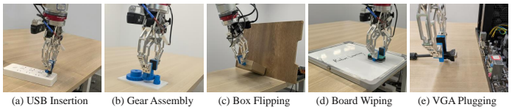
Figure 3 : Five real-world contact-rich manipulation tasks used in our experiments.
원문 · CC BY 4.0 · Peiyuan Tang, Yao Li, Xiaodong Zhang, Wuyang Zhang, Qin Xia, Yanyong Zhang, Zijiang Yang · ForceLDM: A Force-aware Latent Dynamics Model for Contact-Rich Manipulation · 원문 그림 인용 · 원본 PDF 7쪽에서 그림 영역을 추출했습니다.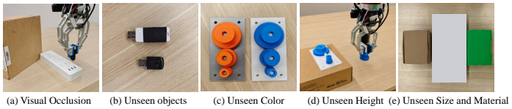
Figure 4 : Out-of-distribution generalization settings used in our real-world evaluation.
원문 · CC BY 4.0 · Peiyuan Tang, Yao Li, Xiaodong Zhang, Wuyang Zhang, Qin Xia, Yanyong Zhang, Zijiang Yang · ForceLDM: A Force-aware Latent Dynamics Model for Contact-Rich Manipulation · 원문 그림 인용 · 원본 PDF 7쪽에서 그림 영역을 추출했습니다.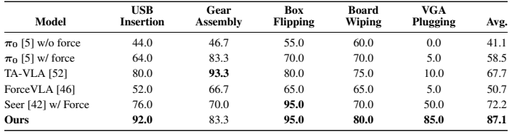
Table 1 : Comparison of success rates (%) on in-distribution (ID) contact-rich manipulation tasks.
원문 · CC BY 4.0 · Peiyuan Tang, Yao Li, Xiaodong Zhang, Wuyang Zhang, Qin Xia, Yanyong Zhang, Zijiang Yang · ForceLDM: A Force-aware Latent Dynamics Model for Contact-Rich Manipulation · 원문 그림 인용 · 원본 PDF 8쪽에서 그림 영역을 추출했습니다.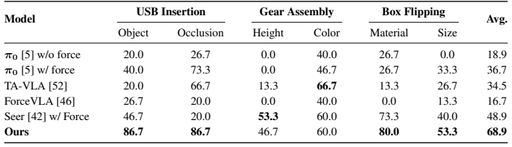
Table 2 : Comparison of success rates (%) on out-of-distribution (OOD) tasks under visual occlusion and changes in object instance, color, assembly height, material, and size.
원문 · CC BY 4.0 · Peiyuan Tang, Yao Li, Xiaodong Zhang, Wuyang Zhang, Qin Xia, Yanyong Zhang, Zijiang Yang · ForceLDM: A Force-aware Latent Dynamics Model for Contact-Rich Manipulation · 원문 그림 인용 · 원본 PDF 8쪽에서 그림 영역을 추출했습니다.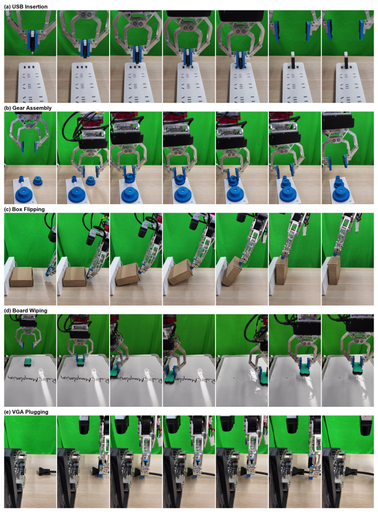
Figure 7 : Successful executions of five real-world manipulation tasks: USB Insertion, Gear Assembly, Box Flipping, Board Wiping, and VGA Plugging. Each row shows seven frames from the initial state to task completion.
원문 · CC BY 4.0 · Peiyuan Tang, Yao Li, Xiaodong Zhang, Wuyang Zhang, Qin Xia, Yanyong Zhang, Zijiang Yang · ForceLDM: A Force-aware Latent Dynamics Model for Contact-Rich Manipulation · 원문 그림 인용 · 원본 PDF 21쪽에서 그림 영역을 추출했습니다.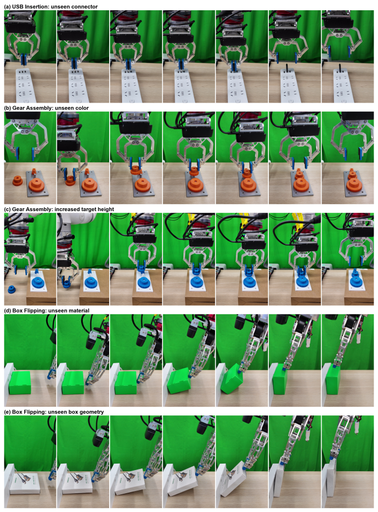
Figure 8 : Successful executions under OOD conditions: (a) an unseen USB connector, (b) an unseen gear color, (c) an increased assembly height, (d) an unseen box material, and (e) an unseen box size. Each row shows seven frames from the initial state to task completion.
원문 · CC BY 4.0 · Peiyuan Tang, Yao Li, Xiaodong Zhang, Wuyang Zhang, Qin Xia, Yanyong Zhang, Zijiang Yang · ForceLDM: A Force-aware Latent Dynamics Model for Contact-Rich Manipulation · 원문 그림 인용 · 원본 PDF 22쪽에서 그림 영역을 추출했습니다.증류 구성요소와 학습 전략의 절제 결과
절제 실험은 증류 구성요소가 중요한 역할을 한다는 것을 보여 줍니다. Ldistill을 제거하면 평균 성공률이 85.1%에서 42.8%로 낮아지며, 저자들은 행동 감독만으로는 teacher의 미래 동역학이 student에게 충분히 전달되지 않는다고 해석합니다. teacher action loss LT를 제거하거나 stop-gradient를 제거한 변형도 원문 표에서 낮은 평균 성공률을 보였습니다. 학습 전략 비교에서 Progressive Noise Injection을 제거하면 평균 성공률이 85.1%에서 74.1%로 낮아지며, 하락 폭은 ID보다 OOD에서 더 큽니다. 이 결과는 해당 제거 변형이 기준 전체 모델보다 낮았다는 관찰이며, 모든 구성요소가 어떤 조건에서도 이득을 준다는 증명은 아닙니다.
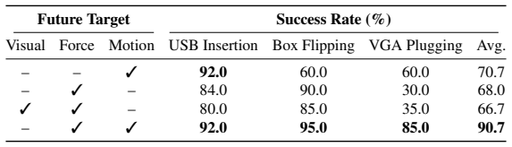
Table 3 : Ablation of future modalities used for dynamics distillation. Visual, Force, and Motion denote future RGB observations, force/torque signals, and optical flow, respectively. We report success rates (%) on USB Insertion, Box Flipping, and VGA Plugging.
원문 · CC BY 4.0 · Peiyuan Tang, Yao Li, Xiaodong Zhang, Wuyang Zhang, Qin Xia, Yanyong Zhang, Zijiang Yang · ForceLDM: A Force-aware Latent Dynamics Model for Contact-Rich Manipulation · 원문 그림 인용 · 원본 PDF 9쪽에서 그림 영역을 추출했습니다.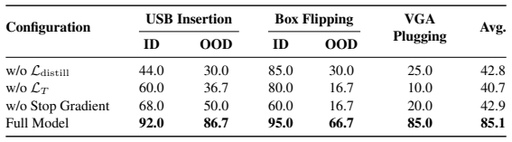
Table 4 : Ablation of teacher–student distillation components. Ldistill and LT denote the representa- tion alignment loss and teacher action loss, respectively. Stop Gradient denotes gradient stopping on teacher targets. We report success rates (%) under both in-distribution (ID) and out-of-distribution (OOD) conditions.
원문 · CC BY 4.0 · Peiyuan Tang, Yao Li, Xiaodong Zhang, Wuyang Zhang, Qin Xia, Yanyong Zhang, Zijiang Yang · ForceLDM: A Force-aware Latent Dynamics Model for Contact-Rich Manipulation · 원문 그림 인용 · 원본 PDF 9쪽에서 그림 영역을 추출했습니다.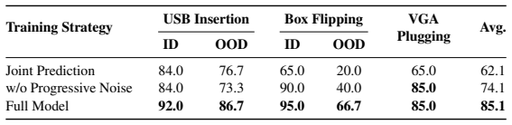
Table 5 : Ablation of the training strategies used in ForceLDM. Joint Prediction combines action learning with direct future-dynamics prediction, while w/o Progressive Noise removes progressive noise injection into the student’s future queries.
원문 · CC BY 4.0 · Peiyuan Tang, Yao Li, Xiaodong Zhang, Wuyang Zhang, Qin Xia, Yanyong Zhang, Zijiang Yang · ForceLDM: A Force-aware Latent Dynamics Model for Contact-Rich Manipulation · 원문 그림 인용 · 원본 PDF 10쪽에서 그림 영역을 추출했습니다.광학 흐름 추정기와 다른 플랫폼에서의 결과
광학 흐름 추정기 비교에서는 Piper-X와 GR00T N1.5 설정에서 RAFT를 DPFlow로 바꾸었을 때 USB 삽입 성공률이 80%에서 75%로, 충전기 삽입 성공률이 60%에서 70%로 바뀌었습니다. 이는 이 설정에서 두 추정기가 비슷한 수준으로 동작했다는 관찰이며, 흐름 추정기 선택에 전혀 의존하지 않는다는 증명으로 읽지 않습니다. 추가 플랫폼인 Piper-X에서 ForceLDM은 USB 삽입 80%와 충전기 삽입 60%, 평균 70%를 기록했습니다. 이 결과는 과제당 20회 시행과 GR00T N1.5 백본, 과제당 100회 시연 데이터라는 조건에서의 결과입니다.
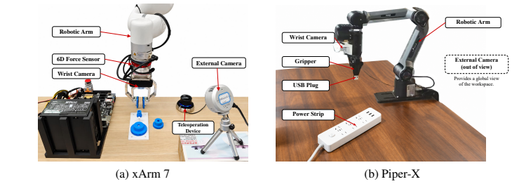
Figure 6 : Real-world experimental setups for (a) the main xArm 7 experiments and (b) the supple- mentary Piper-X evaluation.
원문 · CC BY 4.0 · Peiyuan Tang, Yao Li, Xiaodong Zhang, Wuyang Zhang, Qin Xia, Yanyong Zhang, Zijiang Yang · ForceLDM: A Force-aware Latent Dynamics Model for Contact-Rich Manipulation · 원문 그림 인용 · 원본 PDF 15쪽에서 그림 영역을 추출했습니다.
Table 6 : Comparison of experimental setups across robot platforms.
원문 · CC BY 4.0 · Peiyuan Tang, Yao Li, Xiaodong Zhang, Wuyang Zhang, Qin Xia, Yanyong Zhang, Zijiang Yang · ForceLDM: A Force-aware Latent Dynamics Model for Contact-Rich Manipulation · 원문 그림 인용 · 원본 PDF 15쪽에서 그림 영역을 추출했습니다.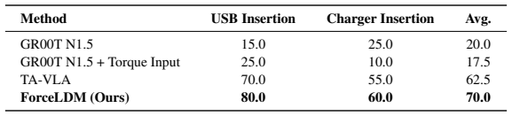
Table 9 : Real-world manipulation success rates (%) on the Piper-X platform. Each method is evaluated over 20 trials per task, with the average success rate reported across both tasks.
원문 · CC BY 4.0 · Peiyuan Tang, Yao Li, Xiaodong Zhang, Wuyang Zhang, Qin Xia, Yanyong Zhang, Zijiang Yang · ForceLDM: A Force-aware Latent Dynamics Model for Contact-Rich Manipulation · 원문 그림 인용 · 원본 PDF 19쪽에서 그림 영역을 추출했습니다.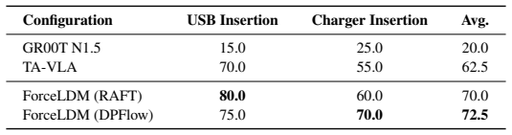
Table 11 : Comparison of optical-flow estimators on real-world manipulation success rates (%) using Piper-X.
원문 · CC BY 4.0 · Peiyuan Tang, Yao Li, Xiaodong Zhang, Wuyang Zhang, Qin Xia, Yanyong Zhang, Zijiang Yang · ForceLDM: A Force-aware Latent Dynamics Model for Contact-Rich Manipulation · 원문 그림 인용 · 원본 PDF 19쪽에서 그림 영역을 추출했습니다.적용 범위와 남은 질문
저자들은 실험이 소규모 데이터셋에서 수행되었으므로 데이터가 커질 때 ForceLDM의 장점이 유지되는지는 확인되지 않았다고 밝힙니다. 또한 2D 광학 흐름에는 명시적인 깊이 정보가 없어 공간 관계를 모델링하는 능력이 제한될 수 있다고 설명합니다. 원문 실패 분석에서는 반복 시도, 불안정하거나 부족한 접촉, 기어 잡기 실패가 보고되었습니다. 따라서 이 결과는 본문에 보고된 과제와 조건의 범위에서 읽어야 하며, 대규모 데이터나 3D 장면 흐름으로의 확장은 아직 검증되지 않았습니다.
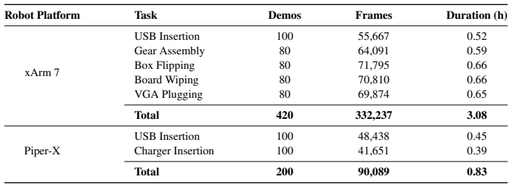
Table 7 : Dataset statistics for the xArm 7 and Piper-X robot platforms.
원문 · CC BY 4.0 · Peiyuan Tang, Yao Li, Xiaodong Zhang, Wuyang Zhang, Qin Xia, Yanyong Zhang, Zijiang Yang · ForceLDM: A Force-aware Latent Dynamics Model for Contact-Rich Manipulation · 원문 그림 인용 · 원본 PDF 16쪽에서 그림 영역을 추출했습니다.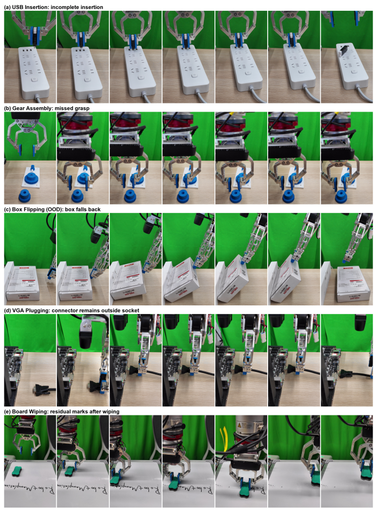
Figure 9 : Representative failure cases: (a) the USB plug failing to fully insert into the target port, (b) a missed gear grasp, (c) a box falling back during flipping under OOD conditions, (d) the VGA connector released before being fully inserted, and (e) small residual marks after wiping. Each row shows seven frames from the initial state to the terminal failure state.
원문 · CC BY 4.0 · Peiyuan Tang, Yao Li, Xiaodong Zhang, Wuyang Zhang, Qin Xia, Yanyong Zhang, Zijiang Yang · ForceLDM: A Force-aware Latent Dynamics Model for Contact-Rich Manipulation · 원문 그림 인용 · 원본 PDF 23쪽에서 그림 영역을 추출했습니다.논문 정보
- 저자
- Peiyuan Tang, Yao Li, Xiaodong Zhang, Wuyang Zhang, Qin Xia, Yanyong Zhang, Zijiang Yang
- 학회·저널
- arXiv · 프리프린트
- 최초 공개일
- 2026년 11월 2일
- 등록일
- 2026년 11월 4일
- 수정일
- 2026년 11월 2일
- 버전
- v1
- arXiv
- 2611.03294
- 분류
- cs.RO
- 원문 이용 조건
- CC BY 4.0
- 제공 범위
- 논문 정보, 해설, 허용된 원문 그림
AI 해설은 논문 원문과 별개의 설명이며 오류가 있을 수 있습니다. 원문과 그림은 각 출처의 이용 조건과 따로 표시된 권리를 따릅니다.
초록
Contact-rich manipulation requires fine-grained control and complex physical interactions with the environment, posing significant challenges for robot policy learning. Vision-only policies struggle with such tasks, as contact states and interaction forces are difficult to infer from visual observations alone. Existing methods mitigate this issue by incorporating force or tactile sensing. However, they often treat these signals as auxiliary observations without fully exploiting their role in modeling future interaction dynamics. To address this, we propose ForceLDM, a force-aware latent dynamics model that learns future contact and motion dynamics to guide action generation. Rather than directly predicting future observations, which can entangle task-relevant dynamics with irrelevant sensory details, ForceLDM learns a compact representation of future dynamics through knowledge distillation. Specifically, a teacher network with privileged future force/torque and optical flow signals extracts future dynamic features, which are then distilled into a student network trained only on current observations. This enables the student model to reason about upcoming contacts and physical dynamics without relying on future sensory inputs at deployment. To improve robustness and generalization, we further introduce a curriculum-based progressive noise injection strategy to mitigate over-reliance on future features. Experiments on five real-world contact-rich manipulation tasks demonstrate that ForceLDM outperforms state-of-the-art baselines, generalizes effectively to novel objects, and remains robust to environmental perturbations. Project page and code are available at https://tpy001.github.io/ForceLDM/.
원문 인용
Peiyuan Tang, Yao Li, Xiaodong Zhang, Wuyang Zhang, Qin Xia, Yanyong Zhang, Zijiang Yang (2026). ForceLDM: A Force-aware Latent Dynamics Model for Contact-Rich Manipulation. arXiv:2611.03294v1. https://arxiv.org/abs/2611.03294v1
BibTeX
@misc{tang2026forceldm,
  title = {{ForceLDM: A Force-aware Latent Dynamics Model for Contact-Rich Manipulation}},
  author = {Peiyuan Tang and Yao Li and Xiaodong Zhang and Wuyang Zhang and Qin Xia and Yanyong Zhang and Zijiang Yang},
  year = {2026},
  eprint = {2611.03294},
  archivePrefix = {arXiv},
  url = {https://arxiv.org/abs/2611.03294v1}
}