논문 해설
When the Simulator Fails, Not the Policy: Auditing Contact Artifacts in Simulated Robot Benchmarks
시뮬레이터가 실패할 때, 정책이 아니다: 시뮬레이션 로봇 벤치마크의 접촉 아티팩트 감사
- 연구 문제 시뮬레이션 벤치마크의 실패 가운데 시뮬레이터가 만든 접촉 아티팩트가 있으며, 이를 추적하여 원인을 고칠 수 있는지 다룹니다.
- 연구 방법 SIMUGUARD는 벤치마크를 바꾸지 않고 물리 스텝을 기록하고, 접촉 아티팩트를 탐지하며, 기록을 정확히 재생하고 한 파라미터만 바꾼 재실행을 수행합니다.
- 주요 결과 RoboTwin의 용기 작업에서 LingBot-V A 실패의 대부분이 아티팩트를 포함하며, PhysX 5.3.1의 삼각형 축퇴 임계값을 5.4.0 값으로 바꾸면 아티팩트가 사라지고 폐루프 성공률이 89%에서 98%로 오릅니다.
시뮬레이션 실패의 원인 문제
시뮬레이션 벤치마크는 정책의 성공률로 점수를 매기며, 실패한 에피소드는 모두 정책에 불리하게 계산됩니다. 그러나 이 논문은 실패 중 상당수가 정책이 아니라 시뮬레이터의 접촉 처리에서 생긴다고 지적합니다. 정책이 물체를 용기에 올려 놓은 뒤 시뮬레이터가 물체를 튕겨 내면, 벤치마크는 이를 정책의 실패로 기록합니다. 이 논문은 이러한 접촉 아티팩트를 탐지하고 원인을 추적하는 방법을 다룹니다.
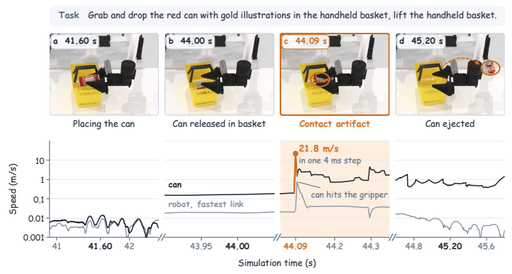
Figure 1 :A contact artifact turns a correct placement into a failure.After LingBot-V A places the 10 g can in the basket on Place Can Basket (a, b), the can’s speed rises from 0.2 to 22 m/s within one 4 ms physics step, a gain of 2.4 J of kinetic energy, while no robot link touches it and the fastest link moves at under 0.1 m/s (c); the can is ejected from the basket and the benchmark records a failure (d). The time axis has four linear segments, one under each frame.
원문 · CC BY 4.0 · Alex Zhou, Junhao Wu, Xueyang Zhou, Yixiao Huo, Hongcheng Gao, Di Zhu, Zhenghao Zhang, Yongchao Chen · When the Simulator Fails, Not the Policy: Auditing Contact Artifacts in Simulated Robot Benchmarks · 원문 그림 인용 · 원본 PDF 2쪽에서 그림 영역을 추출했습니다.SIMUGUARD의 기록·탐지·재생 절차
SIMUGUARD는 벤치마크의 평가 스크립트에 어댑터로 붙어 매 물리 스텝의 구동 입력, 물체 상태, 접촉을 기록합니다. 탐지는 세 단계로 이루어집니다. 첫 단계는 접촉 직후 빠르게 속도가 바뀐 물체를 후보로 삼고, 240 ms 안에 4 cm 이상 이동하는지 확인합니다. 둘째 단계는 중력으로 설명되는 낙하를 제외하기 위해 물체의 최고 속도를 자유낙하 속도 √2g∆z와 비교하며, 비율이 1.5를 넘는 사건만 남깁니다. 셋째 단계는 로봇이 다른 물체를 통해 옮긴 운동을 제외합니다. 재생은 시드로 장면을 다시 만들고 기록된 구동을 첫 스텝부터 적용하며, 워밍 스타트와 장면 상태 쓰기도 함께 복원합니다.
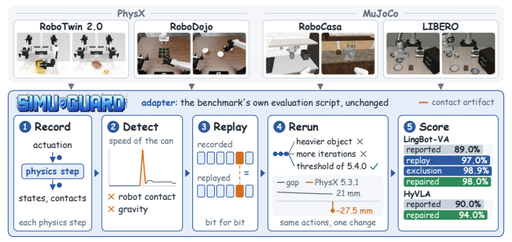
Figure 2 :SIMUGUARDaudits a simulated evaluation without changing it.Attached by an adapter to the benchmark’s own evaluation script, SIMUGUARDrecords every physics step, detects contact artifacts, replays the episode exactly, reruns it with the same actions and one change, and scores the rerun with the benchmark’s own success check. Rerun: a heavier object or more solver iterations leave the artifact; the triangle threshold of PhysX 5.4.0 removes it. Inset: the two pieces that start the ejection of Figure 1 are 21 mm apart, and PhysX 5.3.1 reports them 27.5 mm deep; with the threshold of 5.4.0 it reports no contact. Score, five container tasks in closed loop (Table 3): as run (gray), estimated from LingBot-V A’s recordings (blue, Section 3.6), and measured in the repaired engine (green).
원문 · CC BY 4.0 · Alex Zhou, Junhao Wu, Xueyang Zhou, Yixiao Huo, Hongcheng Gao, Di Zhu, Zhenghao Zhang, Yongchao Chen · When the Simulator Fails, Not the Policy: Auditing Contact Artifacts in Simulated Robot Benchmarks · 원문 그림 인용 · 원본 PDF 2쪽에서 그림 영역을 추출했습니다.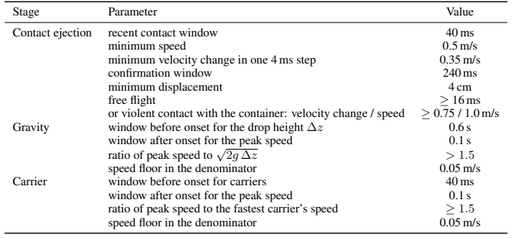
Table 7 :Detector parameters(Section 3.3), identical for all tasks and engines. The thresholds on velocity change are given for a 4 ms step and scale with the physics step on other engines.
원문 · CC BY 4.0 · Alex Zhou, Junhao Wu, Xueyang Zhou, Yixiao Huo, Hongcheng Gao, Di Zhu, Zhenghao Zhang, Yongchao Chen · When the Simulator Fails, Not the Policy: Auditing Contact Artifacts in Simulated Robot Benchmarks · 원문 그림 인용 · 원본 PDF 19쪽에서 그림 영역을 추출했습니다.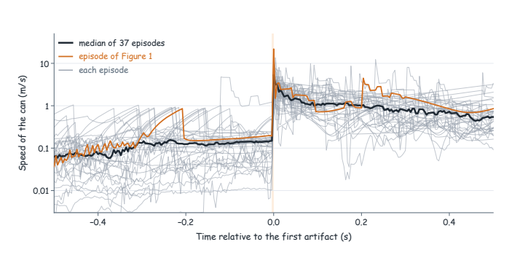
Figure 5 :The can’s speed around the first artifactin all 37 Place Can Basket episodes of LingBot-V A that contain one (21 failures, 16 successes), at every 4 ms step from 0.5 s before to 0.5 s after the onset. Gray: episodes; bold: median; orange: the episode of Figure 1. One step before the onset the can moves at a median 0.15 m/s. The largest one step rise in speed falls on the onset step in 33 episodes and within four steps in the other 4; it ranges from 0.53 to 21.6 m/s, median 5.7 m/s, more than an order of magnitude in the median.
원문 · CC BY 4.0 · Alex Zhou, Junhao Wu, Xueyang Zhou, Yixiao Huo, Hongcheng Gao, Di Zhu, Zhenghao Zhang, Yongchao Chen · When the Simulator Fails, Not the Policy: Auditing Contact Artifacts in Simulated Robot Benchmarks · 원문 그림 인용 · 원본 PDF 25쪽에서 그림 영역을 추출했습니다.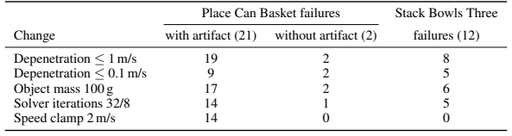
Table 14 :Replays from the first physics stepof the recorded failures: failures that pass the success check.
원문 · CC BY 4.0 · Alex Zhou, Junhao Wu, Xueyang Zhou, Yixiao Huo, Hongcheng Gao, Di Zhu, Zhenghao Zhang, Yongchao Chen · When the Simulator Fails, Not the Policy: Auditing Contact Artifacts in Simulated Robot Benchmarks · 원문 그림 인용 · 원본 PDF 26쪽에서 그림 영역을 추출했습니다.한 파라미터를 바꾼 재실행과 성공률 추정
재실행은 재생에 시뮬레이션 파라미터 하나를 바꾼 것입니다. 바꿀 수 있는 값은 물체 질량, 솔버 반복 수, PhysX의 최대 관통 해제 속도, MuJoCo 접촉의 시간 상수입니다. 아티팩트 직전 0.1초에 변경을 켜는 방식은 그 시점 이후의 물리 결과를 비교하는 개입입니다. 성공률 추정은 플래그된 에피소드 집합 A를 기준으로 계산합니다. 모든 플래그 에피소드가 실패할 때의 하한 (S−S_A)/N과 모두 성공할 때의 상한 (S−S_A+|A|)/N 사이에 실제 값이 놓입니다. 재생 추정은 식 (1)처럼 각 플래그 에피소드의 결과 y_e를 재생 결과 r_e로 바꾸며, 이 추정은 제거된 아티팩트 뒤에도 기록된 행동이 정책의 선택으로 남는다고 가정합니다.
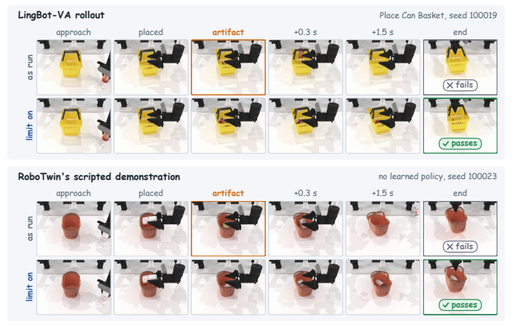
Figure 3 :Two episodes whose outcome the artifact window intervention flips.Each is shown as run and replayed with the depenetration limit switched on 0.1 s before the first artifact; seed, actions and physics up to the switch are identical.Top:LingBot-V A on Place Can Basket.Bottom:one of RoboTwin’s own scripted demonstrations, which the benchmark discards when it fails.
원문 · CC BY 4.0 · Alex Zhou, Junhao Wu, Xueyang Zhou, Yixiao Huo, Hongcheng Gao, Di Zhu, Zhenghao Zhang, Yongchao Chen · When the Simulator Fails, Not the Policy: Auditing Contact Artifacts in Simulated Robot Benchmarks · 원문 그림 인용 · 원본 PDF 3쪽에서 그림 영역을 추출했습니다.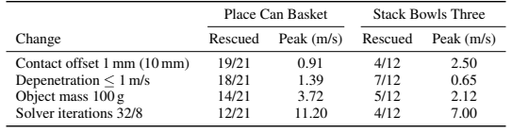
Table 15 :Replays switched on 0.1 s before the first artifact.LingBot-V A episodes with artifacts, replayed with one setting changed.Rescued: failures that pass.Peak: median object speed after the switch over all episodes with an artifact. The contact offset is changed on the task’s objects and containers, the other settings as in Section 3.5.
원문 · CC BY 4.0 · Alex Zhou, Junhao Wu, Xueyang Zhou, Yixiao Huo, Hongcheng Gao, Di Zhu, Zhenghao Zhang, Yongchao Chen · When the Simulator Fails, Not the Policy: Auditing Contact Artifacts in Simulated Robot Benchmarks · 원문 그림 인용 · 원본 PDF 26쪽에서 그림 영역을 추출했습니다.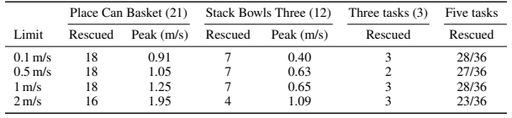
Table 16 :Limit value.LingBot-V A failures with artifacts that pass when replayed with the depenetration limit switched on 0.1 s before the first artifact, and the median peak speed of the object after the switch over these failures.Three tasks: Place Object Basket, Place Bread Basket and Stack Bowls Two, one failure each. The successes with an artifact were replayed at 1 m/s only.
원문 · CC BY 4.0 · Alex Zhou, Junhao Wu, Xueyang Zhou, Yixiao Huo, Hongcheng Gao, Di Zhu, Zhenghao Zhang, Yongchao Chen · When the Simulator Fails, Not the Policy: Auditing Contact Artifacts in Simulated Robot Benchmarks · 원문 그림 인용 · 원본 PDF 26쪽에서 그림 영역을 추출했습니다.RoboTwin 용기 작업의 감사 결과
RoboTwin 2.0의 다섯 용기 작업에서 LingBot-V A의 보고 성공률은 83.1%였습니다. 접촉 아티팩트 에피소드를 모두 실패로 두면 하한 75.8%, 모두 성공으로 두면 상한 98.5%가 됩니다. HyVLA에 대해서는 같은 범위가 [86.0%, 96.0%]로 보고됩니다. 실패 가운데 LingBot-V A는 44개 중 40개, HyVLA는 10개 중 6개가 아티팩트를 포함합니다. 같은 작업에서 RoboTwin의 스크립트 시연도 같은 방식으로 실패했습니다.
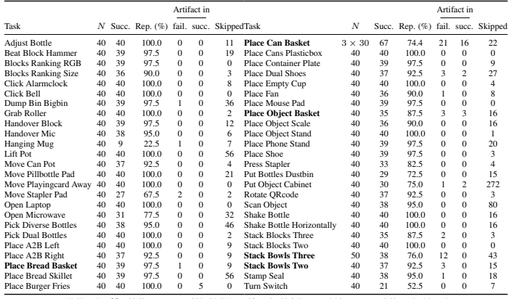
Table 5 :RoboTwin 2.0 runsof LingBot-V A.Artifact: episodes with a contact artifact among failures and successes.Skipped: seeds discarded because the scripted demonstration failed.Succ.: successes;Rep.: reported rate. Bold: the five tasks of Table 1. The 40 tasks outside the ten of the cross task study were run twice with 20 seeds each, and both passes are pooled.
원문 · CC BY 4.0 · Alex Zhou, Junhao Wu, Xueyang Zhou, Yixiao Huo, Hongcheng Gao, Di Zhu, Zhenghao Zhang, Yongchao Chen · When the Simulator Fails, Not the Policy: Auditing Contact Artifacts in Simulated Robot Benchmarks · 원문 그림 인용 · 원본 PDF 18쪽에서 그림 영역을 추출했습니다.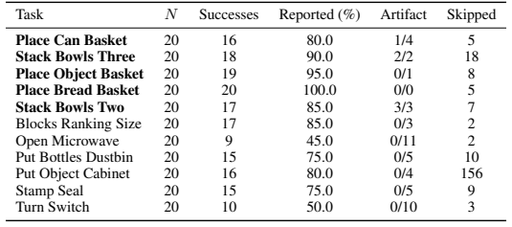
Table 6 :RoboTwin 2.0 runsof HyVLA.Artifact: failures that contain a contact artifact.Skipped: seeds discarded because the scripted demonstration failed.
원문 · CC BY 4.0 · Alex Zhou, Junhao Wu, Xueyang Zhou, Yixiao Huo, Hongcheng Gao, Di Zhu, Zhenghao Zhang, Yongchao Chen · When the Simulator Fails, Not the Policy: Auditing Contact Artifacts in Simulated Robot Benchmarks · 원문 그림 인용 · 원본 PDF 18쪽에서 그림 영역을 추출했습니다.
Table 19 :The benchmark’s own expert fails the same way.Place Can Basket: failures that contain an ejection, and failures that pass the success check when replayed with the depenetration limit switched on before it. The scripted expert acts on ground truth object poses with a motion planner; RoboTwin runs it on every seed before scoring a policy and skips the seed when it fails.
원문 · CC BY 4.0 · Alex Zhou, Junhao Wu, Xueyang Zhou, Yixiao Huo, Hongcheng Gao, Di Zhu, Zhenghao Zhang, Yongchao Chen · When the Simulator Fails, Not the Policy: Auditing Contact Artifacts in Simulated Robot Benchmarks · 원문 그림 인용 · 원본 PDF 28쪽에서 그림 영역을 추출했습니다.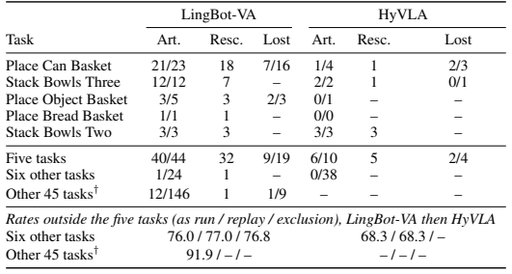
Table 22 :Counts behind Table 1.Art.: failures with an artifact, of all failures.Resc.: failures that pass under the limit.Lost: successes that fail under the limit, of all successes with an artifact. †Both passes of every task (Table 5); of the 40 tasks only the first pass, 4 failures and 3 successes with an artifact, was replayed, and the three Put Object Cabinet replays of the second pass diverge from the recording before the switch and are not counted.
원문 · CC BY 4.0 · Alex Zhou, Junhao Wu, Xueyang Zhou, Yixiao Huo, Hongcheng Gao, Di Zhu, Zhenghao Zhang, Yongchao Chen · When the Simulator Fails, Not the Policy: Auditing Contact Artifacts in Simulated Robot Benchmarks · 원문 그림 인용 · 원본 PDF 31쪽에서 그림 영역을 추출했습니다.PhysX 5.3.1의 거짓 접촉 원인
아티팩트가 시작될 때 PhysX는 기하 형상이 실제로 가지지 않은 접촉을 보고합니다. 원인은 GJK 과정에서 삼각형을 축퇴로 판정하는 고정 임계값입니다. PhysX 5.3.1은 |ab×ac|²≤2^−23 이면 삼각형을 버리는데, 이 값은 기하 크기에 따라 조정되지 않습니다. 논문이 추적한 네 개의 시작 스텝에서 이 값은 1.19×10^−7보다 작았고, 알고리즘은 최근접점을 찾기 전에 멈춰 두 조각이 떨어져 있어도 깊이가 보고되었습니다. PhysX 5.4.0은 이 임계값을 ϵ²≈1.42×10^−14로 바꾸었으며, 이 변경을 적용한 엔진에서 같은 접촉 생성 프로그램이 추적한 거짓 접촉 20개를 재현하지 않았습니다.

Table 2 :One constant.False: the 20 onset contacts we traced (4 on Place Can Basket, 16 on Stack Bowls Three) whose two pieces do not intersect, recomputed outside the simulator from the recorded poses.Real: 4 onset contacts whose pieces do intersect.Expert: RoboTwin’s scripted demonstration on 60 seeds per task inside the simulator, episodes with an artifact and episodes that fail after a valid plan.
원문 · CC BY 4.0 · Alex Zhou, Junhao Wu, Xueyang Zhou, Yixiao Huo, Hongcheng Gao, Di Zhu, Zhenghao Zhang, Yongchao Chen · When the Simulator Fails, Not the Policy: Auditing Contact Artifacts in Simulated Robot Benchmarks · 원문 그림 인용 · 원본 PDF 7쪽에서 그림 영역을 추출했습니다.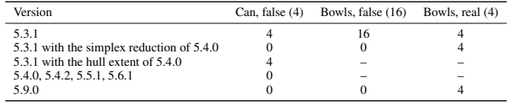
Table 10 :The false contact across versions of PhysX.Onset contacts returned by PhysX’s contact generation outside the simulator for the recorded poses: 4 false contacts on Place Can Basket, 16 false contacts and 4 real penetrations on Stack Bowls Three. A dash: not run.
원문 · CC BY 4.0 · Alex Zhou, Junhao Wu, Xueyang Zhou, Yixiao Huo, Hongcheng Gao, Di Zhu, Zhenghao Zhang, Yongchao Chen · When the Simulator Fails, Not the Policy: Auditing Contact Artifacts in Simulated Robot Benchmarks · 원문 그림 인용 · 원본 PDF 22쪽에서 그림 영역을 추출했습니다.수정 엔진과 재생 추정의 비교
수정된 엔진에서 LingBot-V A는 다섯 작업의 폐루프 100개 에피소드 중 98개에서 성공하며, 기존 엔진의 89개와 비교됩니다. 아티팩트가 있는 에피소드는 12개에서 0개로 줄어듭니다. 두 엔진에서 공유된 83개 시드의 차이는 단독으로 유의하지 않습니다(p=0.11). 벤치마크가 엔진을 바꿀 수 없을 때 쓸 수 있는 추정은 배제 방식 98.9%, 재생 방식 97.0%로 보고됩니다. 같은 조건의 원문 표에서는 재생 값 91.9%와 배제 값 98.0%가 함께 제시됩니다. 이 값들은 각각 다른 집계 조건에서 나온 것이므로 같은 결과로 합치지 않습니다.
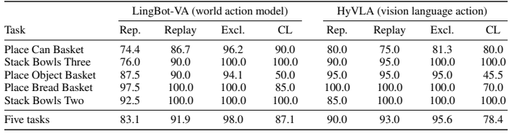
Table 1 :Success rates on RoboTwin 2.0under the four scores of Section 3.6, in percent.Rep.: as run.Replay: Equation (1), every episode with an artifact replayed with the limit switched on before it.Excl.: rate over the episodes without an artifact.CL: new closed loop rollouts with the limit on; as run rate on the shared seeds 81.8% (LingBot-V A) and 90.7% (HyVLA). Counts and the tasks outside the five: Table 22.
원문 · CC BY 4.0 · Alex Zhou, Junhao Wu, Xueyang Zhou, Yixiao Huo, Hongcheng Gao, Di Zhu, Zhenghao Zhang, Yongchao Chen · When the Simulator Fails, Not the Policy: Auditing Contact Artifacts in Simulated Robot Benchmarks · 원문 그림 인용 · 원본 PDF 7쪽에서 그림 영역을 추출했습니다.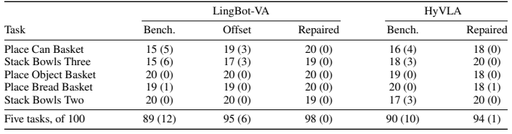
Table 3 :Closed loop evaluation in the repaired engine.Successes of 20, in parentheses episodes with an artifact.Bench.: RoboTwin as released (LingBot-V A reseeded per episode; HyVLA: the run of Table 1).Offset: contact offset 1 mm.Repaired: threshold of PhysX 5.4.0.
원문 · CC BY 4.0 · Alex Zhou, Junhao Wu, Xueyang Zhou, Yixiao Huo, Hongcheng Gao, Di Zhu, Zhenghao Zhang, Yongchao Chen · When the Simulator Fails, Not the Policy: Auditing Contact Artifacts in Simulated Robot Benchmarks · 원문 그림 인용 · 원본 PDF 8쪽에서 그림 영역을 추출했습니다.적용 범위와 남은 질문
수정된 엔진의 폐루프 측정은 두 정책과 다섯 작업에서 각 20개 시드로만 이루어졌습니다. 감지기의 정밀도는 한 작업에서만 측정되었으며, PhysX 5.3.1 이전 버전의 수정은 한 상수만 바꾼 실험입니다. RoboDojo의 거짓 접촉 원인은 찾지 못했고, MuJoCo 벤치마크 감사는 더 작은 규모로 수행되었습니다. 따라서 이 결과를 다른 엔진이나 작업 전반으로 일반화하는 것은 근거가 부족합니다.
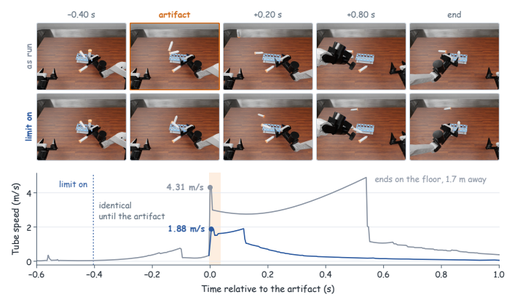
Figure 6 :RoboDojo, Insert Tubes (layout 2), XR-1.Head camera frames at fixed times relative to the first artifact, as run (top) and replayed with the depenetration limit of 1 m/s switched on 0.4 s before it (bottom), and the speed of the ejected tube in both runs. As run, the tube leaves the rack at 4.31 m/s within one step, flies off the table and lands 1.7 m away; the later peak of the gray curve is its fall. With the limit it leaves at 1.88 m/s, slows below 0.4 m/s within 0.3 s and stays on the table. Both rows are replays of the recording; the as run replay matches it bit for bit, and the limited one first differs at the artifact step.
원문 · CC BY 4.0 · Alex Zhou, Junhao Wu, Xueyang Zhou, Yixiao Huo, Hongcheng Gao, Di Zhu, Zhenghao Zhang, Yongchao Chen · When the Simulator Fails, Not the Policy: Auditing Contact Artifacts in Simulated Robot Benchmarks · 원문 그림 인용 · 원본 PDF 29쪽에서 그림 영역을 추출했습니다.
Table 20 :RoboDojo, Insert Tubes layout 2: speed at which the tube leaves, replayed with the depenetration limit switched on 0.4 s before the ejection.
원문 · CC BY 4.0 · Alex Zhou, Junhao Wu, Xueyang Zhou, Yixiao Huo, Hongcheng Gao, Di Zhu, Zhenghao Zhang, Yongchao Chen · When the Simulator Fails, Not the Policy: Auditing Contact Artifacts in Simulated Robot Benchmarks · 원문 그림 인용 · 원본 PDF 30쪽에서 그림 영역을 추출했습니다.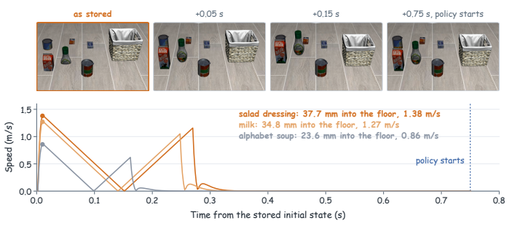
Figure 7 :LIBERO-Object task 0, stored initial state 0, built as the evaluation builds it (official LIBERO, robosuite 1.4.0, MuJoCo 3.2.3) and run through the 15 settle steps that precede every LIBERO policy step. As stored, the salad dressing, the milk and the alphabet soup sit 37.7, 34.8 and 23.6 mm inside the floor. MuJoCo pushes them out within 10 ms at 1.38, 1.27 and 0.86 m/s; they hop, land within 0.3 s and are at rest before the policy acts at 0.75 s. Depths and peak speeds match the audit of all 2000 stored states, of which 650 start inside a support.
원문 · CC BY 4.0 · Alex Zhou, Junhao Wu, Xueyang Zhou, Yixiao Huo, Hongcheng Gao, Di Zhu, Zhenghao Zhang, Yongchao Chen · When the Simulator Fails, Not the Policy: Auditing Contact Artifacts in Simulated Robot Benchmarks · 원문 그림 인용 · 원본 PDF 30쪽에서 그림 영역을 추출했습니다.논문 정보
- 저자
- Alex Zhou, Junhao Wu, Xueyang Zhou, Yixiao Huo, Hongcheng Gao, Di Zhu, Zhenghao Zhang, Yongchao Chen
- 학회·저널
- arXiv · 프리프린트
- 최초 공개일
- 2026년 10월 30일
- 등록일
- 2026년 11월 3일
- 수정일
- 2026년 10월 30일
- 버전
- v1
- arXiv
- 2610.41857
- 분류
- cs.RO
- 원문 이용 조건
- CC BY 4.0
- 제공 범위
- 논문 정보, 해설, 허용된 원문 그림
AI 해설은 논문 원문과 별개의 설명이며 오류가 있을 수 있습니다. 원문과 그림은 각 출처의 이용 조건과 따로 표시된 권리를 따릅니다.
초록
Simulation benchmarks score robot policies by success rate, and every failed episode counts against the policy. Many of these failures are the simulator's fault, not the policy's; we find the cause and fix it. Testing a vision language action model and a world action model in simulation, we find that the policy often places the object and the simulator then ejects it, and that the benchmark's own scripted demonstrations fail the same way. We present SimuGuard, an auditing plugin for LIBERO, RoboTwin, RoboCasa and RoboDojo. It leaves the evaluation unchanged. At every physics step, it records the state and flags an object that starts moving at a contact faster than the robot's contact or gravity account for. It replays a recorded episode bit for bit, and it reruns the episode with one simulation parameter changed. With it we trace these episodes on RoboTwin to the collision detection of the physics engine: for geometry one to two centimeters apart, the engine reports a penetration of about two centimeters, and the solver throws the object out at several meters per second. The cause is one constant: the distance algorithm discards triangles below a fixed area threshold, which valid triangles fall below at the centimeter scale. With that constant changed and nothing else, episodes with an artifact fall from 12 in 100 to none, and the success rate on five container tasks rises from 89% to 98%. Success rates in simulation thus count failures that the simulator causes. Benchmarks on PhysX 5.3.1 or earlier should rerun in a repaired engine. Where the engine cannot change, they should report the success rate together with the range it spans when every flagged episode fails or passes: 75.8% to 98.5% around a reported 83.1% for LingBot-VA.
원문 인용
Alex Zhou, Junhao Wu, Xueyang Zhou, Yixiao Huo, Hongcheng Gao, Di Zhu, Zhenghao Zhang, Yongchao Chen (2026). When the Simulator Fails, Not the Policy: Auditing Contact Artifacts in Simulated Robot Benchmarks. arXiv:2610.41857v1. https://arxiv.org/abs/2610.41857v1
BibTeX
@misc{zhou2026when,
  title = {{When the Simulator Fails, Not the Policy: Auditing Contact Artifacts in Simulated Robot Benchmarks}},
  author = {Alex Zhou and Junhao Wu and Xueyang Zhou and Yixiao Huo and Hongcheng Gao and Di Zhu and Zhenghao Zhang and Yongchao Chen},
  year = {2026},
  eprint = {2610.41857},
  archivePrefix = {arXiv},
  url = {https://arxiv.org/abs/2610.41857v1}
}