Paper commentary
Learn then Bet: Learning Interpretable Rules for Reliable Agent Intervention
- Problem Runtime monitors for LLM agents are often heuristics or verifiers calibrated after the fact, so their learning objective is not tied to false-intervention control and detection.
- Method LeBet learns an OR-of-AND rule monitor by stochastic local search on empirical separation, freezes it, and stops runs with a betting rule applied to the trajectory prefix.
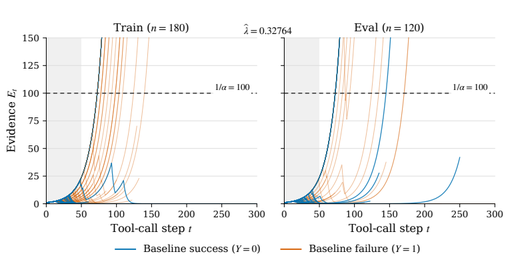
Figure 4 : Betting evidence on training (left) and evaluation (right) trajectories. Each curve represents
Original paper · CC BY 4.0 · You-Lin Chen, Xinyi Lisa Chen, Pedro Herrero-Vidal, Xiaojing Yu, Bingqing Song, Bin Xu · Learn then Bet: Learning Interpretable Rules for Reliable Agent Intervention · Original paper figure · Extracted the figure area from page 32 of the original PDF.Why runtime monitors need a learning objective
Long-running agents can fail at an intermediate step, and that failure then propagates through the rest of the run, so a monitor has to decide during execution when to step in. One family of methods accepts a supplied verifier or monitoring signal and attaches statistical error control to the online decision built on top of it. In the other family, a model of agent behaviour is learned from trajectory data, and the training objective shapes the signal, which is then calibrated separately on held-out data to control false positives.
LeBet asks whether the statistical requirements of reliable intervention can drive the learning step itself, rather than being imposed only after a monitor has been trained. The monitor is learned from complete trajectories, but it is required to act only on the evolving prefix, which keeps the deployed decision consistent with what is observable at run time.
How the monitor is represented and what learning maximizes
The monitor is assembled from a fixed pool of adapted binary predicates computed from the trajectory prefix, which are fixed before the training trajectories are observed. A rule is a conjunction of predicates, and the monitor is a disjunction of rules, so the monitor fires at a step when at least one rule has all of its predicates firing.
The population target is the largest separation, over rule sets with at most KR predicates per rule and at most KS rules, between the monitor's average conditional behaviour on the two classes. Those conditional means are not observable, so learning replaces them with observed averages and empirical frequencies on the training trajectories.
On the training data, the empirical separation takes the lower order statistic of the class-1 averages and the upper order statistic of the class-0 averages at ranks set by the error budgets, and uses the positive part of their gap. The ranks allow only a fixed number of class-0 trajectories to exceed the reference and a fixed number of class-1 trajectories to fall below the target, which ties the objective to the error requirements.
The learned rule set is fitted on the same trajectories that the next-trajectory guarantee is about, so a trajectory's own averages would otherwise enter its fit. The authors therefore refit the rule set with each evaluated trajectory left out, which keeps that trajectory out of its own conditioning sample.
How monitor output becomes an intervention decision
Evidence accumulates as a running product over steps, and each step multiplies in an exponential term in the stake times the monitor output, divided by one minus p0 plus p0 times exp of the stake. Intervention happens at the first step of the monitoring window where that running product reaches the reciprocal of the error budget alpha; if it never does, no intervention occurs.
The stake lambda controls how much a firing step raises the evidence relative to a silent step, and p0 is the reference level against which the monitor's firing is judged. Averages of the monitor over the observed prefix are the quantities the process responds to, so the process reacts to the rate at which the monitor fires.
The bounds connect the observed averages to the stopping decision: if the largest observed average stays at or below p0, the process never stops, and if the smallest observed average clears p0 by a margin, it stops by the last step of the window. That margin depends on a curvature bound v(p0) and on a scale term that grows with the logarithm of one over alpha.
If the betting reference differs from the true reference, the false-intervention bound gains an additional term, and alpha governs how much the betting part contributes. When the betting reference equals p0, that bound reduces to alpha plus the class-0 error budget epsilon0.
Guarantees for the next trajectory
Assumption 1 asks for exchangeability within each class that includes the next trajectory, so the analysis does not need the trajectories to be i.i.d. Assumption 4 requires that swapping one training trajectory changes the leave-one-out conditional-mean extrema by at most a margin Bm, except on a set of exchanges whose probability is controlled by theta and kappa.
Theorem 5 bounds the conditional probability of a false intervention on the next trajectory by delta0(beta/2) plus e0 with probability at least 1 minus beta over the training sample. A parallel statement gives the missed-detection bound through delta1(beta/2) and e1,t, uniformly over the window.
Lowering alpha reduces the betting term in the false-intervention bound, but it pushes the detection bound toward being vacuous. For example, with delta0(beta/2) equal to 0.02, the authors' illustration gives false-intervention bounds of at most 0.03 for alpha 0.01 and 0.07 for alpha 0.05.
A larger empirical separation does not automatically improve the guarantee, because the stability terms may grow at the same time.
Searching rule sets with local edits
Exhaustive search over rule combinations is costly, so the authors use a stochastic local search adapted from FastSRS, which samples trajectories and proposes local edits. The empirical separation is not generally submodular, so the search does not rely on greedy approximation guarantees.
The change caused by swapping one rule for another depends only on the firing of the two rules and on the other rules' firing at that step, which lets the search skip edits that cannot produce the desired change.
The search runs with twenty seeds, and the candidate with the largest signed training gap is selected.
Results on SWE-bench Lite with Ministral 3 8B
The coding agent is Ministral 3 8B, run on all 300 SWE-bench Lite tasks, with 180 trajectories used for learning and 120 held out for evaluation by random splitting. The search uses KR equal to 8, KS equal to 8, epsilon0 and epsilon1 equal to 0.1 and 0.6, a monitoring window from 50 to 500, and alpha equal to 0.01. The predicate pool contains 5,356 predicates, including negations, proposed with an LLM.
On training data its empirical gap is 0.20, with an upper order statistic of 0.68 in class 0 and a lower order statistic of 0.88 in class 1.
With reference 0.78 and stake about 0.32764 in the evaluation split, the policy stopped 29 failing and 3 successful trajectories. That gives a detection rate of 29.59%, from 29 of 98 failing trajectories, and a false-positive rate of 13.64%, from 3 of 22 successful trajectories. Token savings reached 34.46% of the baseline input-plus-output tokens.
Among the trajectories that continue, output precision is 21.59%, compared with 18.33% when no early stopping is applied.
Table 1 lists the true and false stops, the unstopped counts, the stop precision, the rates, output precision and tokens saved for the training and evaluation splits and for evaluation without early stopping.
Limitations
The empirical results cover one benchmark, SWE-bench Lite, and one agent model, Ministral 3 8B.
The guarantees depend on finite within-class exchangeability and on leave-one-out stability averaged over training-sample exchanges, and the empirical section does not report a test of either assumption.
The stochastic search does not need to reach the maximum of the empirical separation, so the selected rule set is one candidate from a heuristic search.
The stability constants Bm, theta and kappa may depend on the learning class and the algorithm, and the excerpt does not give their values for the reported monitor.
Paper info
- Authors
- You-Lin Chen, Xinyi Lisa Chen, Pedro Herrero-Vidal, Xiaojing Yu, Bingqing Song, Bin Xu
- Venue
- arXiv · Preprint
- First published
- 2026-11-13
- Added
- 2026-11-16
- Updated
- 2026-11-13
- Version
- v1
- arXiv
- 2611.17662
- Category
- cs.AI · cs.LG
- Original paper terms
- CC BY 4.0
- What we show
- Paper info, commentary and permitted figures from the original paper
AI commentary is a separate explanation from the original paper and may contain errors. The original paper and figures follow each source's terms of use and any rights noted separately.
Abstract
Autonomous agents now run for hundreds of steps with little or no human supervision. In practice, practitioners use runtime monitors such as turn limits and keyword filters to decide when a run should be stopped, upgraded, or assisted. However, these heuristics may stop runs that would otherwise succeed or allow failing runs to continue. To address this limitation, we introduce LeBet (Learn then Bet), a statistical learning framework that derives its learning objective from sufficient conditions for valid and powerful intervention. In particular, LeBet learns an interpretable OR-of-AND monitor and accumulates evidence through a fixed betting statistic, intervening when the evidence reaches a prescribed threshold. Under finite within-class exchangeability and leave-one-out stability, we derive finite-sample guarantees for false-positive control (validity) and detection power conditional on the training data, using the same trajectories for learning and calibration without assuming independent and identically distributed trajectories. To address the intractable combinatorial optimization problem in our learning formulation, we use stochastic local search that leverages the monitor's Boolean structure to propose rule edits aimed at improving empirical separation. On SWE-bench Lite with Ministral 3 8B, the learned monitor saves $34.46\%$ of input-plus-output tokens and increases output precision from $18.33\%$ to $21.59\%$. The empirical false-positive rate is $13.64\%$. Our results show how to formalize the learning problem over interpretable rule sets with statistical conditions and establish training-conditional guarantees for reliable intervention based on partial histories.
Quote from the paper
You-Lin Chen, Xinyi Lisa Chen, Pedro Herrero-Vidal, Xiaojing Yu, Bingqing Song, Bin Xu (2026). Learn then Bet: Learning Interpretable Rules for Reliable Agent Intervention. arXiv:2611.17662v1. https://arxiv.org/abs/2611.17662v1
BibTeX
@misc{chen2026learn,
  title = {{Learn then Bet: Learning Interpretable Rules for Reliable Agent Intervention}},
  author = {You-Lin Chen and Xinyi Lisa Chen and Pedro Herrero-Vidal and Xiaojing Yu and Bingqing Song and Bin Xu},
  year = {2026},
  eprint = {2611.17662},
  archivePrefix = {arXiv},
  url = {https://arxiv.org/abs/2611.17662v1}
}