Paper commentary
Certified Improvements to Best-Known Thomson-Problem Configurations with a Search Pipeline Built with Large Language Model Agents
- Problem The Thomson records for large N were set recently by a single method, and a search that can lower them has to produce results that others can check.
- Method Replica-exchange basin hopping from the CCD configurations, with a shared pool, recombination after geometric relabelling and gradient-only polishing, with each improvement certified by integer bounds.
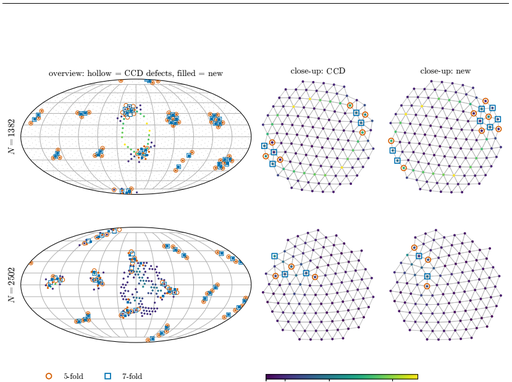
Figure 3 : Where the new configurations for N = 1382 and N = 2502 differ from the CCD configurations. Left: Mollweide projection (centred on the displaced region) of the CCD configuration; points displaced by more than 0.15 ℓ in the new configuration are coloured by displacement (in units of ℓ), hollow markers are defects of the CCD configuration and filled markers those of the new configuration. Middle and right: close-ups of the Delaunay triangulation around the points displaced by more than 0.5 ℓ, with every point coloured by displacement. Correspondence between the configurations is obtained by optimal rotation and a minimum-cost assignment.
Original paper · CC BY 4.0 · Hui Shao, Tao Wang, Xiaotian Liu, Yijie Peng · Certified Improvements to Best-Known Thomson-Problem Configurations with a Search Pipeline Built with Large Language Model Agents · Original paper figure · Extracted the figure area from page 10 of the original PDF.Why the largest Thomson entries were a target
The Thomson problem asks for the arrangement of N unit charges on the sphere that gives the smallest Coulomb energy, and the Cambridge Cluster Database collects the best arrangements known for large N. The database holds 53 Coulomb entries between N = 512 and N = 9913, and the values for the largest sizes, including N = 1382 and N = 2502, came from a method published in October 2026 that lowered earlier basin-hopping results.
Recent AI-assisted work had already reached the database: participants using a coding agent posted configurations for N = 960 up to 0.045 below the database value within a day of a public challenge. Such results usually appear as leaderboard entries, so the study asked how an output produced this way can be turned into a claim that others can check.
How the replica-exchange search moves through configurations
The perturbed configuration is relaxed with L-BFGS in unnormalised coordinates z_i, where each point is recovered as x_i = z_i divided by its norm, and the result is accepted with the Metropolis rule at the replica's temperature. After each step, neighbouring replicas are swapped with the usual replica-exchange probability. Energies stored in the pool and compared with the baseline use compensated summation, while the plain sums are kept for the walk itself.
Merging improvements from different runs
Independent runs often improve different parts of the sphere, but combining them needs a point-to-point correspondence, and identical points exchange places during a long walk, so labels stop matching even when the geometry has barely changed.
A separate combiner process applies Algorithm 1 every five minutes to pairs drawn from the ten best pool configurations below the baseline, and each child is relaxed and polished before entering the pool only if it is lower than both parents.
Certifying a lower energy with integer arithmetic
The certificate therefore works on exact points. Each point is written as (a_i, b_i, c_i)/d_i with integers satisfying a_i^2 + b_i^2 + c_i^2 = d_i^2, so it lies exactly on the sphere.
With K_ij = d_i d_j − (a_i a_j + b_i b_j + c_i c_j), the squared chord length is 2K_ij/(d_i d_j), so every term of the energy equals the square root of d_i d_j divided by 2K_ij. For any integer s above zero, summing floors and ceilings of s times that square root and dividing by s gives a lower bound L and an upper bound U on the energy, computed exactly in integers.
A change counts as certified when the upper bound for the rationalised new configuration lies below the CCD energy. Because the rationalised configuration is itself a valid configuration, no rounding argument is needed for the claim.
Three certified decreases and their structure
The table lists the CCD and new energies together with their certified bounds, the gradient norms, the two smallest Hessian eigenvalues and the defect counts for each size.
The study does not claim global optimality, and its claims refer to the CCD values as listed on 6 and 10 November 2026.
How the N = 2502 configuration was reached
In stage 1, both runs found configurations below the CCD value within 25 wall-clock minutes, reaching −0.0149 and −0.0144 after two hours.
Once the relabelling was fixed, a splice of the −0.0569 configuration with a stage-1 configuration at −0.0096 gave −0.0614 within three minutes, which realised about half of that configuration's decrease.
About 12 core-hours went into N = 2502 before the final configuration appeared, and about 58 core-hours in total when the later stages and the controlled comparison are included.
Polishing alone and the polished baseline
During stage 3 the pipeline reported configurations below the CCD values for N = 3552 and N = 5872, which appeared without any accepted move and so raised suspicion.
Local relaxation and the controlled comparison
The full arm first passed at 4.3 wall-clock minutes and full+ET at 1.5, both reaching −0.0196, while hybrid first passed at 13.8 minutes with a best of −0.0097; the local arm found none within two hours and stayed at 0.0000.
The authors consider a bias in the energies the more likely explanation, since the Metropolis rule and the pool insertion test both used these local energies and could not see gains that appear only after the surrounding lattice relaxes.
Limitations
No equal-budget comparison was run with the October 2026 method or with plain basin hopping, so the pipeline's efficiency relative to that method is not established.
No ablation separately removed the pool, the combiner or replica exchange, so the decrease cannot be attributed to individual components.
The CCD maintainers had not yet confirmed or posted the new configurations, and the release verification script and the paper's verification code were written with the same model family as the search, so they are not independent of the model even though they share no code with it.
Practices drawn from the errors
Each practice is tied to an error in the project: calibration caught a summation bug before any search, the polished baseline removed two spurious records, and the controlled comparison diagnosed the local-relaxation problem after about 72 core-hours had been spent on it.
An AI-written status report stated 78 candidate pairs and 20 superpositions where the logs supported 54 pairs and 6 superpositions, and the study's own hypothesis that lower symmetry is better was withdrawn after it was checked.
Paper info
- Authors
- Hui Shao, Tao Wang, Xiaotian Liu, Yijie Peng
- Venue
- arXiv · Preprint
- First published
- 2026-11-13
- Added
- 2026-11-16
- Updated
- 2026-11-13
- Version
- v1
- arXiv
- 2611.17776
- Category
- cs.AI
- Original paper terms
- CC BY 4.0
- What we show
- Paper info, commentary and permitted figures from the original paper
AI commentary is a separate explanation from the original paper and may contain errors. The original paper and figures follow each source's terms of use and any rights noted separately.
Abstract
The Thomson problem asks for N unit charges on a sphere with minimum Coulomb energy; for large N the best configurations known are curated in the Cambridge Cluster Database, whose largest-N entries were set in October 2026. We report configurations for N = 912, 1382 and 2502 with energies 0.0036186, 0.0109730 and 0.0614033 below the database values, certified by exact integer arithmetic. All three are numerically strict local minima modulo rotations and keep the defect inventory and scar compositions of the database configurations; the database value for N = 912 had been reached by two different methods. Our search runs unconstrained replica-exchange basin hopping from the database configurations, with a shared pool of minima, recombination of improved regions after relabelling by geometry, and gradient-only polishing; replica-exchange basin hopping alone found the N = 912 and 1382 configurations, the former in one of five runs. We built and ran it with large language model agents (Claude, through a chat interface and the Claude Code agent), and we report every search, including those that failed. Two findings matter for others who search the database. Polishing alone lowers two entries by more than the threshold at which our pipeline reports a candidate, which produced two spurious records until candidates were compared with the polished database energies (the polished baseline). A local-relaxation speed-up passed its exactness test yet found nothing in a controlled comparison in which every arm with full relaxation went below the database value within 15 minutes. We distil three practices for computational discovery with large language model agents: calibrate the search code and verify candidates with code separate from the search, compare candidates with the polished baseline, and test design changes in controlled comparisons with pass criteria fixed in advance.
Quote from the paper
Hui Shao, Tao Wang, Xiaotian Liu, Yijie Peng (2026). Certified Improvements to Best-Known Thomson-Problem Configurations with a Search Pipeline Built with Large Language Model Agents. arXiv:2611.17776v1. https://arxiv.org/abs/2611.17776v1
BibTeX
@misc{shao2026certified,
  title = {{Certified Improvements to Best-Known Thomson-Problem Configurations with a Search Pipeline Built with Large Language Model Agents}},
  author = {Hui Shao and Tao Wang and Xiaotian Liu and Yijie Peng},
  year = {2026},
  eprint = {2611.17776},
  archivePrefix = {arXiv},
  url = {https://arxiv.org/abs/2611.17776v1}
}